
Water and Wastewater Treatment Equipment Market - Industry Structure Evaluation, Demand Drivers Analysis, Regional Growth Analysis and Identification, Competitive Positioning / Landscape Review & Global Market Size Forecast to 2032
Overview
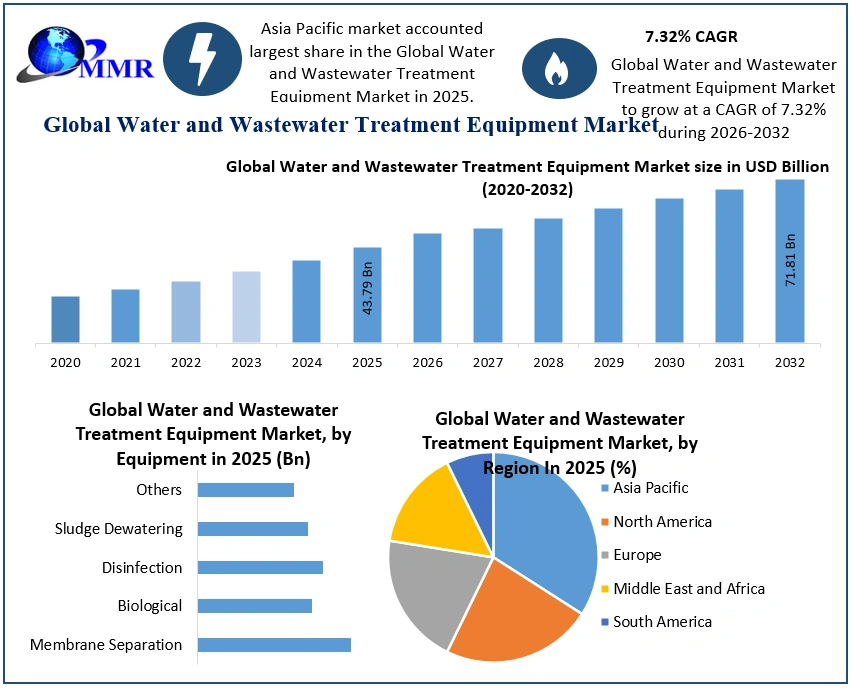
The Water and Wastewater Treatment Equipment Market size was valued at USD 43.79 Billion in 2025 and the total Water and Wastewater Treatment Equipment revenue is expected to grow at a CAGR of 7.32% from 2025 to 2032, reaching nearly USD 71.81 Billion by 2032.
Water and Wastewater Treatment Equipment Market Overview:
Wastewater treatment is the process of removing impurities from wastewater and converting it into an effluent that may be recycled back into the water cycle. During the forecast period, the water and wastewater treatment equipment market is expected to grow thanks to the surging demand for water and wastewater treatment equipment in municipal and industrial applications.
To know about the Research Methodology :- Request Free Sample Report
Water and Wastewater Treatment Equipment Market Dynamics:
Shortage of freshwater resources
As per the United Nations, water scarcity has a disastrous impact on global water consumption. Nearly 1200 million people, or about one-fifth of the world's population, live in areas where physical water scarcity and other drinking water-related challenges exist. An additional 1600 million people, or over a quarter of the world's population, face a lack of financial resources to acquire freshwater from various water sources. The depletion of water resources and water quality is a major concern in many developing countries around the world. In addition, nations with large populations, such as India and China, provide opportunities for the water and wastewater treatment equipment industry.
According to the World Health Organization, over 51% of the population in India and China did not have access to safe drinking water in 2012. The increasing growth of the world's population, combined with existing limited freshwater resources, has driven the development of a variety of technologies to satisfy the global demand for drinkable water. The technologies adopted are primarily geared at making the bulk of accessible water resources usable. As a result of these circumstances, water and wastewater treatment equipment manufacturers are focusing on alternate water sources such as desalinated and reused water. As a result, the prospects for water and wastewater treatment equipment manufacturers in the market for water and wastewater treatment equipment are likely to improve.
Costs of installation, equipment, and operations are all high.
Although there are numerous benefits to water treatment, the cost of installing water and wastewater treatment equipment is considerable. In the water treatment equipment market, the high cost of equipment and its operation acts as a constraining factor. For example. chemical treatment with chlorine gas demands large storage of the water to be treated. In developing countries, such infrastructure and equipment are scarce. For small-scale industrial applications, ozonation and UV equipment are extremely expensive. For undeveloped and underdeveloped countries, desalination equipment is extremely expensive. Similarly, the costs of operating and maintaining water purification facilities are high.
For example, a treatment system consumes a significant amount of energy to meet water processing and treatment needs. These issues are magnified in economically underdeveloped African countries, where over 45% of the population lacks access to safe drinking water. In addition, these countries lack basic infrastructure for water distribution and storage. This is expected to be a barrier to the global growth of the market.
Demand for energy-efficient innovative water treatment systems is increasing.
The global energy concerns range not only from the depletion of traditional energy reserves, but also from the environmental consequences of their extraction, treatment, emissions, waste disposal, and recycling. As a result, the demand for energy-efficient water treatment solutions is increasing for water treatment equipment. Membrane-based water treatment equipment plays a critical role in ensuring water and energy sustainability. The majority of these membranes have a wide range of uses in industrial operations. Desalination by RO, water and wastewater treatment by membrane reactors (MBR), lithium-ion battery packs, and membrane-based fuel cells are examples.
Membrane systems meet sustainability requirements in terms of eco-friendly parameters, land consumption, flexibility, and adaptability, to meet water and energy shortages. Also, membrane technologies must be enhanced in terms of cost and affordability, as well as energy consumption and efficiency. As a result, innovations in membrane equipment are required to make such development. These conditions are expected to create lucrative opportunities for membrane technologies and membrane equipment innovation in the future to address water and energy sustainability.
Aging Infrastructure.
The majority of privileged countries are confronted with the issue of aging infrastructure. These countries constructed water treatment facilities decades ago and continue to use outdated technology. Large sums of money are expected to be required to restore and upgrade these aging infrastructures. In the early years, developed economies Norway, Germany, China, and others built all of the necessary water infrastructures. In comparison, numerous emerging economies like Angola, South Africa, Egypt, and others, where many people still lack basic access to water, have just recently begun to build their water infrastructure.
Water and wastewater treatment systems have a service life of roughly 70 to 80 years, and many water and wastewater treatment plants have reached the end of their useful lifetimes in recent years. Furthermore, in some nations, water mains are not properly maintained. As a result, massive investments in many places are required to repair and replace the outdated water infrastructure. Although the anticipated rehabilitation or reconstruction of outdated water plants is likely to increase the availability of freshwater, the installation and upgrade of new equipment and systems to replace the old infrastructure are expected to be limited.
Water and Wastewater Treatment Equipment Market Segment Analysis:
Based on Type, the global water and wastewater treatment equipment market is segmented into six types as follows, Filtration (Ultra-Filtration, Micro-Filtration), Disinfection, Adsorption, Desalination, Testing, and Others.
During the forecast period, the desalination segment of the water & wastewater treatment equipment market is expected to grow at the fastest rate of xx%. Desalination is a technique for removing minerals from saline water. Thus, producing freshwater from seawater is expected to drive the growth of the desalination segment.
Based on Derivative, the global water, and wastewater treatment equipment market is segmented into three types as follows, Municipal, Industrial (Oil & Gas, Pulp & Paper, Chemicals, Food & Beverages), and others (Power, Mining, Pharmaceuticals, etc.).
In 2025, the municipal segment was dominant and held 66% of the overall market share in terms of revenue. During the forecast period, the municipal segment of the water and wastewater treatment equipment market is expected to grow at the fastest rate of xx%. The municipal segment is expected to lead the water and wastewater treatment equipment market. The rising use of water and wastewater treatment equipment in residential and non-residential applications is expected to drive the growth of the segment. The market for water and wastewater treatment equipment is growing thanks to the rising demand for treated water from municipal uses and varying rules governing industrial wastewater disposal.
Based on Process, the global water and wastewater treatment equipment market is segmented into three types as follows, Primary Treatment, Secondary Treatment, and Tertiary Treatment.

In 2025, the tertiary treatment segment was dominant and held 43% of the overall market share in terms of revenue. The segment is expected to grow at a CAGR of xx% during the forecast period. The removal of phosphates and nitrates from the water supply is the third and last phase in the basic wastewater treatment system. Activated carbon and sand are two of the most widely used components that help with this process.
Sedimentation of solid waste within the water is the first step in wastewater treatment. This is done after the water has been filtered to remove major contaminants. Wastewater is filtered and separated from impurities in a series of tanks and filters. The resulting "sludge" is then pumped into a digester, where it is further processed. This first batch of sludge contains almost half of the wastewater's suspended particles.
Oxidation is used in secondary wastewater treatment to further treat wastewater. It can be done in three ways as follows, Biofiltration, Aeration, and Oxidation Ponds.
Based on Equipment, the global water, and wastewater treatment equipment market is segmented into five types as follows, Membrane Separation, Biological, Disinfection, Sludge Treatment, and Others.
In 2025, the membrane separation segment was dominant and held 19% of the overall market share in terms of revenue. The segment is expected to grow at a CAGR of xx% during the forecast period. Membrane separation is a physical treatment method that involves forcing feed water through a semi-permeable membrane at high pressure to remove certain components from the solution. Membrane separation has various advantages over previous approaches, including a small operating area and great filtration efficiency.
Over the forecast period, the sludge treatment segment is expected to grow at the second-fastest rate of xx%. Sludge screening, drying, dewatering, and thickening are all part of these systems. To prevent sludge treatment operations from being disturbed, sludge screening equipment is used to remove particles such as hair, plastics, and fibers.
Water and Wastewater Treatment Equipment Market Regional Insights:
In 2025, Asia Pacific was the dominant region and held 33.9% of the overall market share in terms of revenue. Increased investments in the wastewater treatment industry, in combination with a rapidly increasing manufacturing sector are the factors expected to drive market growth. Also, the region's rising residential sector is likely to increase product adoption in municipal wastewater treatment plants.
In the United States, strict federal and state wastewater restrictions, as well as increased upgrades related to aging infrastructure, are expected to uplift the market growth. Furthermore, rising oil and gas exploration activities in the United States and Canada are likely to drive product demand, driving market growth in North America.
The European market is expected to experience significant growth over the forecast period. Stringent laws and directives, such as the Water Framework Directive (WFD), Urban Wastewater Treatment Directive (UWWTD), and the Drinking Water Directive, are anticipated to increase spending on water & wastewater treatment equipment in the region.
The objective of the report is to present a comprehensive analysis of the global market to the stakeholders in the industry. The past and current status of the industry with the forecasted market size and trends are presented in the report with the analysis of complicated data in simple language. The report covers all the aspects of the industry with a dedicated study of key players that include market leaders, followers, and new entrants.
PORTER, PESTEL analysis with the potential impact of micro-economic factors of the market have been presented in the report. External as well as internal factors that are supposed to affect the business positively or negatively have been analyzed, which will give a clear futuristic view of the industry to the decision-makers.
The report also helps in understanding the global market dynamics, structure by analyzing the market segments and project the global market size. Clear representation of competitive analysis of key players by product, price, financial position, product portfolio, growth strategies, and regional presence in the global market makes the report investor's guide.
Water and Wastewater Treatment Equipment Market Scope: Inquire before buying
| Water and Wastewater Treatment Equipment Market | |||
|---|---|---|---|
| Report Coverage | Details | ||
| Base Year: | 2025 | Forecast Period: | 2026-2032 |
| Historical Data: | 2020 to 2025 | Market Size in 2025: | USD 43.79 Bn. |
| Forecast Period 2026 to 2032 CAGR: | 7.32% | Market Size in 2032: | USD 71.81 Bn. |
| Segments Covered: | by Type | Filtration Ultra-Filtration Micro-Filtration Disinfection Adsorption Desalination Testing Others |
|
| by Derivative | Municipal Industrial Oil & Gas Pulp & Paper Chemicals Food & Beverage Others Power, Mining, Pharmaceuticals |
||
| by Process | Primary Treatment Secondary Treatment Tertiary Treatment |
||
| by Equipment | Membrane Separation Biological Disinfection Sludge Dewatering Others |
||
Water and Wastewater Treatment Equipment Market, by Region
North America (United States, Canada and Mexico)
Europe (UK, France, Germany, Italy, Spain, Sweden, Austria and Rest of Europe)
Asia Pacific (China, South Korea, Japan, India, Australia, Indonesia, Malaysia, Vietnam, Taiwan, Bangladesh, Pakistan and Rest of APAC)
Middle East and Africa (South Africa, GCC, Egypt, Nigeria and Rest of ME&A)
South America (Brazil, Argentina Rest of South America)
Water and Wastewater Treatment Equipment Market, Key Players
1. Veolia Environment
2. Suez Environment
3. DuPont Water Solutions
4. Pentair plc
5. Xylem Inc.
6. Aquatech International Corporation
7. Evoqua Water Technologies Corporation
8. Ecolab Inc.
9. Calgon Carbon Corp.
10. GE Water and Process Technologies
11. ITT Corporation
12. United Utilities
13. VA Tech Wabag
14. Thermax India
15. Siemens India Water Technologies
16. Ion Exchange India Ltd.
17. Toshiba Water Solutions Pvt. Ltd.
18. Others
Frequently Asked Questions:
1. Which region has the largest share in Global Water and Wastewater Treatment Equipment Market?
Ans: Asia Pacific region held the highest share in 2025.
2. What is the growth rate of Global Water and Wastewater Treatment Equipment Market?
Ans: The Global Water and Wastewater Treatment Equipment Market is growing at a CAGR of 7.32% during forecasting period 2026-2032.
3. What is scope of the Global Water and Wastewater Treatment Equipment Market report?
Ans: Global Water and Wastewater Treatment Equipment Market report helps with the PESTEL, PORTER, COVID-19 Impact analysis, Recommendations for Investors & Leaders, and market estimation of the forecast period.
4. Who are the key players in Global Water and Wastewater Treatment Equipment Market?
Ans: The important key players in the Global Water and Wastewater Treatment Equipment Market are – Veolia Environment, Suez Environment, DuPont Water Solutions, Pentair plc, Xylem Inc., Aquatech International Corporation, Evoqua Water Technologies Corporation, Ecolab Inc., Calgon Carbon Corp., GE Water and Process Technologies, ITT Corporation, United Utilities, VA Tech Wabag, Thermax India, Siemens India Water Technologies, Ion Exchange India Ltd., Toshiba Water Solutions Pvt. Ltd., and Others.
5. What was the Global Water and Wastewater Treatment Equipment Market size in 2025?
Ans: The Global Water and Wastewater Treatment Equipment Market size was USD 43.79 Billion in 2025.