
Telemedicine Market – Industry Structure Evaluation, Demand Drivers Analysis, Regional Growth Analysis and Identification, Competitive Positioning Review & Global Market Size Forecast to 2032
Overview
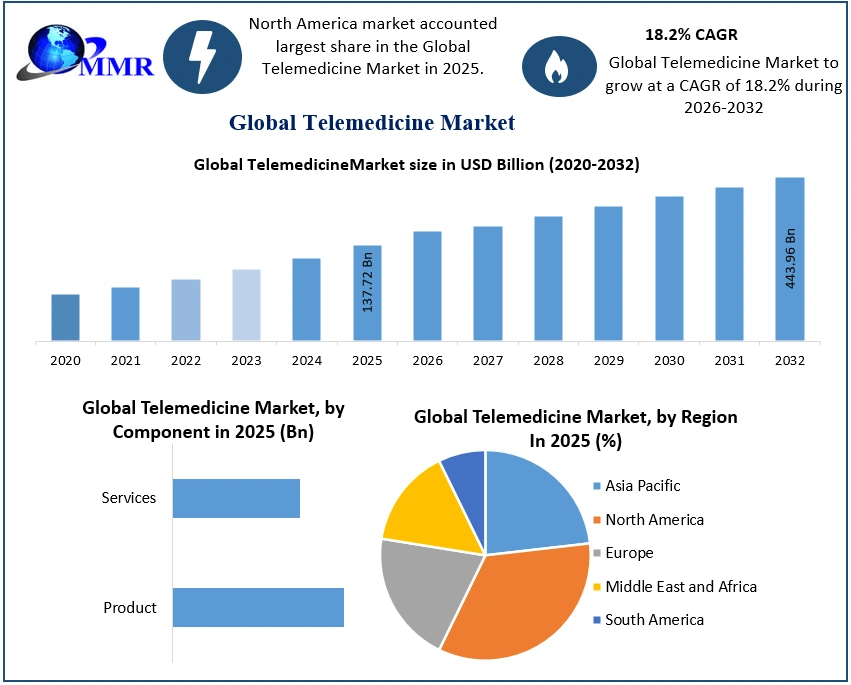
The Telemedicine Market size was valued at USD 137.72 Billion in 2025 and the total Telemedicine revenue is expected to grow at a CAGR of 18.2% from 2026 to 2032, reaching nearly USD 443.96 Billion by 2032.
Telemedicine Market Overview
Telemedicine is a provision of remote clinical services, via real-time two-way communication between the patient and the healthcare provider, using electronic audio and visual means. Many governments around the world have recognized the potential benefits of telemedicine in improving healthcare accessibility and reducing healthcare costs. Some have implemented supportive policies and regulatory frameworks to encourage the adoption of telehealth solutions. Telemedicine allows patients to consult with healthcare professionals, including general practitioners and specialists, remotely, which is expected to boost the Telemedicine Market growth. This is particularly beneficial for individuals in rural or underserved areas.
The scope of the telemedicine market is vast, covering various healthcare services and applications. Teleconsultation allows patients to consult with healthcare professionals remotely, reducing the need for physical visits and increasing access to medical expertise. Remote patient monitoring enables the continuous tracking of vital signs and health parameters, particularly beneficial for individuals with chronic conditions. Mental health services, delivered through telepsychiatry and virtual counseling, address the growing demand for mental healthcare in a convenient and accessible manner.
To know about the Research Methodology :- Request Free Sample Report
Telemedicine Market Dynamics
Consumer Demand for Convenience to boost the Telemedicine Market growth
Patients are increasingly seeking convenient and accessible healthcare options. Telemedicine aligns with this demand by providing virtual consultations that fit into patients' busy schedules, reducing travel time and waiting room delays. The ability to access healthcare from the comfort of one's home resonates with the modern consumer mindset expected to boost the Telemedicine Market growth. The integration of AI and machine learning in telemedicine platforms enhance diagnostic capabilities, aids in treatment planning, and supports personalized medicine. AI algorithms analyze large datasets to identify patterns and trends, contributing to more accurate and timely healthcare decision-making. Governments and regulatory bodies worldwide have recognized the potential benefits of telemedicine and have taken steps to create supportive regulatory frameworks. These regulations clarify the legal aspects of telehealth services, address privacy concerns, and establish reimbursement mechanisms for virtual consultations.
The development of clear guidelines and standards encourages healthcare providers to integrate telemedicine into their practice confidently. Regulatory support has played a crucial role in accelerating the adoption of telehealth solutions across different regions. Patients benefit from reduced travel expenses and time savings associated with virtual consultations. For individuals in remote or underserved areas, telemedicine serves as a vital tool for overcoming geographical barriers, improving healthcare access, and ensuring that medical expertise is available beyond traditional healthcare facilities, which significantly boosts the Telemedicine Market growth.
Telemedicine is the most versatile and widely used technology for delivering health education, information, and health care services over long distances where provider investment in healthcare applications is more, and significantly boost the Telemedicine Market growth. Advanced patient care is supplied through technology, and more access to remote regions is likely to be provided. It also contributes to
Telemedicine Market growth by reducing hospital visits, emergency admissions to hospital rooms and hospitalization rates. However, the market faces problems such as practitioner and patient reluctance to technology, a lack of Smartphone availability, high implementation costs, and data privacy and security concerns. Because steroids are only administered under physician supervision, the telemedicine market has the potential to harm patients' health by providing steroids on fake prescriptions. Due to a lack of patient counselling by telemedicine providers, this aspect can endanger a patient's life.
Chronic diseases are on the rise all over the world, and tele-homecare is a cutting-edge means of delivering care, monitoring a patient, and disseminating information that makes use of the latest telecommunications technologies. Early detection of diseases and the prevention of chronic illnesses are possible thanks to monitoring. Countries are also launching tele-homecare programs, including the UK's whole system demonstrator (WSD), the US's veterans' health segmentation (VHA), and Denmark's TELEKART programming. Tele-homecare solutions regulate, mitigate, and prevent chronic diseases by remotely monitoring patients.
The institutions are effectively collaborating to develop tele-homecare. The University of Ottawa Heart Institute, for example, substantial advancements in telephone monitoring technology, which allows cardiac patients in multiple places to access services through the regional home monitoring software. Tele-home services assist both patients and hospitals since they save money. As a result, the growing acceptability of tele-homecare services has a direct impact on the growth of the telemedicine market.
Opportunities in Telemedicine Market
In-Patient Telemedicine Advancements: While telemedicine has predominantly focused on delivering care to patients at home, the exploration of in-patient telemedicine is emerging as a noteworthy avenue for hospitals and health systems. By deploying specialists into an inpatient setting through video carts, tablets, or bedside monitors, healthcare executives can overcome barriers to providing specialized services in-person. This approach opens new service lines within hospitals, offering a valuable extension of healthcare services to in-patient settings.
Collaborations with Big Tech Giants: Big tech companies, long aspiring to establish a foothold in telemedicine, are leveraging the opportunities presented during the pandemic. Initiatives like Microsoft's 'plasmabot' and Google's enhanced features in Search and Maps for virtual care options showcase the synergy between technology and healthcare.
Telemedicine Market Segment Analysis
Based on Component, the market is segmented into Product, and Services. The product segment dominated the market in 2023 and is expected to hold the largest Telemedicine Market share over the forecast period. Telemedicine Product is an important tool for making healthcare more cost-effective, accessible, and engaging for patients. Kits, software, and hardware are examples of telemedicine products. Furthermore, telemedicine benefits the elderly population because it allows them to receive medical care from the comfort of their own homes. The product segment in the telemedicine market is dynamic and continues to evolve through the integration of emerging technologies. Blockchain technology gains traction in the telemedicine product segment, providing a secure and transparent framework for managing health records, ensuring data integrity, and facilitating interoperability between different healthcare systems.
Based on Application, the market is segmented into Teleradiology, Telepsychiatry, Telepathology, Teledermatology, Telecardiology, and Others. Teleradiology segment dominated the market in 2023 and is expected to hold the largest Telemedicine market share over the forecast period. This is due to the factors such as an increase in imaging practices, healthcare providers' embrace of teleradiology processes, and the simplification and regulation of teleradiology practices The integration of Artificial Intelligence (AI) into teleradiology, the adoption of Picture Archiving and Communication System (PACS), and the expansion of health R&D activities are all expected to be significant growth drivers over the forecast period.

Telemedicine Market Regional Insight
The rapid evolution of technology, in telecommunications and digital health solutions, is a primary driver of the telemedicine market in North America. High-speed internet penetration, the ubiquity of smartphones, and the proliferation of connected devices have created a conducive environment for the expansion of telehealth services. Advanced telemedicine platforms, incorporating secure video conferencing, real-time data transmission, and interoperability with electronic health records (EHRs), are facilitating seamless virtual interactions between healthcare providers and patients. Telemedicine's Market performance by region reflects the growth trajectory shaped by these technological advancements. USD 250 billion of US healthcare spend potentially be shifted to virtual or virtually enabled care.
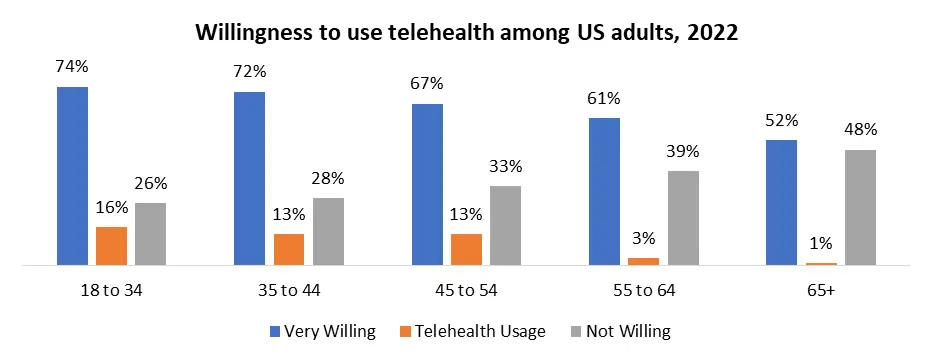
Telemedicine is a rapidly increasing component of healthcare in the United States, due to the country's high adoption of advanced healthcare technologies and the rising burden of chronic diseases. Telemedicine has enhanced care management, improved patients' quality of life, and cut healthcare costs. During the forecast period, the market is expected to grow due to rising demand for mobile technologies, patient adoption of home care, and a reduction in hospital visits.
Global Telemedicine Market Scope: Inquire before buying
| Global Telemedicine Market | |||
|---|---|---|---|
| Report Coverage | Details | ||
| Base Year: | 2025 | Forecast Period: | 2026-2032 |
| Historical Data: | 2020 to 2025 | Market Size in 2025: | USD 137.72 Bn. |
| Forecast Period 2026 to 2032 CAGR: | 18.2% | Market Size in 2032: | USD 443.96 Bn. |
| Segments Covered: | by Component | Product Services |
|
| by Delivery Mode | On-Premise Delivery Cloud-Based Delivery |
||
| by Application | Teleradiology Telepsychiatry Telepathology Teledermatology Telecardiology Others |
||
| by End-User | Providers Payers Patients Other |
||
Telemedicine Market, by Region
North America (United States, Canada and Mexico)
Europe (UK, France, Germany, Italy, Spain, Sweden, Austria and Rest of Europe)
Asia Pacific (China, South Korea, Japan, India, Australia, Indonesia, Malaysia, Vietnam, Taiwan, Bangladesh, Pakistan and Rest of APAC)
Middle East and Africa (South Africa, GCC, Egypt, Nigeria and Rest of ME&A)
South America (Brazil, Argentina Rest of South America)
Telemedicine Key Players include:
North America:
1.Teladoc Health, Inc. (United States)
2.American Well Corporation (United States)
3.MDlive Inc. (United States)
Europe:
1.Philips Healthcare (Netherlands)
2.Siemens Healthineers (Germany)
Asia-Pacific:
1.Ping An Good Doctor (China)
2.WeDoctor (China)
3.Alibaba Health Information Technology Limited (China)
4.Novartis International AG (Switzerland)
Latin America:
1.Omint (Brazil)
2.Telemedicina do Brasil (Brazil)
Middle East and Africa:
1.Okadoc (United Arab Emirates)
2.Vezeeta (Egypt)
Global/Operates in Multiple Regions:
1.Teladoc Health, Inc. (United States)
2.American Well Corporation (United States)
3.Philips Healthcare (Netherlands)
4.InTouch Technologies, Inc. (United States)
5.Cisco Systems, Inc. (United States)
6. Watson Health (United States)
Frequently Asked Questions:
1: What are the key services and applications encompassed within the vast scope of telemedicine?
Ans: The scope of telemedicine covers various healthcare services and applications, including teleconsultation for remote patient consultations, remote patient monitoring for continuous health tracking, and mental health services delivered through telepsychiatry and virtual counseling.
2: How does telemedicine address the growing demand for mental healthcare, and what role does it play in improving accessibility?
Ans: Telemedicine addresses the demand for mental healthcare through services like telepsychiatry and virtual counseling, providing convenient and accessible options for patients. It helps overcome geographical barriers, ensuring medical expertise is available beyond traditional healthcare facilities.
3: How much of the US healthcare spend is potentially expected to be shifted to virtual or virtually enabled care, and what factors contribute to the rapid increase of telemedicine in the United States?
Ans: An estimated $250 billion of US healthcare spend is potentially expected to be shifted to virtual or virtually enabled care. The rapid increase in telemedicine in the United States is attributed to the country's high adoption of advanced healthcare technologies, the rising burden of chronic diseases, and the significant benefits of telemedicine in enhancing care management, improving patients' quality of life, and reducing healthcare costs.
4: How does the product segment of telemedicine contribute to making healthcare more cost-effective, accessible, and engaging for patients?
Ans: The product segment of telemedicine, including kits, software, and hardware, is an important tool for making healthcare more cost-effective, accessible, and engaging for patients. It benefits the elderly population by allowing them to receive medical care from the comfort of their homes.
5: How does telemedicine contribute to health education and information dissemination, especially in regions with limited healthcare access?
Ans: Telemedicine is a versatile technology for delivering health education, information, and healthcare services over long distances. It significantly contributes to health education in regions where provider investment in healthcare applications is more challenging, providing more access to remote areas.