
Telecom Services Market Size by Service Type, Transmission, End-Use, Region, Industry-Wide Analysis, Competitive Landscape Assessment & Long-Term Forecast to 2030
Overview
Global Telecom Services Market size was valued at USD 2015.64 Bn in 2023 and is expected to reach USD 3111.75 Bn by 2030, at a CAGR of 6.4 %.
Telecom Services Market Overview
Telecommunications services play an essential role in our modern world, connecting people and organizations across vast geographic regions. These services incorporate a wide range of communication options, with phone service being the most ubiquitous. Phone services have been categorized as either wired, delivered through traditional landlines, or wireless, utilizing mobile networks. Both options provide the convenience of voice communication, but wireless services have seen significant advancements in recent years, becoming the preferred choice for many due to their mobility and availability. To voice communication, telecommunications firms provide an array of other services. Internet access is an important offering, facilitating the global exchange of data and information. The arrival of high-speed broadband and fiber-optic connections has revolutionized how they access the internet, aiding streaming, online gaming and an excess of online services. Television services, whether delivered through cable or satellite, provide a broad range of entertainment choices, from live sports to on-demand streaming platforms.
Businesses and homes rely on telecommunications companies for networking services. Companies need robust and secure networks to facilitate their operations, involving dedicated services such as Virtual Private Networks (VPNs) and data center connections. Residential networking services provide the backbone for in-home Wi-Fi, smart devices, and seamless connectivity. The choice of these services varies depending on location and the specific telecommunications provider. Rural areas, for instance, have inadequate access to high-speed internet, while urban centers often enjoy a wider selection of service options.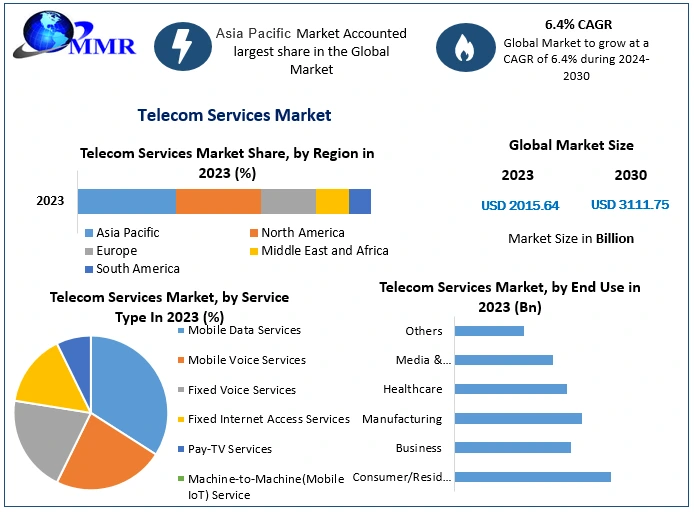 To know about the Research Methodology :- Request Free Sample Report
Telecom Services Market Dynamics:
Driver
Rising spending on 5G infrastructure implementation to drive the Telecom Services Market Growth
5G technology signifies a transformative leap in wireless communication, contributing to higher speeds, lower latency and greater connectivity, which opens the door to new applications and services. This improved connectivity is mainly crucial in the increasingly digital world, where the demand for data-intensive applications, such as augmented reality, virtual reality, IoT devices and autonomous vehicles, is rapidly expanding. 5G has been supporting these technologies at scale, making it essential for telecom service providers to invest in 5G infrastructure. The growing reliance on remote work, telemedicine and online education, particularly in the wake of the COVID-19 pandemic, has underscored the importance of strong and high-speed connectivity. 5G infrastructure has been addressing the needs of these emerging trends, enabling seamless remote communication and access to critical services.
As businesses and individuals embrace the Internet of Things (IoT), the deployment of 5G networks becomes instrumental in facilitating the interconnectivity of myriad devices, from smart appliances to industrial sensors. This translates to an increased demand for telecom services that have bane accommodating these IoT ecosystems. The potential economic benefits of 5G are also substantial, with its capacity to fuel innovation and economic growth. As such, governments, telecom companies and industries are incentivized to invest in 5G infrastructure to remain competitive in a rapidly evolving digital landscape. This increasing investment in 5G infrastructure is thus a growth driver for the Telecom Services Market, as it helps the evolving requirements of a digitally connected world.
IT spending on Telecommunications Services is seeing continuous growth as companies invest in connectivity and communication technologies. Simultaneously, the increasing investments in 5G infrastructure implementation are driving an important shift in telecommunications, providing faster speeds, lower latency, and the foundation for cutting-edge applications like IoT, autonomous vehicles, and augmented reality. These investments collectively shape the future of connectivity and digital transformation.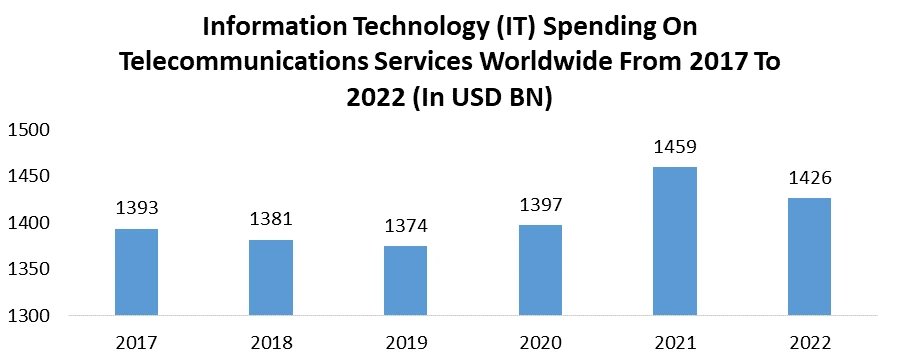 Trend
Trend
Integration in Edge Computing
Edge computing empowers the processing and analysis of data closer to the source or "edge" of the network, rather than relying on distant data centers. This substantially reduces data transmission times, resulting in lower latency. In applications where real-time or near-real-time responses are critical including autonomous vehicles, telemedicine and industrial automation, reduced latency is essential. Telecom services that integrate edge computing have provided the low-latency infrastructure essential for these applications, making them more efficient and reliable.
Edge computing minimizes the requirement to send large volumes of data over long distances to centralized data centers. Instead, only relevant or processed data is transmitted, minimizing the strain on network bandwidth. This is particularly important in the Telecom Services Market, where network capacity and efficient data transmission are key considerations. Telecom providers can optimize their networks by integrating edge computing, which not only conserves bandwidth but also enhances the overall quality of service.
Edge computing is a transformative trend in the Telecom Services Market, particularly benefiting both Telecom Service Assurance and Telecom Enterprise Services. By processing data locally, edge computing bolsters data privacy and security, making it invaluable for sensitive applications such as surveillance cameras and healthcare devices, while satisfying stringent data protection requirements. Edge computing seamlessly aligns with the Internet of Things (IoT) by delivering efficient data processing and enabling real-time decision-making. In the Telecom Service Assurance sector, it provides real-time monitoring and troubleshooting, enhancing issue detection and overall service quality.
In the Telecom Enterprise Services Market, it enhancements efficiency and security, ensuring compliance with data processing regulations and supporting crucial real-time applications. This convergence of edge computing and telecommunications services significantly enhances performance, security and real-time capabilities, providing for the evolving needs of industries and consumers.
Telecom Services Market Segments
Based on Service Type, the market is segmented into Mobile Data Services, Fixed Voice Services, Fixed Internet, Access Services, Mobile Voice Services, Pay-TV Services and Machine-to-Machine (Mobile IoT) Services. Mobile Data Services dominated the Telecom Services Market in 2023. Mobile data services provide a level of connectivity that transcends geographical boundaries. Unlike fixed-line services, which are inadequate in infrastructure, mobile data services provide a ubiquitous connection. This means people have to stay connected wherever they are, whether it's in urban areas, remote regions, or while on the move. This ubiquity has made mobile data the lifeline of modern society.
Mobile data services have been associated with the digital divide, granting access to information and prospects for those previously underserved. In emerging economies, where fixed-line infrastructure is limited, mobile data services have been instrumental in allowing people access to education, healthcare, e-commerce and government services. The increase in smartphones and tablets has transformed these devices into multifunctional tools, effectively merging communication, computing and entertainment. Mobile data services have enabled users to access a wealth of resources through a single, portable device, making them an essential part of daily life.
Mobile data services offer instant connectivity, allowing for real-time interactions. This has revolutionized business communications, telemedicine and emergency services. Mobile data services are the backbone of video conferencing, mobile banking and social media, making it possible to collaborate, transact and communicate on the fly.
Industries including agriculture, logistics, healthcare and smart cities rely on mobile data to collect and transmit data from sensors and devices. This drives efficiencies and improves decision-making across several sectors. In an increasingly fast-paced world, mobility is highly valued. People want to remain connected while on the move, whether commuting, traveling, or simply walking around. Mobile data services provide this demand for seamless connectivity, supporting everything from navigation to entertainment during transit.
Telecom Services Market Regional Insights
Asia Pacific dominated the Telecom Services Market in 2023 and is expected to continue its dominance during the forecast period. The region is a hotbed for IoT applications across various industries such as manufacturing, agriculture, healthcare and smart cities. The proliferation of IoT devices requires strong telecom infrastructure, connectivity solutions and data management, making telecom services a linchpin in this technological revolution. The regional IoT market is sustained by rapid urbanization, industrialization and increasing demand for smart devices among consumers, all of which rely heavily on seamless, high-speed connectivity.
Effective telecom operations management plays an essential role in the region's dominance. Asia Pacific has invested extensively in streamlining its telecom operations, optimizing networks, and ensuring reliable service delivery. The deployment of cutting-edge technologies including 5G and software-defined networking (SDN), improves network efficiency and service quality. Telecom operators in the region are leveraging automation, artificial intelligence (AI), and data analytics for proactive maintenance and issue resolution, ensuring that services remain reliable and competitive.
The diverse population of Asia Pacific provides substantial market potential for telecom IT services and IoT telecom services. With over half of the world's population residing in this region, there's a heightened demand for communication and connectivity solutions. The growing middle class with greater disposable income is driving this demand, leading to an expanding consumer base that seeks advanced telecom services such as high-speed internet, digital entertainment and mobile communication. This trend also extends to the adoption of telecom IT services, enabling efficient network management and customer service. The IoT telecom services sector is flourishing, with industries leveraging data connectivity for smart applications and real-time monitoring, boosting the market's growth.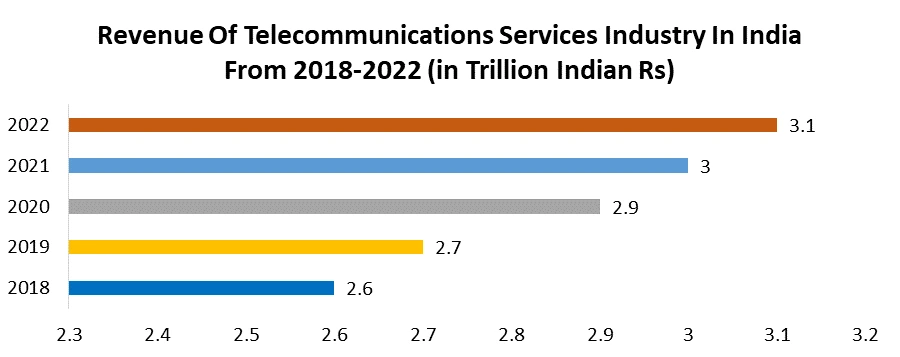
Telecom Services Market Competitive Landscape
The competitive landscape of the global Telecom Services market entails an analysis of key companies, their size, strengths, weaknesses, barriers and threats. This comprehensive overview delves into the influence of competitive rivals, potential market entrants, customers, suppliers, and substitute products that significantly impact the telecom market's profitability. Market players operate at various levels, spanning from local to regional and global scales, shaping the dynamic Telecom market analysis, where competition and innovation drive industry evolution and growth. Some of the key players are Amdocs (US), AT&T(US), CenturyLink(US), Cisco Systems, Inc. (US), Comarch S.A. (Poland), Ericsson AB (Sweden), GTT Communications, Inc.(US), Huawei Technologies Co., Ltd.(China), IBM (US), NTT Data(Japan) and Others Many companies have conducted research and development activities to fulfill consumer demand and increase their portfolio. For instance,
In 2022, Amdocs continued to invest heavily in research and development, focusing on key areas including 5G, cloud, AI, and ML.
1.The development of a new 5G network slicing solution that enables telecom operators to create and manage dedicated network slices for diverse types of traffic and services.
2.The development of a new cloud-native customer relationship management (CRM) solution for telecom operators. This solution enables operators to offer their customers with a more personalized and seamless experience across all channels.
Telecom Services Market Scope: Inquire before buying
| Telecom Services Market | |||
|---|---|---|---|
| Report Coverage | Details | ||
| Base Year: | 2023 | Forecast Period: | 2024-2030 |
| Historical Data: | 2018 to 2023 | Market Size in 2023: | US $ 2015.64 Bn. |
| Forecast Period 2024 to 2030 CAGR: | 6.4% | Market Size in 2030: | US $ 3111.75 Bn. |
| Segments Covered: | by Service Type | Mobile Data Services Mobile Voice Services Fixed Voice Services Fixed Internet Access Services Pay-TV Services Machine-to-Machine(Mobile IoT) Service |
|
| by Transmission | Wireline Wireless |
||
| by End-Use | Consumer/Residential Business Manufacturing Healthcare Media & Entertainment Others |
||
Telecom Services Market, By Region
North America (United States, Canada and Mexico)
Europe (UK, France, Germany, Italy, Spain, Sweden, Austria and Rest of Europe)
Asia Pacific (China, South Korea, Japan, India, Australia, Indonesia, Malaysia, Vietnam, Taiwan, Bangladesh, Pakistan and Rest of APAC)
Middle East and Africa (South Africa, GCC, Egypt, Nigeria and Rest)
Telecom Services Key players
1. Amdocs (US)
2. AT&T(US)
3. CenturyLink(US)
4. Cisco Systems, Inc. (US)
5. Comarch S.A. (Poland)
6. Ericsson AB (Sweden)
7. GTT Communications, Inc.(US)
8. Huawei Technologies Co., Ltd(China)
9. IBM (US)
10. NTT Data(Japan)
11. Sprint.com(US)
12. Tech Mahindra(India)
13. Unisys(US)
14. Verizon(US)
15. Windstream(US)
Frequently Asked Questions:
1] What segments are covered in the Global Telecom Services Market report?
Ans. The segments covered in the Global Telecom Services Market report are based on Service Type, Transmission and End User.
2] Which region is expected to hold the highest share in the Global Telecom Services Market?
Ans. Asia Pacific is expected to hold the highest share of the Global Telecom Services Market.
3] Who are the top key players in the Global Telecom Services Market?
Ans. Amdocs (US), AT&T(US), CenturyLink(US), Cisco Systems, Inc. (US), Comarch S.A. (Poland), Ericsson AB (Sweden), GTT Communications, Inc.(US), Huawei Technologies Co., Ltd.(China), IBM (US), NTT Data(Japan) and Others are the top key players in the Global Telecom Services Market.
4] Which segment hold the largest market share in the Global Telecom Services market by 2030?
Ans. The Service Type segment hold the largest market share in the Global Telecom Services market by 2030.
5] What is the market size of the Global Telecom Services market by 2030?
Ans. The market size of the Global Telecom Services market is USD 3111.75 Bn. by 2030.
6] What was the market size of the Global Telecom Services market in 2023?
Ans. The market size of the Global Telecom Services market was worth USD 2015.64 Bn. in 2023.