
Sports Mouth Guard Market - Industry Structure Evaluation, Demand Drivers Analysis, Regional Growth Analysis and Identification, Competitive Positioning Review & Global Market Size Forecast to 2032
Overview
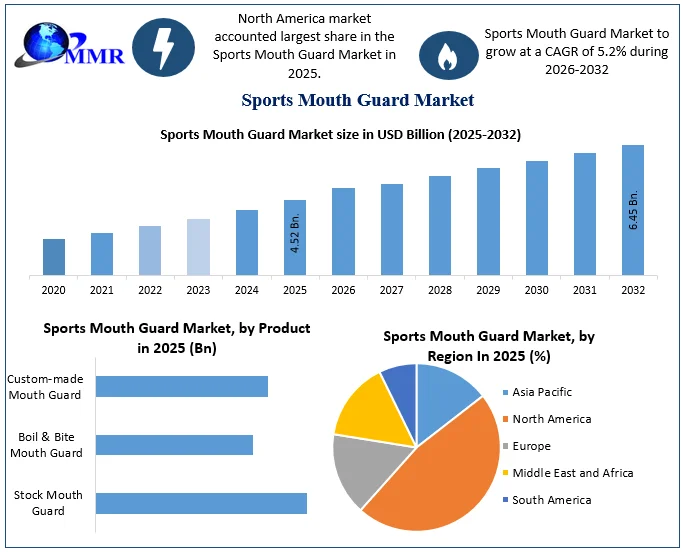
Sports Mouth Guard Market was valued at USD 4.52 Billion in 2025, and it is expected to reach USD 6.45 Billion by 2032, exhibiting a CAGR of 5.2% during the forecast period (2026-2032).
Sports Mouth Guard Market Overview:
During sports, mouth guards are worn across the top row of teeth to assist avoid oral injuries. They guard against broken teeth, damaged lips, and other oral injuries. If an athlete has braces or fixed dental equipment (such as a bridge) on the lower jaw, the dentist may advise him or her to wear a mouth guard to protect these teeth as well. Mouth guards are required sporting equipment for anybody participating in a sport that includes falling, bodily contact, or flying equipment. The market's growth may be linked to the high treatment expenses of sports-related oral injuries, as well as rising measures to raise consumer knowledge about the need for sports momouth guards The market is also driven by the technological advancements in mouth guards leading to improvements in their durability, protection level, and flexibility.
To know about the Research Methodology :- Request Free Sample Report
Research Methodology
The Global Sports Mouth Guard Market report provides an evaluation of the market for the forecast period. The report comprises various segments as well as an analysis of the trends and factors that are playing a substantial role in the market. In the report, the market outlook section mainly encompasses fundamental dynamics of the market which include drivers, restraints, opportunities, and challenges faced by the industry. Based on the understanding of requirements, a secondary research is conducted to identify the segment specifications, qualitative and quantitative data along with the factors responsible for the growth of the market. The secondary source referred for the research are press releases, company annual reports, government websites, and research papers related to market. Moreover, quantitative and qualitative data is extracted from paid database like Reuters, Bloomberg, Hoovers, etc. The secondary research carried out at primary level is verified by primary research.
In the report, Porter examines competition, new entrants in the market, supplier power, buyer power, and the threats of the substitute products and services in the market. PESTLE identifies factors like political, economic, sociocultural, technological, legal, and environmental, that may affect an organization and its competitive standing. The main approach used to calculate accurate market size is bottom-up market sizing approach, where macro and micro view of all the potential customers, revenue and current market is considered as a whole. On the other hand, the research is also conducted by considering micro level segment that can be realistically targeted and calculated, which results in better forecasting and more accurate data on amore granular level.
Sports Mouth Guard Market Dynamics
Dental injuries caused by sports: Participation in youth and adolescent sports has gradually increased throughout the years. It is believed that between 20 and 25 million young people participate in competitive sports. Injuries have grown as a result of this increase in participation levels. According to some sources, sports account for around 36% of all accidental injuries to children and adolescents. According to the American Dental Association, maxillofacial injuries account for 10-20% of all sports-related injuries.
As per the National Youth Sports Foundation for Safety, the most prevalent form of orofacial injury encountered during sports involvement is oral injuries. They claim that if an athlete does not wear a protective mouth guard, he or she is 60 times more likely to suffer tooth injury. These accidents frequently result in lasting damage to oral tissues, necessitating medical intervention. Mouth guards can be worn by players in competitive and leisure sports when there is a chance of impact, contact, or collision, preventing dental injury. This factor contributes to the market's growth.
Mouth guards are used while playing many sports: The price and comfort of mouth guards vary, but they all give some protection. The best mouth guard should be comfortable, tear-resistant, and robust. A mouth guard should be comfortable, long-lasting, and easy to clean. It should not obstruct speech or breathing. Mouth guards are required when participating in numerous sports in many countries. There are various sports in which mouth guards are suggested to participants, and a growth in the number of players increases mouth guard sales.
Custom mouth guards are recommended to the players for the following sports like boxing, acrobats, basketball, football, gymnastics, weightlifting, field hockey, handball, lacrosse, martial arts, shot putting, racquetball, rugby, skateboarding, skiing, ice hockey, skydiving, soccer, water polo, surfing, roller hockey, volleyball, squash, and wrestling, etc. across the world. It is also recommended that the mouth guard should be worn during all practices and competition. These factors drive the growth of the sports mouth gaurd market.
Technological advancements in mouth guards: Advances in mouth guard technology to improve fit and durability are expected to boost demand for these items. Leading sporting equipment manufacturers make mouth guards. Mouth guards have been improved from the early to mid-twentieth century. Previously, it was difficult to communicate while wearing a mouth guard due to its insufficient fit and size. Smaller, more flexible, and more durable guards, on the other hand, allow an athlete to speak correctly. A personalised mouth guard is also available, which is moulded to the individual's mouth size for a precise fit. The advancements in mouth guard technology are not restricted to fit. The technology has also increased the mouth guard's durability since a denser material allows for a better damage resistance without adding any thickness to the mouth guard.
Self-fitting mouth guards are one example of technical advancement. For example, OPRO Self-Fit mouth guards include revolutionary anatomically orientated fins for the best fit and retention. The placement and depth of the fins were determined using data from 1 million OPRO Custom-Fit dental impressions. For example, Maher Orthotic is an acrylic custom-made mouth guard invented by Dr. Gerald Maher, a temporomandibular joint expert and the New England Patriots' team dentist. This device moves the jaw forward, increasing the amount of space in the oral pharynx and allowing the athlete to breathe and talk more comfortably. Furthermore, it improves biting occlusion and stability, assisting in damage avoidance. All these technological advancements in mouth guards are driving the growth of the sports mouth guard market.
Constant development of mouth guards: Manufacturers are continually producing new items to fulfil customer demands and to differentiate themselves from competition. These advancements benefit consumers, producers, and contribute to market growth. Mouth guards with shock absorbers have been produced and are intended to protect the mouth, jaw, or head area from an impact caused by sporting activities. An NXTRND mouth guard, for example, works as a shock absorber by dispersing impact forces and increasing the distance between the upper and lower teeth. Bacteria may readily collect on mouth guards, causing a variety of dental disorders.
As a result, firms are offering antimicrobial mouth guards, such as OPRO's ultra-hygienic mouth guards. Antimicrobial protection prevents the spread of dangerous bacteria like antibiotic-resistant MRSA. Sensor technology is available in mouth guards. For example, OPRO+ incorporates PROTECHT's high precision sensor technology, which detects, transmits, and displays relevant information about every head hit a player experiences during training or competitive matches to medical specialists, coaches, and trainers. Damprotech is an excellent material for use in mouth guards to disperse energy and protect wearers' mouths from high-velocity hits in the oral region while participating in sports.
Growing awareness of dental care and mouth guards: Around 10% of sports accidents involve head injuries, including mouth injuries, the severity of which is determined by the athlete's age and the type of sport practised. Oral injuries can have substantial functional, cosmetic, and psychological consequences. In 25% of cases, tooth damage might lead to pulp necrosis or severe discomfort. Fractures and cracks in the enamel, as well as concussions, are examples of less serious injuries.
According to the American Dental Association (ADA), sports mouth protectors can prevent more than 200,000 oral injuries each year. Dentists, referees, and coaches all have a key role in influencing players' acceptance of sports mouth guards and are thus expected to enhance adoption and knowledge of mouth guards. Team coaches and referees help to ensure that mouth guards are worn during practise and competition, while dentists not only educate trainers, coaches, athletes, parents, and other school officials about various products and their uses, but also provide custom-made mouth guards in their practise settings.
Sports Mouth Guard Market Segment Analysis
Based on product, the market is segmented into stock, custom-made, and boil and bite mouth guard. The boil and bite mouth guard segment dominated the market and held the largest revenue share of more than 40% in 2025. This is due to their capacity to protect against various orofacial injuries better than a standard mouth guard and their comparatively low cost. The most popular form of mouth guard is the boil-and-bite mouth guard, which is constructed of thermoplastic polymer. They are made in the mouth using the finger, tongue, and biting pressure after being submerged in hot water.
However, research on the length of the dental arch in high school and college athletes has revealed that most boil-and-bite mouth guards do not cover all of the posterior teeth. Because of the substantial drop in occlusal thickness throughout the moulding and fabrication process, these mouth guards create a misleading sensation of security.
The custom-made sector is expected to increase rapidly throughout the forecast period because to the excellent protection and fit given by these devices, which no other form of mouth guard can match. Furthermore, unlike other mouth guards, these are incredibly resilient and hold their shape for an extended period of time. Custom mouth guards developed by a dentist meet all of the material adaption, retention, comfort, and stability standards. They have the least amount of interference with speech and almost no influence on breathing. As a result, bespoke mouth guards have widespread acceptance in the scientific literature.
Stock mouth guards are low-cost, prefabricated, ready-to-wear mouth guards that come in a limited number of sizes (usually small, medium, and large). These large mouth guards have no retention and must be kept in place by biting down repeatedly, which might interfere with speech and breathing. The stock mouth guard is the least protective of the mouth guard kinds and is not advised for use in sports.
Based on the distribution channel, the market is broadly categorized into online and offline. The offline segment dominated the sports mouth guard market and accounted for the largest revenue share of 81.3% in 2025. Over the forecast period, the category is expected to increase at a rapid pace. This is due to the availability of a diverse selection of products/brands at retail sporting goods stores, as well as an increased focus on the usage of custom-fitted mouth guards. Several manufactures sell their products both online and through the internet channel. OPRO, Shock Doctor, and Akervall Technologies are a few of the established industry participants that sell products through both of the distribution channels listed above.
Global Sports Mouth Guard Market Recent Development
| Date | Company | Development | Impact |
|---|---|---|---|
| 01 January 2025 | Ohio State University College of Dentistry | Researchers published a comprehensive study providing empirical evidence that specific 3D-printed mouthguard configurations exhibit superior energy absorption compared to traditional ethylene vinyl acetate (EVA) guards. | The findings validate digital fabrication methods, accelerating industry-wide shifts toward 3D-printed custom dental protective gear. |
| 15 February 2025 | SprintRay Inc. | The company launched its proprietary SportsGuard resin, a biocompatible material engineered specifically for fabricating high-performance athletic mouthguards using Digital Light Processing (DLP) 3D printers. | This material launch improves office workflow efficiency, enabling dental professionals to deliver same-day customized protective mouthguards. |
| 12 March 2025 | OPRO Group | The company unveiled a next-generation custom-fit mouthguard product range leveraging advanced digital scanning and 3D manufacturing technology. | The rollout scales up production precision, providing athletes across multiple contact disciplines with enhanced anatomical fit and impact protection. |
| 26 March 2025 | Sportech Limited | The sports distribution enterprise completed the acquisition of the brand rights and complete business assets of Makura Sport Limited. | This transaction shifts operational control to expand the worldwide distribution network of Makura's specialized protection portfolio. |
| 18 June 2025 | Shock Doctor / HITIQ Limited | The firms entered into a strategic product integration partnership to embed HITIQ's PROTEQT impact-sensing technology platform directly into Shock Doctor’s retail lines. | The integration commercializes smart data-enabled mouthguards at scale, allowing real-time head impact tracking for amateur and youth sports markets. |
| 14 August 2025 | Shock Doctor Inc. | The manufacturer introduced an upgraded premium line of high-impact protective gear featuring multilayer shock-absorption design elements and expanded airflow pathways. | The mechanical upgrades increase structural safety while improving breathing comfort and speech clearance during competitive athletic activities. |
Sports Mouth Guard Market Regional Insights
North America dominated the market and accounted for the largest revenue share of 40.3% in 2025. The presence of sports and dental associations demanding the use of mouth guards, as well as relatively high disposable income and product availability, are expected to contribute to the region's market growth. For example, roughly 5 million teeth are avulsed each year, mostly during athletic activities, with tooth replacement costing approximately USD 500 million.
Sports-related dental injuries account for 13-39 percent of all dental injuries, according to a research published in the Journal of the American Dental Association (JADA), with 2-18 percent impacting the craniofacial region. Only five sports are officially mandated by the National Federation of State High School Associations (NFHS): football, ice hockey, lacrosse, field hockey, and wrestling. Wrestlers who need fixed orthodontic equipment must compete. However, many high schools and institutions continue to promote required contact sports protective equipment. Because of the aforementioned factors, the sports mouth guard market is expected to increase at an exponential rate over the forecast period.
Asia Pacific market is expected to develop at a rapid pace during the forecast period. Increased disposable money, more awareness, supporting government programmes, and increased sports engagement may all be related to this expansion. For example, China's State Council announced intentions to build its sports sector in September 2019, including plans to manufacture sports equipment and stimulate participation in sports.
Taekwondo, also known as Tae Kwon Do or Taekwon-Do, is a Korean martial arts style that is now practised by over 70 million people in 188 countries worldwide. However, it has been reported that participating in a contact sport (24%) such as Taekwondo poses a 3 times higher risk of orofacial injuries than participating in a non-contact sport (8%) such as volleyball, where the risk of suffering sports-related orofacial injuries in general is 6 times higher than engaging in average daily activities. Wearing a mouthguard helps reduce sports-related orofacial injuries, and the World Taekwondo Federation implemented a mouthguard regulation in 2003 that mandated the use of mouthguards during competitions, and the Korea Taekwondo Association followed suit in 2010. This has further increased the demand of mouth guards and boosted the growth of the market in the Asia Pacific region.
The objective of the report is to present a comprehensive analysis of the global Sports Mouth Guard Market to the stakeholders in the industry. The past and current status of the industry with the forecasted market size and trends are presented in the report with the analysis of complicated data in simple language. The report covers all the aspects of the industry with a dedicated study of key players that include market leaders, followers, and new entrants.
PORTER, PESTEL analysis with the potential impact of micro-economic factors of the market have been presented in the report. External as well as internal factors that are supposed to affect the business positively or negatively have been analyzed, which will give a clear futuristic view of the industry to the decision-makers. The reports also help in understanding the Sports Mouth Guard Market dynamic, structure by analyzing the market segments and projecting the Sports Mouth Guard Market size. Clear representation of competitive analysis of key players by segment type and regional presence in the Sports Mouth Guard Market make the report investor’s guide.
Sports Mouth Guard Market Scope: Inquire before buying
| Sports Mouth Guard Market | |||
|---|---|---|---|
| Report Coverage | Details | ||
| Base Year: | 2025 | Forecast Period: | 2026-2032 |
| Historical Data: | 2020 to 2025 | Market Size in 2025: | US 4.52 Bn. |
| Forecast Period 2026 to 2032 CAGR: | 5.2 % | Market Size in 2032: | US 6.45 Bn. |
| Segments Covered: | by Product | Stock Mouth Guard Boil & Bite Mouth Guard Custom-made Mouth Guard |
|
| by Distribution Channel | Offline Online |
||
Sports Mouth Guard Market, by Region:
North America (United States, Canada and Mexico)
Europe (UK, France, Germany, Italy, Spain, Sweden, Austria, Turkey, Russia and Rest of Europe)
Asia Pacific (China, India, Japan, South Korea, Australia, ASEAN and Rest of APAC)
Middle East and Africa (South Africa, GCC, Egypt, Nigeria and Rest of ME&A)
South America (Brazil, Argentina, Columbia and Rest of South America)
Sports Mouth Guard Market, Key Players:
1. Venum Predator
2. Akervall Technologies Inc.
3. Shock Doctor Inc.
4. Opro
5.Makura Sport
6. MAX Mouth guards
7. MOGO SPORT
8. Fight Dentist
9. Prolon
10. Armourfit
11. Bernhard Foerster GmbH
12. Vettex
13. GOBSMACKED Sports Mouth guards
14. Brain Pad
15. ShockDoctor
16. ATI
17. Decathlon
18. Nike
19. Opro Mouth guards
20. Mueller
21. Battle Sports Science
22. Maxxmma
Frequently Asked Questions:
1] What segments are covered in the Global Sports Mouth Guard Market report?
Ans. The segments covered in the Sports Mouth Guard Market report are based on Product and Distribution Channel.
2] Which region is expected to hold the highest share in the Global Sports Mouth Guard Market?
Ans. The North America region is expected to hold the highest share in the Sports Mouth Guard Market.
3] What is the market size of the Global Sports Mouth Guard Market by 2032?
Ans. The market size of the Sports Mouth Guard Market by 2032 is expected to reach USD 6.45 Bn.
4] What is the forecast period for the Global Sports Mouth Guard Market?
Ans. The forecast period for the Sports Mouth Guard Market is 2026-2032.
5] What was the market size of the Global Sports Mouth Guard Market in 2025?
Ans. The market size of the Sports Mouth Guard Market in 2025 was valued at USD 4.52 Bn.