
Solar Inverter Market- Industry Structure Evaluation, Demand Drivers Analysis, Regional Growth Analysis and Identification, Competitive Positioning Review & Global Market Size Forecast to 2032
Overview
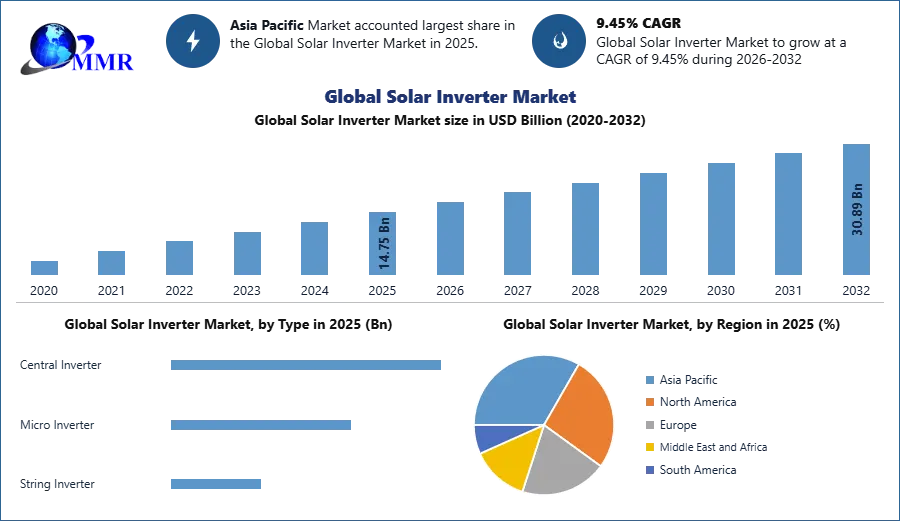
The Solar Inverter Market size was valued at USD 14.75 Billion in 2025 and the total Solar Inverter revenue is expected to grow at a CAGR of 9.45% from 2026 to 2032, reaching nearly USD 30.89 Billion.
Solar Inverter Market Overview:
An essential component of the solar system, the solar inverter transforms the DC power coming from the solar panels into AC power. In addition to converting power, solar inverters track voltage, permit communication with the grid, & shut down in emergencies. As a result, greater use of on-grid solar inverters protects the security and effectiveness of home appliances. On-grid solar inverters produce a pure sine wave of AC electricity as opposed to off-grid inverters. Most frequently utilized in residential and utility applications, solar inverters are also being employed more frequently worldwide in commercial & industrial projects.
 To know about the Research Methodology :- Request Free Sample Report
Solar Inverter Market Dynamics
Solar inverter installation is simple, and rapid advancements in renewable energy are the main drivers of market growth throughout the forecast period. Excessive costs, the lack of panel-level monitoring, and high heat loss in large solar inverters are the main problems limiting industry growth during the forecast period. On the other hand, it is expected that increased government initiatives and investments in the electrification of remote & rural areas would present chances for major players in the global solar inverter market.
In the year 2025, the U.S. overtook Canada as North America's largest market. There is a substantial market for several types of PV inverters. The scale of central inverters (1.5 MW or more) and three-phase string inverters are two recent inverter trends in the United States (60 kW). Although string inverters have steadily increased in popularity in the U.S., central inverters are expected to continue to dominate the market. Solar inverter manufacturers, component manufacturers, inverter manufacturers, distributors, sellers, & end users make up the highly complicated value chain. Since panels make up the majority of the solar value chain, followed by inverters & batteries, different parts generate varying amounts of revenue. Given that solar devices have relatively high efficiency, there is minimal potential for technical distinction due to the complexity of the supply chain.
Unlocking the growth potential of the solar Inverter Industry:
Manufacturers must separate themselves from rivals in the highly competitive solar inverter market to survive. According to MMR report analysis, price pressure and intense competition caused the Top 5 global inverter makers' total revenue to drop 10% last year. ABB paid Fimer to take over its inverter company, Schneider Electric quit the utility-scale inverter market, and KACO sold its string and central inverter operations to Siemens and OCI Power, respectively. These are just a few of the many acquisitions and departures that have occurred in 2019 alone. Yaskawa Solectria Solar, an American inverter maker, believes it has the responsive local customer service and visionary leadership necessary to remain competitive.
One of only three major manufacturers of solar power electronics that is based entirely in the United States is Solectria. The others are hybrid inverter vendor Pika Energy, power optimizer producer Alencon Systems, and manufacturer of microinverters Chilicon Power (which was recently acquired by another U.S. company, Generac). Although Solectria assembles its goods in the United States, its inverters contain certain foreign parts. While combiners and earlier inverter types are produced in Oak Creek, Wisconsin, Yaskawa America facilities in Buffalo Grove, Illinois, manufacture its new inverters. Solectria wants to maintain its position as a Made-in-USA choice for installers in the New England region & beyond by staying at the front of technological and Cybersecurity improvements.
Investment in Solar Inverter Industry:
Many people find solar inverters to be attractive alternative investments. When used by businesses or local governments, these technologies are at the front of enabling continuous improvement in energy production and consumption, which can substantially improve environmental conditions and save costs. Solar inverters combine innovation and efficiency in production to provide smart renewable energy with low consumption costs, making them, particularly appealing to companies with environmental, social, and governance (ESG) portfolios. In the solar inverter business, SMA Solar Technology of Germany held 30% of the market share just 11 years ago; today, Huawei and Sungrow of China control the majority of the market.
Despite losing 4% of its global market share, the Chinese string inverter powerhouse maintained its position as the top provider for the fourth consecutive year, according to an MMR study report. With 64% of all sales globally, Asia-Pacific was once again the largest inverter market in 2019. The second and third-largest providers were Sungrow and SMA, respectively.
Solar Inverter Market Segments:
By End-user, With a revenue share of over 44.0% in the year 2025, the utility segment dominated the solar inverter market. The central & string inverter is the solar inverter that is most frequently utilized in the utility segment. The utility sector is growing for several reasons, the rising demand for renewable energy, the falling cost of solar energy and equipment, and the emergence of government subsidies are primary reasons for the growth of the utility segment. In addition, the segment is rising as a result of the presence of major players who provide customers with market-leading utility-scale solutions through their pre-integrated power plants to increase efficiency and lower balance-of-system costs.
By Type: The largest revenue share in the year 2025 more than 49.0% was accounted for by the central inverter. When properly maintained and installed, these inverters are very dependable and are kept in a secure position. The inverters take the DC electricity from all the PV panels and convert it into AC power, becoming a single point for power distribution. The inverters are integrated with big arrays put on field installations, industrial facilities, and buildings. In 2024, the string inverter market share was the second-largest. The commercial and residential sectors are where the string inverter is most commonly used. One of the key drivers of segment growth is the lower initial cost and simple installation.
These inverters have three-phase variations, are strong, provide great design flexibility, are well-supported (by reputable brands), and have remote system monitoring capabilities. During the forecast period, the micro solar inverters market is expected to increase at a significant rate. Micro PV inverters, which are electronics at the module level, are now a common option for the commercial and industrial sectors. These inverters benefit from excellent levels of dependability, improved performance, and efficiency thanks to the Maximum Power Point Tracker (MPPT), ease of installation, no space limitations, and low cost.
Recent Industry Developments
| Exact Date | Company | Development | Impact |
|---|---|---|---|
| 17 January 2025 | Sungrow Power Supply Co., Ltd. | Launched the SG350HX-20 string inverter with enhanced 20A current compatibility for high-power solar modules during a global renewable energy exhibition. | The launch strengthens utility-scale solar project efficiency and high-power module adoption across large photovoltaic installations. |
| 12 March 2025 | Huawei Digital Power Technologies Co., Ltd. | Introduced the FusionSolar Smart String Inverter series with AI-powered arc-fault detection to enhance system monitoring and safety in distributed PV systems. | The development improves operational safety and intelligent monitoring in commercial and industrial solar deployments. |
| 28 May 2025 | SolarEdge Technologies Inc. | Announced the release of its next-generation Home Hub Inverter integrated with advanced battery compatibility for residential solar energy systems. | The product strengthens residential solar-plus-storage adoption and supports improved home energy management. |
| 19 September 2025 | FIMER S.p.A. | Unveiled the PVS-350 modular central inverter platform designed for large-scale photovoltaic power plants. | The platform improves power density and operational efficiency for utility-scale solar installations. |
| 14 February 2026 | SMA Solar Technology AG | Expanded its inverter manufacturing capacity by opening a new production line for high-capacity Sunny Central inverters in Germany. | The expansion supports growing global demand for utility-scale solar infrastructure and strengthens supply chain resilience. |
Global Solar Inverter Market by Region:
Asia Pacific region is expected to hold the highest revenue share of over 43.0% by 2032. The solar market in this region is increasing quickly, and China is both a key global competitor and its largest provider. The growth of the industry in the region has also been greatly aided by the rising number of solar installations in developing countries.
Top 5 States in India for Solar Power Generation:
The Indian renewables industry progressed a lot in 2017, and Prime Minister Narendra Modi announced a new target of net-zero carbon emissions by 2070. The country's ability to produce green energy is expanding, and its two richest businesspeople recently announced plans to invest thousands of Crores in the industry. While still aiming for 170 GW by 2024, India has achieved its nationally set contributions objective with a total installed non-fossil energy capacity of 157.32 GW, or 40.1% of all installed electrical capacity.
Solar, wind, and hydropower produced 57.71 GW, 40.79 GW, & 51.74 GW, respectively, as of the end of June 2024. The nation's solar industry, which was recently ranked fifth among the world's most attractive solar markets by IBEF, earned the highest-ever investment in the Union Budget for FY 2023, totaling Rs. 33.7 billion, an increase of 30% from Rs. 26 billion in FY21.
| STATES | SOLAR POWER GENERATION CAPACITY |
| Rajasthan | 13.58 GW |
| Karnataka | 7.5 GW |
| Gujarat | 6.3 GW |
| Tamil Nadu | 4.8 GW |
| Telangana | 4.5 GW |
In the year 2024, North America held a large revenue share, with the U.S. being the main driver of solar inverter market growth. A significant market for various kinds of solar inverters is the United States. Recent inverter trends in the nation include the predominance of 1.5 MW plus capacity central inverters and three-phase string inverters with a capacity of at least 60 kW. Although string inverters saw strong growth in North America, central PV inverters are expected to continue holding the biggest market share during the forecast period.
Due to the presence of supportive government policies and the provision of subsidies like home feed-in tariffs (FITs), which encourage consumers to invest in renewable energy, Europe is expected to have a substantial CAGR over the projected period. Due to the high-tech nature of the inverters, Germany is a global leader in the production of solar inverters. As a result, German solar companies have an edge over rivals.
Competitive Scenario in the Global Solar Inverter Market
Acquisition, business expansions & technological advancements are common strategies followed by major market players.
Solar Inverter Market Scope: Inquire before buying
| Global Solar Inverter Market | |||
|---|---|---|---|
| Report Coverage | Details | ||
| Base Year: | 2025 | Forecast Period: | 2026-2032 |
| Historical Data: | 2020 to 2025 | Market Size in 2025: | 14.75 USD Billion |
| Forecast Period 2026-2032 CAGR: | 9.45% | Market Size in 2032: | 30.89 USD Billion |
| Segments Covered: | by Type | Central Inverter Micro Inverter String Inverter |
|
| by Application | Residential Commercial Utilities |
||
| by Connection Type | On-grid Off-grid |
||
| by Phase | Single-phase Three-phase |
||
| by End User | Solar Power Plants Residential Buildings Commercial Buildings Industrial Facilities |
||
Solar Inverter Market, by Region
North America (United States, Canada and Mexico)
Europe (UK, France, Germany, Italy, Spain, Sweden, Austria and Rest of Europe)
Asia Pacific (China, South Korea, Japan, India, Australia, Indonesia, Malaysia, Vietnam, Taiwan, Bangladesh, Pakistan and Rest of APAC)
Middle East and Africa (South Africa, GCC, Egypt, Nigeria and Rest of ME&A)
South America (Brazil, Argentina Rest of South America)
Key players / competitors profiles covered in the Global Solar Inverter Market report in strategic perspective
1. SMA Solar Technology AG (Germany)
2. Siemens AG (Germany)
3. GoodWe (Germany)
4. Omron Corporation (Japan)
5. TMEIC (Japan)
6. Canadian Solar Inc. (Canada)
7. ABB Ltd (Switzerland)
8. HUAWEI (China)
9. Sungrow (China)
10. Growatt (China)
11. Ginlong Technologies Co (China)
12. Sineng Electric Co. (China)
13. Solax Power (China)
14. Zhejiang Benyi Electrical Co., Ltd. (China)
15. SunPower Corporation (US)
16. Power Electronics (US)
17. Solectria Renewables LLC (US)
18. Hitachi Hi-Rel Power Electronics Pvt. Ltd. (Inida)
19. LENTO INDUSTRIES PRIVATE LIMITED (India)
20. SolarEdge (Israel)
21. LG Electronics (South Korea)
22. Fronius (Austria)
23. Delta Solar Solutions (Taiwan)
24.Sungrow Power Supply Co., Ltd.
25.Huawei Digital Power Technologies Co., Ltd.
26.SolarEdge Technologies Inc.
27.FIMER S.p.A.