
Smart Glove Market Size by Type, Component, End User Industry and Region – Segment-Level Market Assessment, Growth Opportunity Analysis, Competitive Mapping & Forecast to 2032
Overview
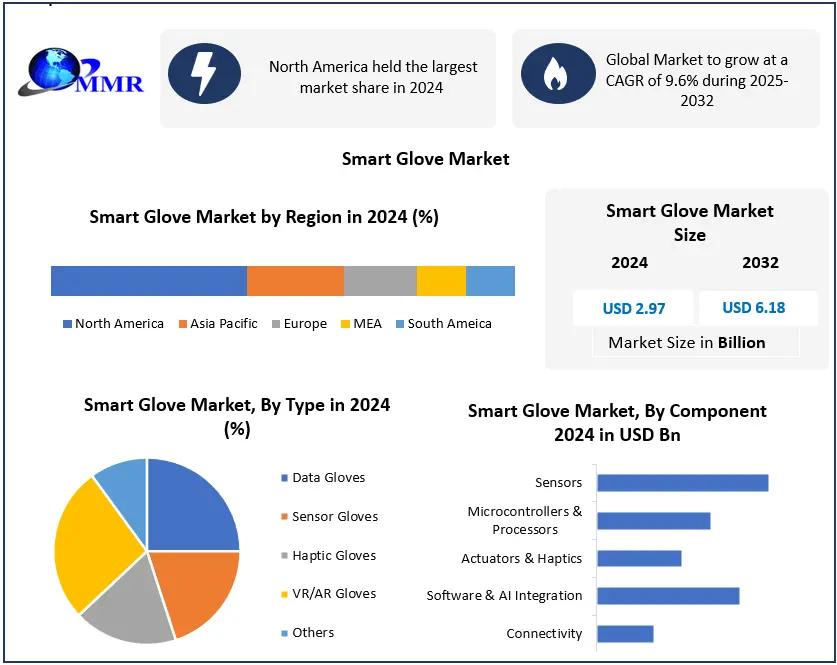
The Smart Glove Market was valued at USD 2.97 Bn in 2024, and total global Smart Glove Market revenue is expected to grow at a CAGR of 9.6% and reach nearly USD 6.18 Bn from 2025 to 2032.
The global smart glove market is prominent in the United States and Europe, with notable presence in India, China, Russia, Israel, and New Zealand. Growing demand in developed countries is driving global market growth.
A smart glove has been developed to translate American Sign Language (ASL) gestures into written and spoken characters for mobile phone applications. The glove is equipped with five flex sensors, with each sensor dedicated to monitoring the movement of a specific finger. Innovative technology enables users to seamlessly communicate in ASL, with the smart glove accurately interpreting the gestures and converting them into text or spoken words within mobile applications.
 To know about the Research Methodology:-Request Free Sample Report
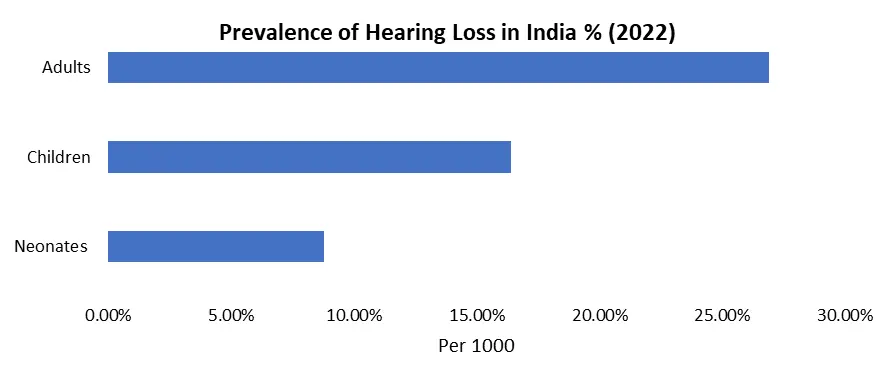
Glove helps people with hearing disabilities lead normal lives by recognizing and interpreting the user’s sign language into spoken English. Thanks to Smart Glove it overcomes the problems being faced by disabled people. Smart glove benefit for the people is increasing the demand for the smart glove market. The evolution in technology has democratized the ability of the average person to comprehend gestures made by individuals with disabilities. On top of that, all over the world around 90% of deaf children are born to hearing parents and only 25% of those can sign, so communication is a huge problem. As per the MMR’s analysis, only 2% of people with hearing impairment have access to the technology, the reason it is either too expensive or cannot be customized according to their needs.
Smart gloves are gaining recognition thanks to their diverse applications in numerous fields, which is fueling the global smart glove market, and thanks to the emerging technologies it is expected to continue the growth throughout the forecast period. The government investment in the healthcare sector is also fueling the smart glove market growth. India invested in the healthcare sector around USD 10.73 billion in 2023.
Applications of the smart glove are in diverse sectors such as the government sector, educational sector, industrial sector, and virtual reality sector. In the government sector, smart gloves are used in banks, hospitals, railway stations, airports, and restaurants where hand gestures are recognized and real-time translation is made, which helps in easier communication. Thus, the smart glove is adopted by the government sector, which is expected to surge the smart glove market demand during the forecast period. In addition, with the help of a smart glove, the children can learn sentence formations, prepositions, and grammar, which can help deaf children to have an education and can have normal education like other children. All over the globe, around 70 million people are profoundly deaf, and 230 million others are hearing impaired or are not able to speak because of conditions like autism or stroke. The number of deaf people is high all over the world, therefore, the demand for the smart gloves market is increasing.
In addition, the usage of smart gloves in the industrial sector is also one of the major reasons the smart glove market is expected to grow during the forecast period. The vast industrial floors often find themselves being extremely unfavorable for vocal or visual communication. The gloves solve the issue by helping the people to communicate about the various activities that happen on the floor regardless of the distance or background noise levels.
The smart glove market is found all over the world mainly, in the United States and Europe but is also in countries like India, China, Russia, Israel, and New Zealand. The presence of the market in developed countries is surging the demand for the smart glove market globally.
Smart Glove Market Dynamics:
Increasing adoption of Nanotechnology and Microencapsulation
Microencapsulation, with its ability to encapsulate the active ingredients or functionalities within tiny particles, allows for controlled release and targeted application. When applied to smart gloves, the technology opens avenues for innovative features and functionalities. The microencapsulation incorporates antimicrobial agents for enhanced hygiene, integrating phase change materials for temperature regulation or embedding sensors for improved haptic feedback, microencapsulation provides a versatile platform for tailoring smart glove capabilities. In addition, the realm of smart glove manufacturers and key players are strategically focusing on integrating these cutting-edge technologies to enhance user experiences.
In addition, the surge in startups delving into the domain showcases the industry’s dynamic nature. The startups are instrumental in pushing the boundaries of what smart gloves achieve, introducing novel applications, and refining existing technologies. The market is witnessing a wave of creativity as these startups leverage microencapsulation and nanotechnology to craft gloves with unprecedented capabilities. The increasing awareness and appreciation of smart gloves among consumers is driving the demand of the smart glove market, and fostering a cycle of innovation and adoption. The Smart glove offers to leverage the transformative potential of microencapsulation and nanotechnology, which is witnessing the growth of the smart glove market. Consumers play a pivotal role in propelling market growth as they increasingly embrace the advantages offered by microencapsulation and nanotechnology in smart gloves.
The Usage of Smart Gloves for Paralyzed Patients
The advent of smart gloves stands as a transformative breakthrough, promising heightened independence and the ability to accomplish daily tasks for paralyzed people. The customization potential of smart gloves emerges as a paramount advantage, as these devices are tailored to address the unique requirements of individual patients. Thanks to the customization the demand for the global smart glove market is increasing and is expected to continue its growth during the forecast period. In addition, the ongoing evolution of the technology foretells a promising future, teeming the innovative applications that extend beyond the current scope. In India around 4.9 lakh people are paralyzed because of any health conditions.
Challenges with Interoperability in Standalone Operations, Real-Time Monitoring, and the Capability to Work in Various Environments
Smart wearable systems encounter hurdles in integration and interoperability, impeding their widespread adoption. Challenges include complex efficacy assessment, posing barriers for early adopters, which hinders the growth of the smart glove market. Issues like technology obsolescence, proprietary algorithms, and scalability obstacles hinder market growth, slowing the accumulation of evidence for wearables' effectiveness in rehabilitation. In addition, most of the haptic gloves are high-cost and based on flex sensors, which change their resistance by bending. These sensors are expensive and cannot register resistance change in several bending points. The cost of haptic gloves is USD 15000, and along with it USD 500 per month for support fee. The high cost of haptic gloves is expected to be a constraint in the smart glove market.
Smart Glove Market Trends:
The advancements continue to unfold, smart glove is poised to offer even more groundbreaking solutions, further elevating the potential for independence and functionality among paralyzed individuals. Smart gloves incorporate AI technology that enables sign language detection through hand gestures. By leveraging cloud-based internet servers, these gloves can instantly convert sign language into messages for mobile communication. Smart gloves breakthrough technology can revolutionize communication for the hearing-impaired, allowing them to communicate effortlessly and effectively through mobile devices. Smart haptic gloves can offer a more intuitive interface since they use 3D movements in space. In addition, 3D movement is better for detecting human intentions and provides more accurate predictions in natural interaction environments.
The researcher has developed an inexpensive sensing glove that is used during pregnancy to help to identify problems. The glove provides real-time data via an app on how birth is progressing and could help to improve birth outcomes in resource regions. In emerging and underdeveloped countries 98% of births still occur reflecting the cost of these problems. The production of the glove is cost-effective it costs less than USD 1 and if human trials are successful it helps to increase the safety of births all over the world.
Smart Glove Market Segment Analysis:
Based on Type, the market is segmented into Data Gloves, Sensor Gloves, Haptic Gloves, VR/AR Gloves, and Others. Data gloves are primarily used for capturing hand and finger movements, making them vital in industrial automation and training applications. Sensor gloves integrate advanced motion and flex sensors, enabling precise gesture recognition across healthcare and robotics. Haptic gloves are gaining traction in gaming, defense simulations, and remote operations by providing real-time tactile feedback. VR/AR gloves dominate the entertainment and training sectors, enhancing immersive experiences. Other specialized gloves cater to niche markets such as research and logistics, further broadening adoption. Collectively, this segmentation reflects growing demand for accuracy, interactivity, and user experience enhancement.
Based on End-User Industry, the market is segmented into Healthcare, Automotive, Aerospace & Defense, Consumer Electronics, Industrial Manufacturing, Gaming & Entertainment, and Education & Research. Healthcare remains a leading adopter, leveraging smart gloves for rehabilitation, physiotherapy, and surgical training. The automotive and aerospace sectors use these devices for design validation, prototyping, and operator training. Defense applications are expanding due to the need for immersive combat training and advanced human–machine interaction. Consumer electronics and gaming industries drive volume demand, particularly through VR/AR integration. Industrial manufacturing benefits from gesture-based control and worker safety applications. Education and research institutions increasingly use smart gloves for skill development and experimental studies, highlighting their cross-industry versatility.
Smart Glove Market Regional Analysis:
North America is substantially leading the global smart glove market with a market share of 35% in 2023 and is expected to grow during the forecast period. The region is significantly showing growth thanks to the surge in demand for wellness surveillance applications and the integration of cutting-edge technologies like the Internet of Things (IoT) and machine intelligence across diverse sectors such as industry, fitness, and healthcare. In fiscal year 2023 United States has provided USD 400 million for healthcare expenditure. The industrial landscape benefits from these advancements, fostering a climate where smart gloves play a pivotal role in enhancing operational efficiency. The incorporation of wearable computing has gained significant traction, supported by the active participation of major competitors in the market. North America’s market leadership is further fueled by a burgeoning interest in fitness and well-being monitoring applications. The region’s inclination towards adopting smart glove technology for health-related purposes contributes substantially to market growth. The demand for advanced solutions continues to grow, and the convergence of technology and health-conscious consumer behavior acts as a driving force. North America emerges as a key player in the global smart glove landscape, propelled by a convergence of technological innovation, industrial integration, and a burgeoning market for health and wellness applications.
Asia-Pacific is expected to be the fastest-growing region with a market value of USD 219.9 million in 2023 and is expected to grow during the forecast period with a CAGR of 7.6%. the surge in wearable medical device popularity is propelled by the increasing utilization of smart glove devices within the healthcare sector and the consumer electronics domain. The escalating demand is witnessed in the Asia Pacific, driven by the pervasive adoption of the Internet of Things (IoT) and the widespread deployment of diverse systems, including wearable computing and sensor technologies across various industry verticals. The region is poised to experience substantial growth in demand for these products in the near future owing to the extensive integration of ubiquitous systems.
Smart Glove Market Scope: Inquire before buying
| Global Smart Glove Market | |||
|---|---|---|---|
| Report Coverage | Details | ||
| Base Year: | 2024 | Forecast Period: | 2025-2032 |
| Historical Data: | 2019 to 2024 | Market Size in 2024: | USD 2.97 Bn. |
| Forecast Period 2025 to 2032 CAGR: | 9.6% | Market Size in 2032: | USD 6.18 Bn. |
| Segments Covered: | by Type | Data Gloves Sensor Gloves Haptic Gloves VR/AR Gloves Other |
|
| by Component | Sensors Microcontrollers & Processors Actuators & Haptics Software & AI Integration Connectivity |
||
| by End User Industry | Healthcare Automotive Aerospace & Defense Consumer Electronics Industrial Manufacturing Gaming & Entertainment Education & Research |
||
Smart Glove Market, by Region
North America (United States, Canada and Mexico)
Europe (UK, France, Germany, Italy, Spain, Sweden, Austria and Rest of Europe)
Asia Pacific (China, South Korea, Japan, India, Australia, Indonesia, Malaysia, Vietnam, Taiwan, Bangladesh, Pakistan and Rest of APAC)
Middle East and Africa (South Africa, GCC, Egypt, Nigeria and Rest of ME&A)
South America (Brazil, Argentina Rest of South America)
Smart Glove Market Key Players:
North America
1. Sempermed (U.S)
2. Cardinal Health Inc (U.S)
3. 3M Company (U.S)
4. Dynarex Corporation (U.S)
5. Vandrico Solutions Inc (Canada)
6. Flint Rehab (U.S)
7. Saebo (U.S)
8. HaptX (U.S)
9. Blue Infusion Technologies’ (U.S)
10. Neofect (U.S)
Europe
1. Ansell Ltd (Australia)
2. Berner International GmbH (Germany)
Asia-Pacific
1. Kossan Rubber Industries BhD (Malaysia)
2. Erenler Medikal (Turkey)
3. Medline Industries (India)
4. Shield Scientific (Malaysia)
5. Supermax Corporation Berhad (Malaysia)
6. Top Glove Corporation Berhad (Malaysia)
7. Dexta Robotics (China)
8. Samsung Electronics Co, Ltd (South Korea)
FAQs
1. What are the growth drivers for the Smart Glove Market?
Ans. Increasing adoption of Nanotechnology and Microencapsulation and the usage of smart gloves in paralyzed patients are expected to be the major drivers for the Smart Glove market.
2. What are the major restraining factors for the Smart Glove market growth?
Ans. The major restraining factors for the Smart Glove market growth include Challenges with Interoperability in Standalone Operations, Real-Time Monitoring, and the Capability to work in Various Environments
3. Which region is expected to lead the Global Smart Glove market during the forecast period?
Ans. The North American region is expected to lead the Global Smart Glove market during the forecast period, driven by the surge in demand for wellness surveillance applications and the integration of cutting-edge technologies like the Internet of Things (IoT) and machine intelligence across diverse sectors such as industry, fitness, and healthcare.
4. What is the projected market size and growth rate of the Smart Glove Market?
Ans. The Global Smart Glove Market size was valued at USD 2.97 Billion in 2024, and the total Smart Glove revenue is expected to grow at a CAGR of 9.6% from 2025 to 2032, reaching nearly USD 6.18 Billion.
5. What segments are covered in the Smart Glove Market report?
Ans. The segments covered in the Smart Glove market report are By Type, By Component, By End user, and Region.