
Silk Market Size by Product, Application, and Production Process – Segment-Level Market Assessment, Growth Opportunity Analysis, Competitive Landscape & Forecast to 2032
Overview
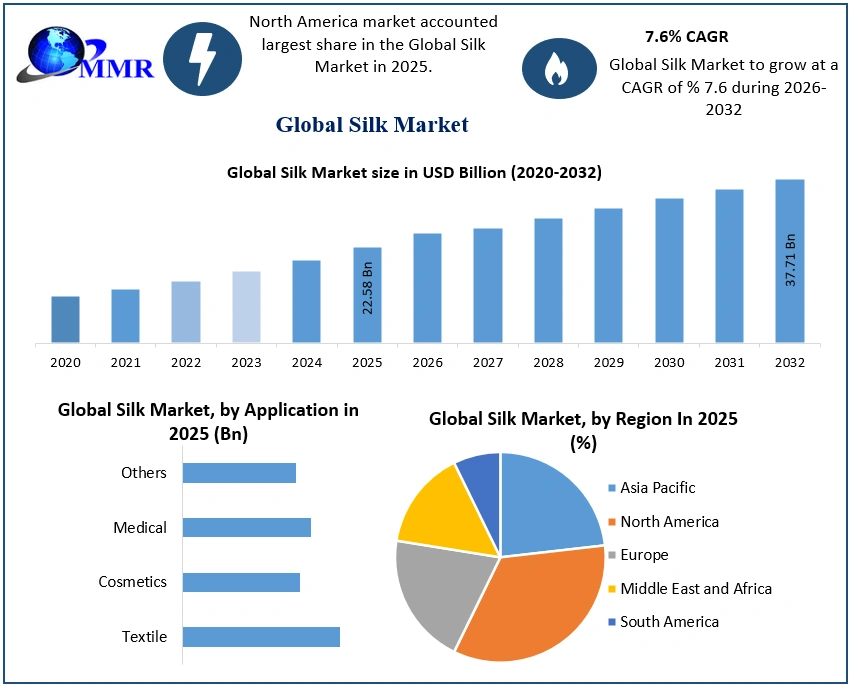
The Silk Market size was valued at USD 22.58 Billion in 2025 and the total Silk revenue is expected to grow at a CAGR of 7.6% from 2025 to 2032, reaching nearly USD 37.71 Billion by 2032.
Silk Industry Snapshot:
Sericulture is the process of producing silk through the cultivation of silkworms. The Top Exporter of silk all over the globe is china (the US $ 945 Mn) and the top Importer is Italy (US $ 322 Mn), silk ranks 50th in the product complexity index. Silk's gleaming appearance is due to the triangular prism-like structure of the silk strand, which allows silk material to refract incoming light at various angles, resulting in various hues. Silk is used in medical and cosmetics applications in addition to the textile industry.
To know about the Research Methodology :- Request Free Sample Report
Silk Market Key Dynamics:
Silk makes up a tiny fraction of the global textile fiber market, accounting for less than 0.2 %. However, this statistic is deceiving, as the actual trading value of silk and silk goods is significantly higher. This is a multibillion-dollar industry, with raw silk costing about twenty time’s as much as raw cotton, the China National Silk Import and Export Corporation alone has an annual turnover of US$ 2-2.5 billion.
Unlike some other fabrics, silk has a lengthy history of use and demand. India is a notable example, where local demand for outnumbers supply (and hampers export growth). Despite the fact that it is currently the second-largest producer of raw silk, India has become the major importer. Other silk producers, such as those in China, are seeing rapid growth in domestic demand as customers become more able to afford lower-cost silk products. In Viet Nam, this pattern is predicted to repeat itself.
Silk production does not necessitate expensive machines or equipment, thus it requires minimal investment. In comparison to investment-intensive sectors, it requires more manpower. These factors contribute to the market's growth. The silk market is growing because of high demand from the textile, cosmetics, and medicinal industries. The excessive cost of raw silk severely restricts the silk market.
Silk demand will be increased by rising silk demand in the textile industry, changing fashion trends, and rising purchasing power in developing countries. The developing nations, particularly China and India, will be the principal growth drivers of the global silk market, with both rising in double digits. In the next few days, China will become a large garment market, while India will be the second most appealing apparel market. Silk is a 100% natural fabric, making it a completely environmentally friendly product. It's also an all-weather fabric that's skin-friendly, long-lasting, and healthful. As a result of the burgeoning textile sector in developing nations, which is increasing people's spending power and the user-friendly qualities of silk, silk consumption is expected to grow faster than other material kinds. The global silk industry will most certainly be hampered by its increased reliance on Chinese raw materials and the high cost of silk compared to other materials.
Global Silk Market Segment Analysis: the Silk market is segmented into Product and Application.
Based on Product, the market is sub-segmented into Mulberry silk, Tussar silk, Eri silk, and others. Mulberry silk has the highest market share during the forecast period. Because of its flexibility, great strength, and durability, mulberry silk is likely to lead the worldwide silk market. Mulberry silk is one of the most well-known and widely used types of silk. Mulberry silk is commonly used in the production of scarves, gowns, blouses, clothing, and wedding gowns, as well as in the interior design of draperies, cushions, and wall hangings. Fabrics, handicrafts, and stitched garments are all made with Tussar silk products as the basic material. Tussar silk is used by fashion designers in their works. Eri silk was primarily employed in the creation of men's and women's winter shawls. Eri silk's thermal characteristics make it an ideal fabric for shrugs.

Based on Application, the market is sub-segmented into Textile, Cosmetics, Medical, and others. Silk's fastest-growing application is in textiles. Silk is a significant factor of textile manufacturing, which is continually growing and changing in terms of demand and supply. Silk is used in textiles because of its shiny appearance, sumptuous feel, lightweight, strength, and resilience. It's used in a variety of products, including wedding gowns, gowns, blouses, scarves, and neckties, as well as cushions, wall hangings, draperies, and upholstery.
Silk Market Regional Insights:
Italy and France - Italy has long been Europe's major importer, processor, and exporter of silk products. Italy imported nearly 300 tonnes of women' blouses, with China accounting for almost 80% of the total. Imports of silk garments, on the other hand, have plummeted in the last five years. Italy is well-known for its highly developed silk processing expertise (finishing, dyeing and printing silk fabrics).
Another country with a significant silk processing sector is France. Lyon has been producing high-quality silk fabrics for both home and international demand for generations. In the French market, more than 70% of silk materials are typically used for garments. Silk appears to be gaining popularity for usage as curtains, wall coverings, bed spreads, and upholstery in interior design. France sells high-end silk fabrics to the United States, with unit prices as high as $30 per m2.
United States - Imports include clothes, interior décor materials, and accessories, and the US market is one of the worlds largest. Unlike Europeans, Americans do not have a lengthy history of wearing silk. As a result, silk has never had the same allure as it does in Europe. The United States was a pioneer market for imported Chinese knitted silk products, initially primarily warm underwear but now also exquisite casuals such as T-shirts, polo neck sweaters, and other items. In the United States, easy maintenance is a "must," so it's critical to produce materials that are easy to maintain.
Germany - The greatest European market for textiles and garments, including silk, is Germany. Natural fibres are preferred by German consumers. Germany imports a wide range of silk clothes, accessories (especially silk pillow coverings), and materials for interior décor. China is the main source of silk clothes. With their handloom silk textiles for home furnishings, India and Thailand have had some success in this sector. The market values quality and is willing to pay a higher price for it.
The objective of the report is to present a comprehensive analysis of the global Silk market to the stakeholders in the industry. The past and current status of the industry with the forecasted market size and trends are presented in the report with the analysis of complicated data in simple language. The report covers all the aspects of the industry with a dedicated study of key players that include market leaders, followers, and new entrants.
PORTER, PESTEL analysis with the potential impact of micro-economic factors of the market have been presented in the report. External as well as internal factors that are supposed to affect the business positively or negatively have been analyzed, which will give a clear futuristic view of the industry to the decision-makers.
The report also helps in understanding the global Silk market dynamics, structure by analyzing the market segments and project the global Silk market size. Clear representation of competitive analysis of key players by product, price, financial position, product portfolio, growth strategies, and regional presence in the global Silk market make the report investor’s guide.
Silk Market Scope: Inquire before buying
| Silk Market | |||
|---|---|---|---|
| Report Coverage | Details | ||
| Base Year: | 2025 | Forecast Period: | 2026-2032 |
| Historical Data: | 2020 to 2025 | Market Size in 2025: | USD 22.58 Bn. |
| Forecast Period 2026 to 2032 CAGR: | 7.6% | Market Size in 2032: | USD 37.71 Bn. |
| Segments Covered: | by Product | Mulberry silk Tussar silk Eri silk Others |
|
| by Application | Textile Cosmetics Medical Others |
||
| by Production Process | Cocoon Production Reeling, Throwing Weaving and Dyeing |
||
Global Silk Market, by Region
North America (United States, Canada and Mexico)
Europe (UK, France, Germany, Italy, Spain, Sweden, Austria and Rest of Europe)
Asia Pacific (China, South Korea, Japan, India, Australia, Indonesia, Malaysia, Vietnam, Taiwan, Bangladesh, Pakistan and Rest of APAC)
Middle East and Africa (South Africa, GCC, Egypt, Nigeria and Rest of ME&A)
South America (Brazil, Argentina Rest of South America)
Leading Companies in the Silk Industry
1. Wujiang First Textile Co., Ltd.
2. Anhui Silk
3. Shengkun Silk Manufacturing Co., Ltd.
4. Zhejiang Jiaxin Silk Co., Ltd.
5. AM Silk GmbH
6. China Silk Corporation
7. Jinchengjiang Xinxing Cocoon Silk Co., Ltd.
8. Bolt Threads Inc.
9. Kraig Biocraft Laboratories, Inc.
10. Entogenetics Inc
11. Wensli Group Co. Ltd.
12. Sichuan Nanchong Liuhe
13. Wujiang Wanshiyi Silk Co. Ltd.
14. Silk India international Ltd.
15. Global Silk Mills Pvt. Ltd.
Frequently Asked Questions:
1. Which region has the largest share in Global Silk Market?
Ans: United States region held the highest share in 2025.
2. What was the Global Silk Market size in 2025?
Ans: The Global Silk Market size was USD 22.58 Billion in 2025.
3. What is scope of the Global Silk Market report?
Ans: Global Silk Market report helps with the PESTEL, PORTER, COVID-19 Impact analysis, Recommendations for Investors & Leaders, and market estimation of the forecast period.
4. Who are the key players in Global Silk Market?
Ans: The important key players in the Global Silk Market are – Wujiang First Textile Co., Ltd., Anhui Silk, Shengkun Silk Manufacturing Co., Ltd., Zhejiang Jiaxin Silk Co., Ltd., AM Silk GmbH, China Silk Corporation, Jinchengjiang Xinxing Cocoon Silk Co., and Ltd.
5. What is the study period of this Market?
Ans: The Global Silk Market is studied from 2025 to 2032.