
SCADA Market Size – Industry Structure Evaluation, Demand Drivers Analysis, Regional Growth Analysis and Identification, Competitive Positioning Review & Global Market Size Forecast to 2029
Overview
SCADA Market was worth US$ 14.36 Bn. in 2023 and total revenue is expected to grow at a rate of 6.4% CAGR from 2024 to 2030, reaching almost US$ 22.17 Bn.
SCADA Market Overview:
SCADA is a software and hardware system that enables industrial organisations to monitor, gather, and process real-time data, as well as control and monitor industrial processes locally or remotely. End users can also utilize human machine interface (HMI) software to interact directly with devices like sensors, valves, pumps, and motors, as well as record occurrences in a log file. Industrial SCADA systems are in high demand because they assist maintain efficiency, process data for better decisions, and notify system faults to help minimize downtime.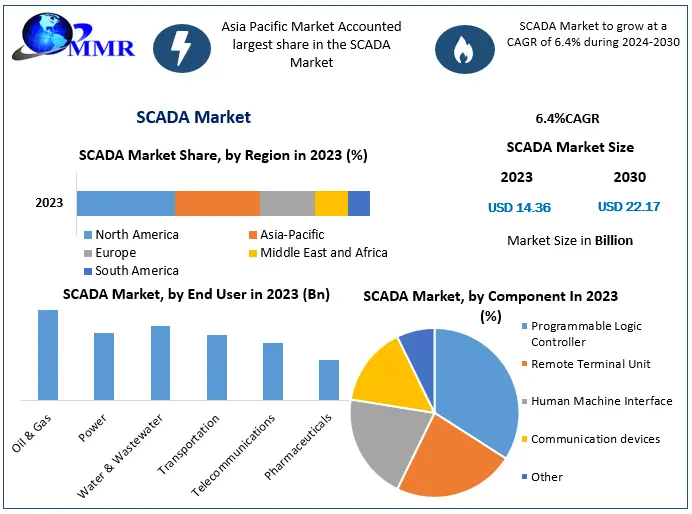 To know about the Research Methodology :- Request Free Sample Report
SCADA Market Dynamics:
The electricity distribution company (discom) – Pashchimanchal Vidyut Vitran Nigam Limited (PVVNL) – will shortly launch a supervisory control and data acquisition (SCADA) system on the network for real-time monitoring of power distribution in Noida. The growing importance of real-time data in industrial environments for process analysis and proactive maintenance, as well as the expanding need for automation technologies, are driving the adoption of Industry 4.0. Most industrial processes and systems can be automated with Industry 4.0, allowing manufacturing units to run around the clock. It also eliminates the human errors that are common in manufacturing operations. Cyber-physical systems, IoT, and cloud computing are all part of Industry 4.0. SCADA system helps real-time reporting to gather current and historical data as well as forecast future developments. As a result, in smart factories, using a SCADA system allows operators to forecast machine maintenance needs, schedule production accordingly, and avoid emergencies and equipment failure during the manufacture of valuable products.
Since 2011, global oil and gas prices have been falling. Oil and gas firms have seen a drop in revenue, profitability, and operating margins as a result of this reduction. As a result, capital spending in infrastructure projects have decreased. Process automation is used in infrastructure projects such as new pipeline building, hydrocarbon exploration, and refinery development. As a result, the drop in capital investments has an impact on the process automation and instrumentation ecosystem as a whole. Oil price volatility is expected to have an impact on infrastructure investments because it reduces investment returns. This has a significant impact on the SCADA market.
A wireless sensor network is a wireless network that includes distributed autonomous devices with sensors to monitor physical or environmental variables (WSN). WSNs can be found in a variety of industries, including oil and gas, medicines, and water and wastewater treatment. The majority of oil and gas operations are located in distant places with harsh environmental conditions. A SCADA system uses sensors placed in a WSN to monitor, manage, and operate tanks, compressors, generators, and separators in an oil and gas plant. The cost of constructing a sensor network and communication system is reduced when a WSN is used. A WSN measures and detects several characteristics in-plant activities, such as pressure, temperature, flow, and system level. In SCADA, using a WSN allows for real-time data monitoring and process control. As a result, the rising R&D in the field of WSN, as well as its active implementation in SCADA systems, will expand SCADA's Application. Wireless sensor networks benefit from rapid software changes, making them compatible with contemporary automated systems in numerous industries that use SCADA.
While developing a sensor-based network to monitor and control vital infrastructures, cyber-attacks are one of the most pressing concerns. SCADA systems are vulnerable to cyber-attacks since they are made up of a network of sensors, mainframe computers, communication systems, and storage systems. SCADA systems use logical processes and physical actions to manage the operational elements of critical infrastructure. Failure of these systems can have a negative impact on a company, a community, and, as a result, the economy. Disasters such as oil or sewage pipeline leaks and spills, as well as power grid outages, can have a long-term negative impact on facility operations.
SCADA Market Segment Analysis:
Based on Type, the market is sub-segmented into Hardware, Software and Services. The services segment is expected to hold a major share in the global SCADA market. This growth in the market is accredited to the rising demand for services, which allow supervisory automation control and data acquisition End User with better efficiency, high reliability, and greater visualization. Additionally, a growing demand for real-time data acquisition is projected to boost the SCADA market growth.
Based on Component, the market is sub-segmented into Programmable Logic Controller, Remote Terminal Unit, Human Machine Interface and Communication devices. During the forecast period, the RTU segment is estimated to account for the greatest proportion of the SCADA market. In a SCADA system, an RTU is an electrical device that is one of the system's basic components. It collects data, converts it to a transmittable format, and sends it to the main system. This is accomplished by the use of several RTUs in a SCADA system. Oil and gas is the most common end-user industry for SCADA systems, so deep-sea exploration and extraction, as well as shale gas, contribute to the expanding need for RTUs.
Based on End Users, the market is sub-segmented into Electrical Power, Oil & Gas, Water & Wastewater, Manufacturing, Transportation, Telecommunication, Chemicals, Food & Beverages, Pharmaceuticals, Automotive. Some of the major factors driving the automotive segment include the growing adoption of industrial automation and control systems in automotive manufacturing and process facilities to increase productivity, efficiency, and reduce human load, as well as the growing need to gather real-time data to control and monitor industrial equipment and manufacturing processes. New SCADA solutions and software are being developed specifically for the automotive industry to improve productivity and quality while reducing unplanned downtime. Additionally, the adoption of industrial robots, machine vision systems, and industrial control systems by automobile companies will accelerate market growth.
SCADA Market Regional Insights:
Asia Pacific is projected to lead the Global SCADA Market. The leading position in the market can be attributed to the growing adoption of automation and internet of things (IOT) for accessing data from remote locations through mobile devices and growing demand for an upgraded version of SCADA. The government Initiative for the adoption of SCADA for power, and water and wastewater applications is also expected to boost the SCADA Market in this region.
Because of stable and improved power management, as well as enormous investment in technologies, North America has the greatest revenue share. Over the forecast period, North America is expected to maintain its dominance. Due to rising demand for automation techniques in the oil and gas sector, Europe is expected to be the second-largest revenue producer over the forecast period. Due to increased investment in automation by governments and enterprises in numerous industries, Asia-Pacific is expected to grow significantly over the forecast period.
Objective of the report is to present a comprehensive analysis of the Global SCADA market to the stakeholders in the industry. The past and current status of the industry with the forecasted market size and trends are presented in the report with the analysis of complicated data in simple language. The report covers all the aspects of the industry with a dedicated study of key players that include market leaders, followers, and new entrants.
PORTER, PESTEL analysis with the potential impact of micro-economic factors of the market have been presented in the report. External as well as internal factors that are supposed to affect the business positively or negatively have been analyzed, which will give a clear futuristic view of the industry to the decision-makers.
The report also helps in understanding the Global SCADA market dynamics, structure by analyzing the market segments and project the Global SCADA market size. Clear representation of competitive analysis of key players by product, price, financial position, product portfolio, growth strategies, and regional presence in the Global SCADA market make the report investor’s guide.
SCADA Market Scope: Inquire before buying
| SCADA Market | |||
|---|---|---|---|
| Report Coverage | Details | ||
| Base Year: | 2023 | Forecast Period: | 2024-2029 |
| Historical Data: | 2018 to 2023 | Market Size in 2023: | US $ 14.36 Bn. |
| Forecast Period 2024 to 2030 CAGR: | 6.4% | Market Size in 2030: | US $ 22.17 Bn. |
| Segments Covered: | by Type | Hardware Software Services |
|
| by Component | Programmable Logic Controller Remote Terminal Unit Human Machine Interface Communication devices Other |
||
| by End User | Oil & Gas Power Water & Wastewater Transportation Telecommunications Pharmaceuticals Chemicals Food & Beverages Others |
||
SCADA Market, by Region
North America (United States, Canada and Mexico)
Europe (UK, France, Germany, Italy, Spain, Sweden, Austria and Rest of Europe)
Asia Pacific (China, South Korea, Japan, India, Australia, Indonesia, Malaysia, Vietnam, Taiwan, Bangladesh, Pakistan and Rest of APAC)
Middle East and Africa (South Africa, GCC, Egypt, Nigeria and Rest of ME&A)
South America (Brazil, Argentina Rest of South America)
SCADA Market Key Player are:
1. IBM Corporation
2. Siemens AG
3. General Electric
4. Cisco Systems, Inc
5. Alstom
6. ABB Ltd
7. Emerson Electric Co.
8. Rockwell Automation, Inc.
9. Schneider Electric SE
10.Alstom
11.Honeywell International, Inc.
12.Omron Corporation
13.Yokogawa Electric Corporation
14.Iconics Inc.
15.Elynx Technologies, LLC
16.Enbase LLC
17.Globalogix
18.Inductive Automation
19.Deagital Sas
20.Mitsubishi Electric
21.Hitachi LTD
22.JFE Engineering Corporation
23.Partita IVA
24.Toshiba Infrastructure Systems & Solutions Corporation
Frequently Asked Questions:
1) What was the market size of Global SCADA Market markets in 2023?
Ans - Global SCADA Market was worth US$ 14.36 Bn in 2023.
2) What is the market segment of Global SCADA Market markets?
Ans -The market segments are based on Type, Component and End Users.
3) What is forecast period consider for Global SCADA Market?
Ans -The forecast period for Global SCADA Market is 2024 to 2030.
4) Which are the worldwide major key players covered for Global SCADA Market report?
Ans - IBM Corporation, Siemens AG, General Electric, Cisco Systems, Inc, Alstom, ABB Ltd, Emerson Electric Co., Rockwell Automation, Inc., Schneider Electric SE, Alstom, Honeywell International, Inc., Omron Corporation, Yokogawa Electric Corporation, Iconics Inc., Elynx Technologies, LLC, Enbase LLC, Globalogix, Inductive Automation, Deagital Sas, Mitsubishi Electric, Hitachi LTD, JFE Engineering Corporation, Partita IVA, Toshiba Infrastructure Systems & Solutions Corporation
5) Which region is dominated in Global SCADA Market?
Ans -In 2023, Asia pacific region dominated the Global SCADA Market