
Road Freight Transportation Market by Vehicle Type, Service Type, Destination, End User and Region - Global Market Size Estimation, Industry-Wide Analysis, Competitive Landscape Assessment & Long-Term Forecast to 2032
Overview
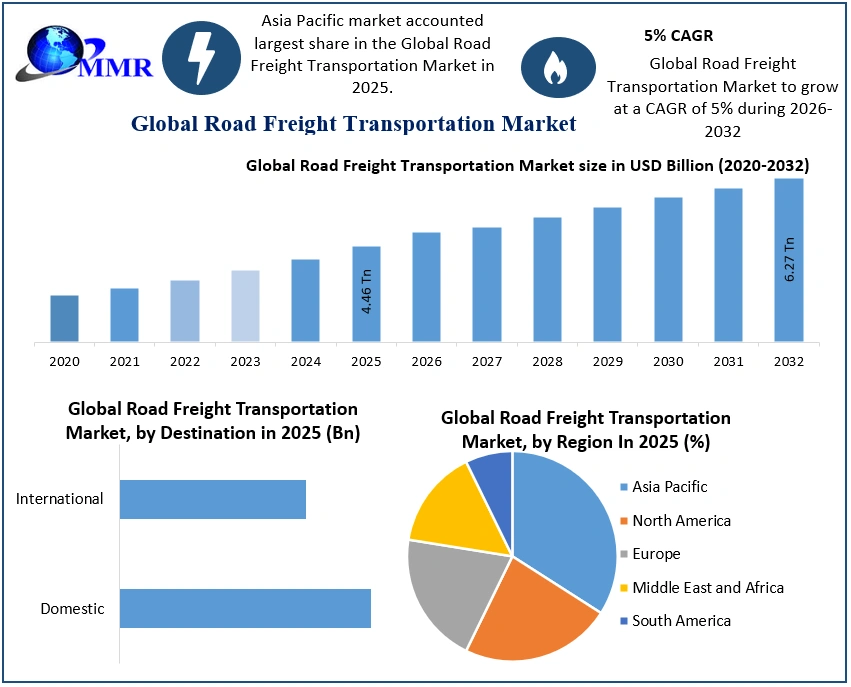
The Road Freight Transportation Market size was valued at USD 4.46 Trillion in 2025 and the total Road Freight Transportation revenue is expected to grow at a CAGR of 5% from 2026 to 2032, reaching nearly USD 6.27 Trillion by 2032.
Road Freight Transportation Market Overview:
Road freight is the transportation of products from one place to another (a loading and unloading point) over a road network using motor vehicles. Commercial road freight transport is the commercial transportation of products by logistics companies or forwarders. Thus, in-house transfers organized by the organizations themselves, such as between separate corporate sites within the context of internal manufacturing processes, are not regarded as commercial freight transport.
Depending on the commodities being transported, several trucks are utilized in road freight. Road freight laws, for example, only apply to cars with an empty weight of more than 3.5 t in EU member states, which essentially implies that lighter vehicles are not covered by national criteria. However, there are certain exceptions: trucks weighing more than 2.5 tonnes must follow road freight transport laws while crossing EU borders beginning in February 2022. These are legal conflicts, and in general, all possible motor vehicles, from vans to semitrailers, are utilized in road freight transport. There is a wide range of vehicles available, including refrigerated vehicles, hazardous goods transportation, container semi-trailers, and vacuum trucks for liquids.
To know about the Research Methodology :- Request Free Sample Report
Scope of the Report:
The report's objective is to provide details to stakeholders in the industry with a complete study of the Road Freight Transportation market. The report analyses complex data in simple language and present the historical and current state of the industry, as well as anticipated market size and trends. The research examines all areas of the industry, including a detailed examination of important companies such as market leaders, followers, and new entrants.
The report includes a PORTER and PESTEL analysis, as well as the possible influence of market microeconomic aspects. External and internal elements that are expected to affect the organization positively or adversely have been studied, providing decision-makers with a clear future vision of the industry.
The report also helps in the comprehension of the market trends and structure by studying market segments and projecting the market size. The study is an investor's guide because of its clear depiction of competitive analysis of key competitors in the market by product, price, financial situation, product portfolio, growth plans, and geographical presence.
The data provides a thorough analysis of the rapid advances that are currently taking place across all industry sectors. Facts and figures, illustrations, and presentations are used to provide key data analysis for the historical period from 2020 to 2025. The report investigates the Road Freight Transportation market's drivers, limitations, prospects, and barriers. This MMR report includes investor recommendations based on a thorough examination of the Road Freight Transportation market's contemporary competitive scenario.
Research Methodology:
Primary and secondary research is used to create the Road Freight Transportation market study. The Bottom-Up Approach is used to examine both secondary and primary data. Secondary data sources include nationalized and global data sources, annual and financial reports from major market participants, news announcements, and so on. Interviews, surveys, expert and trained professional opinions, and other methods were used to collect primary data. The research also includes information on current developments, trade regulations, import-export analysis, production analysis, value chain optimization, market share, the effect of domestic and major & localized market players, changes in market regulations, and strategic market growth analysis.
Road Freight Transportation Market Dynamics:
Growing demand for inland transportation for logistics is a major driver of the market growth.
Road freight transit has various advantages, including being perfect for short-distance travel and providing affordable, adaptable, and cost-effective packaging. The primary benefits of road freight stem from the fact that no other mode of transportation has access to similar infrastructure as trucks. When it comes to inland transportation, the road network is by far the most extensive. This is true not only for Europe but also for the United States.
Due to this, the demand for inland transportation is increasing and is a major driver of the market growth. However, road freight is not reliant on logistical centers like ports, airports, or railway stations, and there are few destinations for products that are not reachable by road. This also improves other forms of transportation, such as water, air, and train. In the great majority of situations, extra road transportation is required to convey products from the (air) port or railway station to the factory or warehouse, or vice versa. The variety and versatility of road freight provide nearly limitless options for moving products from one location to another.
Road Freight Transportation is convenient and flexible.
The Road Freight Transportation is Affordable. Road freight is a cost-effective mode of transportation because of the utilization of existing infrastructure and relatively low-cost transport gear. The price benefit is most obvious for small amounts of freight, therefore road freight is frequently the best alternative for enterprises with limited transit volumes - LTL in particular is an appealing option in this regard.
Likewise, the well-developed road infrastructure allows for flexible route planning or intermediate stops. With road freight, a route may be quickly adjusted and increased. Because use of the road infrastructure is allowed at any time without previous registration or reservations, even spontaneously requested transportation is frequently carried out. Intermodal transport may be accomplished with trucks. When loaded, they may move by sea and rail on customized wagons. This eliminates the need for time-consuming reloading from one method of transportation to another.
Transit-related demerits are a major restrain for the market growth.
Road transportation is not immune to variations in the weather or seasons. During floods, rain, and snow, for example, roadways become inaccessible. In this circumstance, the roads become dangerous for delivery, and freight service is less reliable. Additionally, there are countless road accidents, and there is always a significant chance of accidents or breakdowns in the event of road transit. As a result, it is not as dependable or safe as rail. A heavy load is difficult to manage and convey through the road. In this case, there is always the possibility of overloading and accidents, which can be costly.
Road transportation is slower than rail, air, or water transportation. As a result, it is a significant disadvantage and disincentive. It is a considerably less structured mode of transportation than rail, marine, and air transportation. These are far more organized. Additionally, because it is erratic, the rates might fluctuate at random. It is unstable and unpredictable due to the industry's numerous possibilities.
Segment Analysis:
By Vehicle Type, the Light Commercial Vehicles segment is expected to grow rapidly during the forecast period for the Road Freight Transportation market. People, products, and services are transported in light commercial vehicles. North America is the key region responsible for light commercial vehicle production. The light commercial vehicle is composed of several tiny systems such as interior and exterior systems, steering systems, chassis systems, and so on. Because of the great development in commerce and transportation in the Asia-Oceania area, the manufacturing of light commercial vehicles in this region has increased. The rising demand for light commercial vehicles in the European area is expected to increase the market for more modern light commercial vehicles with lower emissions and total vehicle weight during the forecast period.
By End User, the Oil and Gas segment held the largest market share of about xx% in 2025 and is expected to dominate the market at the end of the forecast period. Transportation requirements in the oil and gas industry, such as stringing services for line pipe delivery, can be unique and complex. Higher safety regulations and the necessity for specialized equipment limit the pool of certified carriers, making it more difficult for suppliers to move freight to project sites swiftly and affordably. These enterprises are increasingly relying on non-asset-based 3PLs and industrial freight brokers, who offer project cargo knowledge and quick access to well-priced capacity for flatbeds and other specialist equipment. Due to this, the growth of this segment is expected to increase during the forecast period.
Regional Insights:
The APAC region held the largest market share of about xx% in 2025 for the Road Freight Transportation market and is expected to grow significantly during the forecast period. The region's road freight transportation industry is expected to grow due to favorable government regulations in countries such as China and India regarding e-commerce and other businesses. Additionally, the region's emerging countries are aggressively investing in port construction to handle more freight. Many continuing megatrends, such as growing populations, urbanization, globalization, digitization, and demographic change, would increase the demand for freight transportation in this region during the forecast period.
From a freight transportation standpoint, the fact that the number of individuals entering the middle class is rapidly increasing is even more challenging than population growth. As a result, there is going to be a significant rise in product demand. The World Economic Forum identified this as a possible time bomb. The increased use of innovative packaging, as well as changes in production and logistics methods, would increase freight trips.
In absolute terms, road freight would grow faster than rail freight. This is a major undertaking. In most economies, meeting future road freight demand cannot be met only by constructing more roads and lanes. Other steps are also required. To strengthen the sustainability of the freight transport system, a better knowledge of the function of the road in freight distribution is required.
India has been the world's fastest-growing major economy in the road freight transportation market during the forecast period, due to expanding demand for products and services. The movement of products within and outside of India has generated economic possibilities for millions of Indians. As national freight activity increases, India's freight transport ecosystem would play a crucial role in supporting the country's ambitious goals. International competitiveness, employment growth, urban and rural lives, and clean air and environment are only a few examples.
According to the Ministry of Shipping (Government of India), the sea handles more than 90% of India's trade by volume. Cargo volume at Indian ports is expected to reach 2,500 million metric tonnes per annum (MMTPA) by 2025, compared to the existing cargo handling capacity of Indian ports, which is just 1,500 MMTPA. As a result, to meet global demands, the Indian government intends to increase the efficiency and capacity of its current ports. With expanding export and import between Asian nations, as well as increased investment in the building of new ports in the area, the market in this region is expected to increase significantly over the forecast period.
Road Freight Transportation Market Scope: Inquire before buying
| Road Freight Transportation Market | |||
|---|---|---|---|
| Report Coverage | Details | ||
| Base Year: | 2025 | Forecast Period: | 2026-2032 |
| Historical Data: | 2020 to 2025 | Market Size in 2025: | USD 4.46 Trillion. |
| Forecast Period 2026 to 2032 CAGR: | 5.0 % | Market Size in 2032: | USD 6.27 Trillion. |
| Segments Covered: | by Vehicle Type | Commercial Light Commercial Heavy Commercial |
|
| by Service Type | Express and Parcel Services Freight Forwarding Third-Party Logistics (3PL) |
||
| by Destination | Domestic International |
||
| by End User | Agriculture Fishing & Forestry Construction Manufacturing Oil and Gas Mining & Quarrying Wholesale & Retail Trade Others |
||
Road Freight Transportation Market, by Region
North America (United States, Canada and Mexico)
Europe (UK, France, Germany, Italy, Spain, Sweden, Austria and Rest of Europe)
Asia Pacific (China, South Korea, Japan, India, Australia, Indonesia, Malaysia, Vietnam, Taiwan, Bangladesh, Pakistan and Rest of APAC)
Middle East and Africa (South Africa, GCC, Egypt, Nigeria and Rest)
Road Freight Transportation Market, Key Players are:
North America
1. United Parcel Service, Inc. (USA)
2. FedEx Freight Corporation (USA)
3. J.B. Hunt Transport Services, Inc. (USA)
4. Knight-Swift Transportation Holdings Inc. (USA)
Asia Pacific
5. CJ Logistics Corporation (South Korea)
6. Nippon Express Holdings, Inc. (Japan)
7. Kerry Logistics Network Limited (Hong Kong)
Europe
8. Kuehne + Nagel International AG (Switzerland)
9. DB Schenker (Germany)
10. Dachser SE (Germany)
11. DSV A/S (Denmark)
12. GEODIS SA (France)
13. XPO Logistics Europe SA (France)
14. FM Logistic (France)
15. Ital Logistics Ltd (United Kingdom)
Middle East & Africa
16. Agility Public Warehousing Company K.S.C.P. (Kuwait)
17. Shipa Delivery (UAE)
South America
18. Braspress Transportes Urgentes Ltda. (Brazil)
19. JSL S.A. (Brazil)
20. EcoRodovias Infraestrutura e Logística S.A. (Brazil)
FAQs:
1. Which is the potential market for Road Freight Transportation in terms of the region?
Ans. Asia Pacific market is the potential market for Road Freight Transportation in terms of the region.
2. What are the restraints for new market entrants?
Ans. Transit-related demerits are a major restrain for the market growth.
3. What is expected to drive the growth of the Road Freight Transportation market in the forecast period?
Ans. Growing demand for inland transportation for logistics is a major driver of the market growth.
4. What was the Global Road Freight Transportation Market size in 2025?
Ans: The Global Road Freight Transportation Market size was USD 4.46 Trillion in 2025.
5. What segments are covered in the Road Freight Transportation Market report?
Ans. The segments covered are Type of Carrier, Vehicle Type, Operation, Industry, and, Region.