
Risk Analytics Market – Industry Structure Evaluation, Demand Drivers Analysis, Regional Growth Analysis and Identification, Competitive Positioning / Landscape Review & Global Market Size Forecast to 2030
Overview
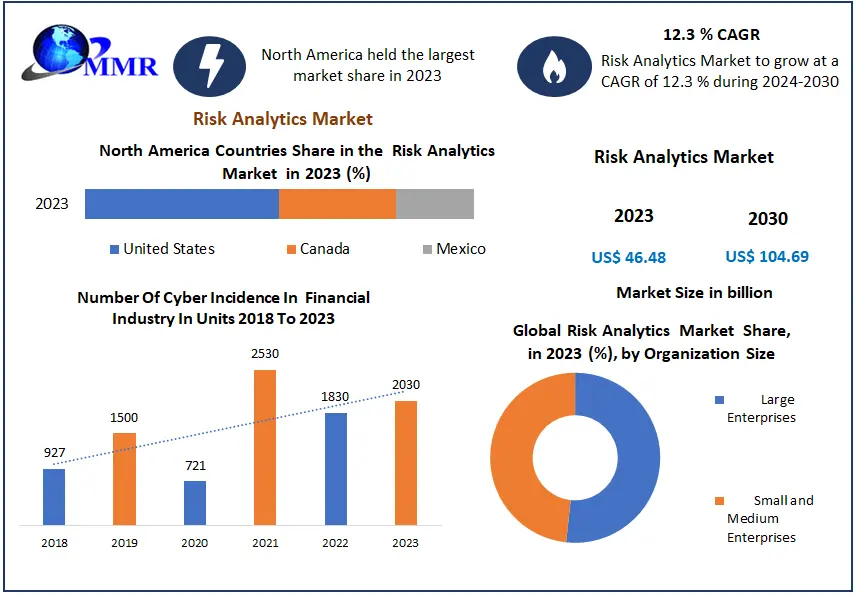
The Risk Analytics Market size was valued at US 46.48 Bn in 2023 and market revenue is growing at a CAGR of 12.3 %from 2024 to 2030, reaching nearly USD 104.69 Bn by 2030.
Risk Analytics Market:
The landscape of the risk analytics market is undergoing a transformation accelerated by advances in computing power and analytical techniques. Banks are leveraging these developments to extract deeper insights from their vast reservoirs of data, enabling them to better identify, measure, and mitigate risks. This shift presents unique opportunities for risk departments to shape the strategic agenda of banks by harnessing their expertise in data and analytics. Leading banks are integrating both internal and external data sources, including unconventional and unstructured data, to evaluate risks comprehensively. Emerging market banks, unencumbered by legacy systems, are pioneering this approach. With the recent surge in computing power, advanced analytical techniques like machine learning are becoming commonplace, enhancing decision models and enabling the automation of manual processes. This factor significantly boosts the Risk Analytics Market.
 To know about the Research Methodology :- Request Free Sample Report
Banks fully embracing these advancements are experiencing a "golden age" of risk analytics, witnessing improvements in credit risk models, and exploring new business models. Some banks have automated lending processes end-to-end, achieving significant efficiencies and revenue increases. Others are using risk models to inform decisions beyond lending, such as marketing and customer segmentation. Many banks face challenges in fully realizing the potential of risk analytics, including outdated technology, data quality issues, skill gaps, and regulatory demands. To overcome these barriers, banks must prioritize risk analytics on their strategic agenda and adopt proactive measures, such as applying analytics to every material decision, leveraging available data, and rapidly accumulating skills through hiring or partnerships.
Risk Analytics Market Dynamics
Driver
Technological Advancements Boosted the Market Growth
Technological advancements have been the engine behind the meteoric rise of the risk analytics market, driving banks into a new era of precision and foresight in risk management. With the exponential growth in computing power, banks now possess the capability to swiftly analyze colossal volumes of data in real time, enabling them to navigate complex risk landscapes with unparalleled agility. Also, breakthroughs in machine learning and artificial intelligence have bestowed upon banks a powerful arsenal of predictive tools. These sophisticated algorithms delve deep into data reservoirs, uncovering intricate patterns and anomalies that were once elusive. Armed with these insights, banks can anticipate risks before they materialize, empowering them to proactively safeguard against potential threats.
The advent of advanced data analytics tools has facilitated the seamless integration and analysis of diverse data streams, ranging from structured too unstructured, and internal to external. This holistic approach to data analysis paints a comprehensive picture of risk factors across various dimensions, providing banks with a panoramic view of potential vulnerabilities and boosting the growth of the Risk Analytics Market. In essence, technological marvels have revolutionized the landscape of risk analytics, equipping banks with the precision, speed, and depth needed to navigate today's dynamic financial environment with confidence and resilience.
Restrain
Regulatory Compliance Burdens Limit the Risk Analytics Market
Regulatory compliance burdens act as a significant constraint on the risk analytics market by compelling financial institutions to prioritize adherence to regulations over-investment in advanced risk management solutions. These regulations, like Basel III and GDPR, demand rigorous risk assessment frameworks and data protection measures, necessitating substantial resources for compliance efforts. As a result, organizations allocate significant budgets and manpower to meet regulatory requirements, leaving fewer resources available for adopting innovative risk analytics tools.
The ever-changing regulatory landscape adds complexity to risk management processes, requiring continuous updates to analytics systems to stay compliant. This constant need for adaptation consumes additional resources and limits the capacity for investment in new risk analytics solutions. Also, the high costs associated with developing and maintaining compliance-focused analytics platforms pose a significant barrier to entry for smaller players in the Risk Analytics Market. This further consolidates the market dominance of established providers, reducing competition and innovation. Therefore, regulatory compliance burdens stifle innovation and market growth in the risk analytics sector by diverting resources towards regulatory adherence rather than investment in advanced risk management technologies.
Regulatory Compliance for Risk Analytics Market
| Points | Implications for Risk Analytics Market |
| Regulatory compliance burdens have significantly increased over the years, consuming a large portion of operating costs for financial institutions. | Risk analytics solutions must prioritize features and capabilities that assist in compliance management, such as robust reporting functionalities and real-time monitoring of regulatory changes. |
| Compliance efforts have become complex and cross-functional, involving various CXO roles. | Risk analytics software needs to offer integrated solutions that facilitate collaboration across different departments and provide comprehensive compliance management capabilities. |
| Emerging technologies like blockchain and robotic process automation hold transformative potential in improving regulatory productivity. | Risk analytics providers should explore incorporating these technologies into their solutions to streamline compliance processes and enhance operational efficiency for financial institutions. |
| Risk analytics software plays a crucial role in helping organizations manage compliance with regulatory requirements. | There is a growing demand for risk analytics solutions that offer advanced compliance management features, tailored specifically to the needs of industries such as banking and finance. |
| Compliance risk management is essential for businesses across all industries. | The risk analytics market should offer solutions that cater to a wide range of industries, providing customizable features and tools to address the unique compliance challenges faced by each sector. |
| Organizations must proactively manage compliance risk by setting codes of conduct and utilizing automation tools. | Risk analytics solutions should include features that enable proactive risk management, such as automated alerts for potential compliance breaches and customizable workflows for risk mitigation. |
Opportunity
Rising Data Proliferation creates lucrative growth opportunities for the Risk Analytics Market
In today's world driven by data, opportunities surge like waves, and the Risk Analytics market is riding high on this digital wave! Imagine a vast ocean of data, brimming with insights waiting to be discovered. Every bit of information holds the potential for lucrative growth. Think of Risk Analytics as a superhero, equipped with advanced technology and predictive abilities to anticipate and neutralize threats swiftly. It's like having a guide to navigate through the sea of information, effortlessly identifying hidden risks before they cause any harm.
But Risk Analytics isn't just about avoiding trouble; it's about seizing opportunities. Businesses can transform challenges into successes by harnessing data to drive growth. Whether its financial institutions safeguarding against Risk Analytics Market shifts or retailers optimizing their supply chains, the innovation potential is limitless. In this digital adventure, Risk Analytics isn't just a tool—it's a game-changer. It boosts businesses to new heights of resilience and innovation, ensuring they stay ahead of the curve in a data-driven world.
Risk Analytics Market Segment Analysis
Based on Components, the solution segment dominated the Risk Analytics Market in the year 2023. In addressing the evolving needs of businesses in managing and mitigating risks effectively. Solutions offered by Risk Analytics providers encompass a wide array of offerings, ranging from software platforms to consulting services, tailored to cater to diverse industry verticals and risk scenarios. The increasing complexity and diversity of risks faced by organizations in today's dynamic business landscape. From cybersecurity threats to regulatory compliance challenges, businesses require comprehensive and customizable solutions to navigate these complexities with confidence.
Also, the rapid advancements in technology, such as artificial intelligence, machine learning, and big data analytics, have fueled the development of sophisticated Risk Analytics solutions. These solutions empower businesses to harness the power of data-driven insights for proactive risk management and strategic decision-making. The growing awareness among organizations about the importance of risk management as a strategic imperative further amplifies the demand for robust and scalable Risk Analytics solutions. As businesses strive to stay ahead of risks and capitalize on opportunities, the solution segment continues to dominate the Risk Analytics market, offering a beacon of innovation and resilience.
Based on Vertical, the banking and finance segment dominated the Risk Analytics Market in the year 2023. Financial institutions operate in a highly regulated environment, necessitating strong risk management frameworks to ensure compliance and stability. Risk Analytics solutions provide these organizations with the tools to navigate complex regulatory landscapes efficiently. The finance sector faces diverse and evolving risks, including credit, market, operational, and cyber risks. Risk Analytics offers tailored solutions to identify, assess, and mitigate these risks effectively, safeguarding assets and optimizing performance.
Also, the banking and finance industry handles vast volumes of data, making it ripe for leveraging advanced analytics techniques to extract actionable insights. Risk Analytics enables these institutions to harness the power of big data to drive informed decision-making and strategic risk management.
Risk Analytics Market Regional Analysis
North America dominated the risk analytics market in the year 2023. The region boasts a highly developed financial sector, with major global financial centers such as New York City, Toronto, and Chicago. These hubs drive substantial demand for risk analytics solutions as financial institutions seek to navigate complex regulatory landscapes, manage portfolio risks, and ensure compliance. North America's technological landscape is characterized by a strong ecosystem of companies specializing in data analytics, machine learning, and artificial intelligence. This rich environment fosters innovation and accelerates the development of innovative risk analytics products tailored to the specific needs of North American businesses.
Also, the region's proactive stance on cybersecurity, fueled by high-profile data breaches and stringent regulatory requirements such as GDPR and CCPA, further drives the adoption of risk analytics solutions. Organizations across various sectors recognize the critical importance of effectively detecting, assessing, and mitigating cyber risks to protect sensitive data and maintain customer trust. Therefore, North America's dominance in the risk analytics market is a result of its combination of a sophisticated financial industry, a thriving technological ecosystem, and a pressing need for comprehensive risk management solutions in an increasingly data-driven and interconnected world. These factors position the region at the forefront of innovation and adoption in the risk analytics space, driving its leadership in the global market.
Risk Analytics Market Scope: Inquire before buying
| Global Risk Analytics Market | |||
|---|---|---|---|
| Report Coverage | Details | ||
| Base Year: | 2023 | Forecast Period: | 2024-2030 |
| Historical Data: | 2018 to 2023 | Market Size in 2023: | US $ 46.48 Bn. |
| Forecast Period 2024 to 2030 CAGR: | 12.3% | Market Size in 2030: | US $ 104.69 Bn. |
| Segments Covered: | by Component | Solution Services |
|
| by Deployment | Cloud On-premises |
||
| by Organization Size | Large Enterprises Small and Medium-sized enterprises |
||
| by Risk Type | Strategic Risk Operational Risk Financial Risk Reputational risk Others |
||
| by Vertical | Banking & Financial Services Insurance Manufacturing Transportation & Logistics Retail & Consumer Goods IT & Telecom Government & Defense Healthcare & Life Sciences Energy & Utilities |
||
Risk Analytics Market, by Region
North America (United States, Canada and Mexico)
Europe (UK, France, Germany, Italy, Spain, Sweden, Austria and Rest of Europe)
Asia Pacific (China, South Korea, Japan, India, Australia, Indonesia, Malaysia, Vietnam, Taiwan, Bangladesh, Pakistan and Rest of APAC)
Middle East and Africa (South Africa, GCC, Egypt, Nigeria and Rest of ME&A)
South America (razil, Argentina Rest of South America)
Risk Analytics Market Key players
North America
1. SAS Institute Inc. - Cary, North Carolina, USA
2. IBM Corporation - Armonk, New York, USA
3. Oracle Corporation - Redwood City, California, USA
4. FICO (Fair Isaac Corporation) - San Jose, California, USA
5. Moody's Analytics - New York, New York, USA
6. Verisk Analytics, Inc. - Jersey City, New Jersey, USA
7. Deloitte - New York, New York, USA
8. Quantitative Risk Management (QRM) - Chicago, Illinois, USA
9. RiskLens - Spokane, Washington, USA
10. Riskonnect, Inc. - Kennesaw, Georgia, USA
11. Resolver Inc. - Toronto, Ontario, Canada
12. MetricStream Inc. - San Jose, California, USA
Europe
1. Aon plc - London, United Kingdom
2. SAP SE - Walldorf, Germany
3. KPMG International - Amstelveen, Netherlands
4. PwC (PricewaterhouseCoopers) - London, United Kingdom
5. EY (Ernst & Young Global Limited) - London, United Kingdom
6. Wolters Kluwer - Alphen aan den Rijn, Netherlands
Asia Pacific
1. SAI Global - Sydney, Australia
2. Protecht Group - Sydney, Australia
Frequently Asked Questions
1] What segments are covered in the Global Risk Analytics Market report?
Ans. The segments covered in the Risk Analytics Market report are based on, Component, Deployment Mode, Organization Size, Risk Type, vertical and Regions.
2] Which region is expected to hold the highest share of the Global Risk Analytics Market?
Ans. The North America region is expected to hold the highest share of the Risk Analytics Market.
3] What is the market size of the Global Risk Analytics Market by 2023?
Ans. The market size of the Risk Analytics Market by 2030 is expected to reach US$ 46.48 Bn.
4] What was the market size of the Global Risk Analytics Market in 2030?
Ans. The market size of the Risk Analytics Market in 2023 was valued at US$ 104.69 Bn.
5] Key players in the Risk Analytics Market.
Ans. SAS Institute Inc. - Cary, North Carolina, USA, IBM Corporation - Armonk, New York, USA, Oracle Corporation - Redwood City, California, USA, FICO (Fair Isaac Corporation) - San Jose, California, USA, Moody's Analytics - New York, New York, USA.