
Rangefinder Market – Industry Structure Evaluation, Demand Drivers Analysis, Regional Growth Analysis and Identification, Competitive Positioning Review & Global Market Size Forecast to 2032
Overview
Rangefinder Market size was valued at USD 2.43 Billion in 2024 and the total Global Rangefinder Market revenue is expected to grow at a CAGR of 4.8% from 2025 to 2032, reaching nearly USD 3.54 Billion.
Rangefinder Market Overview
A rangefinder is a device used to measure the distance between the observer and a target object. It operates using technologies such as lasers, ultrasound and GPS for exact distance calculation.
Global rangefinder market is experiencing steady growth driven by increasing demand in defence, sports, construction as well as automotive sectors. Rising military applications for target acquisition and surveillance rising popularity of outdoor sports like golf and hunting, and increasing adoption in construction and surveying for exact distance measurement. The integration of AI and IoT is enhancing the functionality of rangefinders creating major opportunities for smart and connected devices across industries such as robotics, drones, and autonomous vehicles. North America currently dominates the market because strong military spending and technological adoption. The laser rangefinder segment holds the largest market share, attributed to its high precision and long-distance capabilities. Major key players in the market include Bushnell Corporation, Vortex Optics, Leupold & Stevens, Inc. and Nikon Corporation continue to invest in R&D and product innovation. With growing demand across military, game and industrial areas the global rangefinder market is poised for sustained growth.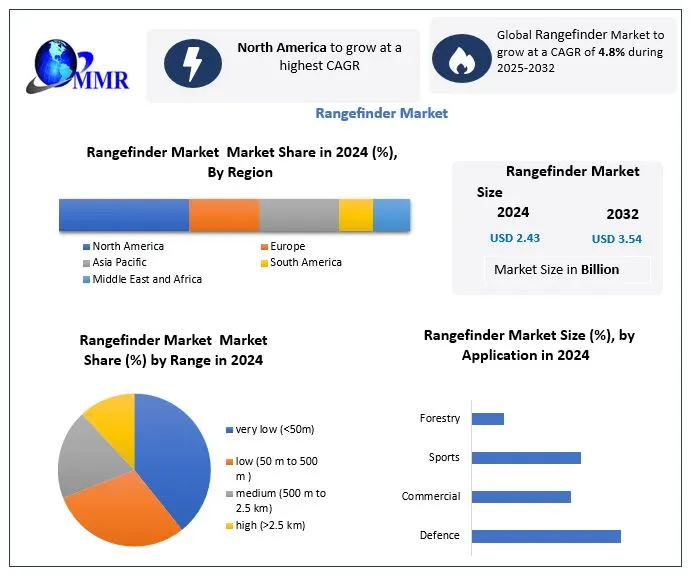 To know about the Research Methodology :- Request Free Sample Report
Rangefinder Market Dynamics:
Rising Demand in Defence and Military Applications to Drive the Market Growth
The increasing demand for rangefinder in defence and military applications is an important driver of market development. Rangefinder are essential tools used by armed forces for target acquisition, monitoring and accurate ballistic calculations. These devices increase the accuracy of long-distance weapons, enabling soldiers to make informed decisions during combat and reconnaissance missions. Their ability to measure the exact distance in various areas and weather conditions makes them inevitable for military operations. Additionally, integration of advanced technologies such as laser, GPS, and AI further enhances their effectiveness, leading to an increase in adoption by defence agencies in developed and developing countries.
Integration with AI and IoT to Boost the Market Opportunity
The integration of Artificial Intelligence and the Internet of Things is creating significant growth opportunities in the rangefinder market. AI enables smart data processing and decision-making capabilities allowing rangefinders to deliver more exact real-time measurements. IoT connectivity facilitates seamless communication with other smart devices and systems making rangefinders ideal for applications such as automated surveillance, industrial automation and smart construction tools. These smart rangefinders monitor environmental conditions adjust settings autonomously as well as transmit data for predictive analysis and remote control. Trend is particularly beneficial in defence, agriculture, and infrastructure sectors where automation and precision are critical. Industries remain to adopt smart technologies AI- as well as IoT-powered rangefinders are expected to gain strong market traction globally.
High Cost and GPS Alternatives to Restrain Growth in the Global Rangefinder Market
A major restraint of the global rangefinder market is the expensive cost of the instrument, its components, and the cost involved in the assembly of those components. A rangefinder generally contains a laser, photo-detector, microprocessor, and other optical components. These are very expensive. So to cut costs, manufacturers tend to buy cheap components; resulting in the overall loss of quality of the final project. This trend in the global rangefinder market is projected to hamper the market growth in the aforementioned forecast period.
A major challenge in the global rangefinder market is the threat of other alternatives like GPS (Global Positioning System). Since GPS gives nearly the same results as that of a rangefinder, it is the preferred choice by some golf sport managers.
Rangefinder Market Segment Analysis:
By Product Type, the segments are laser and ultrasonic rangefinders. Laser rangefinders use laser lights to find the distances. However, these are less reliable as their calibration is affected by atmospheric conditions. Ultrasonic rangefinders emit ultrasonic frequencies and their calibration is more reliable than that of laser-based rangefinders. This laser segment is also projected to dominate the global rangefinder market in the year 2025-2032. This is due to growing applications of ultrasonic rangefinders in defence particularly in the navy to map the floor of the ocean or to find the distance between an underwater target and the source. The laser segment is projected to witness moderate growth in the same forecast period. This is due to its increased use in sports like golf, shooting, etc., and in miscellaneous fields like forestry and land topography.
By Application, the segments are defence, commercial, sports, and forestry. The Defence sector accounted for over half of all shares in the global rangefinder market in the year 2024. This sector is also projected to witness the highest growth in the forecast period (2025-2032). This can be attributed to rising armed conflicts between different countries e.g. The US and the Middle East, Israel and Palestine, the armed conflict in the Ethiopian region, etc. The commercial segment includes industrial robotics and self-driving vehicles equipped with rangefinders. Rangefinders are very important tools for snipers to make their aim as accurate as possible.
The commercial use of rangefinders in the construction industry is also projected to drive the growth of this segment in the same forecast period. Rangefinders in construction, are used to find accurate readings of a slope to finish the levelling of different surfaces. These are also used to check the depth, height, and width of buildings built to verify whether meet the guidelines laid down by safety and protection bodies. The use of rangefinders by biologists is projected to drive the market growth of the forestry segment. Rangefinders also have a high demand from the sports fields in different games like shooting, archery, golf, etc. These are also useful to find out the length of the football or basketball fields so the players can use that data in their game strategies.
Rangefinder Market Regional Analysis
The growth of this region is projected to happen mostly in the defence sector due to the United States’ involvement in various armed conflicts around the globe. The United States was also the second-largest exporter of rangefinders with US$ 195 million worth of exports in the year 2024.
The North American region was followed by the Asia-Pacific region in terms of shares in the global market in the same year. This growth was also associated with high defence investments of countries like China. Furthermore, the booming manufacturing industry in China is also responsible for the growth of the rangefinder market in the region. China was the leading exporter of range finders in the year with US$ 230 million worth of exports.
The largest importer of rangefinders was the United States with US$ 280 million worth of imports followed by Germany with US$ 95 million worth of imports in the same year. Germany is projected to contribute to the growth of the European regional market in the aforementioned forecast period due to its high export of rangefinders worth US$ 140 million in the year 2024.
The objective of the report is to present a comprehensive analysis of the global Rangefinder market to the stakeholders in the industry. The past and current status of the industry with the forecasted market size and trends are presented in the report with the analysis of complicated data in simple language. The report covers all the aspects of the industry with a dedicated study of key players that include market leaders, followers, and new entrants.
Rangefinder Market Competitive Landscape
Major key players such as Bushnell Corporation, Vortex Optics, and Leupold & Stevens, Inc. form backbone of the rangefinder market. These companies are recognized for their advanced optical technologies as well as specialized product portfolios tailored to shooting, golfing, tactical and outdoor applications. Bushnell Corporation, held the largest regional market share of approximately 22% and recorded an appraised revenue of USD 400 million in 2024. It offers extensive range of consumer friendly and affordable rangefinders, particularly dominating the golf and hunting segments. Vortex Optics, holds about 16% market share with estimated 2024 revenue between USD 250–300 million. The brand is known for its strong, weatherproof products and lifetime warranties, gaining popularity among hunters and tactical users. Leupold & Stevens, Inc. commands around 18% of the North American market is estimated to generate USD 300–350 million in revenue as of 2024. Leupold is highly respected for its accurate optics and military-grade rangefinder used by professional shooters and defence agencies. With increasing demand and technological progress such as laser priced, Bluetooth connectivity as well as ballistic calculators, these firms are intensifying innovation and distribution to maintain their competitive edge.
Rangefinder Market Trends
| Trends | Description |
| Integration of Ballistic Software | Rangefinders are increasingly embedded with ballistic calculators for accuracy in shooting and defence applications. |
| Laser Technology Advancement | Development of high-precision laser rangefinders with improved range and accuracy, especially in military and industrial use. |
| Bluetooth & App Connectivity | Smart rangefinders now offer wireless connectivity with smartphones for data logging and remote operation. |
Rangefinder Market Key Development
• In 8 January 2024 Trueyard Laser Tech Co. (Asia Pacific) Announced next-gen rangefinder modules for defence and OEM clients.
• In 15 February 2024 SIG SAUER, Inc. (North America) Upgraded KILO Series with AI-powered long-range sensors.
• In 18 March 2024 Bozeman Optics (Europe) Opened AI-powered R&D center for smart rangefinding solutions.
• In 12 June 2024 ZEISS Group (Europe) Released Victory RF 32 Rangefinder Binoculars with Bluetooth Ballistics.
• In 2 May 2024 Leupold & Stevens, Inc. (North America) Introduced RX-FullDraw 5 Rangefinder for bowhunters.
Rangefinder Market Scope: Inquire before buying
| Rangefinder Market | |||
|---|---|---|---|
| Report Coverage | Details | ||
| Base Year: | 2024 | Forecast Period: | 2025-2032 |
| Historical Data: | 2019 to 2024 | Market Size in 2024: | USD 2.43 Bn. |
| Forecast Period 2025 to 2032 CAGR: | 4.8% | Market Size in 2032: | USD 3.54 Bn. |
| Segments Covered: | by Product Type | Laser Ultrasonic |
|
| by Range | very low (<50 m) low (50 m to 500 m) medium (500 m to 2.5 km) high (>2.5 km) |
||
| by Application | Defence Commercial Sports Forestry |
||
Rangefinder Market by Region
North America (United States, Canada, and Mexico)
Europe (UK, France, Germany, Italy, Spain, Sweden, Austria, and the Rest of Europe)
Asia Pacific (China, South Korea, Japan, India, Australia, Indonesia, Philippines, Malaysia, Vietnam, Thailand and Rest of APAC)
Middle East & Africa (South Africa, GCC, Nigeria, Rest of ME&A)
South America (Brazil, Argentina, Rest of South America)
Rangefinder Market Key Players
North America
1. Bushnell Corporation – (USA)
2. Vortex Optics – (USA)
3. Leupold & Stevens, Inc. – (USA)
4. Garmin Ltd. – (USA)
5. L3Harris Technologies – (USA)
6. Raytheon Technologies Corporation – (USA)
7. FLIR Systems – (USA)
8. Laser Technology, Inc. (LTI) – (USA)
Europe
9. Leica Camera AG – (Germany)
10. Carl Zeiss AG – (Germany)
11. Hensoldt AG – (Germany)
12. Jenoptik AG – (Germany)
13. Thales Group – (France)
14. Safran Electronics & Defence (France)
15. Vectronix AG – (Switzerland)
16. Newcon Optik – (UK)
Asia-Pacific
17. Nikon Corporation – (Japan)
18. Canon Inc. – (Japan)
19. Topcon Corporation – (Japan)
20. Ricoh Company, Ltd. – (Japan)
21. Trueyard – (China)
22. Bosch India – (India)
23. Panasonic Corporation – (Japan)
24. Fujifilm Holdings Corporation – (Japan)
Middle East & Africa
25. Elbit Systems Ltd. – (Israel)
26. Aselsan A.S. – (Turkey)
27. Denel SOC Ltd. – (South Africa)
South America
28. Opto Eletrônica S.A. – (Brazil)
29. Instrutherm – (Brazil)
30. Golabs – (Argentina)
Frequently Asked Question
1: What was the global rangefinder market size in 2024?
Ans: It was valued at USD 2.43 Billion in 2024.
2: Which region dominated the rangefinder market in 2024?
Ans: North America dominated the market due to strong military spending.
3: What are the two main product types in the rangefinder market?
Ans: Laser and ultrasonic rangefinders.
4: Which segment is expected to grow the fastest between 2025 and 2032?
Ans: The ultrasonic rangefinder segment.
5: Name one key player that launched a new product in 2024.
Ans: Leupold & Stevens, Inc. introduced the RX-FullDraw 5 Rangefinder on 2 May 2024.