
Probe Card Market - Industry Structure Evaluation, Demand Drivers Analysis, Growth Analysis and Identification, Competitive Positioning Review & Market Size Forecast to 2032
Overview
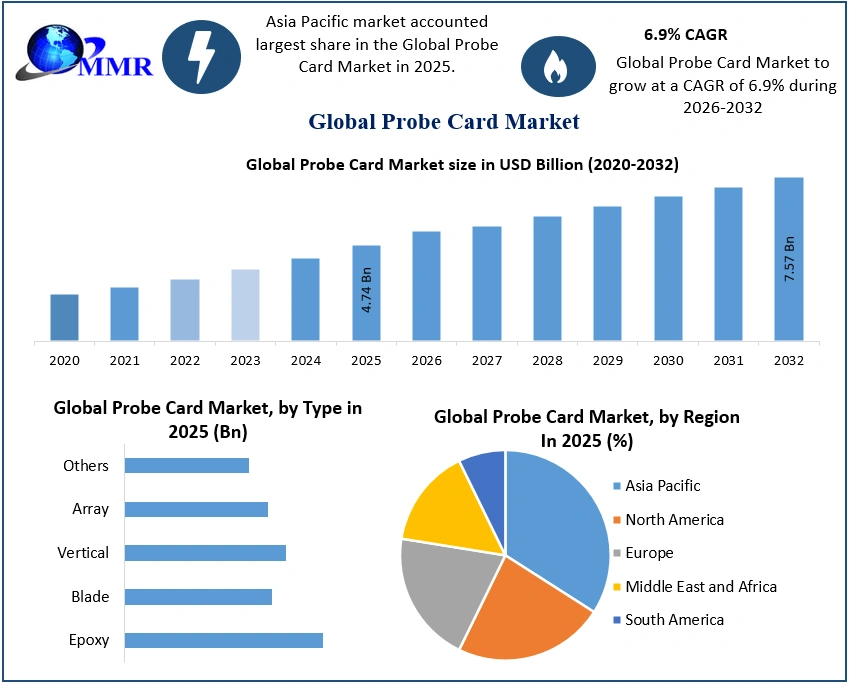
The Probe Card Market size was valued at USD 4.74 Billion in 2025 and the total Probe Card revenue is expected to grow at a CAGR of 6.9% from 2025 to 2032, reaching nearly USD 7.57 Billion by 2032.
Probe Card Market Overview
A probe card, also known as a test card or testing probe, is a specialized electronic testing tool used in the semiconductor industry during the manufacturing process of integrated circuits (ICs) or chips. Its primary function is to test the electrical characteristics and performance of semiconductor devices, such as chips, wafers, or dies, before they are assembled into final products. The probe card typically consists of a flat, rectangular substrate, often made of ceramic or other non-conductive material, onto which hundreds or thousands of tiny probes are attached. These probes are usually made of materials like tungsten or beryllium copper and are designed to make electrical contact with specific points on the surface of the semiconductor device under test.
To know about the Research Methodology:- Request Free Sample Report
With the development of more complex semiconductor devices such as System-on-Chip (SoC), 5G chips, and artificial intelligence (AI) processors, there is a need for more advanced testing solutions. Probe cards with higher pin counts, better precision, and increased flexibility are required to meet the testing requirements of these advanced devices, which is expected to boost the Probe Card Market growth. Continuous technological advancements in probe card design and manufacturing processes contribute to improved performance, reliability, and efficiency of probe cards. Innovations such as advanced materials, innovative probe designs, and enhanced testing techniques are driving the evolution of probe card technology.
Probe Card Market Dynamics
Growing Semiconductor Industry to boost Probe Card Market growth
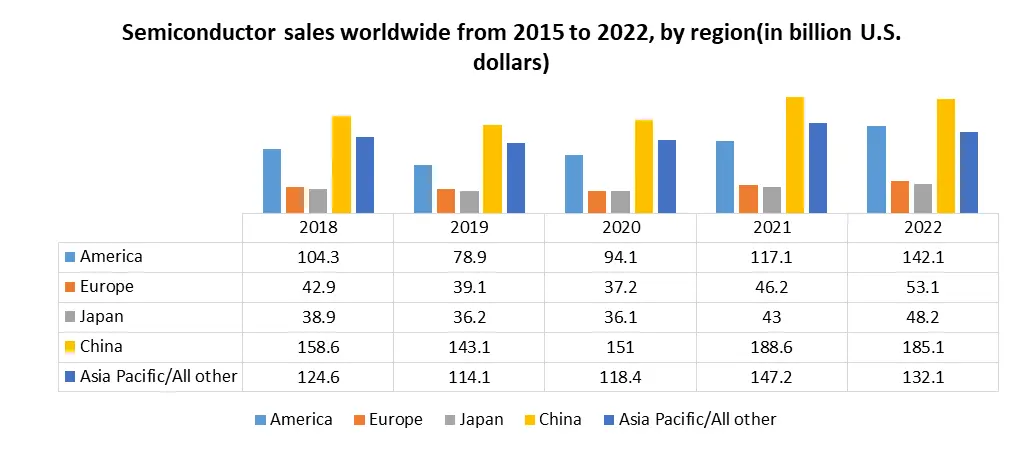
The semiconductor industry serves as the backbone of modern technology, powering devices across various sectors such as consumer electronics, automotive, healthcare, and telecommunications. The continuous demand for semiconductor devices, driven by technological advancements and emerging applications like 5G, artificial intelligence (AI), and Internet of Things (IoT), fuels the need for robust testing solutions, including probe cards, which significantly boosts Probe Card Market growth. With the increasing complexity and sophistication of semiconductor devices, there is a growing need for advanced testing solutions to ensure their quality, reliability, and performance. Probe cards play a critical role in testing the electrical characteristics and functionality of semiconductor devices during the manufacturing process, helping identify defects, and ensuring that only high-quality chips are integrated into final products.
Continuous advancements in semiconductor manufacturing processes, such as the transition to smaller feature sizes, higher integration densities, and new materials, drive the demand for innovative probe card solutions, which is expected to boost the Probe Card Market growth. Probe card manufacturers are developing advanced technologies and materials to meet the evolving testing requirements of next-generation semiconductor devices, including finer pitches, higher pin counts, and increased reliability. The trend towards miniaturization and higher integration levels of semiconductor devices, driven by the demand for smaller, more efficient electronic products, poses challenges for testing and inspection processes. Probe cards with finer pitches, smaller form factors, and higher probe densities are required to accurately test densely packed chips and wafers, ensuring that each device meets stringent quality standards.
High Initial Investment and Development Costs to restrain Probe Card Market growth
Developing advanced probe card technologies requires substantial investment in research, development, and manufacturing capabilities. The high initial investment and development costs is significant barrier to entry for new players in the Probe Card Market and deter smaller companies from competing effectively against established manufacturers. The continuous need for innovation and technology upgrades further escalates development costs. As semiconductor devices become more complex with smaller feature sizes, higher integration densities, and advanced packaging techniques, the testing requirements become more stringent and challenging. Designing probe cards capable of accurately testing these complex devices while maintaining high yields and reliability is a considerable technical challenge. The complexity of semiconductor devices increases the complexity and cost of probe card development, customization, and maintenance.
Despite advancements in probe card technology, there are inherent technical limitations and performance constraints that impact their effectiveness in testing semiconductor devices. For example, as device feature sizes shrink and pitch sizes decrease, achieving precise alignment and contact between probe tips and device pads becomes increasingly difficult. This lead to issues such as probe damage, misalignment, and signal integrity degradation, affecting test accuracy and reliability and significantly limits the Probe Card Market growth. The design, manufacturing, and customization of probe cards involve complex processes that often require long lead times. Semiconductor manufacturers face pressure to reduce time-to-market for their products, which conflict with the time-consuming nature of probe card development and procurement. Delays in probe card availability or customization hinder production schedules and impact overall product launch timelines.
Probe Card Market Segment Analysis
Based on Type, the market is segmented into Epoxy, Blade, Vertical, Array, and Others. Epoxy segment dominated the market in 2025 and is expected to hold the largest Probe Card Market share over the forecast period. The epoxy segment refers to a specific type of probe card technology or construction method that involves the use of epoxy materials in the manufacturing process. Epoxy is a type of thermosetting polymer that is commonly used as an adhesive or encapsulant in various industries due to its excellent bonding properties, mechanical strength, and chemical resistance. Epoxy-based probe cards are considered cost-effective solutions compared to alternative materials or construction method, which is expected to boost the Probe Card Market growth. Epoxy materials are readily available, relatively inexpensive, and compatible with standard manufacturing processes, reducing overall production costs and lead times.
Based on Application, the market is segmented into DRAM, Flash, Foundry & Logic, Parametric, and Others. DRAM segment dominated the market in 2025 and is expected to hold the largest Probe Card Market share over the forecast period. The DRAM (Dynamic Random Access Memory) segment in the probe card industry pertains to the specific use of probe cards in the testing and validation of DRAM chips during the semiconductor manufacturing process. DRAM is a type of volatile memory commonly used in computers, smartphones, tablets, and other electronic devices for temporary data storage and retrieval. The DRAM segment within the probe card market encompasses various aspects related to the testing, characterization, and quality assurance of DRAM chips. Probe cards are instrumental in detecting defects and identifying manufacturing issues in DRAM chips. During wafer-level testing, probe cards are used to scan semiconductor wafers containing multiple DRAM dice to identify defective units or areas with process anomalies. Early defect detection helps semiconductor manufacturers improve yield rates and reduce production costs by identifying and addressing manufacturing issues in a timely manner.
Probe Card Market Regional Insight
Dominance of Semiconductor Manufacturing Hubs in Asia Pacific to boost Probe Card Market growth
Asia Pacific dominated the market in 2025 and is expected to hold the largest Asia Pacific Probe Card Market share over the forecast period. APAC is home to major semiconductor manufacturing hubs, including Taiwan, South Korea, China, and Japan. These countries have established themselves as global leaders in semiconductor production, attracting investments from both domestic and international semiconductor companies. The presence of these manufacturing hubs drives the demand for probe cards as essential tools for testing semiconductor devices during the manufacturing process. APAC countries are known for their rapid technological advancements and innovation in the semiconductor industry. Governments and industry players in countries like South Korea, Taiwan, and Japan heavily invest in research and development to maintain their competitive edge in semiconductor manufacturing, which boosts the Asia Pacific Probe Card Market growth. This continuous innovation drives the demand for advanced probe card technologies capable of testing increasingly complex semiconductor devices.
APAC countries are major consumers of consumer electronics products such as smartphones, tablets, laptops, and televisions. The region's large population, rising disposable incomes, and increasing urbanization contribute to the growing demand for electronic devices. Semiconductor manufacturers in APAC cater to this demand, driving the need for efficient testing solutions like probe cards to ensure the quality and reliability of semiconductor devices used in consumer electronics. Governments in APAC countries often provide support and incentives to stimulate the growth of the semiconductor industry. This support include tax incentives, grants for research and development, and initiatives to attract foreign investments. For example, Taiwan's government has implemented policies to strengthen its semiconductor industry, known as the "Asian Silicon Valley Plan," which includes initiatives to support semiconductor manufacturing and innovation. Such government support fosters a conducive environment for the probe card market to thrive in the region.
Probe Card Market Scope: Inquire before buying
| Probe Card Market | |||
|---|---|---|---|
| Report Coverage | Details | ||
| Base Year: | 2025 | Forecast Period: | 2026-2032 |
| Historical Data: | 2020 to 2025 | Market Size in 2025: | USD 4.74 Bn. |
| Forecast Period 2026 to 2032 CAGR: | 6.9 % | Market Size in 2032: | USD 7.57 Bn. |
| Segments Covered: | by Type | Epoxy Blade Vertical Array Others |
|
| by Application | DRAM Flash Foundry & Logic Parametric Others |
||
Probe Card Market, Key Players are
North America (United States, Canada, and Mexico)
Europe (UK, France, Germany, Italy, Spain, Sweden, Austria, and the Rest of Europe)
Asia Pacific (China, South Korea, Japan, India, Australia, Indonesia, Malaysia, Vietnam, Taiwan, Bangladesh, Pakistan, and the Rest of APAC)
Middle East and Africa (South Africa, GCC, Egypt, Nigeria, and the Rest of ME&A)
South America (Brazil, Argentina Rest of South America)
Leading Probe Card manufacturers include:
North America:
1. FormFactor, Inc. - Livermore, California, USA
2. Cascade Microtech (a FormFactor company) - Beaverton, Oregon, USA
3. Micronics Japan Co., Ltd. (MJC America) - Bothell, Washington, USA
4. SV Probe - Tempe, Arizona, USA
Asia-Pacific:
5. Japan Electronic Materials Corporation (JEMCO) - Tokyo, Japan
6. Technoprobe S.p.A. (A JEM Holdings Company) - Singapore
7. Korea Instrument - Seongnam, Gyeonggi-do, South Korea
8. Microfriend - Hsinchu, Taiwan
9. Technos Instruments - Tokyo, Japan
10. Shenzhen Monte Carlo Technology Co., Ltd. - Shenzhen, Guangdong, China
11. JEM Korea Co., Ltd. (A JEM Holdings Company) - Seoul, South Korea
12. Hon Technologies Co., Ltd. - Shenzhen, Guangdong, China
13. Chunghwa Precision Test Tech. Co., Ltd. - Taoyuan City, Taiwan
14. ChangChun Wancheng Precision Measurement Technology Co., Ltd. - Changchun, Jilin, China
15. JEM Taiwan Co., Ltd. (A JEM Holdings Company) - Hsinchu City, Taiwan
16. Chunghwa Precision Test Tech. Co., Ltd. - Taoyuan City, Taiwan
17. Technoprobe Taiwan Co., Ltd. (A Technoprobe S.p.A. company) - Hsinchu City, Taiwan
Europe:
18. MPI Corporation (Europe) - Nijmegen, Netherlands
19. Wentworth Laboratories Limited - Stevenage, United Kingdom
20. Micromechatronica GmbH - Hagenberg im Mühlkreis, Austria
21. Willert Electronics Ltd - Birmingham, United Kingdom
22. Cascade Microtech (Europe) - Munich, Germany
Frequently asked Questions
1. What is a probe card?
Ans: A probe card, also known as a test card or testing probe, is a specialized electronic testing tool used in the semiconductor industry during the manufacturing process of integrated circuits (ICs) or chips. It tests the electrical characteristics and performance of semiconductor devices before assembly into final products.
2. What are the challenges associated with probe card technology?
Ans: As semiconductor devices become more complex with smaller feature sizes and higher integration densities, achieving precise alignment and contact between probe tips and device pads becomes increasingly difficult.
3. How does the Probe Card Market contribute to the semiconductor industry?
Ans: The Probe Card Market provides essential testing solutions for semiconductor manufacturers, ensuring the quality and reliability of semiconductor devices. Continuous advancements in probe card technology meet the evolving testing requirements of next-generation semiconductor devices, including finer pitches, higher pin counts, and increased reliability, thereby supporting the growth of the semiconductor industry.
4. What factors drive the growth of the Probe Card Market?
Ans: Factors driving the growth of the Probe Card Market include the growing semiconductor industry, characterized by technological advancements and emerging applications like 5G, artificial intelligence (AI), and Internet of Things (IoT).
5. What are the dominant regions in the Probe Card Market?
Ans: Asia Pacific dominates the Probe Card Market, particularly due to its status as a major semiconductor manufacturing hub. Countries like Taiwan, South Korea, China, and Japan lead in semiconductor production, driving the demand for probe cards as essential testing tools during the manufacturing process. Government support and incentives also contribute to the growth of the Probe Card Market in the region.