
Primary Cell Culture Market by Product, Cell Separation Method, Application, Cell Type and Region – Global Market Size Estimation, Industry-Wide Analysis, Competitive Landscape Assessment & Long-Term Forecast to 2032
Overview
Primary Cell Culture Market size is expected to grow at a CAGR of 10.41% during the forecast period and the market size is expected to reach nearly USD 15.04 Bn. by 2032.
The global Primary Cell Culture market report is a comprehensive analysis of the industry, market, and key players. The report has covered the market by demand and supply-side by segments. The global Primary Cell Culture report also provides trends by market segments, technology, and investment with a competitive landscape.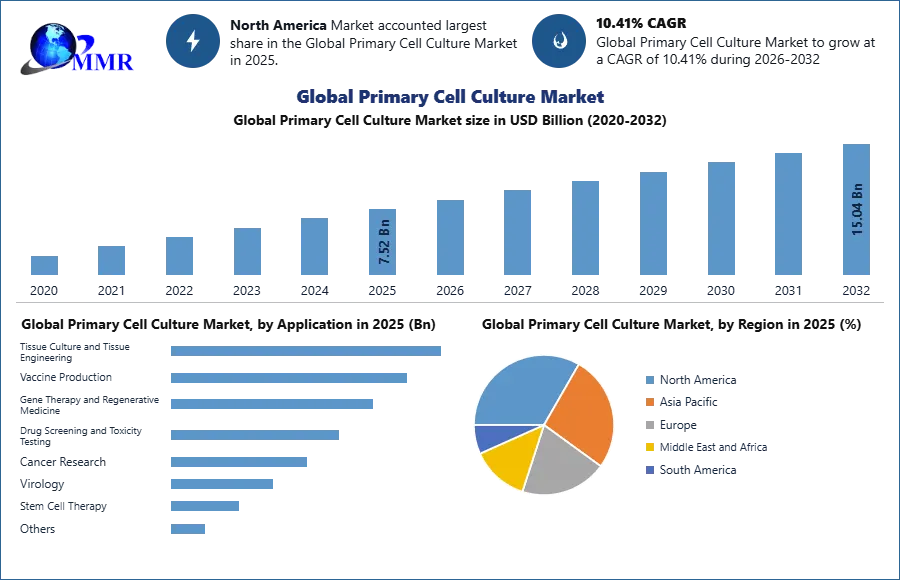 To know about the Research Methodology :- Request Free Sample Report
Primary Cell Culture Market Overview:
The process of isolating single cells directly from living tissues or organs using enzymatic or mechanical methods is known as primary cell culture. The primary cells maintain the normal characteristics of the maternal tissue from which they were separated, mimicking the in vivo situation as closely as possible. Such cells are preferred as in vitro instruments because they maintain natural morphology, growth characteristics, cellular structure, cellular markers, and a variety of other characteristics. To promote replication, primary cells need the right growth conditions.
Enzymatic or mechanical methods are used to separate primary human cells independently from normal human tissue or blood cells. The basic cellular functions of primary cells are preserved. As a result, their use in cell-based research programs is on the rise.
Drivers:
The rising incidence of chronic diseases such as cancer, infections, autoimmune diseases, diabetes mellitus, cardiovascular diseases and nephrological diseases are driving market development. This has resulted in a spike in testing, allowing for widespread use of primary cell cultures.
Demand for cancer research is all over the world. Cancer is one of the leading causes of death worldwide, accounting for a vast number of deaths. Cell culture is being used to produce cancer-cure medications by a variety of pharmaceutical firms and research groups.
The American Cancer Society estimates that 16.9 million cancer sufferers and survivors are there in 2021. Globally, 71.0 million individuals had chronic hepatitis C infection, according to the WHO (2021). As a result, the number of chronic diseases being diagnosed is driving demand for innovative therapies testing, which is anticipated to propel market growth. Furthermore, the market's rise can be due to an increasing emphasis on functional biology. The market for culture medium has risen as a result of many R&D investments for the advancement of novel solutions.
Restraints:
However, revenue development could be hampered by factors such as the high cost of advanced primary cell cultures and the possibility of contamination.
Primary Cell Culture Market Segment Analysis:
Based on Product, the reagents and supplement segment is accounted for the largest share over the forecast period. The segment's development can be attributed to its widespread use in primary cell culture research and manufacturing. Since primary cells are delicate by nature, reagents and supplements are essential for their development. In addition, the segment's growth is aided by the production of novel products such as growth factors and cytokines.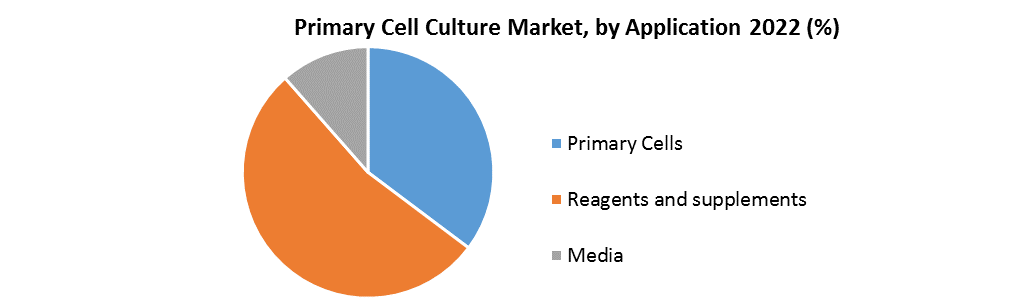
Based on Cell Separation Methods, the enzymatic degradation segment led the primary cell culture industry, contributing to 33.3 percent of total sales. The high preference of this technique for primary cell separation over all other techniques is due to benefits such as less harm to cultures, comparatively quick, and high yield of a representative sample. Trypsin, which is widely used for enzymatic disaggregation of tissues, led the market for primary cell culture in terms of revenue share in 2025. Dissociation of cells form tissues, processing of adhesive cells from flasks, and quick passage of vast cell suspensions are all applications for the enzyme.
Based on Application, the vaccine manufacturing segment led the primary cell culture industry, with a sales share of 12.2 percent, 2025. This increase is due to the growing use of primary animal cultures for virus manufacturing, which is then used to make vaccines like measles and hepatitis B. Over the projected timeframe, the stem cell therapy market is anticipated to develop at a profitable CAGR of 11.9 percent. The segment's rise can be due to scientists around the world becoming more interested in using stem cells in numerous research projects. Researchers' perceptions of primary cells are increasingly evolving as a result of experiments using embryonic, induced, and adult stem cells.
Based on Cell Type, the animal cells segment dominated the primary cell culture industry, accounting for 58.6 percent of total sales. The increasing use of animal origin primary cells in vaccine production is one of the major factors driving the segment forward. Vaccines against rabies, polio, measles, chickenpox and hepatitis B have all been developed using animal-derived primary cultures.
Primary Cell Culture Market Regional Insights:
North America now has the most favorable offer in the industry. This is due to the increased use of cutting-edge therapies in the United States and Canada, as well as the presentation and advancement of computerized culture procedures. These organizations are commonly used for tests, tranquilize scans, research, immunization growth, and monoclonal antibody refinement. Furthermore, market participants' increased emphasis on innovating cell culture applications, instrumentation, and the availability of various types of cells and their cellular associations is leading to market growth in the area.
During the forecast period, Europe is projected to have the second-largest market share. During the forecast period, Asia Pacific is anticipated to grow at the fastest pace. The increased demand is largely due to lower costs associated with stem cell transplantation in the field. Furthermore, researchers are engaged in extensive R&D activities, which contribute to the region's growth.
The objective of the report is to present a comprehensive analysis of the global Primary Cell Culture market to the stakeholders in the industry. The past and current status of the industry with the forecasted market size and trends are presented in the report with the analysis of complicated data in simple language. The report covers all the aspects of the industry with a dedicated study of key players that include market leaders, followers, and new entrants.
PORTER, SVOR, PESTEL analysis with the potential impact of micro-economic factors of the market have been presented in the report. External as well as internal factors that are supposed to affect the business positively or negatively have been analyzed, which will give a clear futuristic view of the industry to the decision-makers.
The report also helps in understanding the global Primary Cell Culture market dynamics, structure by analyzing the market segments and project the global Primary Cell Culture market size. Clear representation of competitive analysis of key players by product, price, financial position, product portfolio, growth strategies, and regional presence in the global Primary Cell Culture market make the report investor’s guide.
Primary Cell Culture Market Scope: Inquire before buying
| Global Primary Cell Culture Market | |||
|---|---|---|---|
| Report Coverage | Details | ||
| Base Year: | 2025 | Forecast Period: | 2026-2032 |
| Historical Data: | 2020 to 2025 | Market Size in 2025: | 7.52 USD Billion |
| Forecast Period 2026-2032 CAGR: | 10.41% | Market Size in 2032: | 15.04 USD Billion |
| Segments Covered: | by Product | Primary Cells Fat Blood Nerve Bone Endothelial Stem Muscle Skin Others Reagents and supplements Attachment Solutions Buffers and Salts Freezing Media Sera Others Media Blood Cells Media Fat Cells Media Bone Cells Media Nerve Cells Media Skin Cells Media Muscle Cells Media Stem Cells Media Others |
|
| by Cell Type | Animal Human |
||
| by Cell Separation Method | Explant Method Enzymatic Degradation Trypsin Collagenase Protease Pronase Dispase Neuraminidase Hyaluronidase Elastase DNase Others Mechanical Separation Others |
||
| by Culture Platform | 2D Monolayer Culture 3D Spheroid / Organoid Microfluidic Organ-on-Chip |
||
| by Application | Tissue Culture and Tissue Engineering Vaccine Production Gene Therapy and Regenerative Medicine Drug Screening and Toxicity Testing Cancer Research Virology Stem Cell Therapy Others |
||
Primary Cell Culture Market by Region
North America (United States, Canada and Mexico)
Europe (UK, France, Germany, Italy, Spain, Sweden, Austria and Rest of Europe)
Asia Pacific (China, South Korea, Japan, India, Australia, Indonesia, Malaysia, Vietnam, Taiwan, Bangladesh, Pakistan and Rest of APAC)
Middle East and Africa (South Africa, GCC, Egypt, Nigeria and Rest of ME&A)
South America (Brazil, Argentina Rest of South America)
Primary Cell Culture Market Key Players:
1. Thermo Fisher Scientific Inc.
2. Merck KGaA
3. Lonza Group Ltd.
4. Corning Incorporated
5. Danaher Corporation (Cytiva)
6. GE Healthcare
7. STEMCELL Technologies Inc.
8. QIAGEN N.V.
9. PromoCell GmbH
10. FUJIFILM Irvine Scientific, Inc.
11. MatTek Ltd.
12. Axol Bioscience Ltd.
13. American Type Culture Collection (ATCC)
14. Cell Biologics, Inc.
15. ZenBio Inc.
16. AllCells Corporation
17. ScienCell Research Laboratories
18. Cyagen Biosciences Inc.
19. HiMedia Laboratories Pvt. Ltd.
20. Sartorius AG
21. Miltenyi Biotec B.V. & Co. KG
22. CellSystems GmbH
23. Creative Bioarray
24. BPS Bioscience Inc.
25. Lifeline Cell Technology Corp.
26. Neuromics Inc.
27. Epithelix Sàrl
28. ReachBio LLC
29. AcceGen Biotechnology
30. Biopredic International
Frequently Asked Questions:
1. Which region has the largest share in Global Primary Cell Culture Market?
Ans: North America region held the highest share in 2025.
2. What is the growth rate of Global Primary Cell Culture Market?
Ans: The Global Primary Cell Culture Market is growing at a CAGR of 10.41% during forecasting period 2026-2032.
3. What is scope of the Global Primary Cell Culture market report?
Ans: Global Primary Cell Culture Market report helps with the PESTEL, PORTER, Recommendations for Investors & Leaders, and market estimation of the forecast period.
4. Who are the key players in Global Primary Cell Culture market?
Ans: The important key players in the Global Primary Cell Culture Market are – Thermo Fisher Scientific, Inc., Merck, Lonza, Corning Incorporated, Danaher Corporation, GE Healthcare, AXOLBIO, PromoCell GmbH, ATCC, FUJIFILM Irvine Scientific, Inc., MatTek Ltd., Axol Bioscience Ltd., and Other Key Players
5. What is the study period of this market?
Ans: The Global Primary Cell Culture Market is studied from 2025 to 2032.