
Global Plastic Compounding Market: by Product Type (Polypropylene, Polyurethane, PVC, ABS, PET, PE, PS & EPS, Other Polymers), by Application (Automotive, Building & Construction, Electrical & Electronics, Medical, Packaging, Others) - Forecast to 2032
Overview
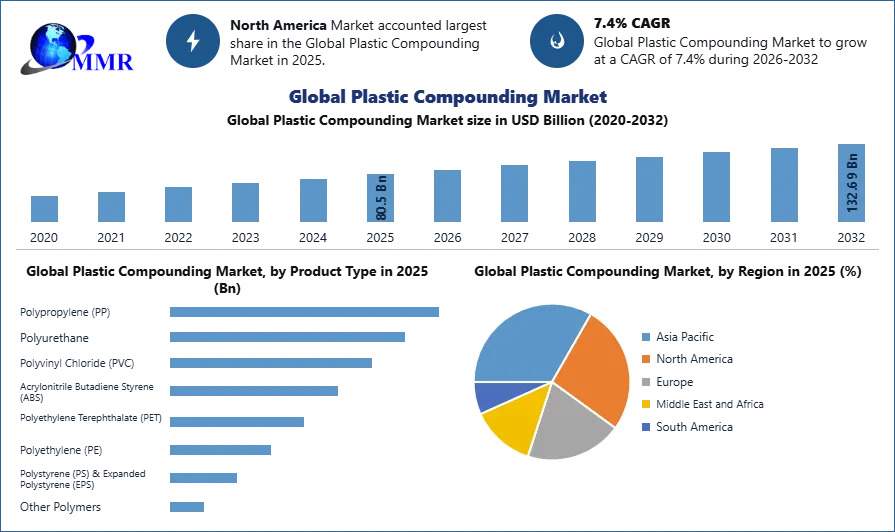
Plastic Compounding Market size is expected to reach USD 132.69 Bn. in year 2032, at a CAGR of 7.4% during the forecast period.
The report study has analyzed the revenue impact of COVID -19 pandemic on the sales revenue of market leaders, market followers and market disrupters in the report and the same is reflected in our analysis.
Plastic Compounding Market Definition:
Plastic Compounding is the process of formulating Plastic product by mixing/blending polymers with certain additives in a molten state to change its physical, thermal and aesthetic characteristic of engineered thermoplastics. Compounding of plastics helps to converts plastic to the desired form that is more effective, uniform, and usable.
To know about the Research Methodology :- Request Free Sample Report
Geographically, Asia Pacific region is accounted for a leading share of 40% in 2025 and expected to grow due to growing consumption & unique compounded products will help this market to grow. Global Plastic Compounding market was valued at USD 80.5 Bn. and is expected to reach USD 132.69 Bn. by 2032, at a CAGR of 7.4% during a forecast period. Prominent key players involved in the production of Plastic compounding product are Solvay SA, BASF SE, Dow Chemical Company and Kraton Corporation, involved in the supply Plastic Compounding product to encounter the demand of the market.
Plastic Compounding Market Dynamics:
The report offers a brief analysis of worldwide plastic compounding Market in terms of revenue from various segments and detailed evaluation of the trends, opportunities, challenges and stakeholders playing a substantial role in the market.
Growing product penetration & Booming Consumer demand in electrical & electronics, automotive, and construction industry owing to its superior characteristics such as flame retardancy, lightweight and a wide range of conductivity are some of the growth drivers for Plastic Compounding Market. Use of compounded plastics specifically in the construction sector for safety windows, doors, insulation materials, cables and storage tanks offer a positive opportunity for the industry growth. Over the last decades, there has been an upsurge demand for electrical devices across the globe owing to advancements in the technology with investment in R&D, henceforth boosting the demand for Plastic Compounding materials.
Plastic Compounding Market: Market Segment Analysis
The report covers competitive analysis of the Plastic Compounding Market in each of the geographical segments thereby providing insight into a market share at the macro as well as micro levels.
Automotive & Transportation Segment is projected to have Highest Share for Compounded Plastics
Based on application, the automotive held the largest market over 25% . The growth is attributed the growing importance of compounded plastics as an alternative to traditional alloys & metals in the automotive industry. India, China, and Brazil are the central hub and offer productive growth for large production.
Polypropylene (PP) in terms of Product Type is projected to have largest Share for Compounded Plastics
Based on Product Type, the polypropylene (PP) is estimated to show continuous growth during the forecast period 2026- 2032. Polypropylene (PP) is thermoplastic polymer resin valuable in various industrial, commercial, Medical, fashion and Housewares application. It is widely used in the automotive sector due to light-weight, lower carbon emissions, high performances and fuel efficiency of the vehicles are predicted to reinforce the demand for those wires globally.
Plastic Compounding Market Regional Insights
Asia Pacific held the largest share in Plastic Compounding Market in 2025 and expected to continue its dominance over the forecast period. Rapid industrialization and presence of dominant industries such as the automotive, and electrical & electronics in the region offer substantial potential for plastic compounding market. APAC is the central hub for production and a major consumer of plastic compounding product. China is likely to dominate the Asia Pacific region by the expansion of the Automotive and Electrical & Electronics industries in the country.
On the contrary, Europe is witnessing substantial growth due to the presence of automobile industries but to remain a saturated market due to stringent environmental regulations by various federal agencies such as the European Chemicals Agency (ECHA).
Competitive Analysis: Global Plastic Compounding Market
The report includes detailed analysis of leading manufacturers, prominent vendors and upcoming trends & challenges that will influence market growth. Further, the adoption of variant strategic business activities such as acquisitions, mergers, collaboration.
The objective of the report is to present a comprehensive analysis of the Global Plastic Compounding Market including all the stakeholders of the industry. The past and current status of the industry with forecasted market size and trends are presented in the report with the analysis of complicated data in simple language. The report covers all the aspects of the industry with a dedicated study of key players that includes market leaders, followers, and new entrants. PORTER, SVOR, PESTEL analysis with the potential impact of micro-economic factors of the market has been presented in the report. External as well as internal factors that are supposed to affect the business positively or negatively have been analyzed, which will give a clear futuristic view of the industry to the decision-makers.
The report also helps in understanding Global Plastic Compounding Market dynamics, structure by analyzing the market segments and projects the Global Plastic Compounding Market size. Clear representation of competitive analysis of key players By Pathogen Type, price, financial position, Product portfolio, growth strategies, and regional presence in the Global Plastic Compounding Market make the report investor’s guide.
Plastic Compounding Market Scope: Inquire before buying
| Global Plastic Compounding Market | |||
|---|---|---|---|
| Report Coverage | Details | ||
| Base Year: | 2025 | Forecast Period: | 2026-2032 |
| Historical Data: | 2020 to 2025 | Market Size in 2025: | 80.5 USD Billion |
| Forecast Period 2026-2032 CAGR: | 7.4% | Market Size in 2032: | 132.69 USD Billion |
| Segments Covered: | by Product Type | Polypropylene (PP) Polyurethane Polyvinyl Chloride (PVC) Acrylonitrile Butadiene Styrene (ABS) Polyethylene Terephthalate (PET) Polyethylene (PE) Polystyrene (PS) & Expanded Polystyrene (EPS) Other Polymers |
|
| by Application | Automotive Building & Construction Electrical & Electronics Medical Packaging Others |
||
| by Source | Fossil-based Bio-based & Recycled |
||
Plastic Compounding Market, by Region
• North America (United States, Canada and Mexico)
• Europe (UK, France, Germany, Italy, Spain, Sweden, Austria and Rest of Europe)
• Asia Pacific (China, South Korea, Japan, India, Australia, Indonesia, Malaysia, Vietnam, Taiwan, Bangladesh, Pakistan and Rest of APAC)
• Middle East and Africa (South Africa, GCC, Egypt, Nigeria and Rest of ME&A)
• South America (Brazil, Argentina Rest of South America)
Key Players / Competitors Profiles Covered in Brief in Global Plastic Compounding Market Report in Strategic Perspective:
• LANXESS A.G.
• BASF SE
• PolyVisions
• Asahi Kasei Corporation
• Aurora Plastics LLC
• Foster Corporation
• SABIC
• LyondellBasell
• Kingfa SCI. & TECH. CO., LTD.
• DuPont
• Celanese Corporation
• RTP Company
• Solvay S.A.
• KURARAY CO., LTD.
• Kraton Corporation
• Covestro AG
• Kraton Corporation
• MRC Polymers
• Adell Plastics
• Sojitz Corporation
• Coperion K-Tron
• S & E Speciality Polymers
• Plstiblends India Ltd.
• Ravago
• Citadel Plastics
Key Recent Developments:
| Exact Date | Company | Development | Impact |
|---|---|---|---|
| 13 February 2026 | BASF SE | The company announced the addition of a new dispersions production line at its Mangalore site in India to meet surging local demand for high-quality compounding additives. | The expansion integrates advanced dispersion technologies to support low-VOC and sustainable formulations for the coatings, construction, and packaging sectors in the Asia-Pacific region. |
| 13 February 2026 | Avient Corporation | Avient revealed strategic plans to expand Dyneema fiber capacity and launch non-PFAS polymer processing aids for packaging applications. | By optimizing existing machinery, the company aims to meet high single-digit growth in defense and packaging demand while strictly adhering to new environmental safety standards. |
| 05 February 2026 | LyondellBasell / SABIC | Major players showcased circular plastic innovations and AI-driven compounding formulations at Plastindia 2026 in New Delhi. | The event highlighted Industry 4.0 integration in compounding, focusing on bio-based materials and real-time simulation tools to enhance manufacturing-led growth in India. |
| 29 January 2026 | Dow | Dow launched the "Transform to Outperform" initiative, targeting a $2 billion EBITDA improvement through AI-driven productivity in its materials science segment. | This plan modernizes supply chain logistics and compounding operations, ensuring the company remains competitive amidst raw resin price fluctuations and global supply surpluses. |
| 07 November 2025 | Coherent Market Insights | The Global Plastic Compounding Market reached an estimated valuation of USD 72.95 billion in 2025, with the Automotive segment capturing a 38.6% share. | Growth is primarily driven by Electric Vehicle (EV) lightweighting requirements and stringent performance criteria, pushing the demand for reinforced thermoplastic compounds. |
| 08 October 2025 | SABIC | SABIC unveiled the MEGAMOLDING™ platform at K 2025, designed to produce large thermoplastic parts for the EV and renewable energy sectors. | The platform enables design freedom and enhanced recyclability, supporting the industry's shift toward large-scale, lightweight plastic components for next-generation mobility. |