
Global Photo Booth Market Analysis: Growth Potential, Competitive Landscape, and Strategic Outlook (2026-2032)
Overview
Global Photo Booth Market Size and Growth Potential
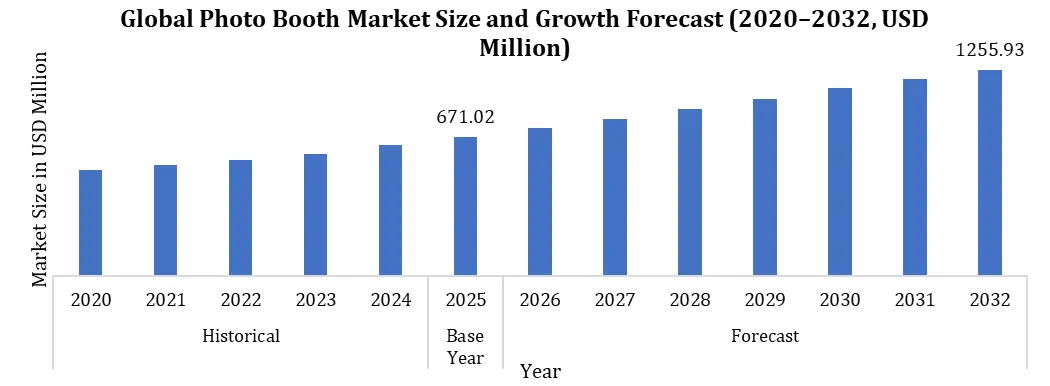
The Global Photo Booth Market size was valued at USD 671.02 Million in 2025 and is projected to reach USD 1,255.9 million by 2032, advancing at a CAGR of 9.37% over the 2026–2032 forecast period, driven by escalating demand from the global events industry, social media sharing culture, corporate experiential marketing, and rapid integration of AI, AR, and 360-degree video technologies.
Photo Booth Market Key Highlights
| Market Parameter | Value / Insight | Trend |
| Global Photo Booth Market Size (2025) | USD 671.02 Million | ↑ Growing |
| Projected Market Size (2032) | USD 1,255.93 Million | ↑ Strong |
| Forecast CAGR (2026–2032) | 9.37% | ↑ Accelerating |
| Europe Market Share (2025) | 34.50% (USD 231.5 Million) | ↑ Dominant |
| Asia Pacific Growth Rate (2026–2032) | 10.17% CAGR | ↑ Expanding |
| Leading Product Type | Open-Air Photo Booths hold the largest share due to flexibility and suitability for large events | ↑ Surging |
| Leading Application Segment | Entertainment & Events 68% of demand driven by weddings, corporate events, and brand activations | ↑ Strong |
| Commercial End-User Share (2025) | 63.2% Market Share | ↑ Strategic |
| Leading Company Global Share | ME Group (Photo-Me International)- 18–22% share | ↑ Market Leader |
| AI-Integrated Photo Booth Adoption | 25%+ of new product launches include AI features | ↑ Rapid Rise |
| Social Media Photo Sharing Rate | 70%+ users share booth photos instantly on social platforms | ↑ Surging |
To know about the Research Methodology :- Request Free Sample Report
The Photo Booth market is advancing at a decisive pace, driven by the structural convergence of social media culture, corporate experiential marketing, and fast product innovation. Photo booths have been transformed from coin-operated novelties into software-enabled, AI-enhanced, brand-configurable platforms that simultaneously entertain, engage, and generate measurable marketing ROI. More than 33% of professionally deployed booths now feature real-time social media upload capabilities, and over 25% of new product launches in 2024–2025 incorporated AI-powered personalization or augmented reality filters indicating a clear industry-wide shift toward technology-premium configurations.
On the supply side, the global photo booth market operates through a rental-dominant service model, with rental services contributing around 63% of total market activity. A typical event rental generates USD 500–2,500 per booking, while premium 360-degree or AI-enabled configurations command USD 3,000–5,000 per event. Hardware units are priced between USD 10,000 and USD 50,000 for professional-grade configurations, with entry-level consumer systems launched in 2024 (HP Sprocket Photobooth) available below USD 1,000.
Photo Booth Market DROCT Analysis (Drivers, Restraints, Opportunities, Challenges, and Trends)
| Category | Factor | Description |
| Driver | Social Media Sharing & User-Generated Content Demand | In the Photo Booth Market, more than 70% of users share captured photos instantly on social media platforms, making photo booths a key engagement tool for events. Over 1.2 million photos were shared via booth platforms in 2023, and nearly 33% of modern booths include built-in social media upload capabilities, boosting demand for interactive event experiences. |
| Restraint | High Equipment Capital Costs | Professional-grade photo booth systems require significant upfront investment, typically ranging from USD 10,000 to USD 50,000 per unit, while advanced digital booth setups can exceed USD 10,000, limiting adoption among smaller event operators and startups. |
| Opportunity | Asia Pacific Market Expansion | The Asia Pacific region represents the largest growth opportunity in the Photo Booth Market, with an expected CAGR of around 10.17% through 2032. Countries such as India (11.64%) and China (11.06%) are witnessing strong demand due to increasing event spending and social media-driven consumer behavior. |
| Opportunity | AI and AR Platform Premiumization | Around 35% of new photo booth innovations (2025) integrate AI features. AI-enabled booths can process up to 1,000 images in 5 minutes, enabling real-time beauty filters, emotion detection, and personalized scene generation—creating pricing power and differentiation for technology-forward operators. |
| Challenge | Supply Chain & Tariff Pressure | Global trade tensions and supply chain disruptions have increased the cost of photo booth components. Hardware procurement costs have risen by an estimated 8–12%, pushing manufacturers to diversify sourcing to countries such as Japan, India, and Taiwan. |
| Trend | Touchless & App-Controlled Interfaces | Increasing demand for hygienic and seamless user experiences has accelerated adoption of touchless and mobile-app-controlled photo booths, with about 26% of booths offering touchless capture features in 2025. |
| Trend | 360-Degree & Overhead Video Booth Formats | 360° video booths are the fastest-growing product format, projected at 8% CAGR. These installations generate 2–3× higher social media engagement and command premium event booking fees of USD 3,000–5,000 per event. |
Global Photo Booth Market Demand Analysis
Rising Global Event Culture and Social Media Convergence Drive Structural Demand for Photo Booth Services Across All Regions
Global photo booth market demand is structurally anchored by the intersection of a rapidly expanding events economy and deep social media integration. The increasing emphasis on experiential engagement across weddings, corporate events, brand activations, and social celebrations has transformed photo booths into essential event-entertainment infrastructure.
Notably, over 42% of weddings in the United States and approximately 35% in the United Kingdom now incorporate professional photo booth services, making them one of the most consistent event-planning line items globally. Advanced features such as instant digital sharing, branded overlays, GIF creation, and AR filters further enhance guest interaction while amplifying social media visibility, thereby sustaining long-term demand across developed and emerging event markets.
Technological Innovation in the Global Photo Booth Market
AI-Powered Personalization: Around 35% of new photo booth innovations (2025) integrate AI features. AI-enabled booths can process up to 1,000 images in 5 minutes, saving nearly 10 hours of editing per event while enabling real-time beauty filters, emotion detection, and personalized scene generation.
Augmented Reality (AR) Integration: Nearly 25% of new product innovations (2024–2025) focus on AR features such as virtual props, animated backgrounds, and themed overlays. AR-enabled booth installations increased 31% between 2022 and 2024, making AR a standard feature in premium event booths.
360-Degree Video Booth Expansion: 360° video booths are the fastest-growing product segment, projected to grow at 8% CAGR. These booths generate 2–3× higher social engagement and typically command USD 3,000–5,000 per event booking.
GIF & Short-Video Capture Formats: More than 50% of new booth systems launched in 2024–2025 support animated GIF and short-video capture, aligning with TikTok and Instagram Reels–style content consumption patterns.
Touchless & App-Controlled Technology: Approximately 26% of booths deployed in 2025 feature touchless capture interfaces driven by mobile-app control, QR-triggered photo sessions, and voice-activated booth operation, reflecting post-pandemic hygiene expectations.
Cloud-Based Digital Delivery: SaaS-delivered photo management platforms enable real-time digital album access, branded photo download portals, and post-event analytics for corporate clients—shifting booth operators from transactional hardware rentals to recurring platform-revenue models.
Global Photo Booth Market Segment Analysis
By Product Type
Open-Air Photo Booths dominate the product segment with the largest market share in 2025, driven by their flexibility, suitability for large outdoor and indoor events, and ease of customization with branded backdrops, props, and lighting configurations. Open-air booths are preferred by corporate event organizers, wedding planners, and brand activation agencies for their aesthetic versatility and high guest throughput.
Enclosed Photo Booths retain relevance in institutional document photography (passport, visa, ID), mall deployments, and amusement venues. ME Group International operates the world’s largest enclosed booth network with approximately 47,000 units deployed across Europe, Japan, and select global markets, anchoring this segment’s revenue base.
By Deployment
Rental Services dominate global deployment with a 63% Photo Booth market share in 2025, reflecting the event-driven, asset-light, and high-turnover nature of the photo booth industry. A typical event rental generates USD 500–2,500 per booking; premium AI-enabled or 360-degree configurations command USD 3,000–5,000 per event. The rental model’s low capital barrier has enabled thousands of independent operators and SMEs to participate, driving fragmentation and geographic expansion.
Equipment Sales represent hardware purchases by institutional document photography networks, large corporate operators, and new market entrants investing in owned assets. Equipment sales are the primary channel for ME Group’s institutional document photography expansion and for technology-forward operators investing in 360-degree and AI-enabled hardware refresh cycles.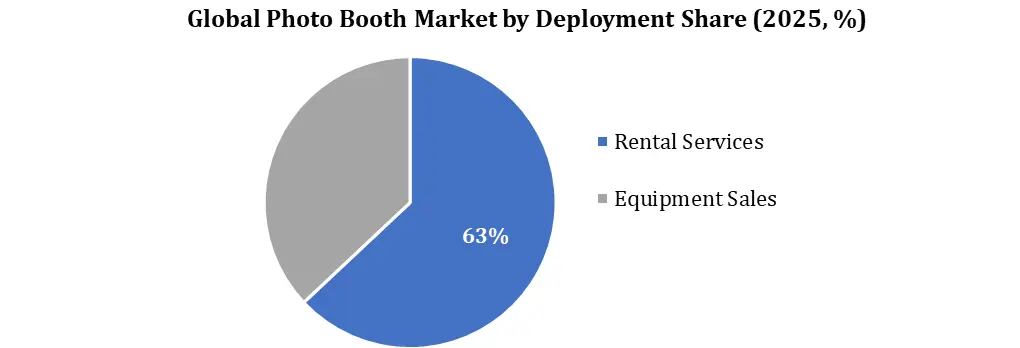
By Component
Hardware (camera, lighting, printer, kiosk): The hardware component encompasses the physical booth infrastructure, including DSLR/mirrorless camera systems, ring-flash and LED lighting rigs, dye-sublimation printers (delivering 4×6 prints in 8–15 seconds), and the kiosk or enclosure structure. Professional-grade hardware is priced between USD 10,000 and USD 50,000 per unit.
Software (photo editing, AR filters, sharing software): Software platforms are the fastest-growing component, commanding 65–80% gross margins on SaaS subscription models. Leading platforms (Simple Booth HALO, Darkroom Booth, Snappic) enable real-time editing, branded overlays, AR filter libraries, social media integration, and cloud-based event management.
Services (installation, rental, maintenance): Professional services encompass booth setup, on-site attendant staffing, consumable replenishment, and post-event digital delivery. Managed service packages are emerging as a recurring revenue model for large-scale commercial operators.
By Pricing Model
| Pricing Model | Description | Typical Price Range | Primary Users |
| Membership / Subscription | Recurring access to booth hardware and software for commercial venues, malls, and corporate campuses | USD 500–2,000/month | Commercial venues, malls, entertainment centers |
| Pay-Per-Use | Transaction-based pricing for consumer-facing booth installations in airports, retail, and public venues | USD 5–15 per session | Airports, retail kiosks, amusement venues |
| Package Pricing | Event-based bundled packages including booth, attendant, prints, and digital delivery | USD 500–5,000 per event | Weddings, corporate events, brand activations |
| Others | Franchise models, revenue-share agreements with venue partners, and white-label platform licensing | Variable | Independent operators, franchise networks |
By End User
Commercial Users like event companies, shopping malls, entertainment venues, and marketing agencies dominate with a 63.2% market share in 2025. The commercial segment is driven by B2B procurement: corporate brands using branded booths as marketing tools, malls deploying booths for footfall engagement, and professional event companies integrating booths as standard service offerings.
Individual / Personal Users represent consumer event hosts (weddings, birthday parties, private celebrations) using rental services or, increasingly, consumer-grade systems such as the HP Sprocket Photobooth (launched November 2024, priced under USD 1,000) for home and casual event use.
Global Photo Booth Market Regional Analysis
Europe dominates the Photo Booth Market, accounting for a 34.50% revenue share in 2025, supported by its well-developed institutional document photography infrastructure and strong demand from weddings and corporate events. Countries such as the United Kingdom, Germany, France, Italy, and Spain represent the region’s key markets, where large booth networks, established operators, and premium event culture sustain consistent demand. The region is projected to grow at a CAGR of around 8.2% during the forecast period.
Asia Pacific is the fastest-growing region, expected to expand at a CAGR of 10.17%, driven by the rapid growth of the wedding industry, increasing social media engagement, and rising demand for digital entertainment at events. Major markets such as China, India, Japan, South Korea, and Australia are witnessing strong adoption of interactive photo booth technologies due to expanding urban celebrations and corporate events.
North America remains a technologically advanced market led by the United States and Canada, where demand is largely fueled by corporate experiential marketing, entertainment venues, and brand promotion events. Meanwhile, South America and the Middle East & Africa are emerging markets, with countries such as Brazil, Argentina, the United Arab Emirates, and Saudi Arabia seeing increasing adoption of photo booth services in weddings, festivals, tourism events, and hospitality venues.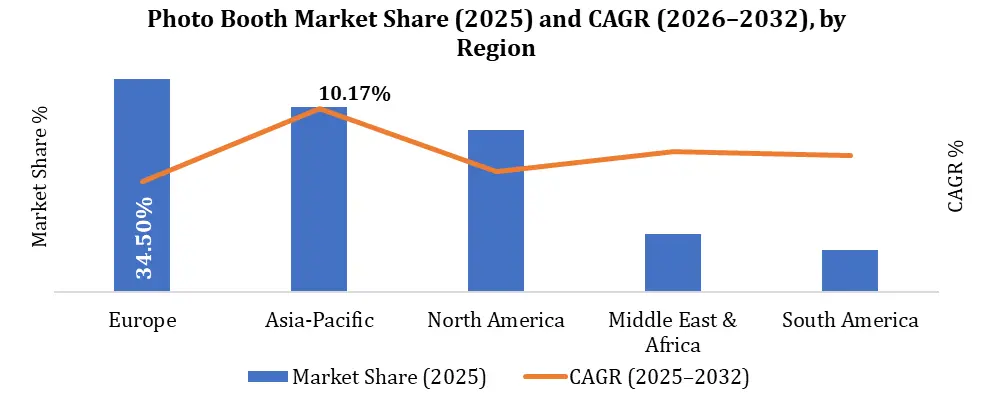
Global Photo Booth Market Competitive Landscape
The global photo booth market is moderately concentrated at the top and highly fragmented below. ME Group International, DEDEM, and Photo Booth International collectively held over 32% of global market share in 2025, confirming a market where the top three operators command meaningful scale advantages while thousands of independent rental operators compete in regional and niche segments. The strategic inflection of 2024–2025 is the decisive shift from hardware-centric to platform-centric competition: operators commanding proprietary SaaS platforms, cloud-based digital delivery, AI personalization engines, and post-event analytics tools are achieving superior pricing power, stronger corporate account retention, and premium valuations.
Photo Booth Market Recent Product Launches (2024-2026)
| Year | Company | Product Launch | Description |
| 2024 | C+A Global | HP Sprocket Photobooth | Launched a compact consumer-grade photo booth priced under USD 1,000, featuring ZINK ink-free printing and mobile app AR filter integration, expanding photo booth usage beyond professional event rentals into the home and casual event segment. |
| 2025 | Photobooth Supply Co. | AI-Enabled Open-Air Photo Booth Platform | Introduced an upgraded open-air booth platform with AI-powered personalization, automated editing, and real-time social sharing, enhancing event engagement and improving operational efficiency for rental providers. |
| 2024 | OrcaVue | 360° Video Booth Pro Series | Released a next-generation 360-degree video booth system designed for corporate events and weddings, supporting slow-motion video capture and instant social media sharing. |
| 2024 | LA Photo Party | AR Photo Booth Platform | Launched an augmented-reality photo booth software platform enabling real-time AR filters, branded overlays, and interactive digital effects for brand activations and experiential marketing events. |
| 2025 | Simple Booth | HALO 3.0 Cloud Platform Update | Released a major update to its SaaS event photo management platform, adding AI-powered background replacement, real-time analytics dashboards, and multi-event corporate account management capabilities. |
| 2025 | RevoSpin | 360 Pro Max Booth System | Launched an upgraded 360-degree video platform with stabilized slow-motion capability, integrated LED lighting ring, and direct TikTok/Instagram upload, targeting premium wedding and brand activation markets. |
Global Photo Booth Market Report Coverage: Inquire before buying
| Photo Booth Market | |||
|---|---|---|---|
| Report Coverage | Details | ||
| Base Year: | 2025 | Forecast Period: | 2026-2032 |
| Historical Data: | 2020 to 2025 | Market Size in 2025: | USD 671.02 Bn. |
| Forecast Period 2026 to 2032 CAGR: | 9.37% | Market Size in 2032: | USD 1255.93 Bn. |
| Segments Covered: | by Product Type | Enclosed Photo Booths Open-Air Photo Booths |
|
| by Deployment | Rental Services Equipment Sales |
||
| by Component | Hardware (camera, lighting, printer, kiosk) Software (photo editing, AR filters, sharing software) Services (installation, rental, maintenance) |
||
| by Pricing Model | Membership/Subscription Pay-Per-Use Package Pricing Others |
||
| by Application | Events & Parties Weddings Corporate Events / Brand Activations Entertainment Industry Document Photo (passport, visa, ID photos) |
||
| by End User | Commercial Users (event companies, malls, entertainment venues, marketing agencies) Individual / Personal Users |
||
North America (United States, Canada, and Mexico)
Europe (UK, France, Germany, Italy, Spain, Sweden, Austria, and the Rest of Europe)
Asia Pacific (China, South Korea, Japan, India, Australia, ASEAN, Indonesia, Philippines, Malaysia, Vietnam, Thailand, ASEAN, Rest of Asia Pacific)
Middle East & Africa (South Africa, GCC, Nigeria, Rest of ME&A)
South America (Brazil, Argentina, Rest of South America)
Profiles of Major Photo Booth Companies: 25+ Key Players
The global photo booth market is characterized by a dual competitive structure. Large-scale network operators and technology platform companies including ME Group, Simple Booth, and Photobooth Supply Co. dominate high-specification, contract-driven, and institutionally embedded segments through global supply chain capabilities, proprietary software platforms, and established brand equity with Tier 1 corporate and institutional clients. Regional specialists and independent rental operators capture cost-sensitive volume segments through proximity advantages, operational flexibility, personalized service delivery, and localized market expertise.
| Sr. No. | Company Name | Headquarters | Core Product / Service Offering | Primary End Markets |
| 1 | ME Group International (Photo-Me) | United Kingdom | Global enclosed booth networks; document & entertainment photography; biometric kiosks; ~47,000 booths globally | Europe, Japan, Global Institutional |
| 2 | Photobooth Supply Co. | United States | Open-air hardware platforms, software ecosystems, event rental systems, operator training programs | North America, Global |
| 3 | Simple Booth | United States | Cloud SaaS photo management (HALO platform), digital event analytics, social media integration | Global Corporate & Events |
| 4 | RevoSpin | United States | 360-degree video booth hardware and software; premium event activations; LED ring systems | North America, Expanding Global |
| 5 | BLUR Productions | United Kingdom | Premium experiential photography, branded event activations, luxury corporate events | Europe, North America |
| 6 | Faceplace (Photo-Me Division) | United States | Document photography kiosks, institutional ID and passport systems, retail deployments | North America Institutional |
| 7 | Foto Master | Asia Pacific (Japan/Australia) | Document photography booths, passport kiosks, ID photo systems for institutional networks | Asia Pacific |
| 8 | Snapden | United States | Eco-friendly booth systems, sustainable event photography, biodegradable print consumables | North America |
| 9 | Kingdom Photo Booth | UK / USA | Event rental, corporate brand activations, wedding photography packages | Europe, North America |
| 10 | Digital Centre | Europe (Spain) | Retail photo solutions, mall and venue installations, document photography systems | Europe, Asia Pacific |
The transition from hardware-centric to platform-centric competition is the defining strategic shift of the current market cycle. Operators who can combine compelling booth hardware with proprietary software platforms enabling branded digital delivery, real-time social integration, post-event analytics, and multi-location management are commanding premium pricing, building defensible competitive moats, and establishing the recurring revenue streams that are reshaping valuation dynamics across the sector.
Risk Assessment & Photo Booth Market Entry Strategies
| Risk Category | Risk Level | Description | Mitigation Strategy |
| Hardware Supply Chain Disruption | Medium–High | Component cost inflation of 8–12%; semiconductor shortages affecting camera and display systems; tariff exposure on China-sourced hardware | XX |
| Market Fragmentation & Price Compression | High | Thousands of independent operators commoditize standard booth rentals; race-to-bottom pricing in mature markets (US, UK, Germany) | XX |
| Economic Sensitivity — Event Spending | Medium | Event industry contracts ~15–25% during recessions; COVID-19 demonstrated structural vulnerability of in-person event dependency | XX |
| Technology Obsolescence Risk | Medium | Rapid AI/AR feature cycles require continuous hardware and software investment; 3–5 year hardware refresh cycles create capital intensity | XX |
| Privacy & Data Regulation | Medium | GDPR (Europe), CCPA (California), and emerging biometric data laws create compliance complexity for photo collection and storage | XX |
Long-Term Photo Booth Industry Opportunities (2028–2032)
The photo booth industry's long-term structural opportunity lies at the intersection of three macro trends: the USD 2.3 trillion global events economy (IBTM World, 2025), the 5.4 billion active social media users globally creating insatiable demand for shareable content, and the USD 450+ billion annual global corporate marketing spend increasingly allocated to experiential and activation channels. By 2030, AI-native photo booth platforms operating at scale will function as real-time brand intelligence terminals capturing facial sentiment data, measuring social amplification in real-time, delivering instant personalized content to guest devices, and providing CMOs with post-event ROI analytics comparable to digital advertising platforms.
Global Photo Booth Market: Research Methodology
This report employs a rigorous multi-source primary and secondary research methodology validated through triangulation across industry databases, operator financial disclosures, trade association data, and expert interviews. The market sizing framework uses a bottom-up demand model validated against top-down supply-side cross-checks, with regional estimates calibrated to country-level event industry data, social media penetration metrics, and photo booth operator revenue benchmarks.
| Research Component | Sources & Methodology |
| Primary Research | In-depth 150+ interviews with photo booth operators, event planners, corporate brand managers, and technology platform executives; operator survey data across 12 countries |
| Secondary Research | Company annual reports and investor presentations; industry association publications (ILEA, MPI, PCMA); trade press (Special Events, BizBash); patent databases; LinkedIn hiring data |
| Market Sizing Model | Bottom-up: unit count × utilization rate × average revenue per booking across rental and equipment sales channels; validated against operator financial disclosures and transaction databases |
| Competitive Intelligence | Web scraping of operator pricing pages; analysis of 200+ operator websites; social media engagement benchmarking; App Store review mining for software platform analysis |
| Forecast Methodology | CAGR regression analysis + qualitative adjustment for AI/AR technology adoption curves, Asia Pacific demographic demand drivers, and event industry post-pandemic recovery trajectory |