
Ocular Drug Delivery Technology Market – Global Market Size, Strategic Growth Drivers, Risk Assessment Framework, Regulatory Landscape Review, Competitive Intensity Mapping & Long-Term Industry Outlook to 2030
Overview
The Ocular Drug Delivery Technology Market size was valued at USD 1.91 Billion in 2023 and the total Ocular Drug Delivery technology revenue is expected to grow at a CAGR of 9.12 % from 2024 to 2030, reaching nearly USD 3.52 Billion by 2030.
Ocular Drug Delivery Technology Market Overview
Ocular Drug Delivery is the precise and targeted administration of therapeutic medications to the eye through innovative technologies and formulations, aiming to treat various ocular diseases and conditions while maximizing treatment efficacy and minimizing side effects. Rapid Growth of ocular diseases globally, including glaucoma, cataracts, macular degeneration, diabetic retinopathy, and dry eye syndrome, among others driving the growth of Ocular Drug Delivery Technology Market. This growth is largely attributed to factors such as an aging population, changing lifestyles, and increased incidences of chronic diseases such as diabetes. As a result, there's a growing demand for advanced treatments and drug delivery mechanisms that are minimally invasive, efficient, and patient-friendly.
The Ocular Drug Delivery Technology Market growth is boosted by several key factors such as heightened focus on developing novel drug delivery technologies that offer sustained and targeted release of drugs within the eye. For instance, sustained-release implants and innovative formulations like nanoparticles and liposomes have gained significant attention for their ability to improve drug efficacy and reduce the frequency of administration. Pharmaceutical companies are increasingly investing in research and development endeavours to introduce more effective ocular treatments. This includes exploring new formulations, enhancing existing drug delivery systems, and innovating with biologics and gene therapy drugs for ocular applications.
Recent developments within the market have been driven by key players like Allergan, Novartis, and Santen Pharmaceutical, among others. These companies have introduced groundbreaking ocular drug delivery technologies and formulations to address critical unmet needs in eye care. For instance, Allergan has pioneered sustained-release implants for conditions like glaucoma, providing long-term drug release directly into the eye, reducing the need for frequent administrations and improving patient compliance. Novartis and Santen Pharmaceutical have also made significant strides in developing innovative drug delivery systems, aiming to enhance treatment outcomes and patient experiences.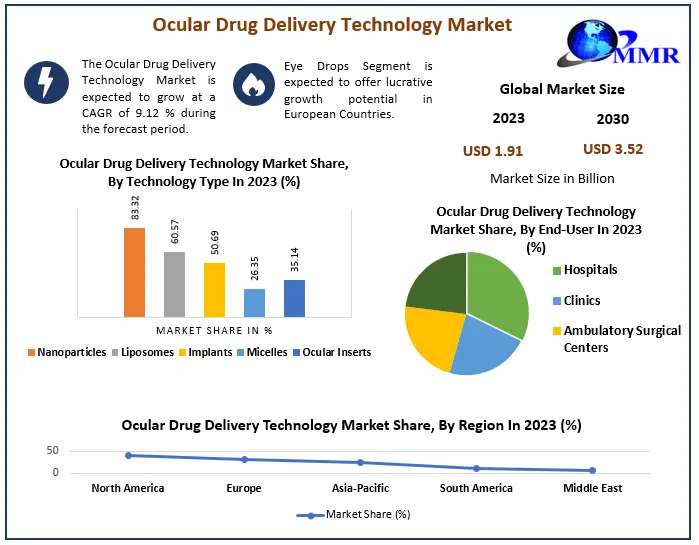 To know about the Research Methodology :- Request Free Sample Report
Ocular Drug Delivery Technology Market Dynamics:
Escalating prevalence of eye conditions such as macular degeneration and diabetic retinopathy boosts demand for efficient drug delivery solutions
Innovations such as sustained-release implants, nanoparticles, and liposomes are pivotal in reshaping treatment paradigms for various eye conditions, propelling the growth of the Ocular Drug Delivery Technology Market. For instance, Ocular Drug Delivery Technology Market key player Allergan's DURYSTA stands out as a sustained-release implant delivering bimatoprost directly into the eye, providing a lasting remedy for glaucoma while reducing treatment frequency and bolstering patient adherence. The escalating prevalence of eye conditions like macular degeneration and diabetic retinopathy amplifies the demand for efficient drug delivery solutions. Novartis' Lucentis signifies this demand, delivering precise treatment for macular degeneration, preserving vision in affected areas. The global aging population contributes substantially to age-related eye diseases, prompting companies like Santen Pharmaceutical with VENDEX to employ sophisticated delivery methods tailored to this demographic's needs.
Effectively managing complications stemming from diseases such as diabetes, Regeneron's EYLEA tackles diabetic retinopathy, preventing vision loss. Addressing patient preferences for minimally invasive treatments, Sun Pharmaceutical's CEQUA offers eye drops catering to chronic dry eye sufferers. Ocular Drug Delivery Technology Market company investing in gene therapy, such as Alcon's Luxturna, are revolutionizing the treatment landscape for hereditary ocular disorders. Collaborative endeavours between academia and industry, exemplified by partnerships like Ocular Therapeutix and McGill University, drive innovations in sustained drug delivery, enhancing treatment efficacy and boosting the growth of Ocular Drug Delivery Technology Market.
The advantages of ocular drug delivery systems are multifaceted and transformative. These systems ensure precision dosing, enabling sustained and controlled drug release, thereby enhancing ocular bioavailability. By circumventing protective barriers, they enable targeted therapy within the eye while minimizing systemic and visual side effects. These systems substantially elevate patient compliance, comfort, and therapeutic drug performance, facilitating self-administration and expediting drug absorption. Their capacity to curtail tissue loss and accommodate delivery systems further underscores their pivotal role in revolutionizing ocular treatments and meeting evolving patient needs.
 Stringent regulatory processes impede the Ocular Drug Delivery Technology Market's growth
Stringent regulatory processes hinder the growth of Ocular Drug Delivery Technology Market. For instance, EyeGate Pharmaceuticals faced substantial delays in the approval of its EyeGate Ocular Bandage Gel due to regulatory setbacks, limiting market entry and hindering growth prospects. Developing formulations suitable for ocular delivery poses a formidable challenge. Companies like Novaliq, encountering difficulties with CyclASol, grapple with complexities in formulating drugs for dry eye treatment, impacting their effectiveness and market viability. Ensuring patient compliance remains an uphill task, impacting treatment efficacy. Alimera Sciences' Iluvien, designed for diabetic macular edema, faces hurdles in patient adherence due to the need for repeated injections, affecting its effectiveness in managing the condition.
Technological constraints persist in drug delivery systems, hindering optimal drug delivery market. For instance, limitations in micro/nanoparticles' sustained drug release, as experienced by EyeGate Pharmaceuticals, curtail their ability to achieve optimal therapeutic outcomes. Developing cost-effective ocular drug delivery systems proves challenging due to high associated costs, hindering market accessibility. Eyenovia's MicroStat faced limitations in this regard, affecting its affordability and widespread adoption. The market's fragmentation presents another challenge, intensifying competition and creating barriers for new entrants like Ocular Therapeutix, vying against established players with innovative drug delivery systems.
Physiological barriers within the eye, such as tear turnover and blinking, impede sustained drug delivery. Graybug Vision, with GB-102, faces challenges in optimal drug retention due to these natural physiological barriers. The limited clinical evidence for novel ocular drug delivery systems inhibits widespread market adoption. For example, pSivida's Durasert for uveitis lacks robust clinical validation, impacting its market acceptance and adoption. Addressing safety concerns remains critical; Novartis' Beovu faced safety issues concerning age-related macular degeneration, affecting its market credibility. Additionally, achieving global market access amid varying regulatory landscapes presents challenges. Companies like Kala Pharmaceuticals encounter hurdles in growing market access for Eysuvis, impacting overall market growth due to regional regulatory disparities.
Ocular Drug Delivery Technology Market Segment Analysis:
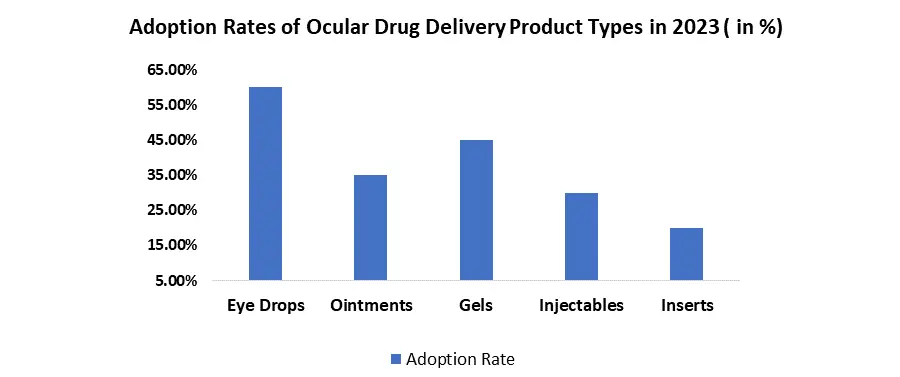
Based on Product Type, Eye drops dominated the Ocular Drug Delivery Technology Market as they widely used, provide ease of application and are commonly used for conditions such as dry eye syndrome and glaucoma due to their non-invasiveness and patient-friendly nature. Ointments, although less preferred due to their greasy texture and potential blurred vision, offer prolonged contact time and are effective for nighttime use or in pediatric patients. Gels strike a balance between drops and ointments, providing prolonged contact and improved bioavailability, commonly used for moderate to severe dry eyes. Injectables, including intravitreal injections, are crucial for targeted drug delivery in severe ocular diseases such as diabetic retinopathy and age-related macular degeneration. Inserts, such as ocular implants or sustained-release devices, offer long-lasting drug release and are beneficial for chronic conditions, although their adoption faces challenges due to insertion complexities.
 Based on Delivery Route, Topical delivery dominated the Ocular Drug Delivery Technology Market, primarily through eye drops and ointments, remains extensively adopted due to its ease of application and patient convenience, making it ideal for treating surface-level conditions like conjunctivitis and dry eye syndrome. Intraocular routes, utilizing injections or implants directly into the eye, showcase moderate adoption, focusing on treating deeper ocular conditions such as macular degeneration or diabetic retinopathy. However, this method demands professional administration, limiting its widespread adoption. Periocular delivery, involving the surrounding eye tissues, displays a comparatively lower adoption rate due to its niche applications, often addressing localized conditions like orbital inflammation or administering drugs near the eye but not directly into it. The diversity in adoption rates reflects the specificities of these delivery routes, fulfilling to a range of ocular conditions and patient needs within the Ocular Drug Delivery Technology Market.
Ocular Drug Delivery Technology Market Regional Insights:
North America Dominance in the Ocular Drug Delivery Technology Market
North America dominated the Ocular Drug Delivery Technology Market as rising collaborations between top pharmaceutical firms and leading research institutions, such as Johns Hopkins University and Pfizer, have include sustained-release technologies for chronic eye ailments such as glaucoma. Europe showcases precision medicine strides, exemplified by partnerships between esteemed academic bodies like the University of Cambridge and industry giants like Novartis, resulting in nano-carrier-based systems for targeted ocular therapy. Asia Pacific, particularly in Japan, embraces innovative ocular implants and microspheres via collaborations between governmental bodies like AMED and firms like Takeda Pharmaceutical, emphasizing cutting-edge drug delivery. South America and Middle East & Africa focus on adapting cost-effective ocular delivery solutions, fostering collaborations between local research entities and pharmaceutical companies to address prevalent eye conditions and accessibility concerns.
These regional dynamics highlight a collaborative landscape driving advancements in ocular drug delivery. Each region's unique partnerships and initiatives address specific healthcare needs, from pioneering sustained-release technologies in North America to precision-based nano-carrier systems in Europe and innovative implants in Asia Pacific. In south America and Middle East & Africa, efforts concentrate on adapting existing technologies to local demands, marking a diverse yet concerted global pursuit to enhance ocular health through tailored drug delivery solutions.
Ocular Drug Delivery Technology Market Scope: Inquire before buying
| Global Ocular Drug Delivery Technology Market | |||
|---|---|---|---|
| Report Coverage | Details | ||
| Base Year: | 2023 | Forecast Period: | 2024-2030 |
| Historical Data: | 2018 to 2023 | Market Size in 2023: | US $ 1.91 Bn. |
| Forecast Period 2024 to 2030 CAGR: | 9.12% | Market Size in 2030: | US $ 3.52 Bn. |
| Segments Covered: | By Product Type | Eye Drops Ointments Gels Injectables Inserts |
|
| By Delivery Route | Topical Intraocular Periocular |
||
| By Technology Type | Nanoparticles Liposomes Implants Micelles Ocular Inserts |
||
| By Application | Glaucoma Cataracts Macular Degeneration Diabetic Retinopathy Dry Eye Syndrome |
||
| By End-User | Hospitals Clinics Ambulatory Surgical Centers Research Institutes |
||
Global Ocular Drug Delivery Technology Market, by Region
North America (United States, Canada and Mexico)
Europe (UK, France, Germany, Italy, Spain, Sweden, Austria and Rest of Europe)
Asia Pacific (China, South Korea, Japan, India, Australia, Indonesia, Malaysia, Vietnam, Taiwan, Bangladesh, Pakistan and Rest of APAC)
Middle East and Africa (South Africa, GCC, Egypt, Nigeria and Rest of ME&A)
South America (Brazil, Argentina Rest of South America)
Ocular Drug Delivery Technology Market Key Players:
Major Contributors in the Ocular Drug Delivery Industry in North America:
1. Regeneron Pharmaceuticals - Headquarters: Tarrytown, New York, USA.
2. EyeGate Pharmaceuticals - Headquarters: Waltham, Massachusetts, USA
3. Alimera Sciences - Headquarters: Alpharetta, Georgia, USA
4. Graybug Vision - Headquarters: Redwood City, California, USA
5. pSivida - Headquarters: Watertown, Massachusetts, USA
6. Kala Pharmaceuticals - Headquarters: Waltham, Massachusetts, USA
7. Ocular Therapeutix - Headquarters: Bedford, Massachusetts, USA
8. Eyenovia - Headquarters: New York, New York, USA
9. Aciont - Headquarters: Salt Lake City, Utah, USA
10. PanOptica - Headquarters: Mount Arlington, New Jersey, USA
11. Icon Bioscience - Headquarters: Newark, New Jersey, USA
12. EyePoint Pharmaceuticals - Headquarters: Watertown, Massachusetts, USA
13. Eyepoint Pharmaceuticals - Headquarters: Watertown, Massachusetts, USA
14. Clearside Biomedical - Headquarters: Alpharetta, Georgia, USA
15. EyeGate Pharma - Headquarters: Waltham, Massachusetts, USA
16. Envisia Therapeutics - Headquarters: Morrisville, North Carolina, USA
Leading players in the Europe Ocular Drug Delivery Technology Market:
1. Allergan - Headquarters: Dublin, Ireland
2. Novartis - Headquarters: Basel, Switzerland
3. Alcon - Headquarters: Geneva, Switzerland
4. Novaliq - Headquarters: Heidelberg, Germany
5. Novo Nordisk - Headquarters: Bagsværd, Denmark
6. Oculis - Headquarters: Lausanne, Switzerland
Key players driving the Asia-Pacific Ocular Drug Delivery Technology Market:
1. Santen Pharmaceutical - Headquarters: Osaka, Japan
2. Sun Pharmaceutical - Headquarters: Mumbai, India
3. Ocular Technologies - Headquarters: Taipei City, Taiwan
FAQs:
1] What Major Key players in the Global market report?
Ans. The Major Key players covered in the Ocular Drug Delivery Technology Market report are Allerga,Novarti, Alcon, Novaliq.
2] Which region is expected to hold the highest share in the market?
Ans. North America region is expected to hold the highest share in the Ocular Drug Delivery Technology Market.
3] What is the market size of the Global market by 2030?
Ans. The market size of the Ocular Drug Delivery Technology Market by 2030 is expected to reach US$ 3.52 Billion.
4] What is the forecast period for the Global Ocular Drug Delivery Technology Market?
Ans. The forecast period for the Ocular Drug Delivery Technology Market is 2024-2030.
5] What was the market size of the Global Ocular Drug Delivery Technology Market in 2023?
Ans. The market size of the Ocular Drug Delivery Technology Market in 2023 was valued at US$ 1.91 Billion.