
Nephrology Devices Market Size by Device Type, Region – Revenue Pool Analysis, Margin Structure Assessment, Capital Flow Trends, Competitive Benchmarking & Forecast to 2032
Overview
Global Nephrology Devices Market size was valued at US$ 6.34 Bn. in 2025 and the total revenue is expected to grow at 6.6% through 2026 to 2032, reaching nearly US$9.91 Bn.
Global Nephrology Devices Market Overview:
The term nephrology devices refer to medical devices that are used to treat kidney diseases. For instance, various devices are being used to treat kidney diseases, including the dialysis machine, which is used to remove solutes, excess water, and toxins from the blood in the kidney failure patients.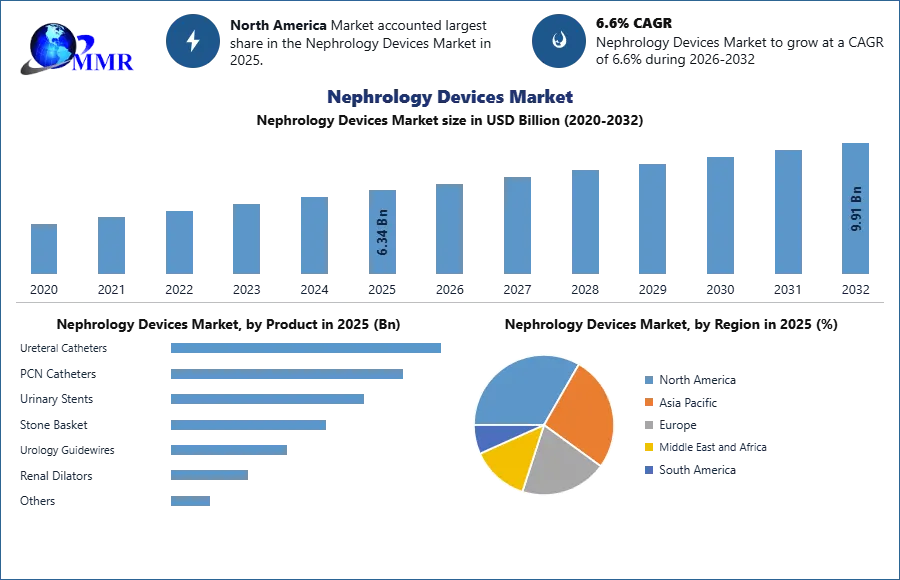 To know about the Research Methodology :- Request Free Sample Report
Market Dynamics:
The increase in the worldwide senior individuals, as well as the increased incidence of chronic kidney disease, are two main drivers driving the nephrological devices market. Furthermore, market growth is supported by developments in nephrology gadgets and high healthcare expenditure. The high cost of these devices, however, is restricting the global Nephrology Devices Market's growth. Equally, during the forecast period, an increase in awareness about the benefits of nephrology devices, such as shortened treatment and recovery time among renal disease patients, is expected to present lucrative prospects.
Renal dysfunction, interstitial nephritis, chronic kidney disease, and other nephrological conditions produce abnormal kidney functioning, which can be lethal. As a result, nephrological devices such as dialysis machines and lithotripters are frequently used to treat these conditions effectively. These devices also serve several purposes in the treatment of nephrological diseases. Dialysis machines, for example, are used to filter solutes, toxins, and water out blood in patients with kidney failure, diabetes, heart failure, and various others. This factor is further estimated to stimulate market growth.
Furthermore, various manufacturers collaborating with significant medical device distributors to promote and supply their products worldwide or in certain areas. As a consequence, they frequently form strategic agreements. These partnerships not only assist manufacturers in obtaining the necessary licenses to market their products but also minimize their liability in the event of a product recall or adverse occurrence.
For instance, in February 2019, Coloplast signed a three-year collaboration for its urological products with Premier, Inc., a healthcare improvement organization based in the US. Moreover, through, its subsidiary in the US., Terumo Corp., a Japanese corporation, acquired Sequent Medical, a medical device maker based in the US. As a result, global players are relocating their manufacturing operations nationwide.
Global Nephrology Devices Market Segment Analysis:
The dialysis instrument segment is anticipated to adhere to the growth of the Nephrology Devices Market.
In 2025, the dialysis instrument held the largest proportion of the nephrology devices market, and it is expected to grow at the fastest rate in the during the forecast period. This is due to the rising demand for these machines in emerging economies such As India, where the number of patients requiring hemodialysis is rising. As a result, there has been an increase in the procurement of hemodialysis equipment, which has contributed to the segment's growth. For example, the Telangana State Government in India gave 268 single-use hemodialysis machines to 39 institutions in July 2017.
As a consequence, there has been an increase in the purchase of hemodialysis machines, which has led to the segment's growth. For illustrate, the Telangana State Government in India gave 268 single-use hemodialysis machines to 39 institutions in July 2017. Therefore, this helped in the upgrading of services provided by the hospitals to the hemodialysis patients. Other factors propelling the growth of the nephrology devices market include heightened understanding of the use of nephrology devices in the treatment of renal illnesses. In particular, the rising prevalence of chronic kidney disease (CKD) contributes to the market's development. For example, As per National Kidney Foundation, Inc., 37 million American adults are suffering from Chronic Kidney Diseases.
Regional Segment:
North America dominated the Nephrology Equipment Market and is projected to continue to do so due to the wide availability of nephrology devices. Additionally, an increase in the geriatric population, which is more susceptible to nephrological problems, is a key factor driving market growth in North America. However, resulting in an increase in awareness about the utilization of nephrology devices, Asia-Pacific is forecasted to rise the quickest over the projected timeframe. Developing economies provide the lucrative business potential for nephrology device manufacturers.
Asia Pacific is predicted to have the highest CAGR of 8.6% from 2026 to 2032. Resulting in multiple factors such as rising knowledge about kidneys and urine problems, rising healthcare expenditure levels, and better healthcare facilities in the area. The regional market is also being driven by the rising prevalence of benign prostatic hyperplasia (BPH), spinal cord injury, and urinary tract infection (UTI). One of the most common infectious disorders in the region is urinary tract infection (UTI). Other reasons driving product demand in APAC include the urgent need for the development of new systems as well as the replacement and upgrade of existing medical infrastructure providers to expand their business.
The objective of the report is to present a comprehensive analysis of the Global Nephrology Devices Market to the stakeholders in the industry. The past and current status of the industry with the forecasted market size and trends are presented in the report with the analysis of complicated data in simple language. The report covers all the aspects of the industry with a dedicated study of key players that include market leaders, followers, and new entrants.
PORTER, SVOR, PESTEL analysis with the potential impact of micro-economic factors of the market have been presented in the report. External as well as internal factors that are supposed to affect the business positively or negatively have been analyzed, which will give a clear futuristic view of the industry to the decision-makers.
The report also helps in understanding the Global Nephrology Devices Market dynamics, structure by analyzing the market segments and project the Global Nephrology Devices Market size. Clear representation of competitive analysis of key players by Grade, price, financial position, Grade portfolio, growth strategies, and regional presence in the Global Nephrology Devices Market make the report investor’s guide.
Global Nephrology Devices Market Scope: Inquire before buying
| Nephrology Devices Market | |||
|---|---|---|---|
| Report Coverage | Details | ||
| Base Year: | 2025 | Forecast Period: | 2026-2032 |
| Historical Data: | 2020 to 2025 | Market Size in 2025: | 6.34 USD Billion |
| Forecast Period 2026-2032 CAGR: | 6.6% | Market Size in 2032: | 9.91 USD Billion |
| Segments Covered: | by Product | Ureteral Catheters PCN Catheters Urinary Stents Stone Basket Urology Guidewires Renal Dilators Others |
|
| by Application | Urolithiasis Urological Cancer & BPH Bladder Disorders Kidney Diseases Others |
||
| by End-use | Hospitals Clinics Ambulatory Surgical Centers Others |
||
Global Nephrology Devices Market, by Region
North America (United States, Canada and Mexico)
Europe (UK, France, Germany, Italy, Spain, Sweden, Austria and Rest of Europe)
Asia Pacific (China, South Korea, Japan, India, Australia, Indonesia, Malaysia, Vietnam, Taiwan, Bangladesh, Pakistan and Rest of APAC)
Middle East and Africa (South Africa, GCC, Egypt, Nigeria and Rest of ME&A)
South America (Brazil, Argentina and Rest of South America)
Key players/Competitors profiles covered in the Global Nephrology Devices Market report in strategic perspective
- Fresenius Medical Care AG & Co. KGaA
- Baxter International Inc.
- Braun Melsungen AG
- Nipro Corporation
- Asahi Kasei Corporation
- Medtronic plc
- Boston Scientific Corporation
- Coloplast A/S
- Cook Group, Inc.
- Teleflex Incorporated
- Hollister Incorporated
- R. Bard (BD)
- Becton, Dickinson & Co. (BD)
- Terumo Corporation
- Olympus Corporation
- Karl Storz GmbH & Co. KG
- Dornier MedTech GmbH
- Richard Wolf GmbH
- Cantel Medical Corporation
- McKesson Corporation
- Cardinal Health, Inc.
- Medline Industries, Inc.
- Owens & Minor, Inc.
- NxStage Medical, Inc.
- Richard Wolf Medical Instruments