
Natural Fragrance Ingredients Market by Product Type, Application, End User and Region - Global Market Size Estimation, Industry-Wide Analysis, Competitive Landscape Assessment & Long-Term Forecast to 2032
Overview
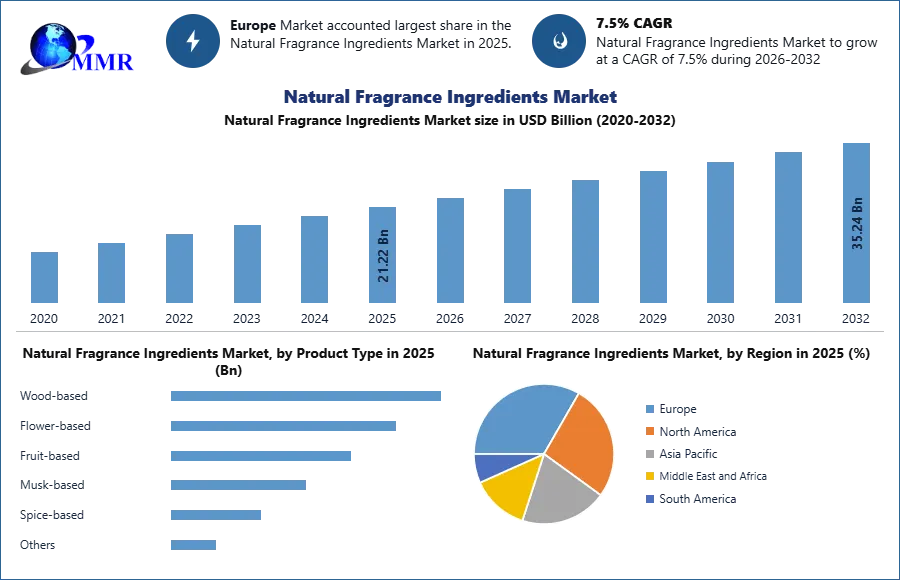
Natural Fragrance Ingredients Market size was valued at USD 21.22 Billion in 2025 and the total revenue is expected to grow at a CAGR of 7.5% from 2025 to 2032, reaching nearly USD 35.24 Billion by 2032.
Natural Fragrance Ingredients Market Overview:
The Natural fragrances are perfumes made from natural and organic sources from the environment. The human body uses the aromatic molecules contained in these natural fragrances either by the senses of the sense of smell or by absorption through the skin. These fragrances are in strong consumer demand due to the increased awareness of the use of natural and synthetic fragrances and the low toxicity of these compounds. Essential oils and extracts are the main sources used to give substrates and perfumes a natural scent. Many natural fragrances are rarely found, so they are more valuable than synthetic fragrances. The demand for natural fragrances has been growing steadily, driven by the increasing consumer preference for products made from eco-friendly and sustainable ingredients. Unlike synthetic fragrances, which may contain chemicals that can irritate the skin or cause allergic reactions, natural fragrances are perceived as safer and healthier. Consumers are becoming more aware of the impact of synthetic chemicals on their health and the environment, which has boosted the demand for natural alternatives.
Essential oils such as lavender, rose, jasmine, and sandalwood, as well as plant extracts, are popular raw materials used in crafting these fragrances. The growing trend of "clean beauty" and wellness also contributes to the rise in popularity of natural fragrances, especially in products like skincare, body care, and home fragrance. Additionally, the increasing use of natural fragrances in the food and beverage industry, as well as in aromatherapy, highlights their versatility and expanding market potential. These factors make natural fragrances a significant part of the global fragrance industry.
To know about the Research Methodology:- Request Free Sample Report
Natural Fragrance Ingredients Market Dynamics
Trend: The Rise of Clean Beauty and Wellness Movement
The natural fragrance ingredients market is increasingly being influenced by the rise of the clean beauty and wellness movement. Consumers are gravitating toward products that not only offer beauty benefits but are also free from harmful chemicals and synthetics. This trend is particularly evident in skincare, personal care, and cosmetics, where natural fragrances are replacing synthetic ones. Consumers are now more conscious of the ingredients used in the products they apply to their bodies and are actively seeking out brands that promote transparency in sourcing and production. With growing awareness about the potential risks of synthetic chemicals, the demand for natural ingredients, including fragrances, continues to increase.
The clean beauty movement has led to a shift in consumer preferences toward products that are organic, cruelty-free, and non-toxic. Natural fragrances, made from plant-based essential oils and extracts, fit perfectly into this trend by providing a safer alternative to chemical-based perfumes and body care products. Moreover, many beauty brands are incorporating essential oils and plant-based fragrance blends to align with consumers' values of sustainability and health. As a result, the demand for natural fragrances is expected to grow as consumers increasingly opt for clean, green, and holistic beauty solutions.
Driver: Increased Consumer Awareness of Health and Environmental Concerns
One of the key drivers of the natural fragrance ingredients market is the growing consumer awareness of health and environmental concerns. Modern consumers are more informed than ever about the potential risks posed by synthetic chemicals in personal care products, including fragrances. These synthetic fragrances can contain allergens, irritants, and endocrine-disrupting chemicals, which can negatively impact health over time. This has prompted consumers to seek out natural alternatives that are perceived as safer, healthier, and more sustainable.
In particular, fragrances made from essential oils and plant extracts offer numerous benefits, such as being biodegradable, non-toxic, and free from harmful chemicals. As consumers continue to prioritize their health and well-being, they are increasingly choosing products with natural fragrances that are free from parabens, phthalates, and other synthetic additives. This awareness has led to a surge in demand for natural fragrance-based products, including perfumes, cosmetics, cleaning products, and home fragrances. Furthermore, natural fragrances are often considered more eco-friendly as they are derived from renewable resources and have a lower environmental footprint compared to synthetic fragrances, making them a preferred choice among environmentally conscious consumers.
Restraint: Limited Availability and High Cost of Raw Materials
Natural fragrance ingredients, such as essential oils, plant extracts, and floral absolutes, are sourced from specific plants or flowers, many of which are seasonal or geographically restricted. For example, ingredients like rose, jasmine, or sandalwood are difficult to cultivate on a large scale and are subject to variations in availability due to climate conditions, crop yields, and sustainability concerns. Additionally, the extraction process for these ingredients can be labor-intensive and costly, further driving up the price of natural fragrance products.
The high cost of raw materials makes it challenging for manufacturers to produce affordable natural fragrance-based products, which may deter some consumers from making the switch from synthetic fragrances. Moreover, as natural ingredients are rarer and more expensive, companies may face difficulties in maintaining consistent supply chains, particularly as demand for natural fragrances continues to rise. This could lead to price volatility and a lack of product availability, which may limit the growth potential of the market in the short term. Additionally, the production costs for natural fragrances may hinder smaller brands from entering the market, creating a barrier to competition and innovation.
Natural Fragrance Ingredients Market Segment Analysis:
Based on Product Type, Flowers dominated Natural Fragrance Ingredients Market in 2025. Flowers are a rich source of aromatic compounds, making them highly sought after for perfumes, cosmetics, and personal care products. Key flowers like rose, jasmine, lavender, and geranium are widely used in the production of natural fragrances due to their strong, pleasant scents and cultural significance. These floral fragrances are often associated with luxury, romance, and freshness, which are highly valued in the fragrance industry.
Flower-based natural fragrances offer a wide range of scent profiles, from sweet and soft to fresh and powdery, catering to a diverse set of consumer preferences. They are primarily used in high-end perfumes and personal care products due to their complexity and the high cost of obtaining these fragrances from flowers. The extraction process, such as steam distillation or solvent extraction, ensures that the natural essence of the flower is captured. Additionally, with growing awareness of the benefits of clean and natural beauty, floral-based fragrances are preferred for their natural, non-toxic qualities. This demand has made flower-based fragrances the dominant product type in the natural fragrance ingredients market, and their popularity is expected to continue growing.
Based on the source, in the natural fragrance ingredients market, essential oils stand out as the most dominant source due to their versatility, aromatic strength, and widespread availability. Essential oils are extracted from various parts of plants such as flowers, leaves, stems, and roots, and they are used as the core ingredient in many natural fragrances. These oils provide a powerful and long-lasting scent profile, which is why they are commonly found in perfumes, cosmetics, and aromatherapy products.
Essential oils like lavender, peppermint, eucalyptus, sandalwood, and citrus are some of the most widely used in the fragrance industry. Their popularity is driven by their pure, concentrated nature, making them highly effective in creating distinctive and personalized fragrance blends. Moreover, essential oils are a key component in the growing trend of wellness and clean beauty, as consumers are increasingly opting for products with natural, sustainable ingredients.The ability to blend various essential oils to create unique fragrances, along with their perceived health benefits (such as stress relief or mood enhancement), has led to their dominance in the natural fragrance market. The ease of extraction through methods like steam distillation also makes essential oils a readily available and cost-effective choice for many manufacturers, further solidifying their position as the leading source in the natural fragrance ingredients market.
Natural Fragrance Ingredients Market Regional Insights:
Europe region dominated the market with a 43 % share in 2025 and is expected to continue its dominance over the forecast period. The natural fragrance ingredients market in Europe is experiencing significant growth, driven by increasing consumer demand for sustainable and health-conscious products. European consumers are becoming more aware of the potential risks associated with synthetic fragrances, such as allergens and chemicals that may cause skin irritation or other health issues. As a result, there is a growing shift towards natural alternatives derived from plant extracts, essential oils, and floral waters, which are considered safer and more eco-friendly. The clean beauty movement, which emphasizes non-toxic and organic ingredients, is particularly strong in Europe, influencing the rising demand for natural fragrance-based products in cosmetics, personal care, and home fragrance markets.
In North America, the rising application of natural fragrance ingredients in products such as soaps and detergents, and cosmetics and toiletries are major drivers in the market. The rising cases of skin allergies are driving the demand for natural fragrance ingredients in cosmetic and personal care products. The rising prevalence of skin diseases in the region is expected to increase the adoption of natural fragrance ingredients in cosmetics and toiletries.
Recent Developments
3 Feb 2026: Givaudan's USD 110 Million Investment in Mexico
On 3 February 2026, Givaudan announced a USD 110 million investment to build a new fragrance compounding facility in Mexico. This strategic move is designed to enhance Givaudan’s ability to meet the growing demand for natural and crafted fragrance ingredients in the global market. The new facility will strengthen its production footprint, providing increased supply chain flexibility and reducing logistics costs and emissions. This investment aligns with Givaudan’s goal of improving supply agility and bolstering its capacity to serve both existing and emerging markets. The move is part of the company’s broader strategy to integrate sustainability into its operations, ensuring that its ingredients are produced with minimal environmental impact. By expanding its manufacturing capabilities in Latin America, Givaudan is positioning itself to cater to the increasing consumer demand for clean-label and natural fragrance solutions while enhancing its operational efficiency in a rapidly evolving industry.
7 Mar 2026: dsm‑Firmenich’s Antitrust Investigation by India’s CCI
On 7 March 2026, dsm‑Firmenich became embroiled in a major antitrust investigation by India’s Competition Commission (CCI), alongside Givaudan and IFF, over alleged anti‑poaching agreements. These agreements are believed to date back to the early 2000s, a period when many fragrance companies were involved in collaborative hiring practices to prevent the poaching of top executives and industry talent. This investigation represents a significant development in the fragrance sector, as it brings attention to the competitive practices and potential anti‑competitive behaviors within the industry. The CCI’s scrutiny could lead to regulatory consequences that may reshape the competitive dynamics of the fragrance industry, forcing major players to adapt their employment and recruitment policies. The probe underscores the growing importance of ethical business practices and regulatory compliance as the fragrance industry faces increased global oversight.
Natural Fragrance Ingredients Market Scope: Inquire before buying
| Natural Fragrance Ingredients Market | |||
|---|---|---|---|
| Report Coverage | Details | ||
| Base Year: | 2025 | Forecast Period: | 2026-2032 |
| Historical Data: | 2020 to 2025 | Market Size in 2025: | 21.22 USD Billion |
| Forecast Period 2026-2032 CAGR: | 7.5% | Market Size in 2032: | 35.24 USD Billion |
| Segments Covered: | by Product Type | Wood-based Flower-based Fruit-based Musk-based Spice-based Others |
|
| by Source | Plant Extracts Essential Oils Natural Resins & Balsams Floral Waters Others |
||
| by Application | Soaps & Detergents Fine Fragrances / Perfumes Cosmetics & Toiletries Candles & Incense Air Fresheners Household Care Products Others |
||
| by End User | Personal Care Home Fragrance Cosmetics Food & Beverage Others |
||
Natural Fragrance Ingredients Market, by Region
North America (United States, Canada and Mexico)
Europe (UK, France, Germany, Italy, Spain, Sweden, Austria and Rest of Europe)
Asia Pacific (China, South Korea, Japan, India, Australia, Indonesia, Malaysia, Vietnam, Taiwan, and Rest of APAC)
Middle East and Africa (South Africa, GCC, Egypt, Nigeria and Rest of ME&A)
South America (Brazil, Argentina Rest of South America)
Key players/Competitors profiles covered in the Natural Fragrance Ingredients Market report in strategic perspective
- Givaudan SA
- Firmenich SA
- Huabao International
- Symrise AG
- Takasago International
- BASF SE
- Sensient Flavors and Fragrances
- International Flavors and Fragrances
- Frutarom Industries Ltd.
- Mane SA
- Sensient Flavors and Fragrances
- Synthite
- Pour le Monde Parfums
- S H Kelkar and Company Limited
- Robertet Fragrances
- Hasegawa Co., Ltd.
- Treatt
- Takasago International Corporation
- Bell Flavors & Fragrances
- Austrian Aromas
- Vigon International
- Worlée-Chemie GmbH
- The Green Chemistry Company
- Chengdu ZY Natural Ingredients Co., Ltd.
- Nicolas L. Taleb
- Sambavan Flavours & Fragrances Pvt. Ltd.
- Indukern
- Kraton Polymers
- Austrian Aromas
- Oriflame