
Global Nano Batteries Market Size by Type, Application, Technology, Region and Forecast 2034
Overview
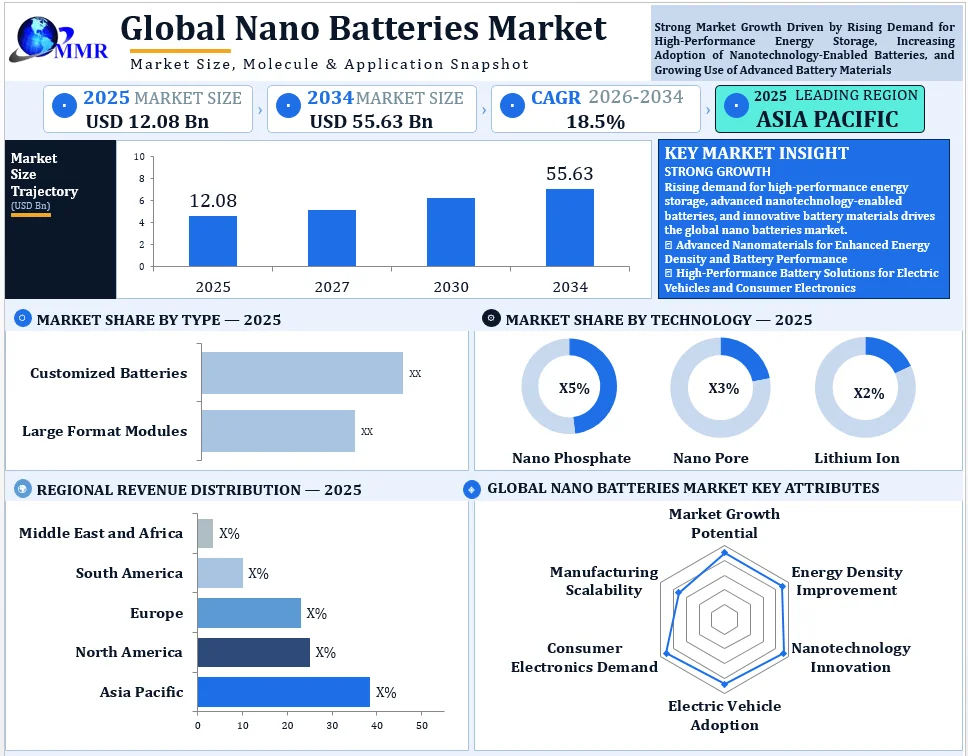
The Global Nano Batteries Market is projected to reach USD 12.08 billion in 2025 and USD 55.63 billion by 2034, growing at a CAGR of 18.5% from 2026 to 2034.
Global Nano Batteries Market Overview
The market experiences strong growth through increasing demand for high-performance energy storage solutions, miniaturized electronic devices, electric vehicles, and portable consumer electronics. Nanotechnology improves battery performance by enhancing electrode conductivity, increasing energy density, enabling faster charging, and extending battery lifespan. These advantages support the adoption of nano batteries in applications requiring compact designs, efficient power delivery, and reliable energy storage.
Growing applications in medical devices, wearable electronics, aerospace systems, and renewable energy storage further strengthen market demand. Medical devices and wearable technologies increasingly require compact batteries that provide consistent power while occupying minimal space. Similarly, electric vehicles and renewable energy systems create demand for advanced battery technologies that support improved energy efficiency, charging performance, and operational reliability.
Advancements in nanomaterials, including carbon nanotubes, graphene, and silicon-based nanostructures, contribute to improvements in electrode performance, energy storage capacity, and charge transfer. Manufacturers focus on developing innovative electrode materials and nanostructured battery components to improve battery efficiency and support diverse application requirements. Increasing investments in battery research, electric mobility, and next-generation energy storage technologies also encourage product innovation and commercialization. These developments strengthen the role of nano batteries across consumer electronics, transportation, healthcare, and industrial energy storage applications.
Key Highlights of the Global Nano Batteries Market
• Strong Market Growth: The Global Nano Batteries Market reaches USD 12.08 billion in 2025 and is projected to reach USD 55.63 billion by 2034, registering a CAGR of 18.5% from 2025 to 2034.
• Customized Batteries Lead by Type: The Customized Batteries segment dominates the market, supported by growing demand for compact, lightweight, and application-specific batteries for smartphones, laptops, tablets, and wireless power tools.
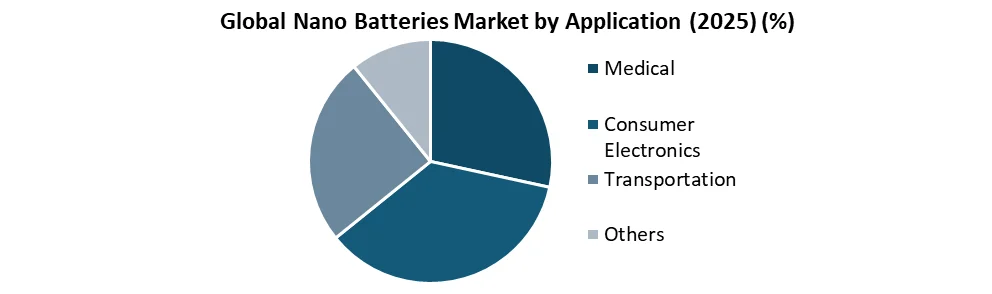
• Consumer Electronics Leads by Application: The Consumer Electronics segment dominates due to increasing demand for portable electronic devices, wearable technologies, faster charging, and longer battery operating life.
• Asia Pacific Leads Regionally: Asia Pacific leads the market through strong electronics manufacturing, expanding electric vehicle adoption, and investments in advanced battery technologies across China, Japan, South Korea, and India.
• Nanomaterial Innovation Creates Growth Opportunities: Advancements in graphene, carbon nanotubes, and silicon-based nanostructures improve electrode conductivity, energy density, charging performance, and battery lifespan, supporting adoption across transportation, medical devices, consumer electronics, and energy storage.
Global Nano Batteries Market Growth and Share Analysis
To know about the Research Methodology :- Request Free Sample Report
Nano Batteries Market Dynamics:
Global Nano Batteries Market Drivers
Increasing Demand for High-Performance Energy Storage Solutions: The global nano batteries market experiences growth through increasing demand for high-energy-density batteries, faster charging capabilities, and improved battery lifespan. Nanomaterials such as graphene, carbon nanotubes, and silicon nanostructures enhance electrode conductivity, accelerate charge transfer, and improve energy storage performance. Electric vehicles, portable electronics, medical devices, and industrial equipment increasingly require compact and efficient energy storage solutions. Global electric vehicle sales exceed 17 million units in 2024, accounting for more than 20% of new car sales worldwide, strengthening demand for advanced battery technologies. Nano-enabled battery materials support the development of lightweight batteries with improved performance, higher energy efficiency, and enhanced charging capabilities for electric mobility and portable electronic applications.
Growing Adoption of Nanotechnology in Electric Vehicles and Consumer Electronics: Increasing adoption of electric vehicles, wearable devices, smartphones, and portable medical equipment strengthens demand for nano batteries. Nanostructured electrodes improve electrical conductivity and facilitate faster charge transfer, supporting enhanced battery performance in compact electronic devices. Global electric vehicle battery demand continues to expand alongside rising electric vehicle production and increasing battery capacity requirements in 2025 and beyond. Manufacturers increasingly explore nanotechnology-based electrode materials to improve battery capacity, reduce charging time, and support longer operating cycles. These developments strengthen the application of nano batteries across transportation, consumer electronics, and next-generation energy storage systems.
Global Nano Batteries Market Restraints
High Manufacturing Costs and Complex Production Processes: The nano batteries market faces challenges associated with the high cost of nanomaterial synthesis, specialized electrode manufacturing, and precision-controlled production processes. Materials such as graphene, carbon nanotubes, and silicon nanostructures require specialized processing and strict quality-control procedures to achieve consistent battery performance. These requirements increase manufacturing complexity and limit cost competitiveness against conventional battery technologies, particularly in price-sensitive consumer electronics and mass-market transportation applications. Manufacturers also face challenges in scaling nanomaterials into commercially viable battery products while maintaining consistent performance, production yields, and product reliability. Manufacturing costs, production scalability, and material consistency therefore remain important barriers to broader commercialization.
Technical Limitations and Battery Performance Stability: Nano batteries face technical challenges related to electrode degradation, material expansion, thermal management, and long-term cycling stability. Silicon-based nanostructures offer high theoretical lithium-storage capacity, but repeated charging and discharging cause volume changes that can damage electrode structures and reduce battery performance. Nanomaterial integration also requires careful control of particle size, electrode composition, and material distribution to maintain consistent electrochemical properties. Manufacturers invest in advanced electrode engineering, protective coatings, and improved battery architectures to address these limitations. Continued improvements in durability, safety, and manufacturing consistency remain essential for expanding commercial applications across electric vehicles, industrial equipment, and portable electronics.
Global Nano Batteries Market Opportunities
Expansion of Renewable Energy Storage and Grid Modernization: Increasing renewable energy deployment creates opportunities for nano batteries in stationary energy storage, grid stabilization, and backup power systems. Solar and wind installations require efficient energy storage technologies to manage fluctuations in electricity generation and improve power availability. Nanomaterials support the development of batteries with improved charging performance, energy efficiency, and operational durability. Advanced electrode materials and nanostructured battery architectures create opportunities for manufacturers to serve renewable energy developers, utilities, and industrial power users. Growing investment in grid modernization, distributed energy systems, and renewable power infrastructure in 2025 and beyond further strengthens demand for high-performance battery technologies.
Advancements in Graphene and Silicon-Based Battery Technologies: Continuous innovation in graphene, carbon nanotubes, silicon nanowires, and nanophosphate materials creates opportunities to improve battery energy density, charging speed, and operating performance. Graphene-based conductive additives enhance electrical conductivity, while silicon-based anode materials offer the potential to increase lithium-storage capacity. These technologies support the development of advanced batteries for electric vehicles, aerospace equipment, wearable electronics, and industrial applications. Collaboration among battery manufacturers, nanomaterial suppliers, and research institutions accelerates material development and commercialization. Improvements in scalable production methods and cost-efficient electrode manufacturing further expand the adoption of nano batteries across emerging energy storage applications.
Global Nano Batteries Market Challenges
Raw Material Supply and Price Volatility: The nano batteries market faces challenges associated with the availability, processing, and pricing of specialized nanomaterials. Graphene, carbon nanotubes, silicon-based materials, and other advanced electrode components require controlled production processes and consistent material quality. Dependence on specialized suppliers exposes manufacturers to supply disruptions, fluctuating input costs, and procurement delays. Material purity and particle characteristics also influence electrode performance, making supplier qualification and quality assurance essential. Manufacturers increasingly focus on diversified sourcing, material optimization, and improved production methods to strengthen supply-chain resilience and reduce dependence on limited sources of advanced battery materials.Commercialization, Standardization, and Recycling Limitations: The commercialization of nano batteries requires consistent performance validation, safety testing, manufacturing standards, and reliable end-of-life management. Differences in nanomaterial composition and electrode design create challenges in establishing standardized testing procedures across battery technologies. Manufacturers also evaluate the environmental impact of nanomaterial production, battery disassembly, and material recovery. Recycling processes require suitable methods to recover valuable battery materials while managing nanoscale components safely. Improvements in standardized testing, recycling infrastructure, and environmentally responsible manufacturing support broader adoption and strengthen the long-term sustainability of nano battery technologies.
Global Nano Batteries Market Segment Analysis:
By Type: The Customized Batteries segment dominates the Global Nano Batteries Market, driven by increasing demand for compact, lightweight, and application-specific energy storage solutions. The segment includes customized batteries used in wireless power tools, laptops, smartphones, tablets, and other electronic devices. Growing adoption of portable electronics and continuous advancements in nanomaterials support improvements in energy density, charging efficiency, battery performance, and operating life. Meanwhile, Large Format Modules support demand for higher-capacity energy storage across transportation and other applications.
By Application: The Consumer Electronics segment dominates the Global Nano Batteries Market, supported by rising demand for smartphones, tablets, laptops, wearable devices, and other portable electronic products. The Medical segment benefits from the growing use of compact batteries in medical devices and portable diagnostic equipment, while the Transportation segment offers strong growth opportunities through increasing electric vehicle adoption, electric bus development, and government initiatives promoting cleaner mobility. Nano batteries support demand for improved energy density, faster charging, and efficient power delivery, while the Others segment includes additional industrial and specialized applications that require compact and high-performance energy storage solutions.
Nano Batteries Market Regional Insights:
Asia Pacific leads the Global Nano Batteries Market, driven by strong electronics manufacturing, increasing electric vehicle adoption, and growing investments in advanced battery technologies. China, Japan, South Korea, and India support regional growth through expanding consumer electronics production, electric mobility initiatives, and advancements in nanomaterials. Rising demand for smartphones, wearable devices, medical equipment, and energy-efficient storage solutions further strengthens the region's market position.
North America holds a significant share of the Global Nano Batteries Market, supported by technological innovation, electric vehicle development, and increasing demand for high-performance energy storage. The United States and Canada contribute through investments in battery research, advanced manufacturing, medical devices, and portable electronics. Growing interest in lightweight batteries, faster charging, and improved energy density supports regional market expansion.
Europe demonstrates strong growth potential in the Global Nano Batteries Market, driven by electric mobility, sustainability initiatives, and advancements in battery engineering. Germany, France, and the United Kingdom support demand through automotive manufacturing, industrial electrification, and consumer electronics applications. The region's focus on reducing transportation emissions and developing efficient energy storage technologies encourages the adoption of nano batteries.
South America experiences growing interest in the Global Nano Batteries Market, supported by increasing consumer electronics demand, electric mobility initiatives, and the gradual development of battery-related infrastructure. Brazil and other regional markets contribute through automotive manufacturing, electronics consumption, and investments in cleaner transportation. Expanding demand for portable electronic devices and energy-efficient technologies creates opportunities for nano battery adoption.
Middle East & Africa presents emerging opportunities in the Global Nano Batteries Market, supported by investments in renewable energy, infrastructure development, and economic diversification. Countries such as Saudi Arabia, the United Arab Emirates, and South Africa encourage demand through electric mobility initiatives, smart technologies, and industrial modernization. Increasing interest in advanced energy storage and efficient electronic devices supports regional market development.
Global Nano Batteries Market Competitive Landscape
The Global Nano Batteries Market features competition among battery manufacturers, nanomaterial developers, and energy storage technology providers. Market participants focus on improving energy density, charging speed, battery lifespan, and safety through nanotechnology innovations. Product development, strategic partnerships, and manufacturing advancements remain key strategies for strengthening market positions.
Key Competitive Strategies
• Nanomaterial Innovation: Companies integrate graphene, silicon nanostructures, and nanoporous materials to improve battery performance and charging efficiency.
• Product Customization: Manufacturers develop specialized batteries for consumer electronics, medical devices, wireless power tools, and transportation applications.
• Manufacturing Scalability: Industry participants optimize production processes to improve consistency, reduce costs, and support commercial adoption.
• Technology Advancement: Continuous development of nano-enabled lithium-ion, nano-phosphate, and nanoporous battery technologies supports product differentiation.
• Strategic Collaborations: Partnerships among battery manufacturers, nanomaterial developers, and automotive companies accelerate innovation and commercialization.
Competitive Outlook
The market's competitive position depends on nanotechnology innovation, cost-effective manufacturing, battery safety, and commercial scalability. Growing demand for consumer electronics and electric vehicles creates opportunities for companies that deliver compact, durable, and high-performance battery solutions.
Global Nano Batteries Market: Recent Developments
| Date | Company | Development | Impact |
|---|---|---|---|
| March 12, 2026 | Group14 Technologies | Begins EV-scale production of its SCC55 silicon battery material at its facility in South Korea, with a designed annual capacity of 2,000 metric tons. |
Supports large-scale production of high-performance silicon-based battery materials for electric vehicles, energy storage, and consumer electronics. |
| May 21, 2026 | X-BATT | Introduces Glassact, a silicon oxycarbide anode technology designed to improve battery capacity, charging performance, and material stability. |
Creates opportunities for higher-energy batteries across electric vehicles, consumer electronics, and industrial applications. |
| May 26, 2026 | POSCO Future M | Secures mass-production technology for silicon anode materials using silicon nano-sizing and carbon composite technologies. |
Strengthens the development of high-capacity batteries with improved charging performance and reduced silicon expansion. |
| May 28, 2026 | Forge Nano and Group14 Technologies | Establish a collaboration combining silicon battery materials, atomic layer deposition coatings, and domestic battery cell manufacturing capabilities. |
Supports improved battery durability, energy density, and manufacturing scalability. |
| June 8, 2026 | Cenate | Initiates collaborations with drone battery manufacturers to develop high-energy battery cells using its silicon anode materials. |
Supports lightweight batteries with greater energy density for drones and unmanned aerial vehicles. |
| June 25, 2026 | TRUNNANO | Launches a dedicated battery materials division focused on layered oxide cathode materials for sodium-ion batteries. |
Expands customized advanced-material solutions for next-generation battery manufacturing and energy storage. |
| August 10, 2026 | Graphene Manufacturing Group (GMG) | Updates the branding of its graphene-based aluminium-ion battery cells developed with the University of Queensland and supported by industry collaborators. |
Strengthens the company's focus on fast-charging battery technology and continued performance development. |
| August 20, 2026 | Asahi Kasei | Develops lithium pre-doping technology for silicon-rich lithium-ion batteries, reporting a 10% increase in energy density in internal cell testing. |
Addresses initial capacity loss in silicon-based batteries and supports higher energy density with existing manufacturing lines. |
| September 10, 2026 | NEO Battery Materials | Launches a 6.3 Ah silicon-enhanced cylindrical battery cell with a reported energy density of 307 Wh/kg. |
Strengthens battery solutions for drones, robotics, and other applications requiring high energy density. |
| October 21, 2026 | Graphene Manufacturing Group (GMG) | Begins providing its G®CELLS graphene-based aluminium-ion battery pouch cells to potential customers for early-stage testing and evaluation. |
Enables customer evaluation of fast-charging performance, cycle life, and energy efficiency ahead of further development and scale-up. |
Nano Batteries Market Scope: Inquire before buying
| Global Nano Batteries Market | |||
|---|---|---|---|
| Report Coverage | Details | ||
| Base Year: | 2025 | Forecast Period: | 2026-2034 |
| Historical Data: | 2020 to 2025 | Market Size in 2025: | US $ 12.08 Bn. |
| Forecast Period 2026 to 2034 CAGR: | 18.5% | Market Size in 2034: | US $ 55.63 Bn. |
| Segments Covered: | by Type | Large Format Modules Customized Batteries |
|
| by Application | Medical Consumer Electronics Transportation Others |
||
| by Technology | Nano Phosphate Nano Pore Lithium-ion |
||
Nano Batteries Market, by Region
North America (United States, Canada and Mexico)
Europe (UK, France, Germany, Italy, Spain, Sweden, Austria and Rest of Europe)
Asia Pacific (China, South Korea, Japan, India, Australia, Indonesia, Malaysia, Vietnam, Taiwan, Bangladesh, Pakistan and Rest of APAC)
Middle East and Africa (South Africa, GCC, Egypt, Nigeria and Rest of ME&A)
South America (Brazil, Argentina Rest of South America)
Nano Batteries Market Key Player
1. A123 Systems LLC
2. 3M Company
3. Front Edge Technology
4. mPhase Technologies Inc.
5. Altair Nanotechnologies Inc.
6. Evonik Industries AG
7. Sony Corporation
8. Next Alternative Inc.
9. Toshiba Corporation
10. Sinlion Battery Tech
11. Valence Technology Inc.
12. ZPower, LLC
13. Nano One Materials Corp.
14. Sila Nanotechnologies Inc.
15. 6K Inc.
16. HPQ Silicon Resources Inc.
17. TFP Hydrogen Products Ltd.
18. FaradPower, Inc.
19. Amprius Technologies, Inc.
20. Enovix Corporation
21. Group14 Technologies
22. Nexeon Limited
23. OneD Battery Sciences
24. NanoGraf Corporation
25. StoreDot Ltd.
26. Enevate Corporation
27. Panasonic Energy Co., Ltd.
28. Samsung SDI Co., Ltd.
29. LG Energy Solution Ltd.
30. Contemporary Amperex Technology Co., Limited (CATL)
31. BYD Company Limited
32. QuantumScape Corporation
33. Nanotech Energy, Inc.
34. XG Sciences, Inc.
35. Cabot Corporation
36. Arkema S.A.
37. Umicore
38. BASF SE
39. Shin-Etsu Chemical Co., Ltd.
40. BTR New Material Group Co., Ltd.
41. Daejoo Electronic Materials Co., Ltd.
42. NantG Power
43. Log9 Materials
44. Murata Manufacturing Co., Ltd.
45. GS Yuasa Corporation
46. EVE Energy Co., Ltd.
47. Sunwoda Electronic Co., Ltd.
48. Gotion High-Tech Co., Ltd.
49. SVOLT Energy Technology Co., Ltd.
50. Farasis Energy
51. Envision AESC
52. E-One Moli Energy Corp.
53. LeydenJar Technologies
54. E-magy
55. Paraclete Energy
Global Nano Batteries Market – Frequently Asked Questions
1. What is the projected size of the Global Nano Batteries Market by 2034?
Ans. The Global Nano Batteries Market is projected to reach USD 55.63 billion by 2034, registering a CAGR of 18.5% from 2025 to 2034.
2. What are the key factors driving the growth of the Global Nano Batteries Market?
Ans. The market is driven by increasing demand for high-performance energy storage, growing adoption of electric vehicles, rising consumption of portable electronic devices, and advancements in nanomaterials that improve battery efficiency and energy density.
3. Which segment dominates the Global Nano Batteries Market by type?
Ans. The Customized Batteries segment dominates the market due to increasing demand for compact, lightweight, and application-specific batteries for smartphones, laptops, tablets, and wireless power tools.
4. Which application segment dominates the Global Nano Batteries Market?
Ans. The Consumer Electronics segment dominates the market, supported by rising demand for portable electronic devices, wearable technologies, and batteries offering faster charging and longer operating life.
5. Which region leads the Global Nano Batteries Market?
Ans. Asia Pacific leads the market due to its strong electronics manufacturing base, increasing electric vehicle adoption, and investments in advanced battery technologies across China, Japan, South Korea, and India.
6. What are the major technologies used in the Global Nano Batteries Market?
Ans. Major technologies include nano-phosphate, nano-pore, and lithium-ion technologies, which support improvements in energy storage capacity, charging efficiency, battery performance, and durability.