
Multi-mode Baseband Unit (BBU) Market Size – Industry Structure Evaluation, Demand Drivers Analysis, Regional Growth Analysis and Identification, Competitive Positioning Review & Global Market Size Forecast to 2032
Overview
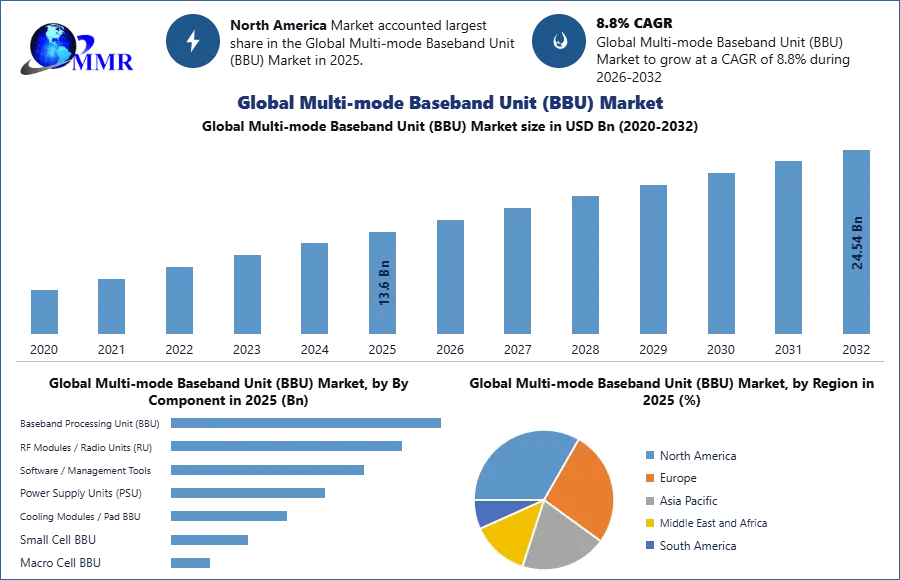
Global Multi-mode Baseband Unit (BBU) Market was valued at USD 13.6 Bn in 2025 and is expected to reach USD 24.54 Bn by 2032, at a CAGR of 8.8% during the forecast period.
The report covers the detailed analysis of the global multi-mode baseband unit industry with the classifications of the market on the basis of component, applications, end-users, and region. Analysis of past market dynamics from 2019 to 2024 is given in the report, which will help readers to benchmark the past trends with current market scenarios with the key players contribution in it.
The baseband unit transmits a signal at its original frequency without modulation. This is a common part of telecom systems that deliver signals through complex trajectories. The baseband unit commonly “runs” data to an RF system, as part of a wireless model.
The report has profiled major key players in the market from different regions. However, the report has considered all market leaders, followers, and new entrants with investors while analyzing the market and estimating the size of the same. The manufacturing environment in each region is different and focus is given on the regional impact on the cost of manufacturing, supply chain, availability of raw materials, labor cost, availability of advanced technology, trusted vendors are analyzed and the report has come up with recommendations for a future hot spot in North America region. Major country’s policies about manufacturing and its impact on market demand are covered in the report.
Global Multi-mode Baseband Unit Market Dynamics
Global multi-mode BBU market is expected to grow at a CAGR of XX% during the forecast period. Technological evolution in the telecom sector and the increasing use of wireless devices for communication are the major driving factors for the growth of Multi-mode BBU across the globe. The BBU is highly adopted by the commercial sector due to low power consumption, small size, modular design, easy deployment, and environment friendly. Penetration of pad BBU is expected to create new opportunities for the market as it makes less noise compared to other BBU and can be used in natural heat dissipation and IP65 protection applications.
Segment Analysis of Global Multi-mode Baseband Unit Market
In 2025, the Baseband Processing Unit (BBU) segment remains the core driver of the market, as it handles the transmission of signals at their original frequency without modulation. RF Modules / Radio Units are increasingly in demand for deployments that require high-frequency support and improved signal quality. Software and Management Tools are rapidly adopted for monitoring, optimization, and automated control of network systems. Power Supply Units and Cooling Modules, particularly Pad BBUs, are favored for energy efficiency, low-noise operation, and IP65 protection in challenging environments. Macro Cell BBUs dominate large-scale network deployments, while Small Cell BBUs are gaining traction in urban areas and dense network setups due to their compact size and modular design.
To know about the Research Methodology :- Request Free Sample Report
The commercial and enterprise segment dominates the market in 2025. Telecom operators and mobile network providers drive the largest demand, fueled by expanding mobile networks and growing traffic volumes. IT and enterprise networks adopt BBUs for data-intensive communications and backbone connectivity, while data centers leverage them for high-speed network operations. Industrial applications, including manufacturing and smart factories, are seeing steady adoption due to automation and IoT integration. Government and defense sectors utilize BBUs for military communications and emergency response networks. Healthcare and life sciences, particularly hospitals and telemedicine services, are emerging end-users, contributing to moderate market demand relative to commercial deployments.
Global Multi-mode Baseband Unit Market Regional Insights
North America leads the global multi-mode BBU market in 2025 due to advanced telecom infrastructure, early 5G adoption, and supportive policies for network modernization. Asia Pacific is a high-growth region, driven by expanding mobile penetration, industrial development, and government initiatives in countries like China and India. Europe shows stable demand, with Germany, the UK, and France as the primary contributors. South America and the Middle East & Africa exhibit moderate growth, primarily influenced by regional infrastructure investment, network modernization programs, and emerging market adoption. The report highlights North America as a potential future hotspot for investment due to favorable manufacturing environments, availability of advanced technology, and strong supply chain networks.
The objective of the report is to present a comprehensive analysis of the global multi-mode baseband unit market including all the stakeholders of the industry. The past and current status of the industry with forecasted market size and trends are presented in the report with the analysis of complicated data in simple language. The report covers all the aspects of the industry with a dedicated study of key players that includes market leaders, followers, and new entrants. PORTER, SWOT, PESTEL analysis with the potential impact of micro-economic factors of the market have been presented in the report. External as well as internal factors that are supposed to affect the business positively or negatively have been analyzed, which will give a clear futuristic view of the industry to the decision-makers. The report also helps in understanding global multi-mode baseband unit market dynamics, structure by analyzing the market segments and project global multi-mode baseband unit market clear representation of competitive analysis of key players by price, financial position, by detection and equipment portfolio, growth strategies, and regional presence in the global multi-mode baseband unit market make the report investor’s guide.
Scope of the Global Multi-mode Baseband Unit Market: Inquire before buying
| Global Multi-mode Baseband Unit (BBU) Market | |||
|---|---|---|---|
| Report Coverage | Details | ||
| Base Year: | 2025 | Forecast Period: | 2026-2032 |
| Historical Data: | 2020 to 2025 | Market Size in 2025: | 13.6 USD Bn |
| Forecast Period 2026-2032 CAGR: | 8.8% | Market Size in 2032: | 24.54 USD Bn |
| Segments Covered: | By Component | Baseband Processing Unit (BBU) RF Modules / Radio Units (RU) Software / Management Tools Power Supply Units (PSU) Cooling Modules / Pad BBU Small Cell BBU Macro Cell BBU |
|
| By Deployment | Single-mode BBU (specific frequency support) Multi-mode BBU (supports multiple frequencies / standards) Macro Cell Deployment Small Cell Deployment |
||
| By Technology Standard | 2G / GSM 3G / WCDMA 4G / LTE 5G / NR (New Radio) TD-LTE / FD-LTE |
||
| By End-User | Commercial / Enterprise Industrial Government / Defense Healthcare & Life Sciences |
||
Global Multi-mode Baseband Unit Market, by Region:
• North America
• Europe
• Asia-Pacific
• South America
• Middle East & Africa
| Exact Date | Company | Development | Impact |
|---|---|---|---|
| 17 February 2026 | Ericsson | Ahead of MWC 2026, Ericsson introduced a new suite of AI-ready radios and Silicon neural network accelerators designed for next-generation Massive MIMO baseband processing. | The integration of on-site AI inference enables real-time network optimization and a sevenfold increase in response times for high-bandwidth AI and AR applications. |
| 12 February 2026 | Samsung Electronics | Samsung successfully completed the industry's first commercial call on a Tier 1 U.S. operator’s live network using a vRAN solution powered by the Intel Xeon 6700P-B processor. | This breakthrough allows baseband, transport, and security functions to be fully integrated into a single-server environment, significantly reducing total cost of ownership (TCO). |
| 14 November 2025 | Ericsson | Ericsson established a dedicated RAN software R&D unit in Bengaluru, India, specifically focused on developing 5G-Advanced features for its Multi-mode Baseband Units. | The facility strengthens local manufacturing capabilities and accelerates the global rollout of ASIC-based compute platforms for high-efficiency network architectures. |
| 19 June 2025 | Huawei / China Telecom | At MWC Shanghai 2025, the partners debuted 5G-A Intelligent Ultra Pooling Uplink technology, utilizing AI-driven orchestration to decouple and pool uplink spectrum across bands. | This innovation improves cell-edge user experience by 15% and reduces end-to-end network latency by over 30%, facilitating the convergence of Mobile AI and 5G-A. |
| 28 February 2025 | ZTE Corporation | ZTE launched its latest generation all-RAT large-capacity BBU series, featuring industry-unique integrated 2G/3G/4G/5G multi-mode baseband boards. | The UniSite solution reduces the number of physical boards required at complex sites, achieving energy savings of 35-40% through the Super-N 2.0 amplifier innovation. |
| 01 January 2025 | Nokia | Nokia officially transitioned its operating model to include a new Mobile Infrastructure segment, unifying its Radio Networks and Technology Standards business units. | The reorganization is designed to capitalize on the AI hardware supercycle, targeting a comparable operating profit increase to over €2.7 billion by 2028. |
Key Players/Competitors Profile, Covered in Global Multi-mode Baseband Unit (BBU) Market Report, From A Strategic Perspective.
1. Huawei Technologies
2. Ericsson AB
3. Nokia Corporation
4. ZTE Corporation
5. Samsung Electronics
6. Cisco Systems, Inc.
7. Fujitsu Limited
8. NEC Corporation
9. CommScope Holding Company, Inc.
10. Mavenir Systems, Inc.
11. Altiostar Networks, Inc.
12. Airspan Networks Inc.
13. Parallel Wireless, Inc.
14. Radisys Corporation
15. Casa Systems, Inc.
16. Ceragon Networks Ltd.
17. JMA Wireless
18. Comba Telecom Systems Holdings Ltd.
19. Ciena Corporation
20. Juniper Networks, Inc.
21. Infinera Corporation
22. Viavi Solutions Inc.
23. Keysight Technologies
24. Alpha Networks Inc.
25. Sercomm Corporation