
Modular Construction Market Size by Type, Material Use, Distribution Channel, End-Use, Region – Segment-Level Market Assessment, Growth Opportunity Analysis, Competitive Mapping & Forecast to 2032
Overview
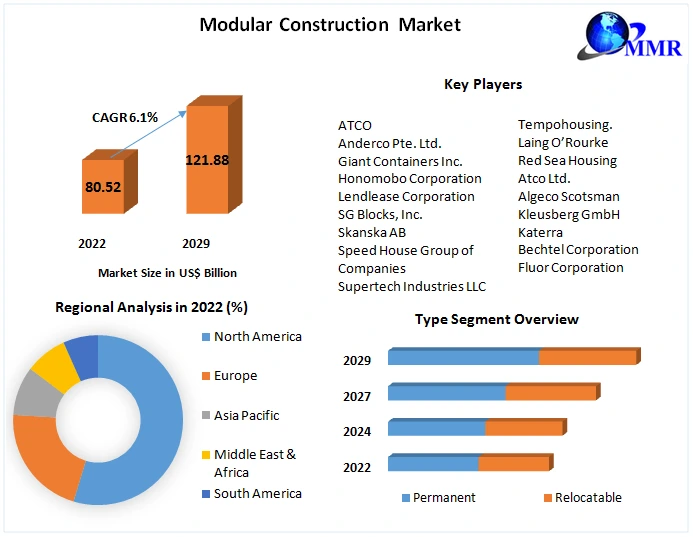
The Modular Construction Market size was valued at USD 96.17. Billion in 2025 and the total revenue is expected to grow at CAGR 6.1% from 2026 to 2032, reaching nearly USD 145.56 Billion.
The modular construction industry is rapidly transforming the global construction sector, offering a faster, more cost-effective, and sustainable alternative to traditional building methods. This growth is driven by factors such as rising urbanization, increasing demand for affordable housing, labor shortages in traditional construction, and the push for sustainable and green buildings. North America and Europe currently dominate the market due to stringent environmental regulations and technological advancements, while Asia-Pacific is the fastest-growing region due to government initiatives supporting prefabricated housing.
The demand for modular construction is primarily driven by residential (45%), commercial (30%), industrial (15%), and healthcare (10%) sectors. The highest consumption of modular construction solutions is seen in the United States, China, Germany, and the United Kingdom, with China alone contributing to nearly 40% of global modular production, mainly for affordable housing and infrastructure projects. The U.S. market accounts for over 25% of global demand, with states like California, Texas, and New York witnessing a significant shift towards modular high-rises, hotels, and schools. In Europe, Sweden, the UK, and Germany are leading the adoption of modular buildings due to their strict building regulations and government incentives for energy-efficient prefabricated structures.
In terms of production, China, the U.S., Germany, Japan, and Canada are the largest manufacturers of modular building components. China alone has over 3,000 modular construction factories, while the U.S. has around 400 specialized modular building manufacturing facilities. The global production capacity has increased by 30% over the past five years, driven by advancements in automation, robotics, and Building Information Modeling (BIM) technology.
 To know about the Research Methodology :- Request Free Sample Report
The cost of modular construction varies depending on materials, design complexity, and location. On average, modular buildings reduce construction costs by 20%-50% compared to traditional methods. The cost per square foot for modular homes ranges from $80 to $200, while modular commercial buildings range from $100 to $300 per square foot. The U.S. market sees higher modular construction costs due to labor expenses, whereas China offers more affordable prefabrication options due to lower material and labor costs. Material price fluctuations, especially for steel, concrete, and wood, significantly impact modular construction pricing. In 2023, steel prices increased by 15%, causing a slight rise in the cost of modular steel-based structures. However, the use of alternative materials like cross-laminated timber (CLT) and sustainable composites is helping stabilize prices.
Modular construction has achieved strong penetration in developed markets like the U.S. (30%), UK (35%), Sweden (45%), and Japan (50%), where governments actively promote prefabricated building solutions. In emerging markets like India, Brazil, and the Middle East, penetration remains below 15% but is growing rapidly due to infrastructure expansion projects. China leads in modular skyscraper construction, with over 200 high-rise modular buildings completed in the last decade. The hospitality sector is also a major driver, with companies like Marriott International constructing over 30% of its new hotels using modular methods.
The industry is experiencing rapid technological evolution, integrating robotic automation, artificial intelligence, digital twin technology, and 3D printing. The adoption of BIM (Building Information Modeling) has increased by over 40% in the last five years, improving design accuracy, cost forecasting, and project efficiency. 3D printing is also playing a crucial role, enabling the production of customized modular components at a reduced cost, with companies like Apis Cor and Winsun leading innovations in 3D-printed modular structures. The modular construction supply chain is becoming increasingly integrated, with companies shifting toward vertically integrated models to enhance efficiency and reduce dependencies on third-party suppliers. China, the U.S., Germany, Canada, and Japan lead in modular component production, with China having over 3,000 dedicated modular manufacturing facilities, while the U.S. houses around 400 specialized modular factories. Major suppliers of raw materials include Nucor Corporation (steel), Louisiana-Pacific Corporation (wood-based modular components), and Holcim (concrete materials). The industry is also witnessing significant investments from private equity and venture capital firms, particularly in sustainable and smart modular construction technologies.

Global Modular Construction Market Dynamics:
The global modular construction market is being driven by changing government policies to decrease construction waste and promote green buildings. For example, the Singapore government has mandated the use of PPVC (Pre-fabricated, pre-finished, volumetric construction) parts in a number of government-owned projects. Moreover, the government grants incentives to companies that standardise contemporary construction practises. During the forecast period 2025-2032, the modular construction market is expected to be driven by increased investment on R&D activities for novel construction solutions.
An increase in population and rapid urbanization drives the growth of the global modular construction market. According to MMR, more than two-thirds of the world's population is expected to live in cities by 2050. This tremendous growth will primarily occur in emerging countries. The fastest urban growth rates will be in Africa and Asia, both of which are still less urbanised than other regions. Africa's urban population is expected to increase from 40% today to 56% in 2050, while Asia's is expected to increase from 48% to 64%.
By 2032, US$57 trillion in global infrastructure investment would be required to support this rapid increase in urbanisation. More than 1 billion people live in housing that falls short of minimum comfort and sanitation standards, and 3 billion additional homes will be needed by 2032. These are the factors that are expected to boost the growth of the global modular construction market during the forecast period 2025-2032.
Modular Construction Market Segment Analysis:
Based on the Type, the market is segmented into Permanent, and Relocatable. Permanent modular construction type segment is expected hold the dominant market shares of xx% by 2032. Permanent modular construction (PMC) is a sustainable and creative building approach that prefabricates single or multi-story structures in modular pieces using offshore and lean manufacturing technologies. PMC can be shaped to integrate into an existing structure. PMC was utilised by the Hawaii Film Studio, for example, to satisfy tight deadlines and budget constraints. Healthcare facilities, hotels, schools, and restaurants are some of the examples of the permanent modular construction.
Based on the Material, the market is segmented into Steel, Wood, Concrete, and Others. Steel material segment is expected to grow rapidly at a CAGR of xx% during the forecast period 2026-2032. Steel has the highest share of the global modular construction market in terms of material consumption. It's well-known for its strength-to-weight ratio. Steel framed relocatable buildings provide a number of advantages over wood framed relocatable buildings. These qualities include design flexibility, strength, structural integrity, durability, security, and fire resistance, all of which reduce the need for repairs and maintenance over the life of the structure.
By End-Use Sector, the market is segmented into Residential Housing, Sports Facilities, Offices, Schools, and Others. Residential housing held the leading share under end-use sector owing to the rising need for quick, inexpensive, and environmentally friendly housing. Prefabricated modular homes are appealing in urban and high-demand locations owing to the less time required to construct than traditional methods. In order to effectively meet demand due to growing urbanization, housing constraints, and population growth, governments and developers are increasingly embracing modular solutions. Additionally, modular homes are affordable, energy-efficient, and adaptable, which appeals to both real estate investors and homeowners. Modular house usage is further boosted by the emergence of eco-friendly building and smart homes. Overall, residential modular construction has the biggest market share due to the demand for high-quality, scalable, and rapid housing solutions.
Modular Construction Market Regional Insights:
Asia Pacific dominated the Modular Construction market in 2025. The modular construction market in the Asia Pacific region is expanding rapidly, driven by increasing urbanization, the need for affordable housing, and the demand for quicker construction solutions. Countries like China, Japan, and India are leading the way, where modular construction techniques are being increasingly adopted in both residential and commercial sectors. In China, the government’s push for sustainable development and eco-friendly buildings is accelerating the adoption of modular methods. India is witnessing a surge in demand for modular construction due to its growing urban population and need for fast-tracked infrastructure projects. Japan, known for its innovative construction approach, is leveraging modular methods for earthquake-resistant buildings and disaster recovery efforts. The Asia Pacific market also benefits from significant investments in construction technology, such as automation and 3D printing, making modular construction more efficient and cost-effective. As the region focuses on sustainability and reducing construction timelines, the modular construction market is poised for substantial growth. The Asia Pacific region's economy has grown due to factors such as the ready supply of raw materials and labour, as well as advanced technologies and innovations. Asia Pacific was the fastest-growing region in terms of population and economic growth, according to the World Bank.
The objective of the report is to present a comprehensive analysis of the Global Modular Construction Market to the stakeholders in the industry. The past and current status of the industry with the forecasted market size and trends are presented in the report with the analysis of complicated data in simple language. The report covers all the aspects of the industry with a dedicated study of key players that include market leaders, followers, and new entrants.
PORTER, PESTEL analysis with the potential impact of micro-economic factors of the market have been presented in the report. External as well as internal factors that are supposed to affect the business positively or negatively have been analyzed, which will give a clear futuristic view of the industry to the decision-makers.
The reports also help in understanding the Global Modular Construction Market dynamic, structure by analyzing the market segments and project the Global Modular Construction Market size. Clear representation of competitive analysis of key players by product, price, financial position, product portfolio, growth strategies, and regional presence in the Global Modular Construction Market make the report investor’s guide.
Modular Construction Industry Ecosystem
Recent Developments
ATCO
April 2025 – ATCO expanded its modular construction capabilities with new modular housing solutions designed to address the growing demand for affordable housing. The company has partnered with various governmental and industrial organizations to provide rapid deployment of modular structures for workforce housing and emergency accommodation. ATCO’s focus is on sustainable construction methods, using energy-efficient designs and materials to meet increasing environmental standards in modular buildings.
Anderco Pte. Ltd.
March 2024 – Anderco launched a new line of eco-friendly modular homes using recycled materials and renewable energy solutions. They introduced smart home technologies in modular units, providing enhanced energy efficiency and reduced carbon footprints. Anderco is focusing on scaling up its modular construction projects in Southeast Asia, addressing both residential and commercial needs.
Modular Construction Market Scope: Inquiry Before Buying
| Modular Construction Market | |||
|---|---|---|---|
| Report Coverage | Details | ||
| Base Year: | 2025 | Forecast Period: | 2026-2032 |
| Historical Data: | 2020 to 2025 | Market Size in 2025: | 96.17 USD Billion |
| Forecast Period 2026-2032 CAGR: | 6.1% | Market Size in 2032: | 145.56 USD Billion |
| Segments Covered: | by Type | Permanent Modular Relocatable Modular |
|
| by Material Use | Wood Concrete Steel Others |
||
| by Distribution Channel | Offline Online |
||
| by End-Use | Hospitals Clinical Research laboratories Others |
||
Modular Construction Market, by Region
North America (United States, Canada and Mexico)
Europe (UK, France, Germany, Italy, Spain, Sweden, Austria and Rest of Europe)
Asia Pacific (China, South Korea, Japan, India, Australia, Indonesia, Malaysia, Vietnam, Taiwan, and Rest of APAC)
Middle East and Africa (South Africa, GCC, Egypt, Nigeria and Rest of ME&A)
South America (Brazil, Argentina Rest of South America)
Key players/Competitors profiles covered in the Modular Construction market report in strategic perspective
1) ATCO
2) Anderco Pte. Ltd.
3) Giant Containers Inc.
4) Honomobo Corporation
5) Bouygues Construction
6) Skyline Champion Corporation
7) Daiwa House Industry Co., Ltd.
8) WillScot Mobile Mini Holdings Corp.
9) Guerdon Modular Buildings
10) Red Sea International Company
11) Skanska AB
12) Algeco UK Limited
13) KLEUSBERG GmbH & Co. KG
14) Katerra
15) Bechtel Corporation
16) SG Blocks, Inc.
17) Modulex Modular Buildings Plc
18) Palomar Modular Buildings
19) System House R & C Co., Ltd.
20) Westchester Modular Homes
21) Koma Modular
22) DPR Construction
23) BAM Construct & Ventures UK Ltd.
24) Promat Shanghai Ltd.
25) GZI China
26) Henan K-Home Steel Structure Co., Ltd
27) Lian Sheng International
28) EPACK Prefab
29) Debrique Creative Labs PVT LTD
30) Pressmach Infrastructure Private Limited