
Matcha Market by Product, Form, Distribution Channel, and Region – Global Market Size Estimation, Industry-Wide Analysis, Competitive Landscape Assessment & Long-Term Forecast to 2032
Overview
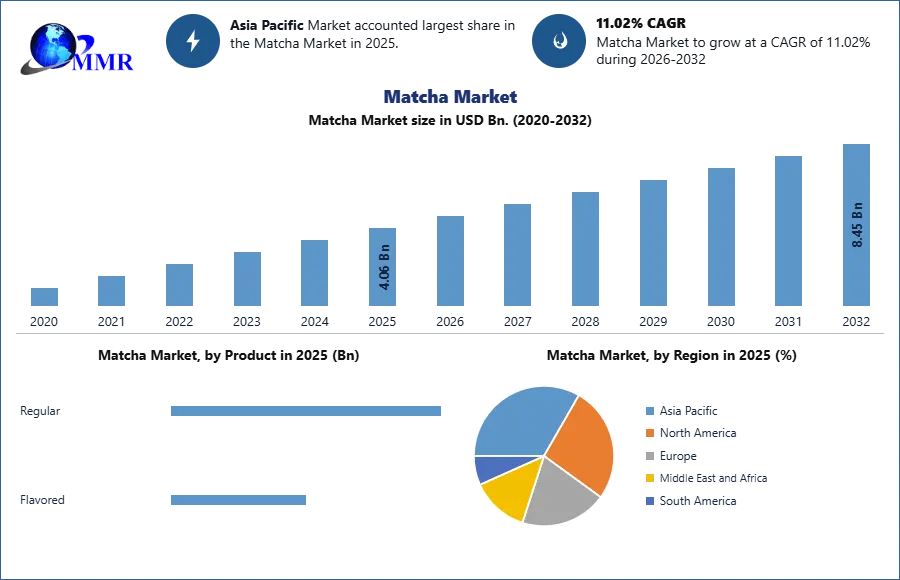
The Matcha Market size was valued at USD 4.06 Billion in 2025 and the total Matcha revenue is expected to grow at a CAGR of 11.03% from 2026 to 2032, reaching nearly USD 8.45 Billion.
Matcha tea is a type of green tea that originates from Japan. It is made from shade-grown tea leaves, which are available in powdered and liquid forms. The demand for Matcha Tea has witnessed a rapid surge in recent years all across the world. Consumers increasingly prioritize healthier and sustainable choices, driving the demand for organic and sustainable tea products. Also, the versatility further grows the demand for matcha tea.
The global Matcha Market growth is driven by rising health consciousness, versatility as a beverage and ingredient, and growing demand for organic and sustainably sourced products. For instance, Matcha tea is high in antioxidants, which help protect against heart disease. Also, Matcha tea helps boost metabolism and promote weight loss. The increasing demand for Matcha Tea not only aligns with health-conscious consumer preferences but also supports sustainable farming methods, contributing to the revitalization of farms and local economies. As a result, the Matcha Market is experiencing robust growth, driven by shifting consumer preferences towards healthier, ethically sourced food options.
The outbreak of the COVID-19 pandemic has shown a positive impact on the market. The pandemic has led to a shift towards at-home consumption of food and beverages, including matcha tea. People are spending more time at home and are looking for healthy and convenient options to prepare at home as well this is attributable to the fact that consumers across the globe are now seeking healthy and wellness food & and beverages, including matcha tea to keep themselves healthy.
To know about the Research Methodology :- Request Free Sample Report
Matcha Market Dynamics:
Increasing Consumer Consciousness About Health And Well-Being
The increasing consumer awareness about health and well-being is expected to be the major factor driving the global Matcha Market. The matcha tea industry growing due the factors such as a rise in health consciousness among consumers, recognized for its rich antioxidant content, matcha offers potential health benefits, including improved heart health by lowering LDL cholesterol. Also, the presence of L-theanine increases brain function, improving focus and memory. Beyond health perks, matcha's versatility as a delicious beverage, whether hot or cold, and its adaptability in recipes like lattes, smoothies, cakes, and ice cream, make it a sought-after choice. Factors like the demand for functional beverages, diverse applications, and increased marketing contribute to the market's growth. As health-conscious trends persist, matcha tea is poised for ongoing popularity.
For instance, in the United States, a rise in health consciousness has driven the demand for matcha tea renowned for its antioxidant richness. Catechins in matcha contribute to improved heart health by balancing cholesterol levels. Epigallocatechin gallate (EGCG) in matcha reduces cancer risk, defending against prostate, breast, and colon cancers. L-theanine enhances brain function, fostering better focus and memory. Beyond health perks, matcha's versatility in various recipes makes it a favored choice. The rising demand for functional beverages, expanded applications, and intensified marketing further fuel market growth. As health-conscious trends persist, matcha tea is projected to sustain popularity, supported by increased disposable income, busier lifestyles, and a growing preference for natural and sustainable products.
Growing Demand for Organic and Sustainable Matcha Tea:
The increasing demand for organic matcha stems from consumer apprehensions about pesticides in conventional tea production coupled with the perceived superior flavor and nutrition of organic variants. The global popularity of matcha tea crafted from shade-grown and finely ground green tea leaves, extends beyond Japan with rising acclaim for its health benefits. The future portends continued growth in organic and sustainable matcha tea, driven by heightened consumer awareness and the availability of high-quality products, aligning with increasing preferences for health-conscious and eco-friendly choices. Also, the factors driven by market growth such as emphasizing sustainability, organic matcha production minimizes synthetic inputs, yielding environmentally friendly products. Sustainable practices such as shade-grown cultivation, water conservation, and waste reduction amplify the benefits, including reduced environmental impact and enhanced biodiversity.
For instance, In Canada, organic matcha tea production prioritizes environmentally friendly practices, minimizing synthetic inputs like pesticides and fertilizers. Sustainable methods, including shade-grown cultivation, water conservation, and waste reduction, amplify the product's benefits, contributing to reduced environmental impact and improved biodiversity. The increasing demand in Mexico mirrors similar concerns about conventional tea production, emphasizing the flavor, nutrition, and health benefits of organic matcha. Mexican production echoes sustainable practices and aligns with a broader trend toward eco-conscious choices. Anticipating continued growth, the future of organic and sustainable matcha tea in Canada and Mexico is driven by heightened consumer awareness, availability of high-quality products, and additional factors like the popularity of functional beverages, expanding applications, increased marketing efforts, and a growing preference for premium offerings.
Price Sensitivity Among Consumers In Emerging Economies
Price sensitivity significantly impacts consumer behavior in emerging economies, especially in the Matcha Market. Limited disposable incomes in these regions make consumers more price-conscious, also challenging producers to balance quality and affordability. The factors contributing to this sensitivity include lower incomes, limited awareness of matcha's benefits, competition from local alternatives, and varying quality levels. To address this, strategies like tiered pricing, local sourcing, emphasizing value, strategic partnerships, and targeted marketing are essential. Educating consumers about matcha's qualities and benefits is crucial, fostering trust and increasing willingness to pay a premium. These approaches collectively mitigate price sensitivity, fostering sustainable growth in emerging markets.
Matcha Market Segment Analysis:
Based on Form, the Powder segment held the largest market share of about 50% in the global Matcha Market in 2025. According to the MMR analysis, the segment is further expected to grow during the forecast period. The Matcha Market showcases a diverse landscape across multiple segments. It stands as the dominant form thanks to its versatility in applications such as lattes and baked goods. Grade segmentation distinguishes ceremonial and culinary grades, with ceremonial grades reserved for traditional Japanese tea ceremonies. Production technology segmentation highlights the traditional pan-fried and newer steamed methods, impacting quality and efficiency.
The organic matcha tea segment is experiencing rapid growth amid increasing consumer demand for organic products. Distribution channels range from hypermarkets to online retail, with the latter expected to exhibit the fastest growth. Regionally, the Asia Pacific leads, with China and Japan propelling growth. Key players include Aiya Matcha, Ito En, and Marukyu-Koyamaen.
Based on Product, the Regular segment held the largest market share in the global Matcha Market in 2025. According to the MMR analysis, the segment is further expected to grow at a significant CAGR during the forecast period. Regular matcha tea characterized by its bright green color, slight bitterness, and grassy aroma, is anticipated to dominate the market. This rise is fueled by increasing consumer awareness of its health benefits, a rising demand for natural and organic products, and its versatile use in various beverages and culinary applications. However, flavored matcha tea, infused with vanilla, chocolate, or fruit flavors, is gaining traction, particularly in beverages like lattes and smoothies. The Asia Pacific region leads the market driven by its deep-rooted tradition of matcha consumption. North America and Europe are also significant markets, with consumers increasingly recognizing the health advantages of matcha. key players in the global Matcha Market include Aiya Matcha, DoMatcha, Encha, Ippodo Tea, Ito En, MatchaBar, Matchaful, Matsuda, The Matcha House, and The Republic of Tea. As consumer demand for healthy and natural products continues to rise, the Matcha Market is expected to thrive, with both regular and flavored varieties catering to diverse preferences.
Matcha Market Regional Insights:
Asia Pacific dominated the global Matcha Market with the highest market share of over 60% in 2025. The region is expected to grow at a CAGR of 6.9 % during the forecast period and maintain its dominance by 2032. The Asia Pacific Matcha Market is growing because of various factors such as increased awareness of matcha's health benefits, antioxidants promoting heart health, and cognitive function. Rising disposable incomes in the region lead to a willingness to invest in premium beverages like matcha tea. The convenience of ready-to-drink options further drives market growth. Beyond traditional forms, matcha is increasingly integrated into lattes, smoothies, and baked goods. Key countries like China, Japan, India, and South Korea play significant roles in production and consumption. The major players include Ito En, Marukyu Koyamaen, Aiya America, and MatchaBar the matcha house. The market's future is promising with increasing demand for organic matcha, growing popularity among younger consumers, and the expanding range of matcha-infused products.
China holds a significant position within the global Matcha Market. It stands as an important force in the global Matcha Market. China boasts sophisticated cultivation techniques, yielding high-quality products. The market thrives on growing consumer awareness, increasing beyond traditional uses into various applications such as food, cosmetics, and supplements. Online sales channels are flourishing, and government initiatives support cultivation and research. Sustainability and organic practices gain emphasis, fostering innovation in flavors and applications. Chinese matcha producers are strategically increasing internationally amid intensifying competition and consolidation. The future outlook signals sustained growth, underlining China's dominance in the global matcha tea industry.Also, Japan plays a significant role in the global Matcha Market. Japan holds a paramount role in the global Matcha Market as its birthplace maintaining a robust tradition of cultivation, consumption, and cultural significance. The roots date back to the 12th century, and matcha is deeply embedded in Japanese culture, particularly in traditional tea ceremonies. Renowned for meticulous cultivation practices, Japanese matcha is prized for its umami flavor and vibrant green color. Consumption has diversified, with matcha incorporated into various beverages and culinary creations. Japanese consumers prioritize health benefits, propelling domestic market strength and international recognition. Sustainability, innovation, and cultural education initiatives signal a promising future for Japan's leadership in the global matcha tea industry.
Recent Industry Developments (2025–2026)
| Exact Date | Company | Development | Impact |
|---|---|---|---|
| 15 February 2025 | Grind | The specialty coffee brand expanded its portfolio by launching a DTC Japanese ceremonial-grade matcha line including ready-to-drink lattes and refillable tins. | This move intensifies cross-category competition between traditional coffee retailers and premium tea providers in the wellness space. |
| 12 April 2025 | Lotte | The company's Coolish brand unveiled a new Matcha Latte ice cream flavor in Japan to target convenience-seeking younger demographics. | The launch reflects the growing mainstream penetration of matcha as a functional flavor in the global confectionery and frozen dessert sectors. |
| 22 May 2025 | Black Sheep Coffee | The chain expanded its seasonal beverage lineup across U.S. locations with Peaches & Cream Matcha and Matcha Lemonade innovations. | These product variations drive market diversification by moving matcha beyond traditional hot lattes into the high-growth iced beverage segment. |
| 18 July 2025 | Ippodo Tea Co. | The company announced the commercial release of its New Harvest Matcha 2025, featuring early-harvest tencha leaves with high umami content. | Limited-edition seasonal releases reinforce brand prestige and cater to the rising consumer demand for single-origin and premium ceremonial grades. |
| 05 October 2025 | McDonald’s Australia | Following high social media demand, the fast-food giant launched a nationwide matcha drink range including hot and iced latte options. | Adoption by global QSR leaders significantly lowers the barrier to entry for mass-market consumers, accelerating volume growth in the Oceania region. |
| 21 January 2026 | 753 Matcha | The company officially launched its Honyama single-origin ceremonial grade matcha, focusing on clean-label transparency and natural sweetness. | This development signals a 2026 market shift toward traceability and connoisseurship, mirroring trends previously seen in the specialty coffee industry. |
Matcha Market Competitive Landscapes:
The Global Matcha Market is expected to be highly competitive active presence of numerous market players. Major companies are striving to introduce cost-efficient and advanced implant-focused products to meet the increasing demand, consequently fostering overall market growth. Key players are adopting various business strategies, including technical partnerships and mergers and acquisitions (M&A) to remain competitive in the Matcha Market.
These strategic endeavors underscore the Matcha Tea industry's commitment to diversifying product lines, innovating within segments, and adopting strategic partnerships to compete effectively in the market landscape. As consumer preferences evolve, these proactive strategies position Matcha Tea manufacturers for sustained growth and competitiveness in the dairy market.
Matcha Market Scope: Inquiry Before Buying
| Matcha Market | |||
|---|---|---|---|
| Report Coverage | Details | ||
| Base Year: | 2025 | Forecast Period: | 2026-2032 |
| Historical Data: | 2020 to 2025 | Market Size in 2025: | 4.06 USD Bn. |
| Forecast Period 2026-2032 CAGR: | 11.02% | Market Size in 2032: | 8.45 USD Bn. |
| Segments Covered: | by Product | Regular Flavored |
|
| by Form | Powder Liquid |
||
| by Distribution Channel | Offline Hypermarket/Supermarket Grocery Stores Others Online store E-commerce Platforms Company Owned Websites |
||
Matcha Market, by Region:
North America (United States, Canada, and Mexico)
Europe (UK, France, Germany, Italy, Spain, Sweden, Austria, and the Rest of Europe)
Asia Pacific (China, South Korea, Japan, India, Australia, Indonesia, Malaysia, Vietnam, Taiwan, Bangladesh, Pakistan, and the Rest of APAC)
Middle East and Africa (South Africa, GCC, Egypt, Nigeria, and the Rest of ME&A)
South America (Brazil, Argentina Rest of South America)
Key Players / Competitors Profiles Covered in Brief in Global Matcha Market Report in Strategic Perspective:
- Aiya Matcha
- DoMatcha
- Encha
- Ippodo Tea
- Ito En
- MatchaBar
- Matchaful
- Matsuda
- The Matcha House
- The Republic of Tea
- Marukyu Koyamaen
- AOI Tea Company
- Mizuba Tea Co.
- Matcha.com
- Jade Monk LLC
- Nestle SA
- The Unilever Group
- Harney & Sons Fine Teas
- The Hain Celestial Group, Inc.
- Shaoxing Royal Tea
- Midori Spring
- Sun Time Tea Company
- TEAJA Organic
- Vivid Vitality Ltd.
- Marushichi Seicha