
Global Marine Propulsion Engine Market Size by Propulsion, Ship Type, Application and Region – Segment-Level Market Assessment, Growth Opportunity Analysis, Competitive Mapping & Forecast to 2032
Overview
Marine Propulsion Engine Market size is expected to reach nearly US$ 45.39 Bn. by 2032with a CAGR of 2.79% during the forecast period.
Marine Propulsion Engine Market Introduction
The Marine propulsion engines are machines that burn fuel to generate thrust, which aids in the movement of ships over water. Various ongoing government initiatives in the shipbuilding industry and inland waterways are projected to propel the marine propulsion engine market forward throughout the projected period.
Depending on their size, ships are equipped with one or more propulsion engines. Furthermore, steam turbines were employed in the early stages of maritime propulsion; however, due to technological advancements, diesel or alternative fuel engines and gas turbines now have a larger market share.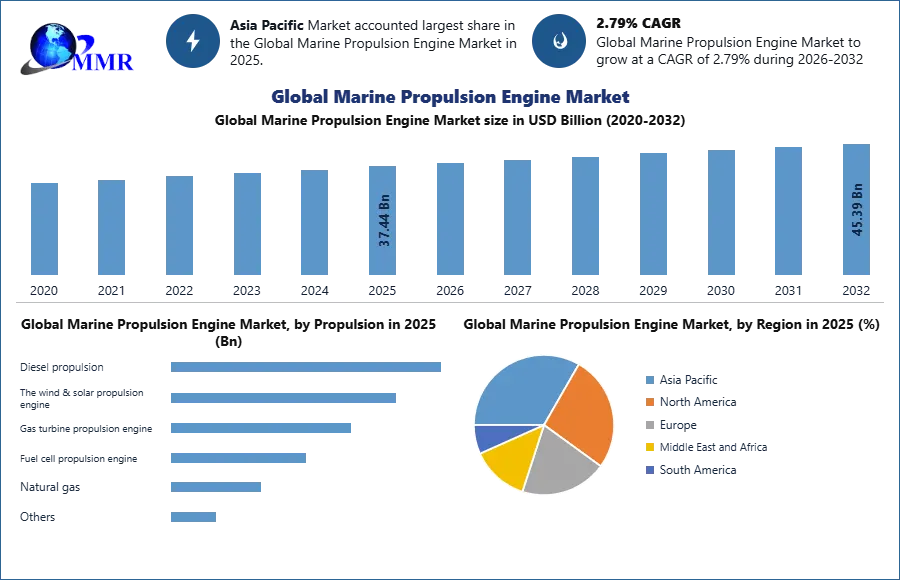
To know about the Research Methodology:- Request Free Sample Report
Marine Propulsion Engine Market Dynamics
The marine propulsion engines market is likely to be driven by significant modernization in marine propulsion as a result of the rising need for operationally reliable and cost-effective ships. The shipping sector has begun to place a greater emphasis on lowering fossil fuel usage by creating electric motors that also aid in energy efficiency. The key driver of the market is expected to be the growing need for reliable and fuel-efficient ships.
The use of renewable energy sources such as solar and wind energy to supply auxiliary power needs is expected to grow, boosting the demand for marine propulsion engines. The growing importance of increasing diesel engine capacity to power next-generation tankers with big cargo holding capacity would increase the worldwide market growth.
The focus on renewable energy sources is the second main factor that is going to have an impact on the market. Global warming and an imminent energy crisis are two of the world's most serious issues in the twenty-first century. LNG consumption is expected to rise as conventional and shale gas reserves are depleted, particularly as a naval fuel. LNG adoption necessitates the presence of specialized insulated tanks and a secure location, resulting in a requirement for more storage capacity.
However, a variety of other tank layouts are used, as well as a variety of system options for using LNG. The introduction of nuclear propulsion systems has piqued the curiosity of ship designers because a little percentage of nuclear fuel is used to provide energy that is equivalent to a large weight of coal or oil. It's also useful for icebreakers in the Arctic while they're probing frozen waterways. In order to reduce CO2, NOX, SOX, volatile organic compounds, and particulate matter emissions, non-conventional energy sources like wind and solar energy could be used.
The marine propulsion engines market is expected to be hampered by strict pollution regulations and the limitations of renewable energy sources for main propulsion. The international marine community works in both international and territorial water around the world, necessitating compliance with a strict regulatory structure capable of serving this level of international complexity.
Marine Propulsion Engine Market Segment Analysis
The marine propulsion engines population is segmented into diesel propulsion, wind & solar propulsion engines, gas turbine propulsion engines, fuel cell propulsion engines, steam turbine propulsion engines, natural gas, and others based on propulsion mode.
Diesel propulsion technology has been the dominant propulsion medium in the maritime sector during the previous decade. The development of propulsion systems that run on alternative fuels and emit low emissions has gained special relevance as technology advances and public awareness about environmental conservation grows. In medium-speed four-stroke marine propulsion engines, significant advancements in braking mean effective pressure, firing pressures, fuel injection technology, and turbo-charging efficiency have dramatically decreased fuel oil usage.
Although wind and solar energy have gained popularity as supplementary marine propulsion engines, they are insufficient to provide primary propulsion power requirements. Unless full sail propulsion is used, wind-based solutions are confined to propulsion augmentation applications, which may have negative cost and economic repercussions in terms of the number of ships required and voyage times. Furthermore, wind power systems rely on a consistent and effective wind speed, as well as the installation of appropriate control technologies onboard. Because they do not generate harmful pollutants, wind and solar energy have gained popularity as supplemental power sources. Furthermore, wind-based approaches can be used to create partial propulsion benefits and dual fuel hybrid systems. Photovoltaic cells can be used to create enough electricity to drive vessels utilizing solar power as an auxiliary power source.
Recent Development: Marine Propulsion Engine Market
| Exact Date | Company | Development | Impact |
|---|---|---|---|
| 04 February 2026 | Wärtsilä | Announced a €140 million investment to expand production capacity at its Sustainable Technology Hub in Finland by 35%. | This expansion directly addresses the surging global demand for fuel-flexible engines and future-proof marine propulsion technologies. |
| 22 January 2026 | Wärtsilä | Secured a major order to supply future-ready Wärtsilä 31 engines for Allseas Group’s new semi-submersible Heavy Transport Vessel. | The modular design allows for a seamless transition to low-carbon fuels, significantly reducing long-term operational emissions and maintenance costs. |
| 27 October 2025 | Rolls-Royce Power Systems | Successfully completed the first test-bench run of a high-speed mtu marine engine powered exclusively by methanol. | This technological milestone proves the viability of climate-friendly drives for the leisure and commercial marine sectors using existing engine architectures. |
| 28 August 2025 | Everllence (formerly MAN Energy Solutions) | Received the first commercial order for its 7S60ME-LGIA dual-fuel ammonia engines for installation on Aurora-class car carriers. | The deployment marks a critical step toward zero-carbon shipping by utilizing ammonia as a primary propulsion fuel for large-capacity vessels. |
| 04 June 2025 | MAN Energy Solutions | Officially rebranded as Everllence to signal a strategic shift toward sustainable energy excellence and alternative fuel leadership. | The rebranding aligns the company's identity with its decarbonization roadmap, focusing on methanol and ammonia engine portfolios. |
| 22 May 2025 | Everllence / DTU | Formed the NH3 Spark – FutureFlex consortium to develop a four-stroke engine capable of operating on pure ammonia without pilot fuel. | This R&D milestone aims to eliminate fossil-fuel dependencies entirely in auxiliary power and electric propulsion for the maritime industry. |
Marine Propulsion Engine Market Regional Insights
China to dominate the Asia Pacific Market
Asia Pacific accounts for a major share of the marine propulsion engine market and is expected to maintain its dominance throughout the forecast period. This is primarily due to the fact that key countries such as China, Japan, and South Korea have developed into industrial powerhouses as a result of their reliance on foreign trade. The marine engines market in the Asia Pacific is expected to grow rapidly due to rising investments in shipbuilding and commercial freight transit in key economies. China is currently the world's largest exporter, thus a bigger number of commercial ships would be required, which would boost demand for marine propulsion engines.
Along with trade, countries around the world have begun to strengthen their navies in order to combat ocean piracy. Asian navies, in particular, are rapidly expanding their defense capabilities, which is expected to boost the market for marine propulsion engines in the Asia Pacific region.
European developers are working on a comparable technology that they hope to market by 2030 in order to compete in China's autonomous technology field. MacGregor, a maritime engineering firm, and Rolls-Royce, an engine manufacturer, signed a Memorandum of Understanding in 2022 to investigate how autonomous technology can aid ship navigation and cargo systems on container ships.
Marine Propulsion Engine Market Report Scope: Inquire before buying
| Global Marine Propulsion Engine Market | |||
|---|---|---|---|
| Report Coverage | Details | ||
| Base Year: | 2025 | Forecast Period: | 2026-2032 |
| Historical Data: | 2020 to 2025 | Market Size in 2025: | 37.44 USD Billion |
| Forecast Period 2026-2032 CAGR: | 2.79% | Market Size in 2032: | 45.39 USD Billion |
| Segments Covered: | by Propulsion | Diesel propulsion The wind & solar propulsion engine Gas turbine propulsion engine Fuel cell propulsion engine Natural gas Others |
|
| by Ship Type | Container Ship Tanker Bulk Carrier Naval Ship Passenger Ship Others |
||
| by Fuel Type | Heavy Fuel Oil(HFO) Marine Diesel/ Gas Oil Others |
||
| by Application | Commercial Passenger Defense |
||
Marine Propulsion Engine Market, by Region
Asia Pacific (China, South Korea, Japan, India, Australia, Indonesia, Malaysia, Vietnam, Taiwan, Bangladesh, Pakistan and Rest of APAC)
Europe (UK, France, Germany, Italy, Spain, Sweden, Austria and Rest of Europe)
North America (United States, Canada and Mexico)
Middle East and Africa (South Africa, GCC, Egypt, Nigeria and Rest of ME&A)
South America (Brazil, Argentina Rest of South America)
Marine Propulsion Engine Market Key Players
- MAN Energy Solutions
- Wärtsilä Corporation
- Caterpillar Inc.
- Cummins Inc.
- Rolls‑Royce Power Systems
- Volvo Penta
- Hyundai Heavy Industries Engine & Machinery
- Mitsubishi Heavy Industries Marine Machinery
- Daihatsu Diesel
- Yanmar Co. Ltd.
- GE Marine
- Kawasaki Heavy Industries
- ABB Marine & Ports
- Fairbanks Morse Defense
- Masson Marine
- Torqeedo GmbH
- Niigata Power Systems
- Deutz AG
- Isuzu Motors
- Perkins Engines
- Vetus
- Steyr Motors
- Scania AB
- Siemens Energy
- ABB Turbocharging
- Schottel GmbH
- Doosan Engine
- STX Engine
- Oceanvolt
- China State Shipbuilding Corporation
Frequently Asked Questions:
1. Which region has the largest share in Global Marine Propulsion Engine Market Market?
Ans: Asia Pacific region held the highest share in 2025.
2. What is the growth rate of Global Marine Propulsion Engine Market Market?
Ans: The Global Marine Propulsion Engine Market Market is growing at a CAGR of 2.79 % during forecasting period 2026-2032.
3. What is scope of the Global Marine Propulsion Engine Market Market report?
Ans: Global Marine Propulsion Engine Market Market report helps with the PESTEL, PORTER, COVID-19 Impact analysis, Recommendations for Investors & Leaders, and market estimation of the forecast period.
4. Who are the key players in Global Marine Propulsion Engine Market Market?
Ans: The important key players in the Global Marine Propulsion Engine Market Market are – Hyundai Heavy Industries Caterpillar MAN SE Mitsubishi Heavy Industries Volvo Penta Rolls-Royce Cummins Wartsila GE Transportation Deutz AG AB Volvo BAE Systems Plc Beta Marine Ltd. General Electric Co. Yanmar Holdings Co. Ltd. Scania DAIHATSU DIESEL MFG. CO. LTD. Nigata Power Systems Co. , Ltd. Fairbanks Morse Engine Masson-Marine
5. What is the study period of this Market?
Ans: The Global Marine Propulsion Engine Market Market is studied from 2025 to 2032.