
Management Consulting Market : by Type ( Strategy Consulting , Operations Consulting , Financial Advisor ) Organization Size ( Large Enterprises ,Small & Medium-Sized Enterprises ) Global Forecast to 2034
Overview
The Management Consulting Market size was valued at USD 374.67 Billion in 2025 and the total Management Consulting revenue is expected to grow at a CAGR of 8.2% from 2026 to 2034, reaching nearly USD 761.54 Billion by 2034.
The management consulting market growth is fueled by companies' increasing need for expertise in areas like digital transformation, strategy, and operational efficiency. Major players include McKinsey & Company, Boston Consulting Group, and Bain & Company, but boutique and niche firms are also carving out space. Demand is high for consultants specializing in data analytics, cybersecurity, and sustainability. Meanwhile, clients are seeking more flexible engagement models, with project-based work gaining traction alongside traditional retainer agreements. Technology is a double-edged sword, providing powerful tools for consultants while also threatening to commoditize some services. The future lies in consultancies that leverage tech to enhance human expertise and deliver high-impact solutions.
Management Consulting Market Overview:
Management consulting also known as business consulting, is definite as "advisory and/or implementation services provided to senior management of organizations with the goal of improving the effectiveness of their business strategy, organizational performance, and operational processes." Owing to the vast diversity in disciplines and the varying expertise required of advisors, management consulting represents the broadest area within the consulting industry, including between 50% and 55% of the total consulting market.
Management Consulting Market Dynamics
The MMR report covers all the trends and technologies playing a major role in the growth of the Management Consulting Market over the forecast period. It highlights the drivers, restraints, and opportunities expected to influence the Management Consulting Market growth during 2026-2034.
Minimization of Costs & Increasing Digital Marketing to Boost Management Consulting Market
Organizations are continuously attempting to minimize costs and improve efficiency so that cost savings can be passed on to customers in order to stay competitive. As a result, demand for business process improvements and operational efficiency consultancy is increasing. Agile, Artificial Intelligence, and analytics are three technical skill sets that MNCs are actively seeking consulting advice on. Corporate buyers are increasingly interested in digital marketing and transformation consulting as both product and service companies invest more in user experience design, customer-focused data analytics, and customer engagement techniques. 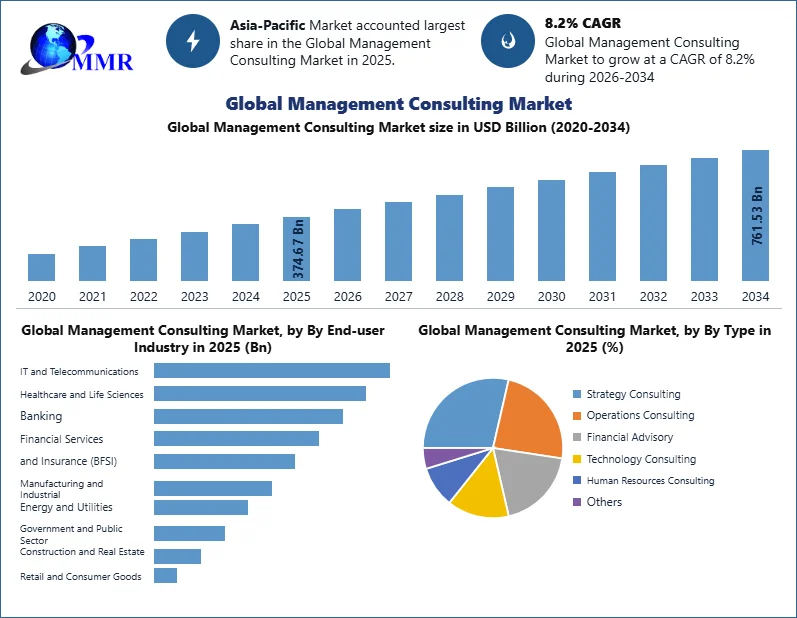 To know about the Research Methodology :- Request Free Sample Report
Regulatory Developments & Growth of Freelance Consulting to Drive Management Consulting Market Growth
Regulatory developments such as the US Tax Reform, BREXIT, the EU GDPR (General Data Protection Regulation), and others have resulted in a rise in consulting demand across all main service lines. Multinationals will seek high-value assistance to be compliant with regulations, fuelling demand for management and regulation consulting. The significant growth of the freelance consulting industry can be attributed to the pricing and flexibility afforded by independent/freelance consultants. For example, independent consulting accounts for 10% of the £10 bn consulting sectors in the United Kingdom. As a result, traditional consulting firm/industry revenues are expected to be eaten up by the freelance consulting sector during the forecast period.
Growing Globalisation & Industrialisation to Boost Management Consulting Market
More joint ventures (JV), global expansion, foreign investments, and multinational corporations establishing facilities in high-growth areas are expected as a result of globalisation. Category management consultants are increasingly forming joint ventures with firms in other countries to do market research. To mitigate risk, some corporations are focused on purchasing established enterprises in new areas. Due to increased internet penetration, developments in data security, and automation of consultant duties, globalisation in the management consulting sector is accelerating. The Management Consulting Market is quickly developing because of internationalisation and the creation of new categories.
Technological advancements such as ERP consulting and IT training are projected to play a key influence in the growth of the Management Consulting Market during the forecast period. Because of the firms' continued need for financial management help, which aids in the budgeting and financial planning processes, the Management Consulting Market continues to grow.
Lack of Skilled Workers & Increasing Costs to Restraint Management Consulting Market Growth
Growth in the historic period resulted from the robust economic growth in developing markets, regulatory improvements in the financial sector, outsourcing of back-end operations to low-cost economies, and public investments. Factors that negatively influenced growth in the historic period were lack of skilled workers and political and social instability. Going forward, faster economic growth, the development of digital consulting, and the increase in globalization will amplify growth. Factors that could hamper the growth of the Management Consulting Market in the future contain increasing costs and reducing margins, developments of artificial intelligence with a potential to substitute management consultants, and in-house management consulting teams in big technological companies.
Major Companies M&A Strategies in Management Consulting Market
Player-adopted strategies in the management consulting market consist of strengthening M&A strategies, development in other geographies, and increasing advisory services to small and medium social enterprises. To take benefit of the opportunities, the Business Research Company suggests the management consulting companies consider emphasizing technology advisory offerings, introducing virtual management consulting firms, increasing in developing markets, concentrating on increasing their product portfolio through alliances and providing services to pre-retirees, among other strategies.
Large firms are establishing in-house consulting units and promoting former consultants to executive roles, reducing their reliance on external consultants. Other factors impeding consulting sector development, revenues, and clientele include a lack of time for maintaining client relationships, consultants' desire to give greater value to clients at the same cost, and inadequate time to adequately react to client RFIs/RFPs. In the internet era, the tools, templates, and models of consultants considered as intellectual capital can no longer be kept private. The consulting sector is affected by the democratization of knowledge.
Management Consulting Market Segment Analysis:
In 2025, Technology Consulting dominates the management consulting market due to the accelerated integration of advanced digital systems across industries. The widespread adoption of artificial intelligence (AI), cloud computing, big data analytics, and automation technologies has significantly increased organizational dependence on technology-driven decision-making frameworks. Enterprises are prioritizing digital transformation to enhance operational efficiency, reduce latency, and improve scalability. From a scientific perspective, technology consulting enables data-driven optimization models, predictive analytics, and system interoperability, which enhance productivity by 20–35% and reduce operational costs. Additionally, the convergence of Industry 4.0 technologies and cybersecurity requirements further amplifies demand. As a result, technology consulting contributes the highest revenue share, driven by its critical role in enabling innovation, resilience, and long-term competitive advantage.

By Organization Size: The Management Consulting Market is segmented into Large Enterprises and Small & Medium-Sized Enterprises (SMEs). Large Enterprises dominate the market due to their substantial consulting budgets, complex organizational structures, and continuous demand for strategy, digital transformation, operational optimization, mergers & acquisitions, and regulatory compliance services. Meanwhile, the Small & Medium-Sized Enterprises (SMEs) segment is witnessing rapid growth, driven by increasing adoption of digital technologies, business expansion initiatives, and the growing need for cost-effective consulting services to enhance competitiveness and operational efficiency.

Management Consulting Market Regional Insights
North America dominated the Management Consulting Market in 2025 with market revenue of USD 115.28 Bn. and is expected to dominate the market during the forecast period. Because of the presence of some of the most famous consulting companies serving to a diverse range of end-user verticals, North America is the greatest revenue-generating market. The very unpredictable marketplace across the US economy, combined with ongoing reforms in government regulation, is leading enterprises to seek support in their financial operations across the area from management consulting firms. Leading regional consulting firms such as PricewaterhouseCoopers, IBM, Deloitte, and BCG are incorporating digital transformation into their business models, allowing them to serve numerous end-user domains. Furthermore, new business models like as network-based consulting and crowdsourcing are emerging in management consulting and being adopted by new players, fuelling demand for management consulting services.
Competitive Analysis
The Management Consulting Market is highly competitive and characterized by the presence of global strategy firms, Big Four consulting firms, technology integrators, and specialized advisory providers competing through industry expertise, digital capabilities, and geographic expansion. Traditional strategy leaders such as McKinsey & Company, Boston Consulting Group (BCG), Bain & Company, Oliver Wyman, Kearney, L.E.K. Consulting, Roland Berger, Strategy&, Monitor Deloitte, and EY-Parthenon continue to dominate high-value engagements involving corporate strategy, mergers and acquisitions, organizational transformation, and sustainability consulting. At the same time, the Big Four—Deloitte, PwC, EY, and KPMG—maintain a strong competitive position by offering integrated audit, tax, advisory, risk, and consulting services, enabling them to secure large enterprise and public sector transformation projects. Their extensive global delivery networks, deep industry specialization, and investments in AI, cloud, and ESG advisory continue to strengthen their market leadership.
The market is also witnessing intensified competition from technology and digital consulting firms such as Accenture, IBM Consulting, Capgemini, Cognizant, NTT DATA, HCLTech, Tech Mahindra, Fujitsu Consulting, and DXC Technology, which are capitalizing on rising demand for digital transformation, cloud migration, cybersecurity, and AI implementation. Offshore IT consulting leaders including TCS, Infosys, Wipro, LTIMindtree, Persistent Systems, Mphasis, and Zensar Technologies are expanding their consulting capabilities through platform-led transformation and global delivery models. Meanwhile, specialized firms such as Alvarez & Marsal, FTI Consulting, AlixPartners, Ankura, Mercer, Korn Ferry, Arthur D. Little, PA Consulting, Simon-Kucher & Partners, Palantir Technologies, Fractal Analytics, Mu Sigma, Tiger Analytics, Quantiphi, Tredence, and EXL Service are gaining market share by offering niche expertise in restructuring, human capital, pricing strategy, analytics, AI, and data-driven consulting. Increasing investments in generative AI, advanced analytics, industry-specific solutions, and strategic acquisitions are expected to remain the key competitive differentiators across the global management consulting market.
Recent Development
April 2025: Accenture announced a US$1 billion investment in its Strategy & Consulting business to accelerate capabilities in generative AI, digital transformation, and sustainability services. The investment includes expanding AI talent, developing industry-specific solutions, and strengthening technology partnerships. This move is expected to intensify competition across the global management consulting market while increasing enterprise demand for AI-enabled consulting services.
May 2025: Deloitte received regulatory approval to establish a new consulting entity in China, significantly expanding its consulting footprint in one of the world's fastest-growing advisory markets. The expansion enhances Deloitte's ability to serve multinational corporations and domestic enterprises undergoing digital transformation, creating new growth opportunities for management consulting services across the Asia-Pacific region.
July 2025: Accenture reached an agreement to acquire Maryville Consulting Group, a U.S.-based digital operations and succession consulting firm. The acquisition strengthens Accenture's capabilities in supply chain transformation, operational excellence, and business continuity consulting, enabling the company to expand its service portfolio and address growing enterprise demand for integrated consulting solutions.
January 2026: EY-Parthenon completed a major global expansion, growing its strategy consulting organization to more than 25,000 professionals across over 120 countries. The expansion significantly enhances the firm's ability to deliver corporate strategy, mergers and acquisitions, value creation, and transformation advisory services, increasing competitive pressure among leading global management consulting firms.
June 2026: EY's European Investment Monitor reported that the United Kingdom attracted more than 730 foreign direct investment (FDI) projects in 2025, with technology remaining the largest investment sector and London retaining its position as Europe's leading destination for technology investments. The continued inflow of digital and technology investments is expected to drive sustained demand for management consulting services in digital transformation, market entry, operational optimization, and corporate strategy.
Management Consulting Market Scope: Inquire before buying
| Global Management Consulting Market | |||
|---|---|---|---|
| Report Coverage | Details | ||
| Base Year: | 2025 | Forecast Period: | 2026-2034 |
| Historical Data: | 2020 to 2025 | Market Size in 2025: | 374.67 USD Billion |
| Forecast Period 2026-2034 CAGR: | 8.2% | Market Size in 2034: | 761.54 USD Billion |
| Segments Covered: | By Type | Strategy Consulting Operations Consulting Financial Advisory Technology Consulting Human Resources Consulting |
|
| By Organization Size | Large Enterprise Small & Medium-Sized Enterprise |
||
| By Delivery Model | On-Site Consulting Remote / Virtual Consulting Hybrid Consulting |
||
| By End-User | IT & Telecommunications Healthcare & Life science Banking Financial Services & Insurance Manufacturing and Industrial Energy & Utilities Government & Public Sectors Construction and Real Estate Retail & Consumer Goods Media , Enter |
||
Management Consulting Market, by Region
North America (United States, Canada and Mexico)
Europe (UK, France, Germany, Italy, Spain, Sweden, Austria and Rest of Europe)
Asia Pacific (China, South Korea, Japan, India, Australia, Indonesia, Malaysia, Vietnam, Taiwan, Bangladesh, Pakistan and Rest of APAC)
Middle East and Africa (South Africa, GCC, Egypt, Nigeria and Rest of ME&A)
South America (Brazil, Argentina Rest of South America)
Management Consulting Market, Key Players:
1. McKinsey & Company
2. Boston Consulting Group (BCG)
3. Bain & Company
4. Oliver Wyman
5. Kearney
6. L.E.K. Consulting
7. Roland Berger
8. Strategy& (PwC Strategy arm)
9. Monitor Deloitte
Big4 Consulting Firms
10. Deloitte
11. PwC
12. EY
13. KPMG
Technology & Digital Consulting Firms (Global Integrators)
14. Accenture
15. IBM Consulting
16. Capgemini
17. Cognizant
18. NTT DATA
19. HCLTech
20. Tech Mahindra
21. Fujitsu Consulting
22. DXC Technology
IT & Offshore Consulting Firms
23. Tata Consultancy Services (TCS)
24. Infosys
25. Wipro
26. LTIMindtree
27. Persistent Systems
28. Mphasis
29. Zensar Technologies
Operations, Turnaround & Financial Advisory Specialists
30. Alvarez & Marsal
31. FTI Consulting
32. AlixPartners
33. Ankura
34. Berkeley Research Group (BRG)
35. CRA International
36. Houlihan Lokey (Advisory/Consulting)
Human Capital & HR Consulting Firms
37. Mercer
38. Aon Consulting
39. Willis Towers Watson (WTW)
40. Korn Ferry
41. Spencer Stuart
42. Heidrick & Struggles
Boutique & Niche Strategy / Innovation Firms
43. Arthur D. Little
44. PA Consulting
45. BearingPoint
46. OC&C Strategy Consultants
47. Simon-Kucher & Partners (pricing strategy)
48. Prophet (brand & growth consulting)
49. Innosight (innovation consulting)
Analytics, AI & Data Consulting Firms (Emerging High-Growth Segment)
50. Palantir Technologies (consulting + platforms)
51. Fractal Analytics
52. Mu Sigma
53. Tiger Analytics
54. LatentView Analytics
55. Quantiphi
56. Tredence
57. EXL Service
Others Key Players