
Lysosomal Acid Lipase (LAL) Deficiency Treatment Market Size 2026–2032: Enzyme Replacement Therapy Trends, Key Players, and Future Opportunities
Overview
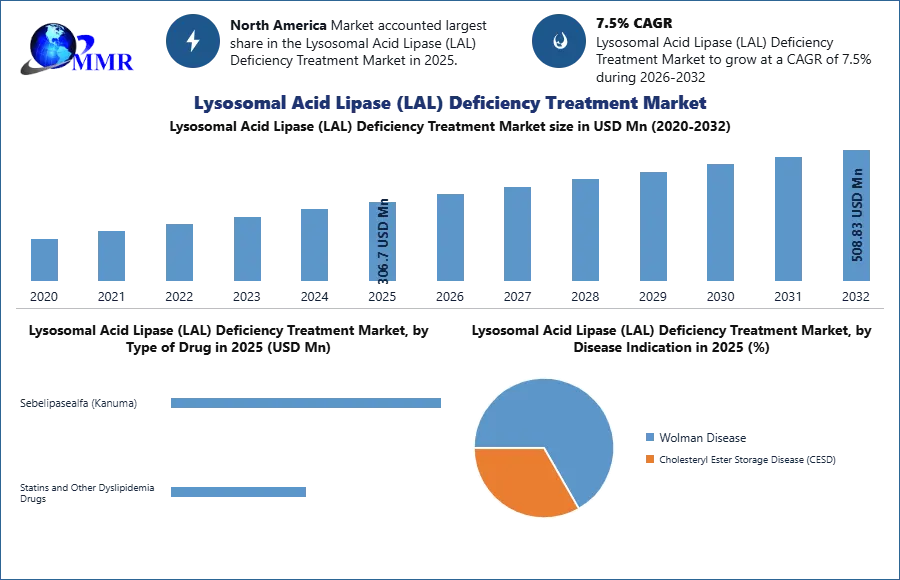
Lysosomal Acid Lipase (LAL) Deficiency Treatment Market size was valued at USD 306.7 Mn. in 2025 and expected to reach USD 508.83 Mn. by 2032.
Lysosomal Acid Lipase (LAL) Deficiency Treatment Market Overview:
Lysosomal acid lipase deficiency (LAL-D) is a rare hereditary condition that is chronic and progressive. It impairs the body's ability to manufacture a lysosomal acid lipase enzyme (LAL). In your cells, this enzyme is required for the breakdown of fats (lipids) and cholesterol. Fats build in organs and tissues throughout the body when the LAL enzyme is missing or weak, causing liver disease and elevated "bad cholesterol," which is connected to cardiovascular disease. AstraZeneca’s plc. is expected to dominate the Lysosomal Acid Lipase (LAL) Deficiency Treatment Market during the forecast period 2026-2032.
 To know about the Research Methodology :- Request Free Sample Report
Lysosomal Acid Lipase (LAL) Deficiency Treatment Market Dynamics:
The Food and Drug Administration (FDA) is expected to drive market growth by approving innovative pharmaceuticals. Kanuma (sebelipase alfa), a novel enzyme replacement medicine developed by Alexion Pharmaceuticals, was authorised by the US Food and Drug Administration (FDA) in 2021. (ERT). Kanuma is the first FDA-approved treatment for the disease's basic cause. It is the only treatment option for LAL insufficiency. Kanuma is expected to have a considerable market increase during the forecast period because it is the sole available medication on the market.
According to the National Institute for Health and Care Excellence (NICE), roughly 50% of people with lysosomal acid lipase (LAL) deficiency have a probability of developing liver problems, such as cirrhosis or fibrosis, or requiring a liver transplant. The rising prevalence of LAL deficiency-related liver problems is expected to boost demand for liver transplants, boosting the LAL deficiency treatment market during the forecast period 2026-2032. The market for Lysosomal Acid Lipase (LAL) Deficiency Treatment is being held back by high costs and a lack of public understanding regarding diagnosis and treatment.
Some of the other key factors driving the Lysosomal Acid Lipase (LAL) Deficiency Treatment market are the rising usage of enzyme replacement treatment, the continuous use of supportive care therapies, and the large number of unmet needs.
Lysosomal Acid Lipase (LAL) Deficiency Treatment Market Segment Analysis:
The Lysosomal Acid Lipase (LAL) Deficiency Treatment Market is segmented by Type of Therapy, Type of Drug, Disease Indication, and End-Users.
Based on the Disease Indication, the market is segmented into Wolman Disease, and Cholesteryl Ester Storage Disease (CESD). Wolman Disease segment is expected to hold the largest market shares of xx% by 2032. Wolman disease is a more severe type of the disease with an earlier onset. It develops as a result of the lack of activity of the LAL enzyme. Infants have no clinical indications at birth, but develop diarrhoea, vomiting, jaundice, and enlarged livers and spleens within a few months. Besides, poor nutrient absorption in the small intestine causes individuals to lose a lot of weight.
Cholesteryl Ester Storage Disease (CESD) segment is expected to grow rapidly at a CAGR of xx% during the forecast period 2026-2032. Cholesteryl Ester Storage Disease (CESD) is more frequent and has a higher frequency in children and adolescents than WD. Because of differences in patient phenotype, diagnosis is difficult, and many cases go unreported or untreated. Because of the high illness prevalence and increased acceptance of enzyme replacement treatment.
Based on the Type of Therapy, the market is segmented into Liver Transplant, and Haematopoietic Stem Cell Transplant. Haematopoietic Stem Cell Transplant segment is expected to grow rapidly at a CAGR of xx% during the forecast period 2026-2032. Hematopoietic stem cell transplantation (HSCT) is an intravenous infusion of hematopoietic stem cells used to restore blood cell production in individuals with damaged or dysfunctional bone marrow or immune systems. Each year, more than 25,000 hematopoietic stem cell transplantations (HSCTs) are performed to treat lymphoma, leukaemia, immune-deficiency diseases, congenital metabolic disorders, hemoglobinopathies, and myelodysplastic and myeloproliferative syndromes. Patients in their 70s and 80s had a two-year post-transplant survival rate of 40%, demonstrating the safety and viability of stem cell transplantation in the elderly.
Lysosomal Acid Lipase (LAL) Deficiency Treatment Market Regional Insights:
North America region is expected to dominate the Lysosomal Acid Lipase (LAL) Deficiency Treatment market during the forecast period 2026-2032. North America region is expected to hold the largest market shares of xx% by 2032. Because of its rapid novel developments, pharmaceutical development, and research, North America is expected to lead the lysosomal acid lipase (LAL) deficiency treatment market. The market is being driven by increased Kanuma usage, high illness prevalence, and the presence of a large patient pool in the United States.
Asia Pacific region is expected to grow rapidly at a CAGR of xx% during the forecast period 2026-2032. This is due to the acceptance of Kanuma and improvements in disease diagnostics, Japan is expected to grow significantly during the forecast period. Globally, there is an urgent need for the development of a curative treatment method with increased efficacy, as well as the development of new early diagnostic markers to accelerate disease diagnosis.
The objective of the report is to present a comprehensive analysis of the Lysosomal Acid Lipase (LAL) Deficiency Treatment Market to the stakeholders in the industry. The past and current status of the industry with the forecasted market size and trends are presented in the report with the analysis of complicated data in simple language. The report covers all the aspects of the industry with a dedicated study of key players that include market leaders, followers, and new entrants.
PORTER, PESTEL analysis with the potential impact of micro-economic factors of the market have been presented in the report. External as well as internal factors that are supposed to affect the business positively or negatively have been analyzed, which will give a clear futuristic view of the industry to the decision-makers.
The reports also help in understanding the Lysosomal Acid Lipase (LAL) Deficiency Treatment Market dynamic, structure by analyzing the market segments and project the Lysosomal Acid Lipase (LAL) Deficiency Treatment Market size. Clear representation of competitive analysis of key players by Product Type, price, financial position, product portfolio, growth strategies, and regional presence in the Lysosomal Acid Lipase (LAL) Deficiency Treatment Market make the report investor’s guide.
Lysosomal Acid Lipase (LAL) Deficiency Treatment Market Scope: Inquiry Before Buying
| Lysosomal Acid Lipase (LAL) Deficiency Treatment Market | |||
|---|---|---|---|
| Report Coverage | Details | ||
| Base Year: | 2025 | Forecast Period: | 2026-2032 |
| Historical Data: | 2020 to 2025 | Market Size in 2025: | 306.7 USD Mn |
| Forecast Period 2026-2032 CAGR: | 7.5% | Market Size in 2032: | 508.83 USD Mn |
| Segments Covered: | by Type of Therapy | Liver Transplant Haematopoietic Stem Cell Transplant |
|
| by Type of Drug | Sebelipasealfa (Kanuma) Statins and Other Dyslipidemia Drugs |
||
| by Disease Indication | Wolman Disease Cholesteryl Ester Storage Disease (CESD) |
||
| By End-User | Hospital Clinics |
||
Lysosomal Acid Lipase (LAL) Deficiency Treatment Market, by Region
• North America (United States, Canada and Mexico)
• Europe (UK, France, Germany, Italy, Spain, Sweden, Austria and Rest of Europe)
• Asia Pacific (China, South Korea, Japan, India, Australia, Indonesia, Malaysia, Vietnam, Taiwan, Bangladesh, Pakistan and Rest of APAC)
• Middle East and Africa (South Africa, GCC, Egypt, Nigeria and Rest of ME&A)
• South America (Brazil, Argentina Rest of South America)
Key Players/ Competitors Profile Covered in Brief in Lysosomal Acid Lipase (LAL) Deficiency Treatment Market Report in Strategic Perspective
Alexion Pharmaceuticals Inc.
AstraZeneca plc.
Merck & Co, Inc
Pfizer, Inc
Teva Pharmaceutical Industries Ltd
Thermo Fisher Scientific
Lonza Group Ltd
Intellia Therapeutics
Cellect Biotechnology
Enochian Biosciences
Takeda Pharmaceutical Company Limited
Sanofi S.A.
BioMarin Pharmaceutical Inc.
Amicus Therapeutics Inc.
Ultragenyx Pharmaceutical Inc.
Regeneron Pharmaceuticals Inc.
Amgen Inc.
Novartis AG
Chiesi Farmaceutici S.p.A.
Orchard Therapeutics plc
Spark Therapeutics Inc.
Regenxbio Inc.
Freeline Therapeutics Holdings plc
Kyowa Kirin Co., Ltd.
Horizon Therapeutics plc