
LPG Tanker Market Vessel Size, Refrigeration & Pressurization, and Region - Global Market Size Estimation, Industry-Wide Analysis, Competitive Landscape Assessment & Long-Term Forecast to 2032
Overview
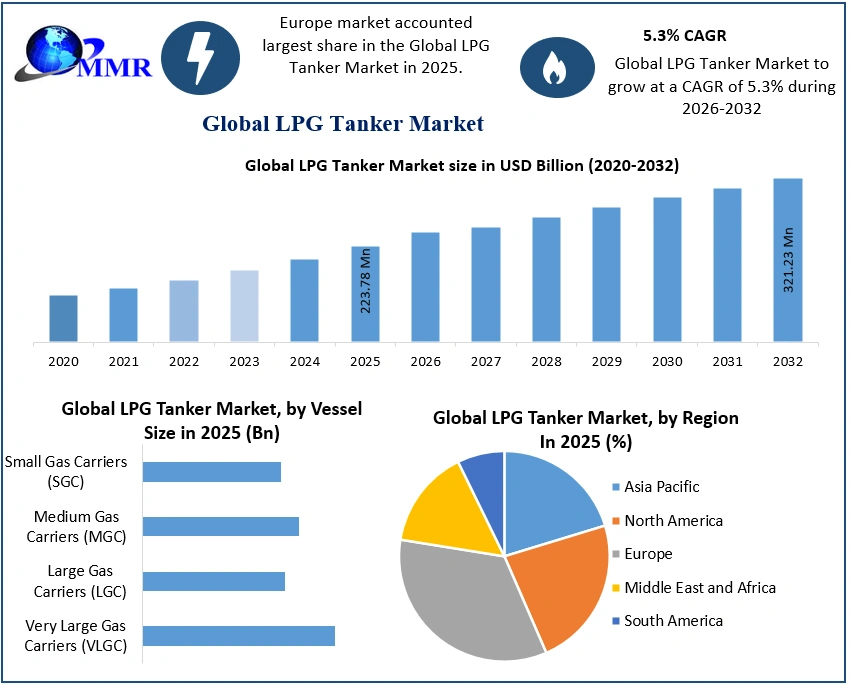
The LPG Tanker Market size was valued at USD 223.78 Million in 2025 and the total LPG Tanker revenue is expected to grow at a CAGR of 5.3% from 2025 to 2032, reaching nearly USD 321.23 Million by 2032.
LPG Tanker Market Overview:
LPG Tanker Market is expected to reach USD 321.23 Mn. by 2032. Bulk transportation of petroleum gases is done using liquefied petroleum gas (LPG) tankers. It consists of various reservoirs that are piled in cargo holds. This report focuses on the different segments of the LPG Tanker market (Vessel Size, Refrigeration & Pressurization, and Region). The leading industry players and regions are thoroughly examined in this report (North America, Asia Pacific, Europe, Middle East & Africa, and South America). It's a thorough examination of today's quick advances in a variety of sectors. Facts and figures, visualisations, and presentations are used to highlight the primary data analysis from 2025 to 2032. The market drivers, restraints, opportunities, and challenges for LPG Tanker are examined in this report. The MMR report's investment suggestions are based on a thorough examination of the current competitive environment in the LPG Tanker market.
To know about the Research Methodology :- Request Free Sample Report
COVID-19 Impact on the LPG Tanker Market:
Many LPG producing businesses had to suspend operations as a result of the COVID-19 outbreak in order to adhere to new regulatory rules. The revenue flow of the LPG Tanker market is directly impacted by this interruption in operations. Manufacturers were influenced by the COVID-19 supply chain block comprising raw materials and intermediates. During the first several months of the pandemic, logistics costs rose. The ongoing COVID-19 pandemic compelled businesses to reassess their industrial strategies.
The COVID-19 pandemic imposed trade restrictions and decreased global demand for LPG across a range of end-use sectors. The growing trade between the United States and the Asia Pacific is estimated to boost the LPG demand. Thus, a decline in demand across several global markets is hampering the growth of the LPG tanker market.
LPG Tanker Market Dynamics:
During the forecast period, the market's growth rate is expected to be driven by a significant increase in shale gas production. Major firms turned their attention to producing oil and gas from shale rock as a result of the instability in crude oil prices, along with advancements in hydraulic fracturing and horizontal drilling techniques. It is also expected that shifting attention to shale gas production will accelerate market growth during the forecast period. During the forecast period, the demand for liquefied petroleum gas (LPG) tankers is likely to be outpaced by the increasing trade ties between the United States and the APAC regions for shale gas because to the lower cost of transportation.
Demand for liquefied petroleum gas from petrochemical companies increased as a result of the instability in crude oil prices, and this demand is expected to support demand for liquefied petroleum gas tankers over the forecast period. However, unstable crude oil prices led to amplified LPG prices and reduced demand, which are expected to hamper market growth throughout the forecast period. Demand for liquefied petroleum gas in many sectors slightly decreased as a result of the COVID-19 pandemic's sudden outbreak. Demand for liquefied petroleum gas began to increase in , and during the forecast period, more liquefied petroleum gas will be traded between the United States and Asian nations. Additionally, because of how COVID-19 is affecting the companies, new orders are probably going to stay low in .
But other ships are already on the order book and will deliver their LPG to the specified sites. Businesses operating in the nation are updating their current fleets. To maintain the demanding climate, they are regularly launching LPG carriers based on the most recent technologies. For instance, in December , NYK stated that Kawasaki Heavy Industries would be developing its first two dual-fuel free VLGC tankers. By , they are expected to be delivered. In order to adapt quickly to changing trade trends, these vessels will be fitted with separate cargo tanks that can transport LPG and ammonia at the same time.
LPG Tanker Market Segment Analysis:
The LPG Tanker Market is segmented by Vessel Size, and Refrigeration & Pressurization.
Based on the Vessel Size, the market is segmented into Very Large Gas Carriers (VLGC), Large Gas Carriers (LGC), Medium Gas Carriers (MGC), and Small Gas Carriers (SGC). Very Large Gas Carriers (VLGC) segment is expected to hold the largest market share of xx% by 2032. Longer distance LPG gas transmission across many nations frequently involves the use of very large gas carriers. The main driver of the segment's growth is the development of trade ties for liquefied petroleum gas between nations, particularly those in Western Africa, Europe, and the Middle East, as well as the United States. However, it is expected that the LGC would narrowly outperform during the forecast period. The global market is likewise heavily dominated by large gas carriers.
Innovation in LGC development is one of the important market trends that has been observed and is expected to accelerate market growth. For instance, the shipping company Exmar, located in Belgium, just delivered its largest dual-fuel LPG carrier, Flanders Innovation, which has an 88,000 cbm capacity. The LPG carrier is 230 metres long, 36.6 metres wide, and has a deadweight tonnage of 55,100 tonnes. Compared to the IMO reference lines, the vessel's dual fuel technology is expected to cut CO2 emissions by around 38%. The primary factor expected to drive the growth of the LGC and MGC segments is the increasing extraction and production of shale gas along with exporting domestic liquefied petroleum gas.
Based on the Refrigeration & Pressurization, the market is segmented into Ethylene, Full Refrigerated, Semi Refrigerated, and Full Pressurized. Full Pressurized segment is expected to grow rapidly at a CAGR of xx% during the forecast period 2025-2032. During the forecast period, the fully pressurised segment is expected to continue to be in the lead. As the volume of LPG carried rises, it is expected that the market would grow steadily across all categories. Fully-refrigerated varieties of VLGCs are designed for long distances and have a gas carrying capacity of 15,000 m3 to 85,000 m3. Such ships can operate with vessels that can withstand a maximum working pressure of 0.28 kg/cm2 and a minimum operating temperature of –50 oC. Since ethylene requires additional refrigeration for safe global shipping, carriers are seen as a distinct industry segment.
Semi Refrigerated segment is expected to grow rapidly at a CAGR of xx% during the forecast period 2025-2032. Due to the Type C tank, these vessels are comparable to full-pressure vessels. The pressure vessel in this situation is typically rated for a maximum working pressure of 57 bars. The ship can carry up to 7,500 m3 of liquefied gas and is mostly utilised for this purpose. In comparison to a fully pressurised container, decompression can lower the thickness of the tank, but at the expense of additional freezing systems and tank insulation. These ships have tanks that can be cylindrical, conical, or spherical and are constructed of steel that can resist temperatures of up to 10 °C. Typically, a tiny ship carrier is a full-pressure vessel. For the shipment spaces of about 7,500m3, semi-refrigerated techniques are employed.
LPG Tanker Market Regional Insights:
Europe region is expected to dominate the LPG Tanker Market during the forecast period 2025-2032. Europe region is expected to hold the largest market share of xx% by 2032. Due to government initiatives and poor domestic production, the market in Europe is largely driven by an increase in LPG demand, which raises the demand for LPG tankers to allow imports.
The North American region is expected to grow rapidly at a CAGR of xx% during the forecast period 2025-2032. North America exported LPG at a global rate of 15.0% in 2025, valued at USD 40 billion, according to the Observatory of Economic Complexity (OEC). In addition, the use of LPG as a cooking fuel is expected to raise demand for the fuel in the United States, Canada, and Mexico. In these nations, LPG is also used for heating purposes in residential structures throughout the winter.
The objective of the report is to present a comprehensive analysis of the Global LPG Tanker Market to the stakeholders in the industry. The past and current status of the industry with the forecasted market size and trends are presented in the report with the analysis of complicated data in simple language. The report covers all the aspects of the industry with a dedicated study of key players that include market leaders, followers, and new entrants.
PORTER, PESTEL analysis with the potential impact of micro-economic factors of the market has been presented in the report. External as well as internal factors that are supposed to affect the business positively or negatively have been analyzed, which will give a clear futuristic view of the industry to the decision-makers.
The reports also help in understanding the Global LPG Tanker Market dynamic and structure by analyzing the market segments and projecting the Global LPG Tanker Market size. Clear representation of competitive analysis of key players by Distribution Channel, price, financial position, product portfolio, growth strategies, and regional presence in the LPG Tanker Market make the report investor’s guide.
LPG Tanker Market Scope: Inquire before buying
| Global LPG Tanker Market | |||
|---|---|---|---|
| Report Coverage | Details | ||
| Base Year: | 2025 | Forecast Period: | 2026-2032 |
| Historical Data: | 2020 to 2025 | Market Size in 2025: | USD 223.78 Mn. |
| Forecast Period 2026 to 2032 CAGR: | 5.3% | Market Size in 2032: | USD 321.23 Mn. |
| Segments Covered: | by Vessel Size | Very Large Gas Carriers (VLGC) Large Gas Carriers (LGC) Medium Gas Carriers (MGC) Small Gas Carriers (SGC) |
|
| by Refrigeration & Pressurization | Ethylene Full Refrigerated Semi Refrigerated Full Pressurized |
||
LPG Tanker Market, by Region
North America (United States, Canada and Mexico)
Europe (UK, France, Germany, Italy, Spain, Sweden, Austria and Rest of Europe)
Asia Pacific (China, South Korea, Japan, India, Australia, Indonesia, Malaysia, Vietnam, Taiwan, Bangladesh, Pakistan and Rest of APAC)
Middle East and Africa (South Africa, GCC, Egypt, Nigeria and Rest of ME&A)
South America (Brazil, Argentina Rest of South America)
LPG Tanker Market, Key Players
North America
1. Dorian LPG Ltd.
2. Manchester Tank & Equipment
3. TerraVest Industries
4. lpg ventures
5. dorian lpg
Europe
6.StealthGas Inc.
7. EXMAR
8. Meyer Turku
9. navigator gas
10. scorpio tankers inc
11. Merkland Tank
APAC
12. The Great Eastern Shipping Co. Ltd.
13. Namura Shipbuilding Co. Ltd
14. STX Corporation
15. Epic Gas Ltd.
16. BW LPG
17. mitsubishi heavy industries ltd
ME
18. BW Group
19. Kuwait Oil Tanker Company
South America
20. Teekay
21. DHT Holdings
Frequently Asked Questions:
1] Which region is expected to hold the highest share in the LPG Tanker Market?
Ans. Europe region is expected to hold the highest share in the LPG Tanker Market.
2] Who are the top key players in the LPG Tanker Market?
Ans. StealthGas Inc., Dorian LPG Ltd., BW Group, Hyundai Heavy Industries Co. Ltd., and Kawasaki Heavy Industries Ltd are the top key players in the LPG Tanker Market.
3] Which segment is expected to hold the largest market share in the LPG Tanker Market by 2032?
Ans. Very Large Gas Carriers (VLGC) segment is expected to hold the largest market share in the LPG Tanker Market by 2032.
4] What is the market size of the LPG Tanker Market by 2032?
Ans. The market size of the LPG Tanker Market is expected to reach USD 321.23 Mn. by 2032.
5] What was the market size of the LPG Tanker Market in 2025?
Ans. The market size of the LPG Tanker Market was worth USD 223.78 Mn. in 2025.