
Liquid Detergent Market - Industry Structure Evaluation, Demand Drivers Analysis, Regional Growth Analysis and Identification, Competitive Positioning Review & Global Market Size Forecast to 2032
Overview
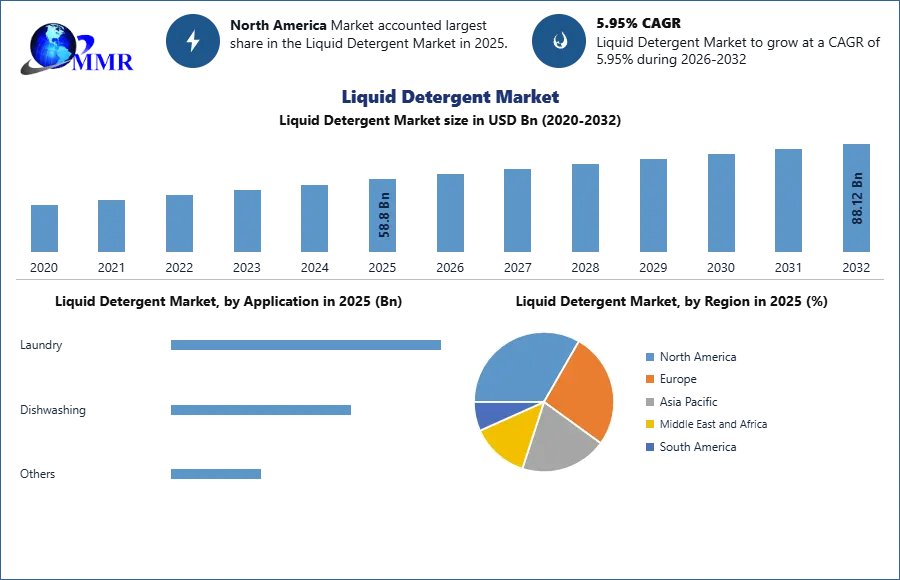
The Liquid Detergent Market size was valued at USD 58.8 billion in 2025 and the total Liquid Detergent Market revenue is expected to grow at a CAGR of 5.95 % from 2026 to 2032, reaching nearly USD 88.12 billion.
Liquid detergent refers to a cleaning agent in liquid form, commonly used for laundry and household cleaning purposes. It typically contains surfactants, water softeners, enzymes, fragrances, and other additives to effectively remove dirt, stains, and odors from fabrics and surfaces. The global liquid detergent market has experienced significant growth over the years, driven by factors such as increasing urbanization, rising disposable incomes, changing consumer lifestyles, and growing awareness of hygiene and cleanliness. The market is characterized by intense competition among key players striving to innovate and offer differentiated products to meet evolving consumer demands. The increasing demand for laundry care and household cleaning products is fueled by rising hygiene awareness and the growing importance of maintaining cleanliness in households.
Moreover, the surge in urbanization and the expanding middle-class population, particularly in emerging economies like China and India, are driving the adoption of liquid detergents. Technological advancements in laundry appliances, such as washing machines with built-in detergent dispensers, are also contributing to market growth by increasing convenience and efficiency in laundry routines. The trend towards eco-friendly and biodegradable detergent formulations is gaining traction, driven by increasing consumer awareness of environmental sustainability.
To know about the Research Methodology :- Request Free Sample Report
Liquid Detergent Market Dynamics:
Customizable Solutions and E-commerce Driving Liquid Detergent Sales:
Companies like all free Clear and Breeze are driving Liquid Detergent Market growth by introducing innovative product formulations that cater to evolving consumer preferences for eco-friendly and efficient cleaning solutions. For example, All Free Clear launched an ultra-concentrated liquid laundry detergent with a USDA Certified Biobased formula, meeting the demand for sustainable alternatives. Innovations in packaging technology, such as Unilever's world-first paper-based laundry detergent bottle, are shaping the market landscape. By using sustainable materials like paper and recycled plastic, companies are addressing environmental concerns and appealing to eco-conscious consumers. Procter & Gamble's investment in a liquid detergent manufacturing unit in Hyderabad, India, reflects the industry's growth efforts to meet growing demand. This strategic move enhances production capacity and strengthens market presence, contributing to overall market growth. Collaboration between ARM & HAMMER and Victoria Justice demonstrates how partnerships drive Liquid Detergent Market growth. By leveraging celebrity endorsements and environmental advocacy, companies attract new customers and differentiate their products in the competitive landscape. Rising awareness among consumers about the environmental impact of traditional detergent packaging is fueling demand for sustainable alternatives.
Companies are capitalizing on this trend by educating consumers about the benefits of eco-friendly options, driving market growth. The increasing emphasis on sustainability and eco-consciousness is prompting consumers to choose liquid detergents with eco-friendly attributes. This shift in consumer preferences creates opportunities for companies to innovate and introduce greener alternatives, driving market growth. Growth in emerging markets like India, as seen with P&G's manufacturing unit in Hyderabad, unlocks new growth opportunities. With rising disposable incomes and urbanization, there is a growing demand for liquid detergents, driving Liquid Detergent Market growth. Companies are increasingly offering customizable and personalized detergent solutions to cater to diverse consumer needs. By providing options such as fragrance preferences and specialized formulas for different fabric types, brands attract a wider customer base and foster market growth. The rise of e-commerce platforms like Amazon provides a convenient avenue for consumers to access a wide range of liquid detergent products. ARM & HAMMER's introduction of Power Sheets Laundry Detergent on Amazon highlights the significance of online channels in driving market growth. Supportive regulatory frameworks promoting sustainability initiatives encourage companies to invest in eco-friendly practices. For instance, certifications like USDA Biobased certification incentivize companies to develop and market products with sustainable attributes, driving overall Liquid Detergent Market growth.
Eco-Friendly Formulations and Packaging Solutions Drive Liquid Detergent Market Growth:
Increasing consumer awareness about environmental sustainability presents a significant growth opportunity for the liquid detergent market. Companies capitalize on this trend by introducing eco-friendly formulations and packaging solutions. For instance, Unilever's paper-based laundry detergent bottle and ARM & HAMMER's Power Sheets Laundry Detergent cater to eco-conscious consumers, driving the market growth. Growing urbanization and disposable incomes in emerging economies create opportunities for market growth. Companies penetrate these markets by offering affordable and tailored liquid detergent products. Procter & Gamble's establishment of a manufacturing unit in Hyderabad, India, reflects the potential for growth in emerging markets. Continuous innovations in detergent formulations and packaging technologies drive market growth. For example, Henkel's all-free clear brand introduced an ultra-concentrated liquid laundry detergent packaged in a novel eco bottle made from 100% recycled plastic, showcasing advancements in sustainable packaging. The proliferation of e-commerce platforms provides opportunities for market growth and reaching a wider consumer base. Brands leverage online channels like Amazon to introduce new products and attract consumers seeking convenience and variety. ARM & HAMMER's launch of Power Sheets Laundry Detergent on Amazon exemplifies the potential of e-commerce in driving Liquid Detergent Market growth.
Tailoring liquid detergent products to meet specific consumer needs and preferences presents an opportunity for market differentiation. Companies offer customizable options such as fragrance choices and specialized formulas for different fabric types, appealing to diverse consumer segments and driving market growth. Supportive regulatory frameworks promoting sustainability initiatives incentivize companies to invest in eco-friendly practices. Certifications like USDA Biobased certification encourage the development and marketing of sustainable liquid detergent products, driving Liquid Detergent Market growth. Continuous product innovation, such as introducing new formulations and packaging designs, is essential for staying competitive in the market. Companies differentiate themselves by offering unique features like concentrated formulas or innovative dispensing methods, attracting consumers, and fostering market growth. Increasing consumer education about the benefits of using liquid detergents over traditional forms drives Liquid Detergent Market growth. Brands launch educational campaigns highlighting the advantages of liquid detergents, such as better stain removal and fabric care, to raise awareness and influence purchasing decisions.
Intense Competition and Pricing Wars in Liquid Detergent Industry:
Stringent environmental regulations pose a restraint on the liquid detergent market. For instance, restrictions on certain chemicals used in detergents, such as phosphates, limit the formulation options for manufacturers and increase production costs. Compliance with these regulations often requires significant investments in research and development to develop alternative formulations that meet regulatory standards while maintaining effectiveness. Fluctuations in the prices of raw materials, such as surfactants and fragrances, impact the profitability of liquid detergent manufacturers. For example, a sudden increase in the cost of petrochemical-based surfactants significantly raises production expenses, leading to higher retail prices for consumers. Companies may struggle to maintain competitive pricing amidst such volatility, affecting market demand and growth. The liquid detergent market is highly competitive, with numerous brands vying for Liquid Detergent Market share. Intense competition leads to price wars and aggressive marketing strategies, reducing profit margins for manufacturers. For instance, price discounting by rival brands to gain market share erodes profitability and hinders investment in research and development for innovation.
Technological advancements in laundry appliances, such as washing machines with built-in detergent dispensers and advanced cleaning functions, reduce the reliance on external detergent products. For instance, the development of detergent pods that dissolve during the wash cycle eliminates the need for measuring and pouring liquid detergent. This trend may lead to reduced demand for traditional liquid detergents. The rising popularity of solid detergent formats, such as laundry pods and bars, presents a challenge for the liquid detergent market. For instance, the convenience and portability of laundry pods appeal to consumers seeking hassle-free laundry solutions. Manufacturers of liquid detergents may need to diversify their product offerings or invest in alternative formats to remain competitive in the evolving market landscape. Economic uncertainty, such as recessions or currency fluctuations, impacts consumer spending patterns and purchasing power, affecting the demand for liquid detergents. For example, during periods of economic downturn, consumers may prioritize essential purchases, leading to reduced discretionary spending on non-essential items like premium liquid detergents. Liquid Detergent Market players must adapt their pricing and marketing strategies to navigate fluctuating economic conditions and maintain market share.
Liquid Detergent Market Segment Analysis:
Based on Type, the segment analysis of the Liquid Detergent Market based on type reveals contrasting trends between Organic and Inorganic Liquid Detergents. The dominance lies with Inorganic liquid detergents, owing to their widespread adoption and established market presence. These detergents typically contain synthetic chemicals and surfactants, offering effective cleaning performance at an affordable price point. However, the trend is gradually shifting towards Organic Liquid Detergents, driven by increasing consumer preference for eco-friendly and sustainable products. Organic detergents utilize natural ingredients such as plant-based surfactants and essential oils, appealing to environmentally conscious consumers. Their adoption is particularly notable in regions with stringent environmental regulations and growing awareness of green living practices.
Liquid Detergent Market Regional Insights:
The Liquid Detergent Market exhibits varying regional dynamics, with certain regions currently dominating the market while others show promising growth potential. In terms of dominance, North America and Europe have traditionally held significant market shares, attributed to higher consumer purchasing power, robust retail infrastructure, and the strong presence of key industry players. For example, in North America, brands like Procter & Gamble and The Clorox Company have established themselves as market leaders. In Europe, companies like Unilever PLC and Henkel AG & Co. KGaA command substantial market share. However, the Asia Pacific region is emerging as a key growth driver in the liquid detergent market, fueled by rapid urbanization, an expanding middle-class population, and increasing consumer awareness of hygiene and cleanliness. Countries like China and India are witnessing a surge in demand for liquid detergents, driven by changing lifestyles, rising disposable incomes, and a shift towards premium and eco-friendly products. For instance, Procter & Gamble's establishment of a manufacturing unit in Hyderabad, India, underscores the region's growth potential. Innovative product offerings tailored to local preferences, such as Unilever's initiatives in India to introduce smaller pack sizes to cater to rural consumers, are driving market growth.
Recent Industry Developments (2025–2026)
| Exact Date | Company | Development | Impact |
|---|---|---|---|
| 16 February 2026 | Unilever PLC | Unilever expanded its digital integration by partnering with Samsung to develop IoT-enabled liquid detergent dispensing systems. | The move automates replenishment and optimizes detergent dosage, strengthening Unilever's position in the smart-home ecosystem. |
| 27 January 2026 | The Procter & Gamble Company | P&G secured strategic partnerships with chemical technology firms to implement novel surfactant structures in its Tide and Ariel liquid lines. | This collaboration enhances stain removal while significantly reducing environmental toxicity of the wastewater. |
| 15 August 2025 | Godrej Consumer Products Limited | The company announced a formal scale-up of its Godrej Fab liquid detergent brand to target $60 million in revenue by 2026. | This expansion aggressively challenges premium-segment incumbents in the rapidly growing South Asian laundry market. |
| 14 May 2025 | Henkel AG & Co. KGaA | Henkel completed the full transition of its Persil and all liquid lines to concentrated formulas with revamped eco-packaging. | The initiative lowers logistics costs by 15% and directly addresses stricter plastic waste regulations in Europe and North America. |
| 02 February 2025 | Hindustan Unilever Limited | HUL entered a strategic alliance with Whirlpool to co-market Surf Excel Matic Liquid specifically for top-load machine cycles. | The partnership creates a direct sales channel through appliance retail, boosting market share in the emerging automated laundry segment. |
Liquid Detergent Market Scope: Inquiry Before Buying
| Liquid Detergent Market | |||
|---|---|---|---|
| Report Coverage | Details | ||
| Base Year: | 2025 | Forecast Period: | 2026-2032 |
| Historical Data: | 2020 to 2025 | Market Size in 2025: | 58.8 USD Bn |
| Forecast Period 2026-2032 CAGR: | 5.95% | Market Size in 2032: | 88.12 USD Bn |
| Segments Covered: | by Type | Organic Liquid Detergent Inorganic Liquid Detergent |
|
| by Application | Laundry Dishwashing Others |
||
| by Distribution Channel | Online Channel Supermarket/Hypermarket Departmental Stores Convenience Store Others |
||
| by End User | Residential Commercial |
||
Liquid Detergent Market, by Region
North America (United States, Canada and Mexico)
Europe (UK, France, Germany, Italy, Spain, Sweden, Austria and Rest of Europe)
Asia Pacific (China, South Korea, Japan, India, Australia, Indonesia, Malaysia, Vietnam, Taiwan, Bangladesh, Pakistan and Rest of APAC)
Middle East and Africa (South Africa, GCC, Egypt, Nigeria and Rest of ME&A)
South America (Brazil, Argentina Rest of South America)
Key Players / Competitors Profiles Covered in Brief in Global Liquid Detergent Market Report in Strategic Perspective:
- Procter & Gamble Co.
- Unilever PLC
- Henkel AG & Co. KGaA
- Church & Dwight Co., Inc.
- Reckitt Benckiser Group PLC
- Colgate-Palmolive Company
- Kao Corporation
- Lion Corporation
- S. C. Johnson & Son, Inc.
- The Clorox Company
- Godrej Consumer Products Limited
- Hindustan Unilever Limited
- Amway Corporation
- Nirma Limited
- Jyothy Labs Limited
- RSPL Group
- LG Household & Health Care Ltd.
- Patanjali Ayurved Limited
- McBride plc
- Venus Laboratories, Inc. (Earth Friendly Products)
- Seventh Generation, Inc.
- Method Products, PBC
- Azafran Innovacion Limited
- Ghari Industries Pvt. Ltd.
- Fena Private Limited