
Library Management Systems Market - Industry Structure Evaluation, Demand Drivers Analysis, Regional Growth Analysis and Identification, Competitive Positioning / Landscape Review & Global Market Size Forecast to 2032
Overview
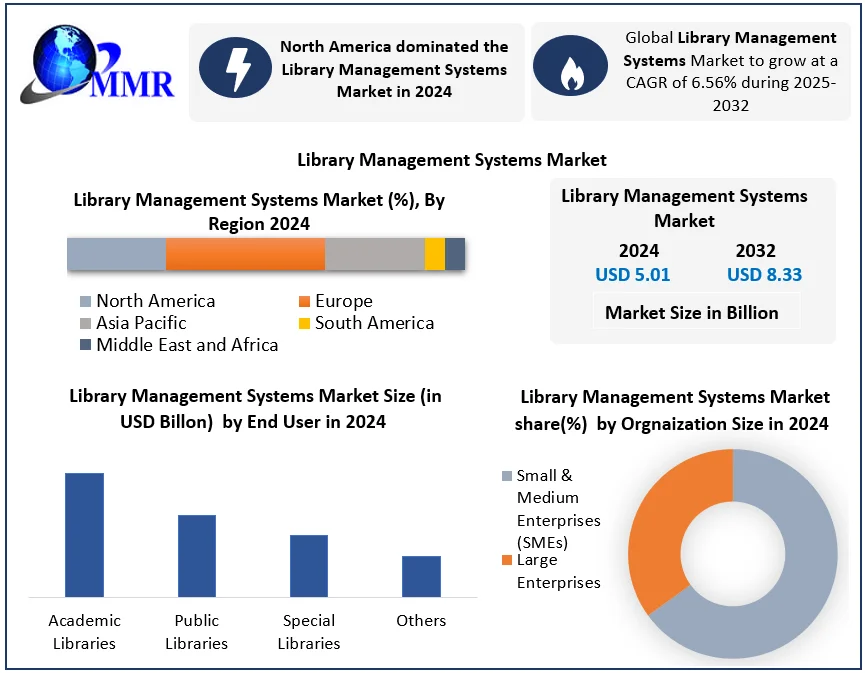
Global Library Management Systems Market size was valued at USD 5.01 Bn. in 2024, and the total Library Management Systems Market revenue is expected to grow by 6.56% from 2025 to 2032, reaching nearly USD 8.33 Bn.
Library Management Systems Market Overview:
A Library Management System (LMS) is a software solution designed to streamline and automate the various operations of libraries, including cataloging, acquisitions, circulation, user management, and access to digital resources. By integrating these functions into a single platform, LMS helps libraries improve efficiency, reduce manual errors, and enhance user experience. Modern LMS platforms also support e-books, online journals, and multimedia content, making them essential in the era of digital learning.
 To know about the Research Methodology :- Request Free Sample Report
LMS solutions provide an integrated platform to manage cataloging, acquisitions, circulation, user accounts, digital resources, and interlibrary loans, thereby improving operational efficiency and enhancing user experience. The shift toward digital learning, e-books, and online resources has significantly accelerated the adoption of LMS. Cloud-based and mobile-enabled solutions are gaining popularity because of their scalability, remote accessibility, and cost-effectiveness, driving the Library Management Systems Market. Academic institutions, public libraries, and corporate knowledge centers are increasingly investing in LMS to streamline workflows, ensure resource discoverability, and support data-driven decision-making. The advanced features, such as AI-powered search, analytics, and integration with e-learning platforms, are boosting the Library Management Systems Industry.
Library Management System Market Dynamics
Growing Digital Transformation in Libraries to drive the Library Management System Market
The educational institutions, research bodies, and government organizations increasingly digitize their services, the need for integrated platforms that manage both physical and digital collections have increased. LMS solutions streamline cataloging, circulation, acquisitions, and database management while offering end users seamless access to e-books, digital archives, and multimedia content, which boosts the Library Management Systems Market growth. With the global shift toward hybrid learning environments and remote research, the demand for digital-first, cloud-based LMS platforms has risen sharply, enabling libraries to extend their services beyond physical boundaries and operate 24/7.
The growing emphasis on interoperability with external databases, open-access repositories, and discovery tools strengthens LMS adoption, as it provides patrons with a unified search and access experience. Vendors are embedding advanced technologies such as artificial intelligence, machine learning, and linked open data, which support predictive cataloging, enhanced search accuracy, and personalized recommendations, aligning with the evolving needs of digital-native users. LMS solutions help libraries optimize resource allocation, automate repetitive tasks, and improve staff productivity, creating operational efficiencies.
High Implementation and Maintenance Costs to hamper the Library Management System Market
Deploying a modern LMS, particularly advanced cloud-based or AI-integrated solutions requires significant upfront investment, covering licensing, customization, staff training, and integration with legacy systems. For smaller public libraries, community institutions, or developing-region universities with limited budgets, these costs are prohibitive, restricting adoption. The ongoing expenses related to subscription fees, software updates, cybersecurity, and technical support add to the financial burden, which hampers the Library Management Systems Market. In many cases, libraries invest in IT infrastructure upgrades to support digital platforms, creating additional barriers. As a result, while large institutions adopt advanced LMS platforms, budgetary constraints slow adoption among smaller libraries, limiting overall Library Management Systems Market penetration.
Library Management Systems Market Segment Analysis:
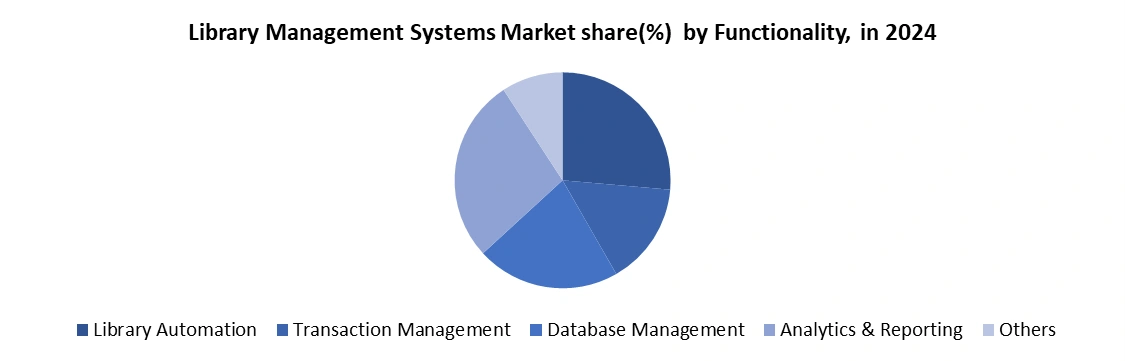
Based on Functionality, the market is segmented into Library Automation, Transaction Management, Database Management, Analytics & Reporting and others. Library Automation dominated the Library Management Systems Market in 2024. Automation solutions encompass cataloging, acquisitions, circulation, serials control, interlibrary loan management, digital resource integration, and automated notifications, enabling libraries to streamline workflows, reduce manual intervention, and enhance resource accessibility. The growing transition from manual and paper-based processes to scalable digital platforms that support hybrid resource management, covering both print and digital collections, drives the Library Management Systems Market. The automation enhances interoperability by integrating with external databases, discovery services, and third-party applications, offering seamless user experiences and real-time data exchange. The global shift toward remote learning, digital libraries, and e-content subscriptions has further accelerated the adoption of automation, as it ensures 24/7 resource availability, centralized access points, and user self-service functionalities such as online reservations and renewals.
Based on Deployment, the market is segmented into On-premise and Cloud-based. Cloud-based deployment dominates the Library Management System Market and is expected to maintain its lead over the forecast period. The dominance of cloud-based systems is driven by their scalability, cost-effectiveness, and accessibility, which enable libraries of all sizes to manage collections and services without heavy investments in infrastructure or IT staff. Cloud solutions provide real-time updates, seamless integration with digital repositories, and remote access capabilities, aligning perfectly with the increasing demand for online and mobile-based learning. Academic libraries, especially in higher education institutions, are rapidly embracing cloud-based LMS to support distance education, collaborative research, and multi-location resource sharing. The cloud deployment supports linked open data, interoperability with learning management systems (LMS in education), and analytics-driven insights, making it an attractive choice for forward-looking libraries.
Library Management System Market Regional Insights:
North America dominated the Largest Library Management System Market Share in 2024. Leading Library Management System vendors such as Ex Libris, SirsiDynix, and Follett Corporation account for a significant portion of global deployments. The region benefits from a mature digital infrastructure, high adoption of cloud-based solutions, and extensive integration of LMS with e-learning platforms across academic institutions, corporate organizations, and public libraries. Universities and research institutes in the U.S. and Canada are at the forefront of digital transformation, emphasizing open access, digital repository management, and AI-driven resource discovery, which continues to boost demand.
Asia Pacific is the fastest-growing region for the Library Management System Market over the forecast period. Countries such as China, India, Japan, South Korea, and Australia are at the forefront of this transformation, with universities, schools, and public libraries increasingly shifting from traditional cataloging methods to cloud-based and mobile-enabled LMS solutions. The region’s massive student population and expanding higher education sector create significant demand for efficient resource management, digital repositories, and online content access. Governments across India and Southeast Asia are supporting large-scale library automation projects to bridge educational gaps and promote digital literacy, while advanced economies such as Japan and South Korea are leading in the integration of AI, machine learning, and data analytics.
Library Management System Market Competitive Landscape
The competitive landscape of the Library Management System Market is highly dynamic, shaped by the presence of established international players, regional providers, and innovative startups that continuously evolve their offerings to meet the changing needs of academic, public, corporate, and special libraries. Leading companies such as Ex Libris (a Clarivate company), SirsiDynix, Innovative Interfaces, Follett Corporation, and Bibliotheca dominate with comprehensive platforms that integrate cataloging, circulation, acquisitions, discovery, and digital resource management, catering to large institutions worldwide.
Ex Libris, in particular, has strengthened its position with the Alma platform, which surpassed 2,500 customers globally by 2023, reflecting growing demand for unified cloud-based resource management solutions. Library Management System key providers such as Civica, Axiell, ByWater Solutions, and Book Systems Inc. are expanding their footprints by offering cost-effective, scalable, and open-source solutions, especially appealing to small and mid-sized libraries seeking flexibility and affordability. The strong competition from regional vendors in Asia-Pacific, such as MasterSoft Education ERP and Libsys, focuses on tailoring systems for local needs, including multilingual support and compliance with regional educational standards. In Europe, players like Koha, Systematic, and Lucidea are building strong user communities and open-source networks to encourage collaboration and innovation.
Library Management System: Key developments
• May 9, 2024 – OCLC launched Meridian, a web application and suite of APIs enabling libraries to create, curate, and connect linked data entities. Integrated with WorldCat Entities, it enhances discoverability, findability, and relevance across the web while supporting the shift from MARC-based cataloging to linked data services. Meridian enables integration with identifiers such as VIAF, ISNI, ORCID, and Wikidata, providing scalable and sustainable authority-linked data. Libraries adopt it without disrupting existing workflows and contribute at their own pace.
• November 14, 2023 – Ex Libris, declared that over 2,500 institutions have adopted the Alma unified library management system, marking significant growth with 180+ libraries joining in 2023 and 500+ since 2021. Alma’s success stems from its ability to unify management of print, electronic, and digital resources, alongside strong community engagement via user groups, Idea Exchange, and open development channels. In 2023, 400+ enhancements were added, with the 2024 roadmap focusing on open access, collaboration, linked data, and AI, strengthening Alma’s position as a future-ready library management system.
Key Trends in the Library Management System (LMS) Market
| Trend | Description |
| Accelerated Digitization and Transformation of Library Infrastructure | Technology-enabled library ecosystems are on the rise. Institutions and state agencies are investing in digitalization, smart technology, and upgrades such as Wi-Fi, RFID, and e-resources. |
| Integrated Multi-Functional Smart Solutions | Initiatives like BHU's "One Card, One University" and NDLI's enhanced platform show a move toward integrating library management into broader institutional services, improving user accessibility, personalization, and operational efficiency. |
| Expansion of Digital Content Access | Collaborations with INFLIBNET and Kindle enable local public libraries to provide large collections of digital resources, supporting distance education and catering to diverse reader preferences. |
Library Management Systems Market Scope: Inquire before buying
| Global Library Management Systems Market | |||
|---|---|---|---|
| Report Coverage | Details | ||
| Base Year: | 2024 | Forecast Period: | 2025-2032 |
| Historical Data: | 2019 to 2024 | Market Size in 2024: | USD 5.01 Bn. |
| Forecast Period 2025 to 2032 CAGR: | 6.56% | Market Size in 2032: | USD 8.33 Bn. |
| Segments Covered: | by Component | Software Services System Integration Training and Consulting Support and Maintenance Others |
|
| by Functionality | Library Automation Transaction Management Database Management Analytics & Reporting Others |
||
| by Deployment | On-premise Cloud-based |
||
| by Organization Size | Small & Medium Enterprises (SMEs) Large Enterprises |
||
| by End User | Academic Libraries Public Libraries Special Libraries Others |
||
Library Management Systems Market, by Region
North America (United States, Canada and Mexico)
Europe (UK, France, Germany, Italy, Spain, Sweden, Austria, Turkey, Russia and Rest of Europe)
Asia Pacific (China, India, Japan, South Korea, Australia, ASEAN and Rest of APAC)
Middle East and Africa (South Africa, GCC, Egypt, Nigeria and Rest of ME&A)
South America (Brazil, Argentina, Columbia and Rest of South America)
Library Management System (LMS) Key Players
1. Ex Libris
2. SirsiDynix
3. Innovative Interfaces
4. Follett Corporation
5. CodeAchi
6. LibLime
7. Clariant
8. The Library Corporation
9. Springshare, LLC
10. MasterSoft Education ERP
11. ETG SECURITY SOLUTIONS LIMITED
12. EBSL
13. Bibliotheca
14. BOOKTEC
15. DAPHNE
16. JI-WIT Limited
17. Malve Panalytical
18. Digital Data Systems
19. Koha
20. Systematic
21. Lucidea
22. Libsys
23. BiblioCommons
24. OCLC
25. Biblionix
26. EnvisionWare
27. Equinox
28. InfoVision Software, Inc.
29. Keystone Systems, Inc.
30. LIBERO
Frequently Asked Questions:
1. Which region has the largest share in the Global Library Management Systems Market?
Ans: The North America region held the largest Library Management Systems market in 2024.
2. What is the growth rate of the Global Library Management Systems market?
Ans: The Global market is growing at a CAGR of 6.56 % during the forecasting period 2025-2032.
3. What is the scope of the Global market report?
Ans: Global market report helps with the PESTEL, PORTER, COVID-19 Impact analysis, Recommendations for Investors & Leaders, and market estimation of the forecast period.
4. Who are the key players in the Global Library Management Systems market?
Ans: The key players in the Global market are Ex Libris, SirsiDynix, Innovative Interfaces, Follett Corporation, CodeAchi and Others.
5. What is the study period of this Library Management Systems Market?
Ans: The Global Library Management Systems Market is studied from 2024 to 2032.