
li ion battery for AEVs Market Size by Type, Product, Application, Region – Segment-Level Market Assessment, Growth Opportunity Analysis, Competitive Mapping & Forecast to 2032
Overview
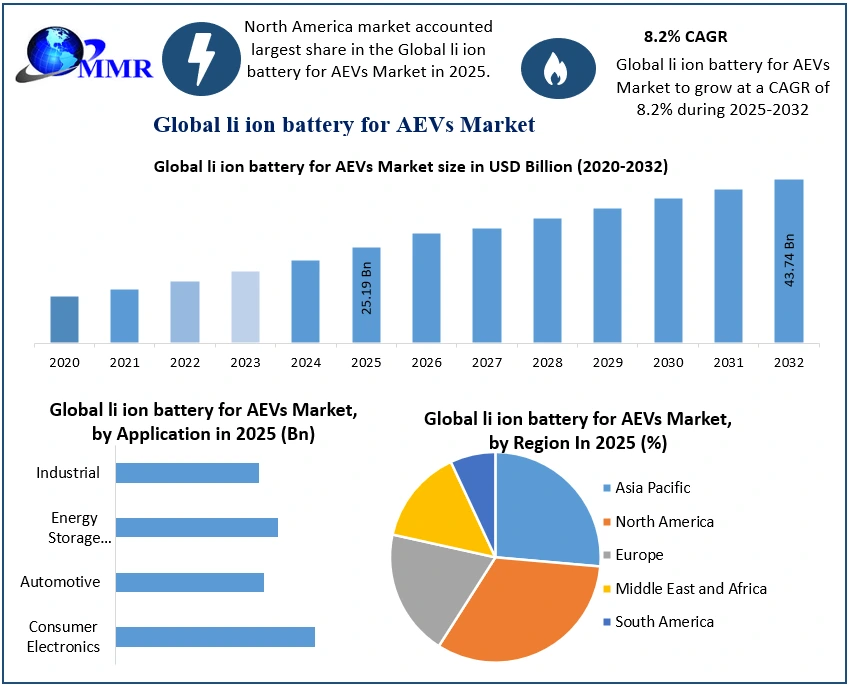
The li ion battery for AEVs Market size was valued at USD 25.19 Billion in 2025 and the total li ion battery for AEVs revenue is expected to grow at a CAGR of 8.2% from 2025 to 2032, reaching nearly USD 43.74 Billion by 2032.
Global li ion battery for AEVs Market Overview:
A rechargeable battery, the Li-Ion Battery for AEVs, is a type of rechargeable battery. It is used to provide power in a variety of applications, including electric cars (HEVs, PHEVs, and BEVs). It can also be utilised in the industrial sector to store renewable energy in a grid storage system. Because of their high capacity and low operating costs, Li-ion batteries are likely to replace lead-acid batteries in HEVs and PHEVs in the future.
Over the projected period of 2025-2032, this would raise the growth rate of 8.2% the worldwide Li-ion Battery Market for AEVs market size. They have one of the best energy-to-weight ratios, a high open circuit voltage, a low self-discharge rate, and a slow loss of charge when not in use, making them one of the most popular types of rechargeable batteries for AVEs.
 To know about the Research Methodology :- Request Free Sample Report
Global Market Dynamics:
Consumer demand for li ion batteries are high thanks to its unique properties such as high energy density, long life, reduced weight, and eco-friendly qualities. Lithium-ion batteries have also emerged as the preferred energy source for electric cars (EVs), hybrid electric vehicles (HEVs), and plug-in hybrid vehicles (PHEVs), as well as energy storage applications, in the fast-growing market. The worldwide wind industry had its best year ever in 2020, with 93 GW of new capacity installed, up 53% from the previous year, fueling demand for ESSs in the world and propelling the expansion of the lithium-ion battery industry.
Li-ion batteries are a good option for NiMH batteries since they produce twice as much energy for the same weight and provide increased output and mileage. The cost of lithium-ion batteries has been declining, with a price of less than USD 137/KWh expected in December 2020, down from around USD 900/KWh in 2011. Because the battery costs a substantial portion of the entire EV cost, the dropping cost of the battery has prompted an increase in demand for EVs.
The government's strict emission limits to safeguard the environment and reduce degradation-based possibilities are projected to have a significant impact on the lithium-ion battery business. The presence of significant electric car firms in the United States, United Kingdom, Germany, and China, such as Nissan, BMW, Tesla, Chevrolet, Ford, Toyota, and Fiat, is expected to boost market expansion. In 2020, the Lithium Iron Phosphate (LFP) product category was worth more than USD 12.0 billion. These batteries have a long life period and provide exceptional product safety.
Increasing lithium-ion battery production capacity in China, led by companies like Panasonic, Contemporary Amperex Technology Co., and LG Chem, as well as growing subsidies for electric vehicles, are expected to provide a massive market opportunity throughout the forecast period. Panasonic, a key battery supplier to OEMs such as Tesla and Toyota, has deployed more lithium batteries globally in 2019 then all of its competitors combined. In 2019, CATL doubled its lithium battery deployment from the previous year to 4,800 tons. CATL also successfully completed and passed all safety tests on its liquid cooling battery energy storage system (BESS) based on lithium iron phosphate (LFP) in 2020.
Most electric vehicle batteries are deemed safe since they are put through a series of testing before being used. However, some instances have cast doubt on the safety of these batteries, such as the recall of 68,000 Chevy EV Bolts following five battery-related fires.
Global li ion battery for AEVs Market Segment Analysis:
Based on product, Global li ion battery for AEVs Market is segmented into Lithium cobalt oxide (LCO), Lithium iron phosphate (LFP), Lithium Nickel Cobalt Aluminum Oxide (NCA), Lithium Manganese Oxide (LMO), Lithium Titanate, and Lithium Nickel Manganese Cobalt based on product. The Lithium cobalt oxide (LCO) segment is expected to lead the market of Li ion battery for the AEVs market. In 2020, Lithium Cobalt Oxide (LCO) was the most important segment, accounting for 32.3 % of global revenue.
Owing to its cheaper cost, longer cycle life, and higher energy density, Lithium Nickel Manganese Cobalt (NMC) will see increased acceptance in electric bikes, power tools, and other electric powering trains over the forecast period. This battery provides excellent overall performance, excels at detailed energy, and has a large capacity and power output.
Based on application, Global li ion battery for AEVs Market is segmented into Consumer Electronics, Automotive, Energy Storage System and Industrial based on application. In 2025, the automotive segment is estimated to have the highest share of xx% of the lithium-ion battery for AEVs market. Lithium-ion batteries are used extensively in battery-powered vehicles such as electric automobiles, e-bikes, and automated guided vehicles.
AEVs are classed as battery electric vehicles (BEVs), hybrid electric vehicles (HEVs), or plug-in hybrid electric vehicles (PHEVs) depending on their power source and use (PHEVs). The expansion of the lithium-ion battery market is aided by rising EV acceptance and awareness. The COVID-19pandemic has wreaked havoc on automobile original equipment manufacturers (OEMs) and mobility industry stakeholders.
Based on Type, Global li ion battery for AEVs Market is segmented into Cylindrical Cell, Prismatic Cell, Pouch Cell, and Secondary Cells. In 2025, the Cylindrical Cell segment is estimated to have the highest share of xx% of the lithium-ion battery for AEVs market. The cylindrical cell is one of the three most common battery cell shapes, with the Prismatic Cell and the Pouch Cell being the other two.
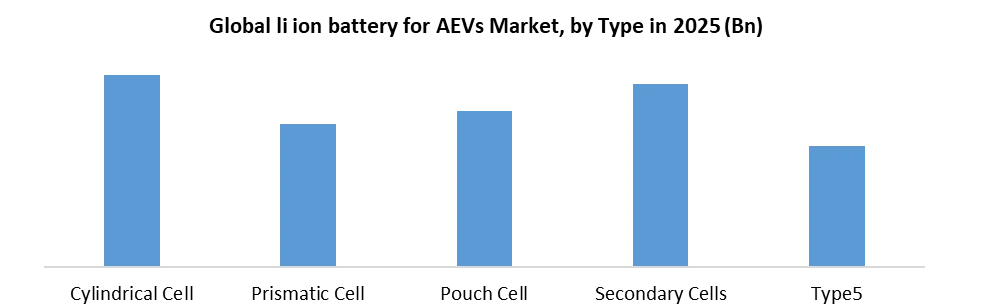
Because they fit within a regular AA or AAA flashlight, they're also known as 18650 or flashlight cells. Due to the higher energy density required in these applications, cylindrical cells are the most often utilized form of battery for HEVs, PHEVs, and BEVs. Because of their low cost, they are the most often employed cell type.
Regional Insights:
During the projected period, the North America region is expected to dominate the market owing to its advanced infrastructure and rising usage. The United States is one of the leading country in North America with HEVs and PHEVs having a capacity range between 48 and 230 kWh.
Thanks to the increased use of battery electric vehicles (BEVs) in countries like Japan, China, and India, the Asia Pacific market is likely to rise significantly. New models such as the Nissan Leaf II (2020), Tesla Model S III (2020), and the Audi E-Tron Quattro Concept (2019) are projected to fuel growth. Technological improvements such as the HEV energy management system, which maximizes the use of Li-ion batteries, are expected to boost adoption rates. CATL and Daimler Truck AG announced in May 2021 that their existing collaboration would be expanded based on their shared vision of CO2-neutral electrified trucking. CATL will supply lithium-ion battery packs for Mercedes-eActros Benz's LongHaul battery-electric vehicle, which is expected to go into production in 2024. Fuel cell electric cars (FCEV) provide an option, although their production scale is currently limited due to high prices per kWh.
The European market is likely to expand in the next years as more BEVs, such as the Renault Zoe, Tesla Model S, and BMW I series are adopted. Countries like Brazil, which has set pollution limits that require zero-emission vehicles by 2020, will boost the Latin American market. Mexico is expected to have high demand as its infrastructure continues to improve, with a focus on light electric vehicle (LEV) solutions, such as public transit systems like bus fleets that are powered by LEVs. The LIM30HL family of industrial lithium-ion battery modules were launched by GS Yuasa Corporation in December 2020. While the LIM30HL series battery modules have the same dimensions as the LIM25H series, they are upwardly compatible and have a larger rated capacity and lower internal resistance.
Market trends:
In 2020, Waymo became the first service provider to offer robotaxi rides to the general public in a section of Phoenix, Arizona. Tesla has stated that it will offer subscription-based "full self-driving" to private vehicle owners in 2021, and Nuro has been granted permission to begin autonomous commercial delivery operations in California in 2021. Two public trials of robo-taxis have been launched in China: one in 2020 in Shenzhen's Pingshan District by Chinese firm AutoX and the other in 2021 at Beijing's Shougang Park by Baidu, which will host 2022 Winter Olympics.
In the press release, the tesla's owner said the industry could produce 30 Mn battery-powered electric vehicles by 2029 as other auto makers begin to build EV models. Roughly 2 Mn EVs were sold globally in 2019. Shortly after Tesla's battery technology day on September 22, Morgan Stanley's research team released an interactive lithium supply and demand model. According to the researchers, global production of lithium carbonate equivalent, or LCE, was around 380,000 tons in 2019.
About a third of it was earmarked for use in lithium-ion batteries in electric automobiles. Large lithium miners, Livent (LTHM), Albemarle (ALB), and SQM account for roughly half of global production. Albemarle is the world's largest lithium producer, with a capacity of roughly 85,000 tons as of 2019. To meet rising demand, all three are increasing production. According to recent plans, the corporations will spend approximately $5000 per ton on LCE capacity. Energy Generation and Storage brought in $1.5 billion in 2019, accounting for 6% of Tesla's total revenue. Automotive revenue accounted for $20.8 billion, or 85 % of total revenue.
The objective of the report is to present a comprehensive analysis of the Global li ion battery for AEVs Market to the stakeholders in the industry. The past and current status of the industry with the forecasted Market size and trends are presented in the report with the analysis of complicated data in simple language. The report covers all the aspects of the industry with a dedicated study of key players that include Market leaders, followers, and new entrants.
PORTER, PESTEL analysis with the potential impact of micro-economic factors of the Market have been presented in the report. External as well as internal factors that are supposed to affect the business positively or negatively have been analyzed, which will give a clear futuristic view of the industry to the decision-makers.
The report also helps in understanding the Global li ion battery for AEVs Market dynamics, structure by analyzing the Market segments and project the Global li ion battery for AEVs Market size. Clear representation of competitive analysis of key players by Deployment, price, financial position, Deployment portfolio, growth strategies, and regional presence in the Global li ion battery for AEVs Market make the report investor’s guide.
Global li ion battery for AEVs Market Scope: Inquire before buying
| Global li ion battery for AEVs Market | |||
|---|---|---|---|
| Report Coverage | Details | ||
| Base Year: | 2025 | Forecast Period: | 2026-2032 |
| Historical Data: | 2020 to 2025 | Market Size in 2025: | USD 25.19 Bn. |
| Forecast Period 2026 to 2032 CAGR: | 8.2% | Market Size in 2032: | USD 43.74 Bn. |
| Segments Covered: | by Type | Cylindrical Cell Prismatic Cell Pouch Cell Secondary Cells |
|
| by Product | Lithium cobalt oxide (LCO) Lithium iron phosphate (LFP) Lithium Nickel Cobalt Aluminum Oxide (NCA) Lithium Manganese Oxide (LMO) Lithium Titanate Lithium Nickel Manganese Cobalt |
||
| by Application | Consumer Electronics Automotive Energy Storage System Industrial |
||
Global li ion battery for AEVs Market, by Region
North America (United States, Canada and Mexico)
Europe (UK, France, Germany, Italy, Spain, Sweden, Austria and Rest of Europe)
Asia Pacific (China, South Korea, Japan, India, Australia, Indonesia, Malaysia, Vietnam, Taiwan, Bangladesh, Pakistan and Rest of APAC)
Middle East and Africa (South Africa, GCC, Egypt, Nigeria and Rest of ME&A)
South America (Brazil, Argentina and Rest of South America)
Global li ion battery for AEVs Market Key Players are:
1. AESC
2. Blue Energy
3. Hitachi
4. LG Chem
5. Panasonic
6. Toshiba
7. Samsung SDI
8. Deutsche ACCUmotive
9. Tesla
10.Johnson Controls
11.Sony
12.A123 Systems
13.Shenzhen BAK battery
14.Coslight India Telecom Pvt. Ltd.
15.Electrovaya, Inc.
16.EnerDel, Inc.
17.Highpower International, Inc.
Frequently Asked Questions:
1] What segments are covered in Global li ion battery for AEVs Market report?
Ans. The segments covered in Global li ion battery for AEVs Market report are based on product, application and type.
2] Which region is expected to hold the highest share in the Global li ion battery for AEVs Market?
Ans. North America is expected to hold the highest share in the Global li ion battery for AEVs Market.
3] What is the Market size of Global li ion battery for AEVs Market in the forecast period 2025-2032?
Ans. The Market size of Global li ion battery for AEVs Market in the forecast period 2025-2032 is USD 43.74 Bn.
4] Who are the top key players in the Global li ion battery for AEVs Market?
Ans. AESC, Blue Energy, Hitachi, LG Chem, Panasonic, Toshiba, Deutsche ACCUmotive, Samsung SDI, Johnson Controls, Sony, A123 Systems, Shenzhen BAK battery, Tesla, Coslight India Telecom Pvt. Ltd., Electrovaya, Inc., EnerDel, Inc., Highpower International, Inc.
5] What was the Market size of Global li ion battery for AEVs Market in 2025?
Ans. The Market size of Global li ion battery for AEVs Market in 2025 was USD 25.19 Bn.