
LED Lighting Market - Industry Structure Evaluation, Demand Drivers Analysis, Regional Growth Analysis and Identification, Competitive Positioning / Landscape Review & Global Market Size Forecast to 2030
Overview
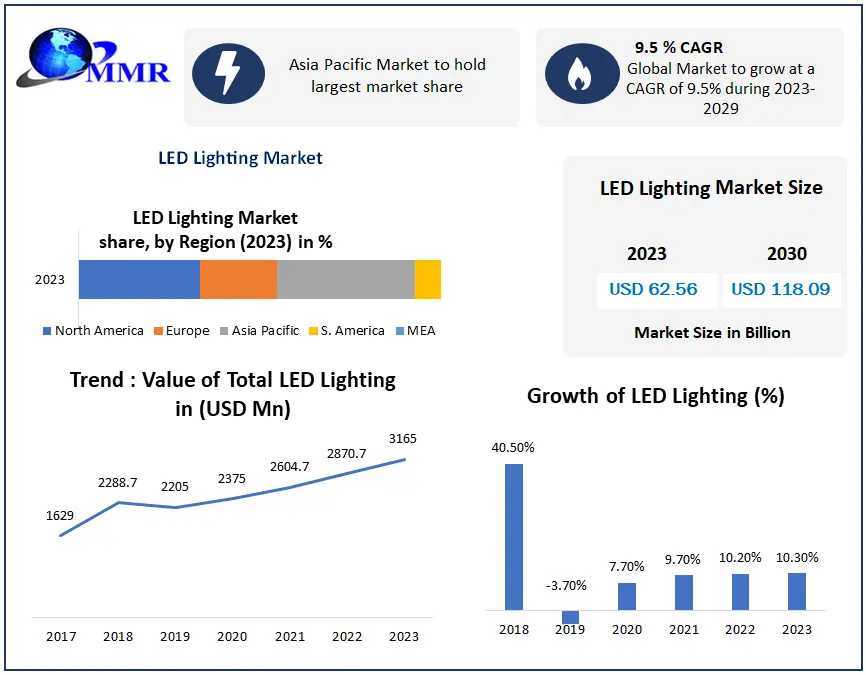
Global LED Lighting Market size was valued at USD 62.56 Bn. in 2023 and the total LED Lighting revenue is expected to grow by 9.5 % from 2024 to 2030, reaching nearly USD 118.09 Bn.
LED Lighting Market Overview
A light-emitting diode (LED) is a semiconductor device that produces visible light when an electrical current flows through it. Essentially, it functions as the reverse of a photovoltaic cell, which transforms visible light into electrical current. LEDs are energy efficient and consume significantly less power compared to incandescent and fluorescent bulbs, making them more energy-efficient.
 To know about the Research Methodology :- Request Free Sample Report
The global LED lighting market has experienced substantial growth over the past decade. This growth is driven by increasing awareness of energy efficiency, government regulations promoting the use of energy-efficient lighting, and advancements in LED technology. Continuous improvements in LED technology have enhanced their efficiency from 90 lm/w to 135 Lm/w, color quality, and lifespan. Innovations such as smart LED lighting systems and tunable white LEDs are also contributing to the LED Lighting industry growth.
LED Lighting Market Dynamics
Favorable government initiatives and regulations for energy-efficient LED lighting solutions across the world
Governments worldwide are increasingly recognizing the importance of energy efficiency and sustainability, leading to the implementation of favorable regulations that promote the adoption of LED lighting solutions, which is expected to boost the LED Lighting Market growth. These regulations are designed to drive the transition from traditional lighting technologies to more energy-efficient and environmentally friendly alternatives.
According to the US Department of Energy, the use of energy-efficient lighting technological products such as ENERGY STAR rated residential LEDs tend to use 75% lesser energy and tend to last 25 times longer than incandescent lighting solutions used in the country. As per the department of energy's forecast, by the year 2035, it is expected that the predominant choice for lighting installations is LED technology. The energy efficiency gains from widespread LED lighting adoption reach an impressive 569 terawatt-hours annually by 2035. This amount is equivalent to the yearly energy output of over 92 power plants each generating 1,000 megawatts. This projection underscores the significant impact and growing prevalence of LED lighting in the global energy landscape.
Also, government offers various benefits for adopting LED lighting solutions instead of traditional lighting solutions. Numerous governments provide financial incentives in the form of rebates for both individuals and businesses undertaking the installation of energy-efficient lighting solutions. These rebates serve as a means to alleviate the upfront expenses associated with acquiring energy-efficient bulbs, thus rendering the transition to such lighting options more economically viable. Also, in certain nations, governmental authorities extend tax incentives to encourage the adoption of energy-efficient lighting systems, which is expected to boost the LED Lighting Market growth. These incentives manifest as tax credits or deductions, enabling individuals and businesses to retain a greater portion of their financial resources while contributing to environmental conservation. By leveraging these tax incentives, users not only benefit from cost savings but also actively participate in initiatives aimed at promoting sustainable practices and reducing overall energy consumption.
Highly Efficient Specification and Multiple Applications of LEDs to Drive LED Lighting Market Growth
Most of the emerging countries are shifting their focus toward energy conservation and eco- friendly lighting solutions. As part of this energy conservation agenda, many countries are actively installing light-emitting diode systems on a large scale. Over the past decade, many customers have switched from CFL to light-emitting diode bulbs. Lighting incur up to 20% or 25% of overall energy costs, so shifting to LEDs save money and reduce monthly energy bills. LEDs are point source of light and are easily adopted in various home decor to enhance aesthetics. It is also used in the camera flash, signal lights, and aviation lights. Such benefits of light-emitting diode lighting systems are expected to drive the global LED Lighting market.
Trend in LED Lighting Market
Smart Lighting Integration: LED lighting systems are increasingly being integrated with smart home and building automation systems. This trend includes the use of IoT (Internet of Things) technology to enable remote control, scheduling, and customization of lighting settings via smartphones and voice-activated assistant.
Energy Efficiency and Sustainability: LEDs continue to lead in energy efficiency and sustainability, reducing energy consumption and carbon footprints. Innovations such as graphene-coated LEDs are enhancing efficiency further, making them more affordable and accessible.
Human-Centric and Therapeutic Lighting: There is growing emphasis on lighting solutions that promote human health and well-being. This includes dynamic lighting that adjusts to natural circadian rhythms and therapeutic lighting solutions designed for medical and wellness applications, such as red light therapy for skin treatments.
Advanced Applications in Agriculture: Agricultural lighting is becoming more sophisticated, with LED systems being used to optimize plant growth and productivity through tailored light spectra. This technology supports controlled-environment agriculture and vertical farming practices.
UV Disinfection: In response to the COVID-19 pandemic, UV-C LED lighting for disinfection purposes has gained prominence. These systems are used to sterilize air, water, and surfaces, enhancing hygiene in various settings such as hospitals, schools, and public transport.
Aesthetic and Functional Design Trends: The design of LED lighting fixtures is becoming more versatile and aesthetic, catering to various interior design trends. In residential spaces, we see trends like recessed lighting for low ceilings, dramatic pendants for vaulted ceilings, and integrated lighting in smart kitchens and bathrooms.
Functional problems associated with LED Technology to limit LED Lighting Market growth
While LED (Light Emitting Diode) technology offers numerous advantages, there are some functional problems and challenges associated with it. Generally, LEDs produce heat, and if not managed effectively, it can affect their performance and lifespan. Overheating leads to color shifting, reduced brightness, and a shorter overall lifespan. Adequate heat sinks and thermal management systems are crucial to mitigate this issue. Achieving consistent color across different LED products and over time is challenge. Variations in color temperature and color rendering occur, impacting the quality of lighting and making it difficult to match colors accurately, especially in commercial or industrial applications.
While LED technology has made significant strides in improving color rendering, some LEDs still struggle to accurately represent certain colors, affecting the overall quality of illumination. Thus, Color Rendering Index (CRI) issues are there to be solved. Advances in phosphor technology and color-mixing techniques aim to address this challenge. Also, LED drivers, which convert AC power to the DC power required for LEDs, introduce power quality issues such as harmonics and electromagnetic interference (EMI). These issues impact the performance of other electronic devices sharing the same power supply. Thus, power quality issues are also there.
Over the recent year as China has been dumping LEDs into global LED Lighting markets, it has been observed that the blue light content of the white LEDs has increased significantly causing harm especially to human eyes.
Opportunity:
Rising adoption of LED lighting in the horticulture sector
The use of LED lighting in horticulture has gained significant traction as a cutting-edge technology that offers numerous benefits to enhance plant growth and optimize crop yields. LED lighting is employed in controlled environment agriculture (CEA) systems, such as greenhouses and vertical farms, to provide artificial light that complements or replaces natural sunlight. LED lighting allows precise control over the light spectrum, enabling farmers to tailor the wavelengths emitted by the LEDs to meet the specific needs of different crops at various growth stages. This spectral control influences factors such as flowering, fruiting, and overall plant development, which presents significant opportunity for the LED Lighting Market growth. From the energy efficiency perspective, LED lights are highly energy-efficient, converting a larger proportion of energy into usable light for plants. This efficiency results in reduced energy consumption compared to traditional lighting sources, making LED lighting a sustainable and cost-effective choice for indoor farming operations.
LED Lighting Industry Ecosystem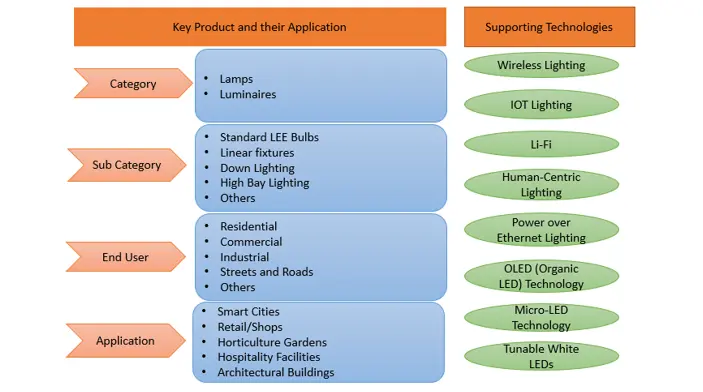
LED Lighting Market Regional Insight
Economic Growth and Urbanization to boost Asia Pacific LED Lighting Market growth
Rapid urbanization across the Asia-Pacific region has led to increased demand for efficient and sustainable infrastructure. As cities expand, there is a growing need for advanced lighting solutions in residential, commercial, and industrial sectors. The economic rise of countries like China, India, and Southeast Asian nations has increased disposable incomes, leading to higher demand for quality lighting products. Growing awareness of environmental issues and the need to reduce carbon footprints are driving the shift towards eco-friendly lighting solutions. LEDs consume less energy and have a lower environmental impact compared to traditional lighting technologies.
Due to rising labor costs in China and a strengthening Yuan, combined with a weakening Rupee, there is a significant opportunity to shift component manufacturing to India. This, along with greater automation in LED lighting production, enable the creation of competitive products for export. The rapid growth of Indian infrastructure and the substantial increase in local demand enhance manufacturing quality, making products more acceptable for export, which significantly boost the Asia Pacific LED Lighting Market growth. The development of smart cities and modernization efforts lead to the production of world-class export products. This shift generate employment opportunities in India. Products designed with features tailored for India is preferred for export, particularly to ASEAN and tropical countries. Indian LED products are highly cost-effective and competitively priced. Establishing a Centre of Excellence in India support the development of India-centric products and facilitate R&D on finished products.
LED Lighting Market Segment Analysis
Based on Application, the market is segmented into Domestic Lighting, TFT Backlight, Mobile Flashlight, Automotive Lighting, Indicator Lights, Horticulture, and Signage. TFT Backlight segment dominated the market in 2023 and is expected to hold the largest LED Lighting Market share over the forecast period. The TFT (Thin-Film Transistor) backlight segment within the LED lighting market focuses on providing backlighting solutions for displays that use TFT technology. TFT displays are a type of LCD (Liquid Crystal Display) that utilize thin-film transistors to improve image quality and control. LEDs consume less power compared to traditional CCFL (Cold Cathode Fluorescent Lamp) backlights, extending the battery life of portable devices.

LED Lighting Market Scope: Inquiry Before Buying
| Global LED Lighting Market | |||
|---|---|---|---|
| Report Coverage | Details | ||
| Base Year: | 2023 | Forecast Period: | 2024-2030 |
| Historical Data: | 2018 to 2023 | Market Size in 2023: | US $ 62.56 Bn. |
| Forecast Period 2024 to 2030 CAGR: | 9.5% | Market Size in 2030: | US $ 118.09 Bn. |
| Segments Covered: | by Product Type | Lamps A-Type T-Type Others Luminaires Downlighting Decorative Lighting Directional Lighting Others |
|
| by Installation | New Retrofit |
||
| by Application | Indoor Residential Commercial Industrial Others Outdoor Streets and Roadways Architectural Buildings Sports Complexes Tunnels Others |
||
| by End-User | Online Offline |
||
LED Lighting Market, by Region
North America (United States, Canada and Mexico)
Europe (UK, France, Germany, Italy, Spain, Sweden, Austria and Rest of Europe)
Asia Pacific (China, South Korea, Japan, India, Australia, Indonesia, Malaysia, Vietnam, Taiwan, Bangladesh, Pakistan and Rest of APAC)
Middle East and Africa (South Africa, GCC, Egypt, Nigeria and Rest of ME&A)
South America (Brazil, Argentina Rest of South America)
Leading LED Lighting Manufacturers Include:
Examining the strategies, innovations, and market positions of major players like Acuity Brands, LG Electronics, Signify Holding, Panasonic Corporation, ams-OSRAM Licht AG, and Syska Group is crucial in understanding the competitive environment of the LED lighting market. These companies promote progress with intelligent lighting solutions, eco-friendly technologies, and environmentally friendly innovations. Firms are investing significantly in technology and product diversification to remain competitive, driven by the growing need for research and development in LED lighting. The market share, product portfolios, and external factors such as regulatory requirements and energy efficiency trends that affect competition are emphasized in the landscape.
North America
1. SMART Global Holdings
2. Principal LED
3. ALLED Lighting Systems
4. CRS Electronics
5. Dals Lighting
Europe
6. Eaton Corporation Plc - Ireland
7. Zumtobel Group AG - Austria
8. dialight plc- united kingdom
9. Phillips Lighting N.V - Netherlands
10. OSRAM Licht AG – Germany
11. Lumileds Lighting
12. Collingwood Lighting
APAC
13. Toshiba Co - Japan
14. Lite-On Technology - Taiwan
15. Everlight Electronics - Taiwan
16. Corvi LED Light
17. Syska Group
18. LEDified Lighting Corporation
19. Toyoda Gosei Company
20. MLS Company (China)
21. Foshan Electrical and Lighting
22. Shenzhen Liantronics
23. CNLight Company
Frequently Asked Questions:
1. What is an LED?
Ans: A light-emitting diode (LED) is a semiconductor device that emits visible light when an electrical current flows through it. It functions as the reverse of a photovoltaic cell, which converts light into electrical current.
2. What has driven the growth of the global LED lighting market?
Ans: Increased awareness of energy efficiency, favorable government regulations, and advancements in LED technology have driven substantial growth in the global LED lighting market.
3. How have advancements in LED technology improved their performance?
Ans: Improvements in LED technology have increased efficiency from 90 lm/w to 135 lm/w, enhanced color quality, and extended the lifespan of LEDs. Innovations like smart LED systems and tunable white LEDs also contribute to market growth.
4. What are the energy savings potential of LEDs in the future?
Ans: By 2035, widespread adoption of LED technology is expected to achieve energy efficiency gains equivalent to 569 terawatt-hours annually, reducing the need for over 92 power plants generating 1,000 megawatts each.
5. Why is there an opportunity to shift LED component manufacturing to India?
Ans: Rising labor costs and a strengthening Yuan in China, along with a weakening Rupee, present an opportunity to shift manufacturing to India, which can offer competitive products through increased automation.