Global Lawn Mower Market Analysis: Industry Trends, Smart Lawn Care Solutions Driving Growth, Top Technological Advancements in Robotic Mowers

6.1%
CAGR (2026-2032)
23.97 USD Bn.
Market Size
301
Report Pages
149
Market Tables

Overview

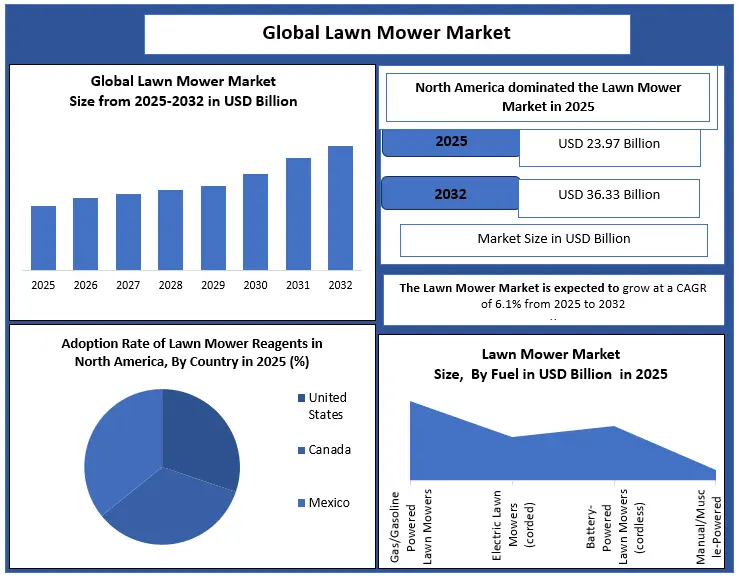
The Lawn Mower Market was valued at USD 23.97 Billion in 2025, and the total revenue is expected to grow at a CAGR of 6.1% from 2026 to 2032, reaching USD 36.33  Billion by 2032.

Lawn Mower Market Overview

The Lawn Mower Market is set to grow from USD 23.97 billion in 2025 to USD  36.33 billion by 2032, driven by increasing adoption of robotic lawn mowers, smart lawn care solutions, and eco-friendly technologies. With a CAGR of 6.1% from 2026 to 2032, the market is experiencing significant transformation, fueled by advancements in GPS navigation, AI-driven systems, and RTK positioning for greater precision and efficiency.

Lawn Mower Market Key Highlights

● Growing Adoption: Robotic mowers expected to grow by 10-12% in North America and Europe by 2025.
● Consumer Demand: 70% of consumers prefer mowers with adaptive mowing schedules and boundary-free navigation in 2025.
● Premiumization: High-end models with advanced features such as longer battery life and weather-based scheduling are gaining traction.
● Technological Advancements: 60% of new models will integrate AI-driven mowing systems and RTK positioning by 2027.
● Eco-Friendly Shift: 40% of new models will be electric-powered by 2032, driving sustainable lawn care.
Lawn Mower Market Snap

To know about the Research Methodology :- Request Free Sample Report

Industry Adoption Trends in the Lawn Mower Market

Robotic Lawn Mowers in Residential Sector

● 15% CAGR is expected for the robotic lawn mower market from 2026 to 2032.
● 70% of homeowners prefer robotic mowers with adaptive mowing schedules.
● 60% of consumers are willing to pay a premium for models that eliminate the need for boundary wires.
● 12% penetration rate of robotic mowers in North America and Europe by 2025.
● 5-7% annual growth in penetration rates in Asia-Pacific as smart home technology adoption increases.

Consumer Preferences and Adoption

● 40-50% increase in sales for GPS robotic mowers that use RTK positioning and boundary-free navigation.
● 30% of consumers in developed markets are already using robotic mowers for residential lawn care.
● 25% of consumers are adopting electric mowers due to environmental concerns and cost-effectiveness.
● 70% of consumers seek eco-friendly and low-maintenance lawn care solutions.
● 50% of Millennials are more likely to choose smart lawn care solutions with app-based scheduling and real-time monitoring.

Emerging Trends in Lawn Mower Market Technology

● 50% of new robotic mowers are expected to incorporate AI-driven adaptive mowing and RTK positioning by 2027.
● Smart lawn care features like weather-based mowing schedules are increasing in demand, with 60% of users preferring models that adapt to weather conditions and lawn growth.

Opportunity: Growing Adoption of Smart Lawn Care Solutions

The rise in demand for robotic and GPS-guided lawn mowers is driving significant growth opportunities in the Lawn Mower Market, supported by consumer preference for efficiency, convenience, and eco-friendly solutions.

Increased Consumer Demand for Automation

● 70% of consumers now prefer automated mowing for convenience and time-saving benefits.
● 50% of households in North America are expected to adopt robotic mowers by 2027, as the technology becomes more affordable.
● 60% of homeowners find GPS-guided mowers more precise than traditional lawn care methods, reducing time and manual effort.

Growing Interest in Sustainable and Eco-Friendly Solutions

● Electric-powered mowers are seeing a significant uptick, driven by the eco-conscious trend, with 40% of new mower models being electric.
● Carbon emissions reduction from robotic mowers is expected to reach 60% annually compared to gas-powered alternatives, making them more attractive to environmentally conscious consumers.

Advancements in Smart Technology

● RTK positioning and AI-based adaptive mowing are becoming standard features, creating an innovative edge for top players in the market.
● Multi-zone management and boundary-free navigation are anticipated to be included in 40% of new robotic mowers by 2027, allowing for greater flexibility and coverage of larger lawns.

Lawn Mower Market Impact: Technological Innovations Driving Growth

The shift towards automated lawn care, coupled with advancements in eco-friendly technologies and smart features, is transforming the market from manual mowing to robotic and automated solutions, creating a substantial opportunity for manufacturers to expand product offerings and capitalize on emerging consumer behaviors.

● Value-driven expansion is accelerating as consumers increasingly prioritize precision, efficiency, and environmentally friendly features over traditional lawn care methods.
● Premium robotic mowers with advanced features like RTK positioning and boundary-free navigation are leading to higher sales, contributing to market value rather than just volume-driven growth.
● The introduction of smart lawn care systems that integrate with home automation is expected to make up 30% of the market share by 2032.

Lawn Mower Market Segment Analysis

The Walk-Behind Lawn Mower segment held a significant share of the Lawn Mower Market in 2025, primarily due to its widespread use for residential and small commercial applications. Honda and Toro were key players in this segment, offering models renowned for their reliability and ease of use. These mowers were particularly popular in suburban areas for homeowners with medium to small lawns, as they were known for their maneuverability and cost-effectiveness.

● The Ride-On Lawn Mower market dominated larger residential and commercial properties in 2025, with companies such as John Deere and Husqvarna leading the segment. These companies offered models designed for efficiency and comfort, catering to homeowners with expansive lawns and professionals in landscaping. John Deere held a strong position in the segment due to its reputation for high-performance and durable products.

Lawn Mower Market Regional Analysis

In 2025, North America dominated the Lawn Mower Market, driven by high adoption rates of robotic mowers and eco-friendly solutions. The region saw significant growth in both residential and commercial segments, with consumers increasingly opting for autonomous and electric mowers due to their convenience and sustainability benefits.Lawn Mower Market by region
Lawn Mower Market Recent Development

Dec 2025 : Deere declared the acquisition of Tenna, enhancing mixed-fleet operations and asset tracking capabilities, which could support future connected mower deployments.

March 2025 : Husqvarna introduced a new robotic lawnmower platform designed specifically for commercial applications, scheduled for launch in 2025. The lineup features three models — Automower 580L EPOS, Automower 580 EPOS, and Automower 560 EPOS — designed to transform turf management across sports fields, golf courses, and facility maintenance environments.

January 2025 : Deere introduced Autonomous Mower at CESS 2025

Lawn Mower Market Scope: Inquire before buying

Lawn Mower Market
Report Coverage Details
Base Year: 2025 Forecast Period: 2026-2032
Historical Data: 2020 to 2025 Market Size in 2025: USD 23.97 Bn.
Forecast Period 2026 to 2032 CAGR: 6.1% Market Size in 2032: USD 36.33 Bn.
Segments Covered: by Type Walk-Behind Lawn Mowers
Ride-On Lawn Mowers
Robotic Lawn Mowers
Other/Hybrid Types
by Power/Fuel Gas/Gasoline Powered Lawn Mowers
Electric Lawn Mowers (corded)
Battery-Powered Lawn Mowers (cordless)
Manual/Muscle-Powered Mowers
by End-User Residential
Commercial
by Distribution Channel Offline Retail / Specialty Stores
Online Retail (E-commerce)
Direct Sales

Lawn Mower Market Key Players

1. Deere & Company (John Deere)
2. Husqvarna Group
3. Honda Motor Co., Ltd.
4. The Toro Company
5. Makita Corporation
6. Andreas Stihl AG & Co. KG
7. AriensCo
8. Kubota Corporation
9. Robert Bosch GmbH
10. Stiga S.p.A.
11. Positec Group
12. EGO POWER+ (CHEVRON)
13. AL-KO Gardentech
14. Altoz Inc.
15. iRobot Corporation
16. Greenworks Tools
17. Fiskars Finland Oy Ab
18. American Lawn Mower
19. Techtronic Industries
20. Mammotion
21. Victa
22. Yamabiko Corporation
23. Navimow (Segway/BEIJING)
24. Eufy (Anker)
25. Stanley Black & Decker, Inc.

Frequently Asked Questions

1. What are the growth drivers for the Lawn Mower Market?
Answer: The growth of the Lawn Mower Market is driven by increasing demand for landscaping and lawn care across residential, commercial, and industrial sectors. Key factors include the rise in urbanization, the adoption of automated lawn care solutions such as robotic mowers, and the growing popularity of eco-friendly, battery-powered mowers.

2. What are the major restraints for the growth of the Lawn Mower Market?
Answer: Major restraints include the high initial cost of advanced products like robotic and electric mowers, which can be a barrier for price-sensitive consumers. Additionally, the complexity of maintaining and repairing high-tech equipment, such as robotic mowers, may limit adoption, especially in less technologically advanced regions. Seasonal demand fluctuations and competition from alternative outdoor maintenance solutions also affect growth.

3. Which region is expected to lead the global Lawn Mower Market during the forecast period?
Answer: North America is expected to lead the global Lawn Mower Market during the forecast period. This is driven by high consumer spending on residential and commercial lawn care, strong adoption of innovative technologies such as robotic mowers, and the region’s advanced infrastructure for outdoor power equipment.

4. What is the projected market size and growth rate of the Lawn Mower Market?
Answer: The Lawn Mower Market is projected to be valued at USD 23.97 billion in 2025 and is expected to grow to USD 36.33 billion by 2032, at a CAGR of 6.1% from 2025 to 2032. This growth is attributed to technological advancements, increased demand for robotic and battery-powered mowers, and the rising trend of smart and sustainable lawn care.

5. What segments are covered in the Lawn Mower Market report?
Answer: The Lawn Mower Market report covers the following key segments Type, Fuel, End-User, and Distribution Channel

Table of Contents

1. Lawn Mower Market Introduction 1.1. Study Assumptions and Market Definition 1.2. Scope of the Study 1.3. Executive Summary 2. Global Lawn Mower Market: Competitive Landscape 2.1. MMR Competition Matrix 2.2. Competitive Landscape 2.3. Key Players Benchmarking 2.3.1. Company Name 2.3.2. Headquarter 2.3.3. Product Portfolio 2.3.4. End-User 2.3.5. Total Company Revenue (2025) 2.3.6. Certifications 2.3.7. Global Presence 2.4. Market Structure 2.4.1. Market Leaders 2.4.2. Market Followers 2.4.3. Emerging Players 2.5. Mergers and Acquisitions Details 2.6. Recent Developments 2.7. Market Positioning & Share Analysis 2.7.1. Company Revenue and Market Share (%) 2.7.2. MMR Competitive Positioning 2.8. Strategic Developments & Partnerships 2.8.1. Mergers, acquisitions, and joint ventures 2.8.2. Expansion into emerging markets 2.8.3. Strategic alliances with OEMs 2.8.4. Investments in new production facilities 2.8.5. Sustainability initiatives and green product launches 3. Lawn Mower Market: Dynamics 3.1. Lawn Mower Market Trends 3.2. Lawn Mower Market Dynamics 3.2.1. North America 3.2.2. Europe 3.2.3. Asia Pacific 3.2.4. Middle East and Africa 3.2.5. South America 3.3. PORTER’s Five Forces Analysis 3.4. PESTLE Analysis 4. Technology Readiness & Obsolescence Risk Assessment 4.1. Maturity of Lawn Mower Technologies (Electric, Gas, Battery-Powered, Robotic) 4.2. Technology Readiness Levels (TRLs) for Autonomous Lawn Mowers and AI-Based Navigation 4.3. Obsolescence Risk from Advancements in Battery Efficiency and Smart Features 4.4. Dependency on Raw Material Innovations (Engines, Motors, Lithium Batteries, Steel) 4.5. Lifecycle Assessment of Lawn Mower Products and Environmental Sustainability Impacts 4.6. Automation and Digitalization in Lawn Mower Manufacturing and Smart Mower Development 4.7. Compatibility with Evolving Environmental and Noise Pollution Regulations 5. Commercial & Non-Commercial Application Assessment 5.1. Use of Lawn Mowers in Residential Lawn Care 5.2. Application in Commercial Landscaping and Municipal Lawn Maintenance 5.3. Integration of Lawn Mowers in Golf Courses, Sports Fields, and Parks 5.4. Use of Lawn Mowers in Rental Services for DIY Lawn Care 5.5. Application in Robot-Driven Lawn Maintenance for Smart Homes 5.6. Professional Landscaping vs Consumer Retail Lawn Mowers 5.7. Scalability from Local Mower Manufacturers to Global Lawn Equipment Distribution 6. Cost Structure, Pricing & Economic Viability 6.1. Cost Breakdown Across Raw Materials, Manufacturing, Packaging, and Distribution 6.2. Pricing Models for Premium, Commercial, and Budget Lawn Mowers 6.3. Impact of Raw Material Costs (Engines, Batteries, Steel, Motors) on Pricing 6.4. Margin Pressure from Private Label Brands and Competitive Manufacturers 6.5. Capital Expenditure vs Operating Expenditure in Mower Manufacturing Facilities 6.6. Cost Sensitivity and Consumer Price Preferences Across Regions 6.7. Long-Term Profitability and Break-Even Analysis for Lawn Mower Manufacturers 7. Manufacturing, Scalability & Quality Control 7.1. Production Capacity Expansion Trends in Lawn Mower Manufacturing 7.2. Standardization vs Customization in Lawn Mower Features and Design 7.3. Quality Assurance and Compliance with Lawn Equipment Safety Standards 7.4. Challenges in Scaling Production While Maintaining Product Consistency 7.5. Localization of Production and Regional Manufacturing Strategies 7.6. Role of Contract Manufacturers and Private Label Production 7.7. Product Failure Risks, Recalls, and Quality Control Measures 8. Supply Chain Risk & Procurement Dynamics 8.1. Critical Raw Material Dependencies (Engines, Lithium Batteries, Motors, Steel) 8.2. Supplier Concentration and Global Sourcing Risks 8.3. Procurement Models: Direct Sourcing, Distributors, and Third-Party Suppliers 8.4. Government Regulations on Environmental Impact and Chemical Usage in Lawn Mowers 8.5. Distribution Channels: Retail Stores, E-commerce, Specialty Stores, and Wholesale 8.6. Logistics Constraints Including Storage, Shelf Life, and Transportation 8.7. Supply Chain Resilience and Mitigation Strategies for Material Shortages 9. Market Performance & Competitive Positioning 9.1. Market Share by Product Type (Robotic, Electric, Gas, Manual, Riding Lawn Mowers) 9.2. Competitive Differentiation Based on Performance, Durability, and Price 9.3. Brand Recognition, Customer Loyalty, and Retail Partnerships 9.4. Impact of Private Label and Regional Lawn Mower Brands on Global Competition 9.5. Strategic Partnerships with Retail Chains, E-commerce Platforms, and Landscapers 9.6. Portfolio Expansion into Electric, Robotic, and Sustainable Lawn Mowers 9.7. Barriers to Entry and Competitive Advantages in the Lawn Mower Industry 10. Regulatory Pathways & Policy Environment 10.1. Environmental Regulations on Emissions and Noise Pollution by Region 10.2. Safety Standards and Certification Requirements for Lawn Mower Manufacturing 10.3. Labeling Requirements and Compliance with Consumer Protection Standards 10.4. Regional Trade Regulations and Import/Export Restrictions on Lawn Equipment 10.5. Compliance with Health, Safety, and Quality Certifications 10.6. Government Regulations on Energy Consumption, Fuel Efficiency, and Battery Disposal 10.7. Impact of Environmental and Safety Regulations on Product Development, Marketing, and Distribution 11. Lawn Mower Market: Global Market Size and Forecast by Segmentation (by Value USD Mn and Volume Units) (2025-2032) 11.1. Lawn Mower Market Size and Forecast, by Type (2025-2032) 11.1.1. Walk-Behind Lawn Mowers 11.1.2. Ride-On Lawn Mowers 11.1.3. Robotic Lawn Mowers 11.1.4. Other/Hybrid Types 11.2. Lawn Mower Market Size and Forecast, By Power/Fuel (2025-2032) 11.2.1. Gas/Gasoline Powered Lawn Mowers 11.2.2. Electric Lawn Mowers (corded) 11.2.3. Battery-Powered Lawn Mowers (cordless) 11.2.4. Manual/Muscle-Powered Mowers 11.3. Lawn Mower Market Size and Forecast, By End-User (2025-2032) 11.3.1. Residential 11.3.2. Commercial 11.4. Lawn Mower Market Size and Forecast, By Distribution Channel (2025-2032) 11.4.1. Offline Retail / Specialty Stores 11.4.2. Online Retail (E-commerce) 11.4.3. Direct Sales 11.5. Lawn Mower Market Size and Forecast, by Region (2025-2032) 11.5.1. North America 11.5.2. Europe 11.5.3. Asia Pacific 11.5.4. Middle East and Africa 11.5.5. South America 12. North America Lawn Mower Market: Global Market Size and Forecast by Segmentation (by Value USD Mn and Volume Units) (2025-2032) 12.1. North America Lawn Mower Market Size and Forecast, by Type (2025-2032) 12.1.1. Walk-Behind Lawn Mowers 12.1.2. Ride-On Lawn Mowers 12.1.3. Robotic Lawn Mowers 12.1.4. Other/Hybrid Types 12.2. North America Lawn Mower Market Size and Forecast, By Fuel (2025-2032) 12.2.1. Gas/Gasoline Powered Lawn Mowers 12.2.2. Electric Lawn Mowers (corded) 12.2.3. Battery-Powered Lawn Mowers (cordless) 12.2.4. Manual/Muscle-Powered Mowers 12.3. North America Lawn Mower Market Size and Forecast, By End-User (2025-2032) 12.3.1. Residential 12.3.2. Commercial 12.4. North America Lawn Mower Market Size and Forecast, By Distribution Channel (2025-2032) 12.4.1. Offline Retail / Specialty Stores 12.4.2. Online Retail (E-commerce) 12.4.3. Direct Sales 12.5. North America Lawn Mower Market Size and Forecast, by Country (2025-2032) 12.5.1. United States 12.5.2. Canada 12.5.3. Mexico 13. Europe Lawn Mower Market Size and Forecast by Segmentation (by Value USD Mn and Volume Units) (2025-2032) 13.1. Europe Lawn Mower Market Size and Forecast, by Type (2025-2032) 13.2. Europe Lawn Mower Market Size and Forecast, By Fuel (2025-2032) 13.3. Europe Lawn Mower Market Size and Forecast, By End-User (2025-2032) 13.4. Europe Lawn Mower Market Size and Forecast, By Distribution Channel (2025-2032) 13.5. Europe Lawn Mower Market Size and Forecast, by Country (2025-2032) 13.5.1. United Kingdom 13.5.2. France 13.5.3. Germany 13.5.4. Italy 13.5.5. Spain 13.5.6. Sweden 13.5.7. Austria 13.5.8. Rest of Europe 14. Asia Pacific Lawn Mower Market Size and Forecast by Segmentation (by Value USD Mn and Volume Units) (2025-2032) 14.1. Asia Pacific Lawn Mower Market Size and Forecast, by Type (2025-2032) 14.2. Asia Pacific Lawn Mower Market Size and Forecast, By Fuel (2025-2032) 14.3. Asia Pacific Lawn Mower Market Size and Forecast, By End-User (2025-2032) 14.4. Asia Pacific Lawn Mower Market Size and Forecast, By Distribution Channel (2025-2032) 14.5. Asia Pacific Lawn Mower Market Size and Forecast, by Country (2025-2032) 14.5.1. China 14.5.2. S Korea 14.5.3. Japan 14.5.4. India 14.5.5. Australia 14.5.6. Indonesia 14.5.7. Malaysia 14.5.8. Vietnam 14.5.9. Taiwan 14.5.10. Rest of Asia Pacific 15. Middle East and Africa Lawn Mower Market Size and Forecast by Segmentation (by Value USD Mn and Volume Units) (2025-2032) 15.1. Middle East and Africa Lawn Mower Market Size and Forecast, by Type (2025-2032) 15.2. Middle East and Africa Lawn Mower Market Size and Forecast, By Fuel (2025-2032) 15.3. Middle East and Africa Lawn Mower Market Size and Forecast, By End-User (2025-2032) 15.4. Middle East and Africa Lawn Mower Market Size and Forecast, By Distribution Channel (2025-2032) 15.5. Middle East and Africa Lawn Mower Market Size and Forecast, by Country (2025-2032) 15.5.1. South Africa 15.5.2. GCC 15.5.3. Egypt 15.5.4. Nigeria 15.5.5. Rest of ME&A 16. South America Lawn Mower Market Size and Forecast by Segmentation (by Value USD Mn and Volume Units) (2025-2032) 16.1. South America Lawn Mower Market Size and Forecast, by Type (2025-2032) 16.2. South America Lawn Mower Market Size and Forecast, By Fuel (2025-2032) 16.3. South America Lawn Mower Market Size and Forecast, By End-User (2025-2032) 16.4. South America Lawn Mower Market Size and Forecast, By Distribution Channel (2025-2032) 16.5. South America Lawn Mower Market Size and Forecast, by Country (2025-2032) 16.5.1. Brazil 16.5.2. Argentina 16.5.3. Chile 16.5.4. Colombia 16.5.5. Rest Of South America 17. Company Profile: Key Players 17.1. Deere & Company (John Deere) 17.1.1. Company Overview 17.1.2. Business Portfolio 17.1.3. Financial Overview 17.1.4. SWOT Analysis 17.1.5. Strategic Analysis 17.1.6. Recent Developments 17.2. Husqvarna Group 17.3. Honda Motor Co., Ltd. 17.4. The Toro Company 17.5. Makita Corporation 17.6. Andreas Stihl AG & Co. KG 17.7. AriensCo 17.8. Kubota Corporation 17.9. Robert Bosch GmbH 17.10. Stiga S.p.A. 17.11. Positec Group 17.12. EGO POWER+ (CHEVRON) 17.13. AL-KO Gardentech 17.14. Altoz Inc. 17.15. iRobot Corporation (robotic mowers) 17.16. Greenworks Tools 17.17. Fiskars Finland Oy Ab 17.18. American Lawn Mower 17.19. Techtronic Industries 17.20. Mammotion 17.21. Victa 17.22. Yamabiko Corporation 17.23. Navimow (Segway/BEIJING) 17.24. Eufy (Anker) 17.25. Stanley Black & Decker, Inc. 17.26. Others 18. Key Findings 19. Industry Recommendations 20. Lawn Mower Market: Research Methodology

Custom Market Research Services

We Will Customise The Research For You, In Case The Report Listed Above Does Not Meet With Your Requirements