
Lab Automation Market - Industry Structure Evaluation, Demand Drivers Analysis, Regional Growth Analysis and Identification, Competitive Positioning / Landscape Review & Global Market Size Forecast to 2032
Overview
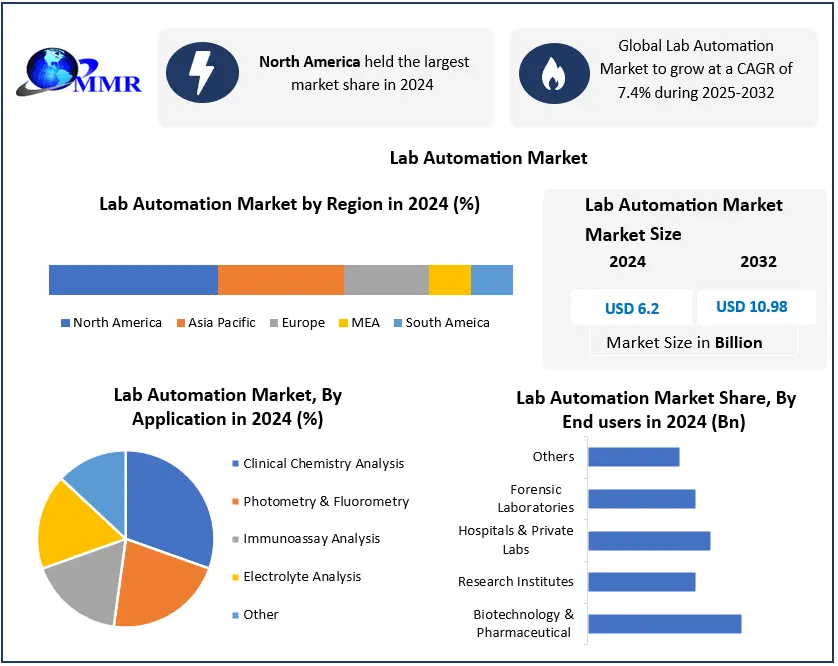
The Lab Automation Market was valued at USD 6.2 Billion in 2024, and total Global Lab Automation Market revenue is expected to grow at a CAGR of 7.4% and reach nearly USD 10.98 Billion from 2025 to 2032.
Lab Automation Market Overview:
The integration of technology in the laboratory to optimise and enable new and more efficient procedures is known as laboratory automation. In clinical, nonclinical, and industrial settings, laboratory automation can help create the groundwork for improved accuracy, quality, and consistency. Laboratory automation increases productivity by improving the quality of experimental data and reducing overall lab process durations. Machine vision, conveyor systems, robotics, and computer hardware and software are all included in a laboratory automation system. In order to stay competitive in the current market, lab automation is becoming a more viable alternative and a necessary solution for laboratories. Researchers no longer have to conduct repeated activities due to modern automation technology. Lab automation assists by allowing laboratory employees to keep control over the influx of samples, thereby enhancing workflow and allowing for the prompt delivery of patient findings.
 To know about the Research Methodology :- Request Free Sample Report
Lab Automation Market Dynamics:
Alternative hardware configurations known as 'modular automation' have been developed by automation providers to supply specialized lab automation tools required in a particular laboratory. Modular automation allows for the customization of hardware to meet the needs of the laboratory, as well as the ability to recombine components to meet the demands of the ever-changing laboratory environment. The services that the system may deliver are adaptable to a wide range of laboratory requirements and budgets.
One of the primary factors likely to fuel the market growth during the forecast period is the increase in the benefits provided by laboratory automation. The change from purely manual intervention to laboratory automation has various advantages for clinical laboratories. Increased productivity, consistent findings, safe working conditions, and significant time, space, and testing cost savings are just a few of the key benefits. Laboratory automation allows for the use of laboratory equipment for repetitive operations such as labeling tubes and sample verification, as well as the reduction and minimization of physical stress caused by manual chores, resulting in lower expenses and more space in the lab.
Automating typical lab procedures with dedicated workstations and software to programme instruments boosts lab productivity and gives individual researchers more creative time. Automation produces high-quality data, improves documentation, and allows for the generation of more data with less work. As a result, the Lab Automation Market is estimated to develop due to increased reproducibility and precision.
However, one of the main factors restricting the growth of the laboratory automation market is the high initial investment cost. Such high costs can be attributed to the expense that laboratories must bear in order to implement the advanced technologies used in laboratory automation.
COVID-19 IMPACT:
The COVID-19 epidemic has put diagnostic laboratories under a lot of strain, with teams growing capacity and rapidly growing testing menus while dealing with staff shortages and the requirement to keep working spaces safe and socially separated. Diagnostic laboratories that have adopted process automation have been among the most successful in limiting disruption and even thriving in these difficult conditions. Because of the flexibility that automated systems provide, forward-thinking laboratories have been able to quickly return to near-full productivity while still adhering to local social distancing regulations. When the constraints are relaxed and people can return, these laboratories will be in a great position to take use of their automated procedures to grow their capabilities even further.
COVID-19 has compelled diagnostic laboratories to enhance testing capabilities and scale up services, putting significant strain on physical infrastructure as well as data management systems. Growth of high-throughput testing capabilities without scaling procedures in the digital environment may limit the efficiencies that automation provides and may jeopardise the results' integrity. In the event of a global pandemic, errors in the processing of test results could have major consequences for the disease's spread and erode public confidence in testing measures.
According to research, the industry total testing volumes were 245.3% as a baseline in 2021. Routine testing, which proverb a descent of 66% in the initial days of the COVID-19 epidemic. However, currently is it almost over 100% of pre-epidemic baseline levels across the United States. Although COVID-19 and routine testing volume pooled is unbiased underneath 250% of baseline. Corporate professionals estimate significant COVID-19 testing throughout 2021 and even into 2025 and an upsurge in greatly penetrating antibody testing as the number of individuals vaccinated increases.
Lab Automation Market Segment Analysis:
Based on the Type, the global Lab Automation market is segmented into Total Automation Systems and Modular Automation Systems. The Total Automation Systems segment held the largest market share of 48.3% in 2024. Because of the numerous advantages that these systems provide. One of the major driving factors expected to fuel the segment's growth over the forecast period has been advances in this persuasion in numerous life science procedures. Total automation systems and modular automation systems are the two types of automation systems used in the market. For subsequent processing, total automation systems are further split into phases. Many drug discovery laboratories are currently embracing lab automation systems such as benchtop automation systems, which are primarily driven by the need to facilitate repetitive activities or technically complex processes.
Based on the Application, the global Lab Automation market is segmented into Clinical Chemistry Analysis, Photometry & Fluorometry, Immunoassay Analysis, and Electrolyte Analysis. The Clinical Chemistry Analysis segment held the largest market share of 27.4.6% in 2024. This high share are described to technological improvements, an increase in automated systems provided by market players, and an increase in the use of automated systems as a result of their benefits, which include reduced risk of contamination and the removal of human error, among others.
Regional Insights:
North America held the largest market share of 37.3% in 2023 and it remain kept its leading position during the forecast period. due to a positive federal attitude, broad acceptance of modern technology, a significant concentration of well-known firms, and the presence of a sophisticated healthcare infrastructure Several automation solution vendors in the United States are always inventing to accommodate a wide range of clinical equipment. The US Food and Drug Administration approved Beckman Coulter's lab automation system, for example. Several well-known companies around the world provide bacteriology laboratory automation systems in pieces or as complete systems. The laboratory automation market in the United States is likely to grow as a result of these advancements.
Asia Pacific is expected to grow at the highest CAGR of 9.92% in the global Lab Automation market during the forecast period. The reason is the growing need for lab automation in developing nations such as China and India. Increased efforts by regional and global businesses to provide access to cutting-edge lab automation technologies in these promising areas are also thought to be contributing to the region's profitable growth.
The objective of the report is to present a comprehensive analysis of the global Lab Automation Market to the stakeholders in the industry. The past and current status of the industry with the forecasted market size and trends are presented in the report with the analysis of complicated data in simple language. The report covers all the aspects of the industry with a dedicated study of key players that include market leaders, followers, and new entrants.
PORTER, PESTEL analysis with the potential impact of micro-economic factors of the market has been presented in the report. External as well as internal factors that are supposed to affect the business positively or negatively have been analyzed, which will give a clear futuristic view of the industry to the decision-makers.
The reports also helps in understanding the global Lab Automation Market dynamic, structure by analyzing the market segments and project the global Lab Automation Market size. Clear representation of competitive analysis of key players by product, price, financial position, product portfolio, growth strategies, and regional presence in the global Lab Automation Market make the report investor’s guide.
Lab Automation Market Scope: Inquire before buying
| Lab Automation Market | |||
|---|---|---|---|
| Report Coverage | Details | ||
| Base Year: | 2024 | Forecast Period: | 2025-2032 |
| Historical Data: | 2019 to 2024 | Market Size in 2024: | USD 6.2 Bn. |
| Forecast Period 2025 to 2032 CAGR: | 7.4% | Market Size in 2032: | USD 10.98 Bn. |
| Segments Covered: | by Product | Equipment’s Automated Workstations Robotic Systems Microplate readers Others Software & Informatics Workstations automation software Laboratory Information Management System (LIMS) Scientific Data management system Electronic Laboratory notebook |
|
| by Type | Total Automation Systems Modular Automation Systems |
||
| by Application | Clinical Chemistry Analysis Photometry & Fluorometry Immunoassay Analysis Electrolyte Analysis Other |
||
| by End-User | Biotechnology & Pharmaceutical Research Institutes Hospitals & Private Labs Forensic Laboratories Others |
||
| by Application | Clinical Chemistry Analysis Photometry & Fluorometry Immunoassay Analysis Electrolyte Analysis Other |
||
Lab Automation Market, by Region
North America (United States, Canada and Mexico)
Europe (UK, France, Germany, Italy, Spain, Sweden, Austria and Rest of Europe)
Asia Pacific (China, South Korea, Japan, India, Australia, Indonesia, Malaysia, Vietnam, Taiwan, Bangladesh, Pakistan and Rest of APAC)
Middle East and Africa (South Africa, GCC, Egypt, Nigeria and Rest of ME&A)
South America (Brazil, Argentina Rest of South America)
Lab Automation Market, Key Players
1. Tecan Group Ltd
2. Thermo Fisher Scientific Inc
3. Danaher Corporation
4. Hamilton
5. F. Hoffmann-La Roche Ltd.
6. Qiagen N.V.
7. Abbott Laboratories
8. Siemens AG
9. PerkinElmer Inc.
10. Agilent Technologies, Inc.
11. bioMerieux
12. Eppendorf
13. Bruker
14. Avantor
15. Smiths Group
16. Corning
17. Agilent
18. Roche
19. Bio-Rad
20. Gilson
21. Eppendorf
22. Beckman Coulter Life Sciences
23. PerkinElmer
24. Analytik Jena
25. VWR International
26. Shimadzu
27. SCIEX
28. HORIBA
29. Heska Corporation
Frequently Asked Questions:
1. Which region has the largest share in Global Lab Automation Market?
Ans: North America region held the highest share in 2024.
2. What is the growth rate of Global Lab Automation Market?
Ans: The Global Lab Automation Market is growing at a CAGR of 6.2% during forecasting period 2025-2032.
3. What is scope of the Global Lab Automation Market report?
Ans: Global Lab Automation Market report helps with the PESTEL, PORTER, COVID-19 Impact analysis, Recommendations for Investors & Leaders, and market estimation of the forecast period.
4. Who are the key players in Global Lab Automation Market?
Ans: The important key players in the Global Lab Automation Market are – Tecan Group Ltd, Thermo Fisher Scientific Inc, Danaher Corporation, Hamilton, F. Hoffmann-La Roche Ltd., Qiagen N.V., Abbott Laboratories, Siemens AG, PerkinElmer Inc., Agilent Technologies, and Inc.
5. What is the study period of this Market?
Ans: The Global Lab Automation Market is studied from 2024 to 2032.