
Infertility Treatment Market - Industry Structure Evaluation, Demand Drivers Analysis, Regional Growth Analysis and Identification, Competitive Positioning Review & Global Market Size Forecast to 2030
Overview
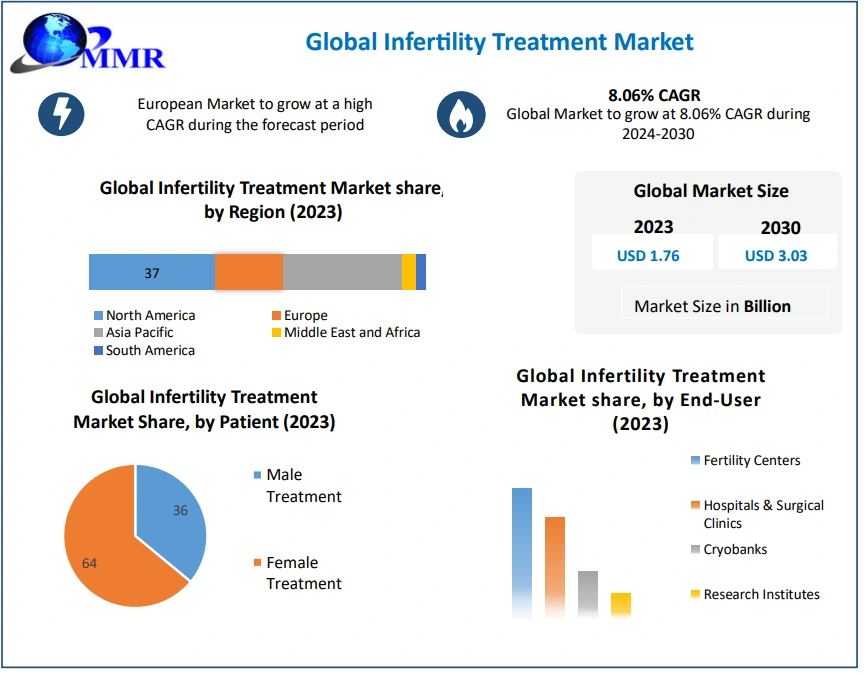
Infertility Treatment Market was valued at USD 1.76 Billion in 2023, and it is expected to reach USD 3.03 Billion by 2030, exhibiting a CAGR of 8.06% during the forecast period (2024-2030).
Infertility Treatment Market Overview
The market for infertility treatments includes a wide range of medical interventions, assisted reproductive technologies (ART), and supportive therapies designed to help individuals and couples achieve successful pregnancies. The major driving factors for global infertility treatment market include declining global fertility rate, rising number of fertility conventions worldwide, technological advancements, and accelerating public-private investments, resources, grants, and increasing adoption of surrogacy by single parents and same- sex couples. The future of the market is marked by a trajectory towards personalized, accessible, and comprehensive reproductive care, emphasizing not only treatment efficacy but also the overall well-being of individuals and couples pursuing the dream of parenthood.
 To know about the Research Methodology:-Request Free Sample Report
Infertility Treatment Market Report Scope and Research Methodology
The objective of the report is to present a comprehensive analysis of the global Infertility Treatment Market to the stakeholders in the devices. The past and current status of the Surgery with the forecasted market size and trends are presented in the report with the analysis of complicated data in simple language. The report covers all the aspects of the Surgery with a dedicated study of key players that include market leaders, followers, and new entrants.
PORTER, PESTLE analysis with the potential impact of micro-economic factors of the Infertility Treatment market have been presented in the report. External as well as internal factors that are supposed to affect the business positively or negatively have been analyzed, which will give a clear futuristic view of the Surgery to the decision-makers.
The reports also help in understanding the Market dynamic, structure by analysing the market segments and projecting the Infertility Treatment Market size. Clear representation of competitive analysis of key players by price, financial position, Surgery portfolio, growth strategies, and End-Industrial presence in the Infertility Treatment Market make the report investor’s guide.
Infertility Treatment Market Dynamics
Increasing Investments in the Healthcare Infrastructure driving the Global Infertility Treatment Market
The anticipated rise in federal government funding is poised to propel the market growth rate. Furthermore, the healthcare industry's expansion, driven by both public and private entities, particularly in developing economies, presents lucrative opportunities for market growth. The assurance of high returns on investments from research activities is also a favorable factor for the market. Moreover, the market stands to benefit from an upswing in the occurrences of lifestyle diseases, genetic abnormalities, stress, obesity, prostate cancer, varicocele, and other health conditions. An increase in personal disposable income levels, a growing number of fertility clinics globally, augmented investments in advanced medical products and devices, and the emergence of promising markets like China, India, Brazil, and Mexico collectively contribute positively to the Infertility Treatment market's growth trajectory.
Technological Advancements creating Opportunities for the Global Infertility Treatment Market
Over the past few years, there has been notable progress in the field of reproductive medicine, leading to substantial advancements in the effectiveness and viability of In Vitro Fertilization (IVF). This evolution has transformed IVF into a progressively more feasible option for couples facing challenges with infertility, owing to continuous research and innovative developments in the field. Recent breakthroughs in IVF technology are revolutionizing the realm of fertility treatment. Innovations ranging from genetic screening to time-lapse embryo imaging, artificial intelligence, and enhanced culture media are providing a ray of hope for couples facing infertility challenges. With ongoing advancements in research and technology, the prospects of success in IVF are consistently on the rise, bringing the aspiration of parenthood within reach for an increasing number of individuals and families across the world. These are expected to drive the global Infertility Treatment Market growth during the forecast period.
| Advancement | Explanation |
| Preimplantation Genetic Testing (PGT) | Preimplantation Genetic Testing (PGT) enables the screening of embryos to detect genetic abnormalities prior to implantation, thereby elevating the likelihood of a successful pregnancy through the selection of healthy embryos. |
| Time-lapse Embryo Imaging | Employing time-lapse technology for ongoing monitoring of embryo development enables enhanced selection based on growth patterns and developmental milestones, thereby contributing to improved success rates in IVF. |
| Artificial Intelligence (AI) & Machine Learning | Utilizing AI and machine learning, patient data and embryonic development are analyzed to offer tailored treatment recommendations, enhancing the outcomes of IVF. |
| Ovarian Tissue Cryopreservation | This technology facilitates the cryopreservation of ovarian tissue containing viable eggs, providing an option for women undergoing cancer treatment or other medical procedures that may impact fertility. |
| Improved Culture Media | The utilization of advanced culture media formulations establishes an optimal laboratory environment for embryo development, resulting in improved embryo quality and higher rates of success in IVF. |
| Single Embryo Transfer (SET) | By transferring a meticulously selected single embryo, Single Embryo Transfer (SET) aims to decrease the likelihood of multiple pregnancies. This approach ensures elevated success rates while simultaneously mitigating potential complications. |
| Egg Freezing Techniques | The success rates of egg freezing have been enhanced with the adoption of vitrification, a swift freezing technique, providing women with expanded choices for preserving their fertility. |
High Cost Associated with the Treatments Restraining the Infertility Treatment Market Growth
Infertility treatments, especially advanced procedures such as In Vitro Fertilization (IVF) and other assisted reproductive technologies (ART), often involve substantial expenses. The financial burden is a source of stress and anxiety for individuals or couples already grappling with the emotional challenges of infertility. This strain leads some to forego or delay seeking treatment due to financial constraints. Infertility treatments requires multiple cycles to achieve success, amplifying the overall cost. Each cycle of treatment includes expenses related to diagnostic tests, medications, medical procedures, and laboratory services. The cumulative financial commitment over multiple cycles are overwhelming for individuals or couples, deterring them from pursuing additional attempts.
Infertility Treatment Market Regional Insights
Asia Pacific Infertility Treatment Market held the largest share in the global market in 2023. This is attributed to the surge in government initiatives aimed at fostering awareness, a notable uptick in medical tourism, increasing research endeavors, a rise in lifestyle-related diseases, a growing demand for smoking products, and an escalating need for high-quality healthcare services.
Japan, renowned for having one of the world's most aged populations, has witnessed a prolonged decline in its birth rate spanning several decades. Contributing factors to this decline include the increasing cost of living, gender inequality, and a growing hesitancy towards marriage. In recent times, the Japanese government has undertaken substantial initiatives to extend national coverage for fertility treatments. This involves a comprehensive strategy of subsidizing 70% of the expenses associated with in vitro fertilization (IVF) for up to six cycles. Notably, certain local governments, particularly in rural regions, have taken additional measures by agreeing to cover the remaining 30% of the treatment costs. This collective effort aims to enhance accessibility to fertility treatments for all segments of the population, irrespective of financial constraints.
In 2022, India Infertility Treatment Market, which had previously lacked regulations governing fertility care processes, underwent a significant transformation with the implementation of two groundbreaking laws. The first of these, the Assisted Reproductive Technology (Regulation) Act, 2021, introduces regulations determining eligibility for assisted reproductive technology (ART) treatment, mandates the establishment of a registry for ART clinics, and oversees the procedures involved in ART treatments. The second law, the Surrogacy (Regulation) Act, 2021, specifically addresses the regulation of gestational surrogacy (GS) journeys. A noteworthy change introduced by these laws is the prohibition of commercial GS journeys. These regulatory measures were prompted, in part, by mounting concerns surrounding infertility rates and the substantial proliferation of ART clinics, leading to India's emergence as one of the world's fastest-growing hubs for such facilities.
Infertility Treatment Market Segment Analysis
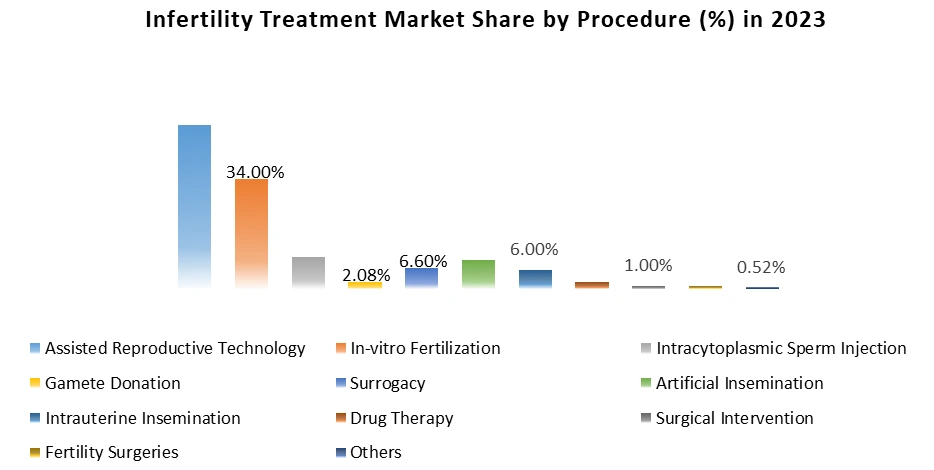
By Procedure, the medication segment estimated for a largest Infertility Treatment market share share in 2030. The medication segment is the largest contributor due to a wide range and operation. The adding blessing of fertility services and artistic shifts has led to high demand for medicine and treatments. The mindfulness of sterility treatment has increased over time, thereby reducing the hesitancy of people to conclude for drug. The high acceptance rate is because of the enhancement in success rate and advanced ways to cure sterility. ART procedures include different procedures like artificial copulation, in- vitro fertilization IVF, surrogacy, and others. The favourable fiscal support for ART procedures in both developed and emerging countries is another factor contributing to the growth. The surgical interventions segment is anticipated to witness gradational growth by 2030. Surgical interventions are considered as the alternate line of care after drug. This segment is likely to see an incremental growth of around$ 200 million during the forecasting period.
By End-User, Fertility clinics dominate the Infertility Treatment market due to the high success rate of fertility services and IVF clinics. The number of fertility centers is expanding across the globe. These conventions enthral the largest share in the gravidity treatment request. Fertility centers offer different services, similar as IVF programs, egg donation, ICSI, IMSI, and other services. The member is projected to hold the highest share during the forecast period. This is due to the constant rise in conventions and adding connection of clinics with fertile advisers and experts. Hospitals are a significantly fast- growing member. They give traditional medical care, similar as fertility drugs, medicines, conventions, and surgeries. They also grease procedures similar as IVF and ART, which are likely to have significant demand during the cast period. Gynaecologists and urologist conventions offer high- quality women’s healthcare services, including labour care, and define drug for fertility treatment. They're primary healthcare centers performing primary fertility evaluations among end- users. Hence, this member is anticipated to grow at a steady growth during the forecasting period.
Infertility Treatment Market Scope: Inquire before buying
| Infertility Treatment Market | |||
|---|---|---|---|
| Report Coverage | Details | ||
| Base Year: | 2023 | Forecast Period: | 2024-2030 |
| Historical Data: | 2018 to 2023 | Market Size in 2023: | US $ 1.76 Bn. |
| Forecast Period 2024 to 2030 CAGR: | 4.4% | Market Size in 2030: | US $ 3.03 Bn. |
| Segments Covered: | by Procedure | Assisted Reproductive Technology In-vitro Fertilization Intracytoplasmic Sperm Injection Gamete Donation Surrogacy Artificial Insemination Intrauterine Insemination Drug Therapy ART Procedure Surgical Intervention Fertility Surgeries Others |
|
| by Patient | Male Treatment Female Treatment |
||
| by End-User | Fertility Centers Hospitals & Surgical Clinics Cryobanks Research Institutes |
||
Infertility Treatment Market, by Region
North America (United States, Canada and Mexico)
Europe (UK, France, Germany, Italy, Spain, Sweden, Austria and Rest of Europe)
Asia Pacific (China, South Korea, Japan, India, Australia, Indonesia, Malaysia, Vietnam, Taiwan, Bangladesh, Pakistan and Rest of APAC)
Middle East and Africa (South Africa, GCC, Egypt, Nigeria and Rest of ME&A)
South America (Brazil, Argentina Rest of South America)
Infertility Treatment Key Players
1. CCRM
2. Ferring Pharmaceutical
3. Merck & Co
4. Monash IVF Group
5. The Cooper Company
6. Thermo Fisher
7. United Healthcare Group
8. Surelife Pte Ltd.
9. Biogenics Inc.
10. Cook Group Incorporated
11. Esco Micro Pte. Ltd.
12. Genea Limited
13. Hamilton Throne Ltd.
14. Ihmedical A/S
15. Invo Bioscience
16. Irvine Scientific
17. Ivftech APS
18. Kitazato
19. Labotect GmbH
20. Lifeglobal Group LLC
21. Medgyn Products Inc.
22. Microtech Ivf S.R.O.
23. Nikon Instruments Inc.
24. Ri.Mos
25. Rinovum Women's Health Company
26. Rocket Medical PLC
27. Somatex Medical Technologies GmbH
28. The Baker Company Inc.
29. The Cooper Companies Inc.
30. Thermo Fisher Scientific Inc.
31. Vitrolife AB
32. Zander Scientific Inc.
Frequently Asked Questions:
1] What segments are covered in the Global Infertility Treatment Market report?
Ans. The segments covered in the Infertility Treatment Market report are based on Procedure, Patient and End-User.
2] Which region is expected to hold the largest share in the Global Infertility Treatment Market?
Ans. The Asia Pacific region is expected to hold the largest share in the Infertility Treatment Market.
3] What is the expected Global Infertility Treatment Market size by 2030?
Ans. The Infertility Treatment Market size by 2030 is expected to reach USD 3.03 Bn.
4] What is the forecast period for the Global Infertility Treatment Market?
Ans. The forecast period for the Infertility Treatment Market is 2024-2030.
5] What was the market size of the Global Infertility Treatment Market in 2023?
Ans. The Infertility Treatment market size in 2023 was valued at USD 1.76 Bn.