
Global Industrial Internet of Things Market (IIoT) Market by Software, Vertical, Component, Region – Global Market Size Estimation, Industry-Wide Analysis, Competitive Landscape Assessment & Long-Term Forecast to 2032
Overview
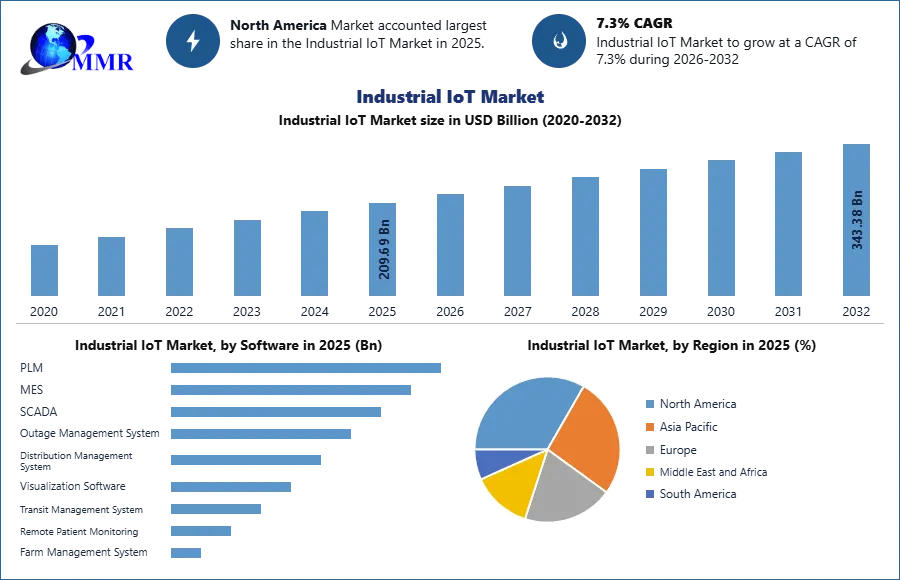
The Industrial Internet of Things (IIoT) Market size was valued at USD 209.69 Billion in 2025 and the total Industrial Internet of Things (IIoT) revenue is expected to grow at a CAGR of 7.3% from 2026 to 2032, reaching nearly USD 343.38 Billion by 2032.
Industrial Internet of Things (IIoT) Market Overview:
The Industrial Internet of Things (IIoT) integrates smart sensors, actuators, and devices to optimize manufacturing and industrial processes through data collection, exchange, and analysis. It spans sectors like manufacturing, energy management, utilities, and oil and gas. IIoT leverages intelligent machines and real-time analytics to enhance efficiency, quality control, sustainability, and supply chain traceability. It supports predictive maintenance, energy management, and asset tracking, benefiting industries worldwide. Technological advancements, operational efficiency focus, and collaborations drive market growth. The manufacturing sector dominates, while logistics and transportation show high growth potential. North America leads in adoption, with Asia Pacific exhibiting significant growth due to increasing factory automation and industry 4.0 initiatives.
To know about the Research Methodology :- Request Free Sample Report
Industrial Internet of Things (IIoT) Market Dynamics
Technological advancements, including affordable processors and sensors providing real-time data, are expected to be a key driver of growth in Industrial Internet of Things (IIoT) Market.
Driving the growth of the IIoT market are significant technological advancements. Among these advancements, affordable processors and sensors capable of delivering real-time data stand out as pivotal. These components have become more accessible and cost-effective, enabling businesses of all sizes to adopt IIoT solutions. Affordable processors enable the development of robust computing devices capable of managing the vast volumes of data generated by industrial equipment and sensors. This capability allows for real-time data processing and analysis, furnishing insights crucial for improving operational efficiency, detecting potential issues, and making well-informed decisions.
Additionally, the evolution of sensors has been instrumental in capturing real-time data from diverse industrial assets and processes. Modern sensors possess the capability to measure a wide array of parameters including temperature, pressure, vibration, and humidity with exceptional accuracy and reliability. This real-time data facilitates predictive maintenance, asset monitoring, and the optimization of production processes. Moreover, advancements in connectivity technologies, such as wireless networks and the Internet, have streamlined communication between devices and systems within industrial environments. This enhanced connectivity enables remote monitoring and control of industrial assets, fostering more efficient operations and proactive maintenance approaches.
The amalgamation of affordable processors, advanced sensors, and improved connectivity technologies has fueled the proliferation of IIoT solutions across industries. With businesses increasingly recognizing the value of real-time data analytics and automation in enhancing productivity and reducing costs, the demand for IIoT technologies is expected to continue its rapid growth trajectory in the Industrial Internet of Things (IIoT) market.
Growing focus on operational efficiency and strong collaboration among industry players are driving the Industrial Internet of Things (IIoT) market's growth.
The Industrial Internet of Things (IIoT) market is experiencing a rapid surge, attributed to various factors, notably the increasing emphasis on operational efficiency and robust collaboration among industry stakeholders.
Primarily, there's a notable inclination towards optimizing operational efficiency across diverse industries. In the current competitive environment, businesses are continuously on the lookout for avenues to streamline their operations, cut down costs, and bolster productivity. IIoT technologies offer a versatile array of solutions to address these challenges by facilitating real-time monitoring, predictive maintenance, and automation of industrial processes. Through the adoption of IIoT systems, enterprises can fine-tune their operations, curtail downtime, and optimize resource utilization, consequently leading to enhanced efficiency and profitability.
Strategic partnerships and collaborations empower companies to harness each other's expertise, resources, and networks to drive innovation and accelerate Industrial Internet of Things (IIoT) market growth. For instance, technology firms are collaborating with industrial manufacturers to craft bespoke IIoT solutions tailored to specific industry requisites. Similarly, strategic alliances between IIoT platform providers and system integrators can facilitate the seamless assimilation of IIoT solutions into existing infrastructure and processes.
Recent Example: A recent example showcasing the impact of operational efficiency and collaboration in the IIoT market is the partnership between a leading IIoT platform provider and a major manufacturing company to implement predictive maintenance solutions. By leveraging real-time data from sensors embedded in manufacturing equipment, the companies were able to proactively identify maintenance needs, optimize equipment uptime, and reduce unplanned downtime significantly. This collaboration not only improved operational efficiency but also demonstrated the value of strategic partnerships in driving innovation and market growth in the IIoT sector.
The advantages presented by the Industrial Internet of Things (IIoT) such as automated quality assurance monitoring, improved power efficiency leading to large-scale profit margins, enhanced productivity, and increased efficiency within the manufacturing industry, among others, are expected to propel Industrial Internet of Things (IIoT) market growth. Moreover, IIoT holds potential and capabilities to support industries in reducing operating costs, ensuring worker safety, and boosting throughput. By focusing on delivering measurable outcomes rather than just selling solutions, companies are progressively introducing new product and service hybrids to strengthen their market position and generate additional revenue streams, thereby accelerating Industrial Internet of Things (IIoT) market growth over the forecast period.
The IIoT market is witnessing a continual increase in IoT adoption due to various factors, including advancements in wireless network technologies and the widespread penetration of Wi-Fi connectivity for machine sensors in factories. Additionally, the growth of smart cities and smart transportation is driving the adoption of IoT, thereby fueling the growth of the Industrial Internet of Things (IIoT) Market during the forecast period.
Moreover, technology is enabling organizations to leverage sophisticated analytics and methodologies such as Machine Learning (ML) and Artificial Intelligence (AI) to provide prescriptive and predictive analytical solutions, opening up new opportunities for the sector. The continuous learning process associated with ML and AI, without any interruptions or downtime, makes them increasingly valuable tools in the IIoT market, thus driving market growth over the forecast period.
Industrial IoT is increasingly embracing edge computing due to its advanced capabilities, including offering IoT devices independence for analysis and data management. The architecture of edge computing enables instant response time by processing data with reduced latency, facilitating the prompt detection of immediate changes in power flows and enabling engineers to make better decisions. This edge computing architecture is expected to generate significant demand during the forecast period, further driving market growth in the Industrial Internet of Things (IIoT) Market.
Market concentration
The Industrial Internet of Things (IIoT) market is currently experiencing a high growth stage with an accelerating pace. This trend is fueled by continuous innovation, facilitated by the increasing availability of affordable processors and sensors capable of processing real-time data, empowering companies to make informed decisions promptly. Furthermore, the IIoT market is witnessing significant merger and acquisition (M&A) activities among leading players. These companies are expanding their portfolios through investments in research and development, as well as the integration of cutting-edge technologies, thereby driving Industrial Internet of Things (IIoT) market growth.
However, alongside this growth, the IIoT market is facing increasing regulatory scrutiny. Concerns regarding data protection, cybersecurity regulations, and environmental standards are prompting regulatory interventions. Some regions have introduced laws governing data localization and sovereignty, which could significantly impact the Industrial Internet of Things (IIoT) market's development and adoption trajectory. Despite being a distinctive and evolving technology, the IIoT faces competition from alternative solutions such as Industry 4.0, SCADA (Supervisory Control and Data Acquisition), and edge computing. While these technologies address specific aspects of industrial connectivity, automation, and data analysis, they present potential substitutes for certain IIoT functionalities.
Moreover, the concentration of end-users within various industry verticals plays a crucial role in the IIoT market. As multiple sectors adopt IIoT solutions for tasks like remote monitoring, data management, and analytics, opportunities arise for companies specializing in the development of tailored IIoT solutions for these industries. This end-user demand further drives the evolution and adoption of IIoT technologies.
Recent Industry Developments (2025–2026):
| Exact Date | Company | Development | Impact |
|---|---|---|---|
| 18 February 2026 | IoT Analytics | Released the 2026 Industrial Digital Technology Outlook, identifying 64 critical industrial technologies across AI, automation, and connectivity. | Establishes a strategic roadmap for manufacturers to prioritize investments in mature vs. emerging IIoT infrastructure. |
| 12 February 2026 | CUI Labs | Announced the expansion of industrial autonomy engagements across the APAC and EU regions to secure multi-domain trust stacks. | Strengthens cross-border IIoT security and promotes the adoption of sovereign integration toolkits in regulated sectors. |
| 25 November 2025 | Siemens | Showcased software-defined automation roadmaps at the SPS 2025 fair, signaling a shift toward hardware-agnostic control systems. | Accelerates IT/OT convergence by allowing industrial logic to run as isolated workloads on standard industrial PCs. |
| 14 November 2025 | JK Tyre & Industries | Launched India’s first locally produced smart tyres featuring integrated IIoT sensors for real-time pressure and temperature tracking. | Enhances fleet operational efficiency and safety through direct integration of sensor data into logistics management platforms. |
| 05 July 2025 | Napino Tech Ventures | Partnered with Teksun Microsys to launch Rapidise Technology, an AIoT-focused ODM with $4 million in initial funding. | Speeds up the commercialization of connected devices for the automotive and industrial manufacturing sectors in emerging markets. |
| 10 February 2025 | Cisco | Received the Industrial IoT Company of the Year 2025 award for advancements in securing energy and manufacturing networks. | Validates zero-trust architectures as the industry standard for protecting mission-critical industrial infrastructure. |
Industrial Internet of Things (IIoT) Market Segment Analysis:
In 2025, the manufacturing sector held the largest market share and is expected to maintain its dominance throughout the forecast period. The advent of Industry 4.0 has propelled the adoption of Industrial Internet of Things (IIoT) in both discrete and process manufacturing domains. This trend is driven by IIoT's ability to optimize operations, reduce downtime, improve efficiency, and facilitate data-driven decision-making, resulting in increased profit margins and reduced costs with rapid returns on investment in IoT adoption. Moreover, the rapid uptake of digital manufacturing technologies by manufacturing industries underscores the crucial role of IoT implementation in these advanced technologies, further fueling market growth.
On the other hand, the logistics and transportation segment is expected to witness the highest compound annual growth rate (CAGR) from 2026 to 2032. This growth is attributed to the significant emphasis placed by transportation companies on enhancing asset management, driving the adoption of smart transportation solutions. Additionally, modern alternatives such as Bluetooth Low Energy (BLE) tags are gaining traction, offering enhanced data tracking capabilities in confined spaces and facilitating operational management. This trend is anticipated to further propel Industrial Internet of Things (IIoT) market growth during the forecast period.
Industrial Internet of Things (IIoT) Market Regional Analysis:
North America held the largest market share, surpassing 32% in 2025, and is poised to maintain its leadership throughout the forecast period. This dominance is primarily attributed to the region's early adoption and widespread implementation of industrial IoT technology. Furthermore, robust government initiatives aimed at advancing digitalization across the industrial sector, coupled with a surge in the deployment of industrial IoT devices, are expected to fuel Industrial Internet of Things (IIoT) market growth. The increasing adoption of transformative technologies such as cloud computing and artificial intelligence (AI) further contributes to the region's expected market growth during the forecast period.
The Asia Pacific region is poised to exhibit a substantial compound annual growth rate (CAGR) from 2026 to 2032. Notably, the demand for advanced factory automation systems is witnessing a notable uptick across the region, particularly in key markets such as China and Japan. South Korea's industrial internet of things (IIoT) market is experiencing exponential growth, driven by technological advancements like 5G and industry 4.0 initiatives, along with the proliferation of smart factory trends. Moreover, manufacturing sectors in the region are increasingly acknowledging the advantages of integrating robot arm technology into their operations. Leading countries in the Asia Pacific are making significant investments in industry 4.0 technologies with the aim of achieving self-sufficiency in production and manufacturing. This concerted effort is expected to further propel Industrial Internet of Things (IIoT) Market growth throughout the region.
Industrial Internet of Things Market (IIoT) Scope: Inquire before Buying
| Industrial IoT Market | |||
|---|---|---|---|
| Report Coverage | Details | ||
| Base Year: | 2025 | Forecast Period: | 2026-2032 |
| Historical Data: | 2020 to 2025 | Market Size in 2025: | 209.69 USD Billion |
| Forecast Period 2026-2032 CAGR: | 7.3% | Market Size in 2032: | 343.38 USD Billion |
| Segments Covered: | by Software | PLM MES SCADA Outage Management System Distribution Management System Visualization Software Transit Management System Remote Patient Monitoring Farm Management System |
|
| by Vertical | Manufacturing Energy Oil &Gas Metal & Mining Healthcare Retail Transportation Agriculture |
||
| by Component | Hardware Software Services |
||
Industrial Internet of Things Market (IIoT), by Region:
North America (United States, Canada and Mexico)
Europe (UK, France, Germany, Italy, Spain, Sweden, Austria and Rest of Europe)
Asia Pacific (China, South Korea, Japan, India, Australia, Indonesia, Malaysia, Vietnam, Taiwan, Bangladesh, Pakistan and Rest of APAC)
Middle East and Africa (South Africa, GCC, Egypt, Nigeria and Rest of ME&A)
South America (Brazil, Argentina Rest of South America)
Key Players / Competitors Profiles Covered in Brief in Global Industrial Internet of Things Market (IIoT) Market Report in Strategic Perspective:
- Cisco
- GE (General Electric)
- Intel
- Rockwell Automation
- Texas Instruments
- Honeywell
- IBM (International Business Machines Corporation)
- PTC
- Siemens
- ABB
- Emerson Electric
- SAP SE
- Huawei Technologies
- Schneider Electric
- Mitsubishi Electric
- Robert Bosch GmbH
- Amazon Web Services (AWS)
- Microsoft Corporation
- Dassault Systèmes
- Advantech
- Yokogawa Electric
- NEC Corporation
- Fujitsu
- KUKA AG
- Software AG