Indoor Robots Market Size by Robot Type, Application, End User, Region, Industry-Wide Analysis, Competitive Landscape Assessment & Long-Term Forecast to 2032

16.11%
CAGR (2026-2032)
37.33 USD Bn.
Forecast Market Size
326
Report Pages
139
Market Tables

Overview

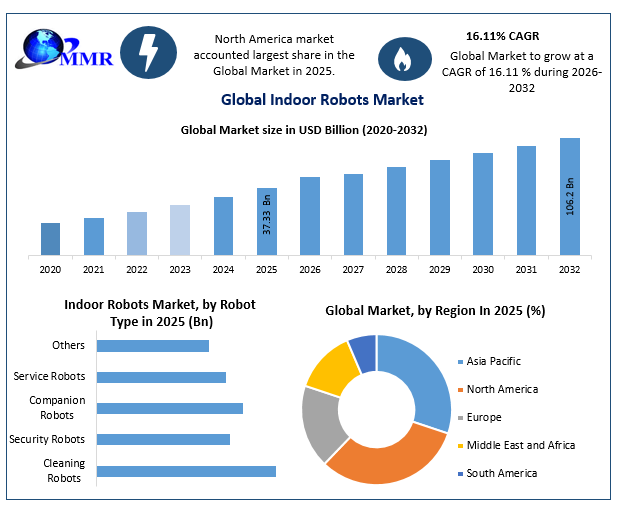
The Indoor Robots Market size was valued at USD 37.33 Billion in 2025 and the total Indoor Robots revenue is expected to grow at a CAGR of 16.11% from 2026 to 2032, reaching nearly USD 106.2 Billion.

Indoor Robots Market Overview

Indoor robots are designed to perform various tasks such as cleaning, surveillance, delivery, customer assistance, inventory movement, and patient support within indoor environments. Growing labor shortages, rising operational costs, and increasing demand for contactless automation solutions are accelerating market adoption globally. Technological advancements in artificial intelligence, machine learning, sensors, computer vision, and autonomous navigation systems are significantly improving robot efficiency, mobility, and real-time decision-making capabilities. Cleaning robots and service robots are witnessing strong demand across smart homes, hospitals, shopping malls, airports, hotels, and warehouses due to their ability to improve operational productivity and reduce manual workload. The market is also benefiting from rising smart building infrastructure and increasing investments in Industry 4.0 and digital transformation initiatives. Additionally, indoor robots are increasingly integrated with cloud platforms, IoT-enabled monitoring systems, and AI-based analytics to enhance automation performance and remote management.
To know about the Research Methodology:-Request Free Sample Report

Indoor Robots Market Dynamics:

Trend

One of the major trends shaping the Indoor Robots Market is the increasing integration of artificial intelligence and autonomous navigation technologies into robotic systems for smart indoor automation. Companies are increasingly deploying AI-enabled robots capable of machine learning, real-time obstacle detection, facial recognition, speech interaction, and adaptive decision-making to improve operational efficiency and user experience. Companion robots and service robots are gaining popularity in healthcare, hospitality, and residential applications due to rising demand for interactive and personalized robotic assistance. Another important trend is the rapid growth of robotic automation in warehouses and retail stores where autonomous mobile robots are used for inventory management, product delivery, and order fulfillment. Indoor robots are also increasingly connected with IoT-based building management systems and cloud platforms for remote monitoring and predictive maintenance. The healthcare sector is witnessing growing deployment of indoor robots for patient monitoring, medicine delivery, and rehabilitation support.

Driver

The growing demand for automation and operational efficiency across commercial, residential, healthcare, and logistics industries. Businesses are increasingly adopting indoor robotic systems to reduce labor dependency, improve service consistency, minimize operational costs, and enhance customer experiences. Rising labor shortages and increasing wages in developed economies are further encouraging organizations to invest in robotic automation technologies. In the healthcare sector, indoor robots are widely used for patient assistance, rehabilitation support, medicine delivery, and elderly care applications to address caregiver shortages and improve healthcare efficiency. The rapid expansion of e-commerce and warehouse automation is also driving strong demand for autonomous mobile robots capable of inventory movement, sorting, and order fulfillment operations. Technological advancements in artificial intelligence, computer vision, sensors, and navigation systems are significantly improving robotic mobility, accuracy, and real-time interaction capabilities.

Restraint

One of the major restraints affecting the Indoor Robots Market is the high initial investment and integration cost associated with advanced robotic systems. Indoor robots equipped with artificial intelligence, autonomous navigation, machine vision, and sensor technologies require significant capital expenditure for hardware deployment, software integration, maintenance, and system upgrades. Small and medium-sized businesses often face financial challenges in adopting robotic automation due to uncertain return on investment and infrastructure limitations. Additionally, integrating indoor robots with existing operational systems and smart building infrastructure can be technically complex and time-consuming. Limited battery life, navigation challenges in crowded environments, and difficulties in handling unpredictable indoor conditions also affect operational efficiency. Another key challenge is cybersecurity and data privacy concerns associated with connected robotic systems that collect and process large amounts of operational and user data.

Indoor Robots Market Segment Analysis

By Robot Type

The Cleaning Robots segment dominates the Indoor Robots Market due to increasing adoption of automated cleaning solutions across residential, commercial, healthcare, and industrial environments. Cleaning robots are widely used in homes, offices, hospitals, shopping malls, airports, and hospitality facilities for floor cleaning, vacuuming, disinfection, and maintenance operations. Rising awareness regarding hygiene, sanitation, and workplace cleanliness is significantly driving demand for robotic cleaning systems globally. The COVID-19 pandemic further accelerated the adoption of autonomous cleaning and disinfection robots in healthcare facilities and public infrastructure to minimize human contact and improve infection control measures. Technological advancements in AI-based navigation, sensors, obstacle detection, and smart mapping systems are improving cleaning efficiency and autonomous operation capabilities. Consumers are increasingly adopting robotic vacuum cleaners and smart home cleaning robots due to convenience, time savings, and integration with smart home ecosystems.

By Application

The Warehouse & Logistics segment dominates the Indoor Robots Market due to the rapid expansion of e-commerce, increasing warehouse automation, and growing demand for efficient material handling operations. Indoor robots are extensively used in warehouses and fulfillment centers for inventory transportation, automated sorting, pallet movement, picking operations, and real-time inventory management. Companies are increasingly deploying autonomous mobile robots and AI-driven logistics robots to improve operational efficiency, reduce order processing time, and minimize labor dependency. Rising labor shortages and increasing warehouse operational costs are further encouraging investments in robotic logistics automation globally. Technological advancements in autonomous navigation, machine vision, robotic fleet management, and cloud-connected warehouse systems are significantly improving robotic coordination and warehouse productivity. The increasing need for high-speed fulfillment and same-day delivery services in the e-commerce sector is also driving strong demand for warehouse robotics.

Indoor Robots Market Regional Analysis

North America dominates the Indoor Robots Market due to the strong presence of advanced robotics technology providers, rapid adoption of automation solutions, and increasing investments in artificial intelligence and smart infrastructure development. The United States and Canada are witnessing high deployment of indoor robots across healthcare facilities, warehouses, retail stores, hospitality, and residential applications to improve operational efficiency and reduce labor dependency. Rising labor shortages, increasing wages, and growing demand for contactless automation solutions are accelerating robotic adoption across commercial and industrial sectors. The region also benefits from strong e-commerce growth, which is driving large-scale investments in warehouse robotics, autonomous mobile robots, and smart fulfillment technologies. In healthcare, indoor robots are increasingly utilized for patient monitoring, rehabilitation support, medicine delivery, and elderly care assistance. Technological advancements in AI, machine learning, cloud robotics, and autonomous navigation systems are significantly improving indoor robot capabilities and adoption rates.

Recent Developments

On March 2025

iRobot introduced its largest-ever lineup of Roomba floor-cleaning robots featuring advanced LiDAR navigation, AI-powered obstacle detection, dual spinning mop systems, and improved smart home connectivity. The company focused on enhancing autonomous indoor cleaning efficiency and real-time room mapping capabilities for residential environments. The new robotic systems also support voice assistant integration and intelligent cleaning customization through upgraded software platforms. Rising consumer demand for smart home automation and autonomous cleaning solutions continues driving adoption of robotic indoor technologies. The development reflects increasing investment in AI-enabled indoor robots designed for convenience, energy efficiency, and connected living environments.

On February 2025

SoftBank Robotics expanded its indoor robotics strategy by strengthening AI-powered service robot solutions for office buildings, hospitality, and commercial environments. The company focused on integrating autonomous navigation, edge computing, and intelligent interaction technologies into indoor robotic systems to improve customer engagement and operational automation. SoftBank also emphasized development of “physical AI” robotics designed for indoor assistance and smart facility management applications. Increasing demand for contactless services, automation efficiency, and smart building technologies continues supporting robotic deployment across indoor commercial spaces. The development reflects growing adoption of AI-driven service robots within digitally connected indoor environments globally.

Indoor Robots Market Scope: Inquire before buying

Indoor Robots Market
Report Coverage Details
Base Year: 2025 Forecast Period: 2026-2032
Historical Data: 2020 to 2025 Market Size in 2025: 37.33 USD Billion
Forecast Period 2026-2032 CAGR: 16.11% Market Size in 2032: 106.2 USD Billion
Segments Covered: by Robot Type Cleaning Robots
Security Robots
Companion Robots
Service Robots
Others
by Application Healthcare
Warehouse & Logistics
Hospitality
Retail
Others
by End User Commercial
Industrial
Residential

Indoor Robots Market, by Region

North America (United States, Canada and Mexico)
Europe (UK, France, Germany, Italy, Spain, Sweden, Austria, Turkey, Russia and Rest of Europe)
Asia Pacific (China, India, Japan, South Korea, Australia, and Rest of APAC)
Middle East and Africa (South Africa, GCC, Egypt, Nigeria and Rest of ME&A)
South America (Brazil, Argentina, Columbia and Rest of South America)

Key players/Competitors profiles covered in the Indoor Robots Market report in strategic perspective

1. iRobot Corporation
2. Aethon
3. Ecovacs
4. Cobalt Robotics
5. SoftBank Robotics Group
6. GeckoSystems International Corporation
7. InTouch Technologies
8. Simbe Robotics, Inc.
9. NXT Robotics Corporation
10. Omron Adept Technologies
11. Savioke, Inc.
12. Intuitive Surgical, Inc.
13. Knightscope, Inc.
14. Savioke, Inc.
15. TransEnterix, Inc.
16. Yujin Robot, Co., Ltd.
17. ASUSTeK Computer Inc.
18. LG Electronics
19. Toyota Motor Corporation
20. DENSO CORPORATION
21. FANUC CORPORATION
22. KUKA AG
23. Kawasaki Heavy Industries, Ltd.

Table of Contents

1. Indoor Robots Market Introduction 1.1. Study Assumption and Market Definition 1.2. Scope of the Study 1.3. Executive Summary 2. Global Indoor Robots Market: Competitive Landscape 2.1. MMR Competition Matrix 2.2. Competitive Landscape 2.3. Key Players Benchmarking 2.3.1. Company Name 2.3.2. Business Segment 2.3.3. End-user Segment 2.3.4. Revenue (2025) 2.3.5. Company Locations 2.4. Leading Indoor Robots Market Companies, by market capitalization 2.5. Market Structure 2.5.1. Market Leaders 2.5.2. Market Followers 2.5.3. Emerging Players 2.6. Mergers and Acquisitions Details 3. Indoor Robots Market: Dynamics 3.1. Indoor Robots Market Trends by Region 3.1.1. North America Indoor Robots Market Trends 3.1.2. Europe Indoor Robots Market Trends 3.1.3. Asia Pacific Indoor Robots Market Trends 3.1.4. Middle East and Africa Indoor Robots Market Trends 3.1.5. South America Indoor Robots Market Trends 3.2. Indoor Robots Market Dynamics by Region 3.2.1. North America 3.2.1.1. North America Indoor Robots Market Drivers 3.2.1.2. North America Indoor Robots Market Restraints 3.2.1.3. North America Indoor Robots Market Opportunities 3.2.1.4. North America Indoor Robots Market Challenges 3.2.2. Europe 3.2.2.1. Europe Indoor Robots Market Drivers 3.2.2.2. Europe Indoor Robots Market Restraints 3.2.2.3. Europe Indoor Robots Market Opportunities 3.2.2.4. Europe Indoor Robots Market Challenges 3.2.3. Asia Pacific 3.2.3.1. Asia Pacific Indoor Robots Market Drivers 3.2.3.2. Asia Pacific Indoor Robots Market Restraints 3.2.3.3. Asia Pacific Indoor Robots Market Opportunities 3.2.3.4. Asia Pacific Indoor Robots Market Challenges 3.2.4. Middle East and Africa 3.2.4.1. Middle East and Africa Indoor Robots Market Drivers 3.2.4.2. Middle East and Africa Indoor Robots Market Restraints 3.2.4.3. Middle East and Africa Indoor Robots Market Opportunities 3.2.4.4. Middle East and Africa Indoor Robots Market Challenges 3.2.5. South America 3.2.5.1. South America Indoor Robots Market Drivers 3.2.5.2. South America Indoor Robots Market Restraints 3.2.5.3. South America Indoor Robots Market Opportunities 3.2.5.4. South America Indoor Robots Market Challenges 3.3. PORTER's Five Forces Analysis 3.4. PESTLE Analysis 3.5. Technology Roadmap 3.6. Regulatory Landscape by Region 3.6.1. North America 3.6.2. Europe 3.6.3. Asia Pacific 3.6.4. Middle East and Africa 3.6.5. South America 3.7. Key Opinion Leader Analysis For Indoor Robots Industry 3.8. Analysis of Government Schemes and Initiatives For Indoor Robots Industry 3.9. Indoor Robots Market Trade Analysis 3.10. The Global Pandemic Impact on Indoor Robots Market 4. Indoor Robots Market: Global Market Size and Forecast by Segmentation (in USD Billion) 2025-2032 4.1. Indoor Robots Market Size and Forecast, by Robot Type (2025-2032) 4.1.1. Cleaning Robots 4.1.2. Security Robots 4.1.3. Companion Robots 4.1.4. Service Robots 4.1.5. Others 4.2. Indoor Robots Market Size and Forecast, by Application (2025-2032) 4.2.1. Healthcare 4.2.2. Warehouse & Logistics 4.2.3. Hospitality 4.2.4. Retail 4.2.5. Others 4.3. Indoor Robots Market Size and Forecast, by End User (2025-2032) 4.3.1. Commercial 4.3.2. Industrial 4.3.3. Residential 4.4. Indoor Robots Market Size and Forecast, by Region (2025-2032) 4.4.1. North America 4.4.2. Europe 4.4.3. Asia Pacific 4.4.4. Middle East and Africa 4.4.5. South America 5. North America Indoor Robots Market Size and Forecast by Segmentation (in USD Billion) 2025-2032 5.1. North America Indoor Robots Market Size and Forecast, by Robot Type (2025-2032) 5.1.1. Cleaning Robots 5.1.2. Security Robots 5.1.3. Companion Robots 5.1.4. Service Robots 5.1.5. Others 5.2. North America Indoor Robots Market Size and Forecast, by Application (2025-2032) 5.2.1. Healthcare 5.2.2. Warehouse & Logistics 5.2.3. Hospitality 5.2.4. Retail 5.2.5. Others 5.3. North America Indoor Robots Market Size and Forecast, by End User (2025-2032) 5.3.1. Commercial 5.3.2. Industrial 5.3.3. Residential 5.4. North America Indoor Robots Market Size and Forecast, by Country (2025-2032) 5.4.1. United States 5.4.1.1. United States Indoor Robots Market Size and Forecast, by Robot Type (2025-2032) 5.4.1.1.1. Cleaning Robots 5.4.1.1.2. Security Robots 5.4.1.1.3. Companion Robots 5.4.1.1.4. Service Robots 5.4.1.1.5. Others 5.4.1.2. United States Indoor Robots Market Size and Forecast, by Application (2025-2032) 5.4.1.2.1. Healthcare 5.4.1.2.2. Warehouse & Logistics 5.4.1.2.3. Hospitality 5.4.1.2.4. Retail 5.4.1.2.5. Others 5.4.1.3. United States Indoor Robots Market Size and Forecast, by End User (2025-2032) 5.4.1.3.1. Commercial 5.4.1.3.2. Industrial 5.4.1.3.3. Residential 5.4.2. Canada 5.4.2.1. Canada Indoor Robots Market Size and Forecast, by Robot Type (2025-2032) 5.4.2.1.1. Cleaning Robots 5.4.2.1.2. Security Robots 5.4.2.1.3. Companion Robots 5.4.2.1.4. Service Robots 5.4.2.1.5. Others 5.4.2.2. Canada Indoor Robots Market Size and Forecast, by Application (2025-2032) 5.4.2.2.1. Healthcare 5.4.2.2.2. Warehouse & Logistics 5.4.2.2.3. Hospitality 5.4.2.2.4. Retail 5.4.2.2.5. Others 5.4.2.3. Canada Indoor Robots Market Size and Forecast, by End User (2025-2032) 5.4.2.3.1. Commercial 5.4.2.3.2. Industrial 5.4.2.3.3. Residential 5.4.3. Mexico 5.4.3.1. Mexico Indoor Robots Market Size and Forecast, by Robot Type (2025-2032) 5.4.3.1.1. Cleaning Robots 5.4.3.1.2. Security Robots 5.4.3.1.3. Companion Robots 5.4.3.1.4. Service Robots 5.4.3.1.5. Others 5.4.3.2. Mexico Indoor Robots Market Size and Forecast, by Application (2025-2032) 5.4.3.2.1. Healthcare 5.4.3.2.2. Warehouse & Logistics 5.4.3.2.3. Hospitality 5.4.3.2.4. Retail 5.4.3.2.5. Others 5.4.3.3. Mexico Indoor Robots Market Size and Forecast, by End User (2025-2032) 5.4.3.3.1. Commercial 5.4.3.3.2. Industrial 5.4.3.3.3. Residential 6. Europe Indoor Robots Market Size and Forecast by Segmentation (in USD Billion) 2025-2032 6.1. Europe Indoor Robots Market Size and Forecast, by Robot Type (2025-2032) 6.2. Europe Indoor Robots Market Size and Forecast, by Application (2025-2032) 6.3. Europe Indoor Robots Market Size and Forecast, by End User (2025-2032) 6.4. Europe Indoor Robots Market Size and Forecast, by Country (2025-2032) 6.4.1. United Kingdom 6.4.1.1. United Kingdom Indoor Robots Market Size and Forecast, by Robot Type (2025-2032) 6.4.1.2. United Kingdom Indoor Robots Market Size and Forecast, by Application (2025-2032) 6.4.1.3. United Kingdom Indoor Robots Market Size and Forecast, by End User (2025-2032) 6.4.2. France 6.4.2.1. France Indoor Robots Market Size and Forecast, by Robot Type (2025-2032) 6.4.2.2. France Indoor Robots Market Size and Forecast, by Application (2025-2032) 6.4.2.3. France Indoor Robots Market Size and Forecast, by End User (2025-2032) 6.4.3. Germany 6.4.3.1. Germany Indoor Robots Market Size and Forecast, by Robot Type (2025-2032) 6.4.3.2. Germany Indoor Robots Market Size and Forecast, by Application (2025-2032) 6.4.3.3. Germany Indoor Robots Market Size and Forecast, by End User (2025-2032) 6.4.4. Italy 6.4.4.1. Italy Indoor Robots Market Size and Forecast, by Robot Type (2025-2032) 6.4.4.2. Italy Indoor Robots Market Size and Forecast, by Application (2025-2032) 6.4.4.3. Italy Indoor Robots Market Size and Forecast, by End User (2025-2032) 6.4.5. Spain 6.4.5.1. Spain Indoor Robots Market Size and Forecast, by Robot Type (2025-2032) 6.4.5.2. Spain Indoor Robots Market Size and Forecast, by Application (2025-2032) 6.4.5.3. Spain Indoor Robots Market Size and Forecast, by End User (2025-2032) 6.4.6. Sweden 6.4.6.1. Sweden Indoor Robots Market Size and Forecast, by Robot Type (2025-2032) 6.4.6.2. Sweden Indoor Robots Market Size and Forecast, by Application (2025-2032) 6.4.6.3. Sweden Indoor Robots Market Size and Forecast, by End User (2025-2032) 6.4.7. Austria 6.4.7.1. Austria Indoor Robots Market Size and Forecast, by Robot Type (2025-2032) 6.4.7.2. Austria Indoor Robots Market Size and Forecast, by Application (2025-2032) 6.4.7.3. Austria Indoor Robots Market Size and Forecast, by End User (2025-2032) 6.4.8. Rest of Europe 6.4.8.1. Rest of Europe Indoor Robots Market Size and Forecast, by Robot Type (2025-2032) 6.4.8.2. Rest of Europe Indoor Robots Market Size and Forecast, by Application (2025-2032) 6.4.8.3. Rest of Europe Indoor Robots Market Size and Forecast, by End User (2025-2032) 7. Asia Pacific Indoor Robots Market Size and Forecast by Segmentation (in USD Billion) 2025-2032 7.1. Asia Pacific Indoor Robots Market Size and Forecast, by Robot Type (2025-2032) 7.2. Asia Pacific Indoor Robots Market Size and Forecast, by Application (2025-2032) 7.3. Asia Pacific Indoor Robots Market Size and Forecast, by End User (2025-2032) 7.4. Asia Pacific Indoor Robots Market Size and Forecast, by Country (2025-2032) 7.4.1. China 7.4.1.1. China Indoor Robots Market Size and Forecast, by Robot Type (2025-2032) 7.4.1.2. China Indoor Robots Market Size and Forecast, by Application (2025-2032) 7.4.1.3. China Indoor Robots Market Size and Forecast, by End User (2025-2032) 7.4.2. S Korea 7.4.2.1. S Korea Indoor Robots Market Size and Forecast, by Robot Type (2025-2032) 7.4.2.2. S Korea Indoor Robots Market Size and Forecast, by Application (2025-2032) 7.4.2.3. S Korea Indoor Robots Market Size and Forecast, by End User (2025-2032) 7.4.3. Japan 7.4.3.1. Japan Indoor Robots Market Size and Forecast, by Robot Type (2025-2032) 7.4.3.2. Japan Indoor Robots Market Size and Forecast, by Application (2025-2032) 7.4.3.3. Japan Indoor Robots Market Size and Forecast, by End User (2025-2032) 7.4.4. India 7.4.4.1. India Indoor Robots Market Size and Forecast, by Robot Type (2025-2032) 7.4.4.2. India Indoor Robots Market Size and Forecast, by Application (2025-2032) 7.4.4.3. India Indoor Robots Market Size and Forecast, by End User (2025-2032) 7.4.5. Australia 7.4.5.1. Australia Indoor Robots Market Size and Forecast, by Robot Type (2025-2032) 7.4.5.2. Australia Indoor Robots Market Size and Forecast, by Application (2025-2032) 7.4.5.3. Australia Indoor Robots Market Size and Forecast, by End User (2025-2032) 7.4.6. Indonesia 7.4.6.1. Indonesia Indoor Robots Market Size and Forecast, by Robot Type (2025-2032) 7.4.6.2. Indonesia Indoor Robots Market Size and Forecast, by Application (2025-2032) 7.4.6.3. Indonesia Indoor Robots Market Size and Forecast, by End User (2025-2032) 7.4.7. Malaysia 7.4.7.1. Malaysia Indoor Robots Market Size and Forecast, by Robot Type (2025-2032) 7.4.7.2. Malaysia Indoor Robots Market Size and Forecast, by Application (2025-2032) 7.4.7.3. Malaysia Indoor Robots Market Size and Forecast, by End User (2025-2032) 7.4.8. Vietnam 7.4.8.1. Vietnam Indoor Robots Market Size and Forecast, by Robot Type (2025-2032) 7.4.8.2. Vietnam Indoor Robots Market Size and Forecast, by Application (2025-2032) 7.4.8.3. Vietnam Indoor Robots Market Size and Forecast, by End User (2025-2032) 7.4.9. Taiwan 7.4.9.1. Taiwan Indoor Robots Market Size and Forecast, by Robot Type (2025-2032) 7.4.9.2. Taiwan Indoor Robots Market Size and Forecast, by Application (2025-2032) 7.4.9.3. Taiwan Indoor Robots Market Size and Forecast, by End User (2025-2032) 7.4.10. Rest of Asia Pacific 7.4.10.1. Rest of Asia Pacific Indoor Robots Market Size and Forecast, by Robot Type (2025-2032) 7.4.10.2. Rest of Asia Pacific Indoor Robots Market Size and Forecast, by Application (2025-2032) 7.4.10.3. Rest of Asia Pacific Indoor Robots Market Size and Forecast, by End User (2025-2032) 8. Middle East and Africa Indoor Robots Market Size and Forecast by Segmentation (in USD Billion) 2025-2032 8.1. Middle East and Africa Indoor Robots Market Size and Forecast, by Robot Type (2025-2032) 8.2. Middle East and Africa Indoor Robots Market Size and Forecast, by Application (2025-2032) 8.3. Middle East and Africa Indoor Robots Market Size and Forecast, by End User (2025-2032) 8.4. Middle East and Africa Indoor Robots Market Size and Forecast, by Country (2025-2032) 8.4.1. South Africa 8.4.1.1. South Africa Indoor Robots Market Size and Forecast, by Robot Type (2025-2032) 8.4.1.2. South Africa Indoor Robots Market Size and Forecast, by Application (2025-2032) 8.4.1.3. South Africa Indoor Robots Market Size and Forecast, by End User (2025-2032) 8.4.2. GCC 8.4.2.1. GCC Indoor Robots Market Size and Forecast, by Robot Type (2025-2032) 8.4.2.2. GCC Indoor Robots Market Size and Forecast, by Application (2025-2032) 8.4.2.3. GCC Indoor Robots Market Size and Forecast, by End User (2025-2032) 8.4.3. Nigeria 8.4.3.1. Nigeria Indoor Robots Market Size and Forecast, by Robot Type (2025-2032) 8.4.3.2. Nigeria Indoor Robots Market Size and Forecast, by Application (2025-2032) 8.4.3.3. Nigeria Indoor Robots Market Size and Forecast, by End User (2025-2032) 8.4.4. Rest of ME&A 8.4.4.1. Rest of ME&A Indoor Robots Market Size and Forecast, by Robot Type (2025-2032) 8.4.4.2. Rest of ME&A Indoor Robots Market Size and Forecast, by Application (2025-2032) 8.4.4.3. Rest of ME&A Indoor Robots Market Size and Forecast, by End User (2025-2032) 9. South America Indoor Robots Market Size and Forecast by Segmentation (in USD Billion) 2025-2032 9.1. South America Indoor Robots Market Size and Forecast, by Robot Type (2025-2032) 9.2. South America Indoor Robots Market Size and Forecast, by Application (2025-2032) 9.3. South America Indoor Robots Market Size and Forecast, by End User (2025-2032) 9.4. South America Indoor Robots Market Size and Forecast, by Country (2025-2032) 9.4.1. Brazil 9.4.1.1. Brazil Indoor Robots Market Size and Forecast, by Robot Type (2025-2032) 9.4.1.2. Brazil Indoor Robots Market Size and Forecast, by Application (2025-2032) 9.4.1.3. Brazil Indoor Robots Market Size and Forecast, by End User (2025-2032) 9.4.2. Argentina 9.4.2.1. Argentina Indoor Robots Market Size and Forecast, by Robot Type (2025-2032) 9.4.2.2. Argentina Indoor Robots Market Size and Forecast, by Application (2025-2032) 9.4.2.3. Argentina Indoor Robots Market Size and Forecast, by End User (2025-2032) 9.4.3. Rest Of South America 9.4.3.1. Rest Of South America Indoor Robots Market Size and Forecast, by Robot Type (2025-2032) 9.4.3.2. Rest Of South America Indoor Robots Market Size and Forecast, by Application (2025-2032) 9.4.3.3. Rest Of South America Indoor Robots Market Size and Forecast, by End User (2025-2032) 10. Company Profile: Key Players 10.1. iRobot Corporation 10.1.1. Company Overview 10.1.2. Business Portfolio 10.1.3. Financial Overview 10.1.4. SWOT Analysis 10.1.5. Strategic Analysis 10.1.6. Scale of Operation (small, medium, and large) 10.1.7. Details on Partnership 10.1.8. Regulatory Accreditations and Certifications Received by Them 10.1.9. Awards Received by the Firm 10.1.10. Recent Developments 10.2. Aethon 10.3. Ecovacs 10.4. Cobalt Robotics 10.5. SoftBank Robotics Group 10.6. GeckoSystems International Corporation 10.7. InTouch Technologies 10.8. Simbe Robotics 10.9. Inc. 10.10. NXT Robotics Corporation 10.11. Omron Adept Technologies 10.12. Savioke 10.13. Intuitive Surgical 10.14. Knightscope 10.15. TransEnterix 10.16. Yujin Robot 10.17. Co. 10.18. Ltd. 10.19. ASUSTeK Computer Inc. 10.20. LG Electronics 10.21. Toyota Motor Corporation 10.22. DENSO CORPORATION 10.23. FANUC CORPORATION 10.24. KUKA AG 10.25. Kawasaki Heavy Industries 11. Key Findings 12. Industry Recommendations 13. Indoor Robots Market: Research Methodology 14. Terms and Glossary

Custom Market Research Services

We Will Customise The Research For You, In Case The Report Listed Above Does Not Meet With Your Requirements