
Hyperloop Technology Market Size by Transportation System, Carriage Type, Speed, Region, Industry-Wide Analysis, Competitive Landscape Assessment & Long-Term Forecast to 2030
Overview
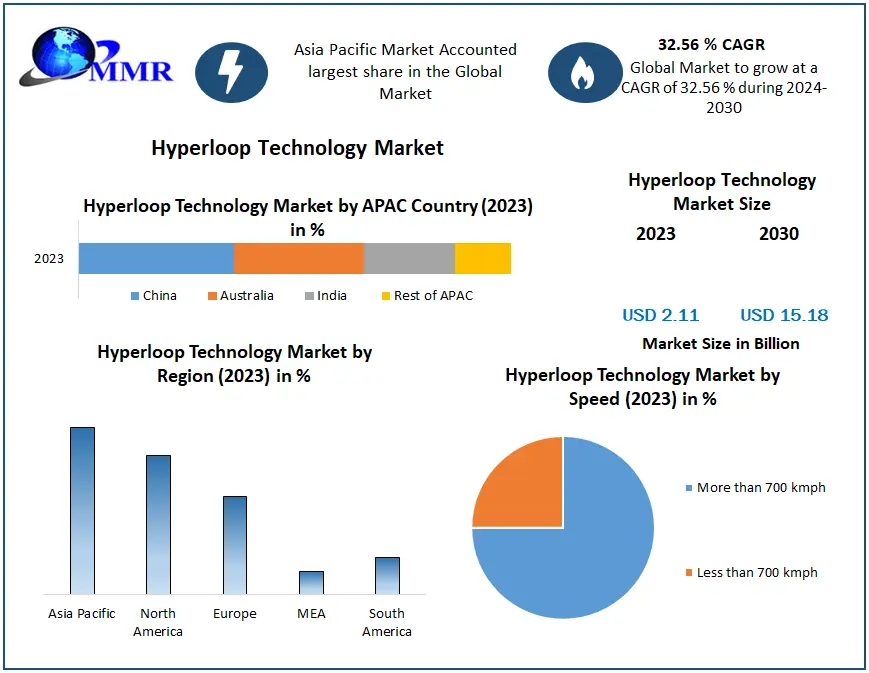
Hyperloop Technology Market was valued at USD 2.11 Bn in 2023 and is expected to reach USD 15.18 Bn by 2030, at a CAGR of 32.56 % during the forecast period.
Hyperloop Technology Market Overview
Hyperloop technology is a proposed mode of passenger and freight transportation that involves pods or capsules traveling through low-pressure tubes at high speeds. It was conceptualized by Elon Musk in 2013, although various companies and organizations have since been working on developing and implementing it. The basic concept involves using magnetic levitation (maglev) or air propulsion to move the pods through the tubes, which are maintained at low air pressure to reduce friction and air resistance, allowing for high speeds. Hyperloop pods could potentially travel at speeds exceeding 700 mph (1100 km/h), significantly faster than conventional modes of transportation like trains or cars.
 To know about the Research Methodology :- Request Free Sample Report
The Hyperloop technology market is significant, particularly in densely populated regions with high demand for fast and efficient transportation. Hyperloop systems could offer competitive advantages over traditional modes of transportation, such as reduced travel times, lower environmental impact, and enhanced connectivity between cities. Various Hyperloop prototypes have been built and tested around the world. These tests typically involve demonstrating key technologies such as levitation, propulsion, and tube infrastructure. Companies are also conducting feasibility studies to assess the viability of Hyperloop routes in different regions. Hyperloop Technology companies are investing significant resources in research and development to overcome technical challenges and bring Hyperloop technology to fruition. This includes developing propulsion systems, levitation mechanisms, tube infrastructure, safety systems, and pod designs.
Hyperloop Technology Market Dynamics
Speed and Efficiency to boost Hyperloop Technology Market growth
Hyperloop technology potential to revolutionize transportation by offering unprecedented speed and efficiency boosts the Hyperloop Technology Market growth. Hyperloop systems have the capability to transport passengers and cargo at speeds exceeding 700 mph (1100 km/h), significantly faster than traditional modes of transportation such as trains or cars. This speed advantage dramatically reduce travel times, making it an attractive option for commuters, businesses, and freight transport. With growing concerns about climate change and air pollution, there is a growing demand for sustainable transportation solutions. Hyperloop technology has the potential to be environmentally friendly compared to conventional modes of transportation. By using renewable energy sources to power the system and producing minimal emissions during operation, Hyperloop systems could help reduce greenhouse gas emissions and mitigate the environmental impact of transportation.
Advances in materials science, propulsion systems, levitation technology, and automation are driving innovation in the Hyperloop technology market. Companies are continuously researching and developing new technologies to improve the performance, safety, and cost-effectiveness of Hyperloop systems. Breakthroughs in areas such as magnetic levitation, vacuum tube design, and pod aerodynamics are paving the way for the commercialization of Hyperloop technology. Hyperloop technology has the potential to transform global trade and connectivity by enabling faster, more efficient transportation of goods and people over long distances. Hyperloop systems could facilitate international trade by reducing shipping times and costs, opening up new markets, and enabling just-in-time logistics. This increased connectivity could drive economic growth and stimulate investment in Hyperloop infrastructure projects around the world.
Technical Challenges in implementation to restrain Hyperloop Technology Market growth
Hyperloop technology involves numerous technical challenges that need to be addressed before it can become a commercially viable transportation solution. These challenges include ensuring the safety and reliability of high-speed travel, developing efficient propulsion and levitation systems, designing robust vacuum tube infrastructure, and mitigating potential risks such as tube depressurization or pod malfunction. Overcoming these technical hurdles requires extensive research, testing, and validation, which can be time-consuming and costly. Building a Hyperloop system requires substantial investment in research, development, and infrastructure. The cost of developing the necessary technology, including propulsion systems, vacuum tubes, and pod designs, can be prohibitively high. Furthermore, constructing the infrastructure to support Hyperloop networks, including land acquisition, tube installation, and station construction, adds to the overall cost. Securing funding for Hyperloop projects can be challenging, particularly in the absence of proven commercial viability and revenue streams.
Hyperloop technology is relatively new and unfamiliar to the general public, leading to skepticism and concerns about its safety, feasibility, and potential impact. Addressing public perception and building trust in Hyperloop systems is essential for gaining public acceptance and support. Educating the public about the benefits, safety measures, and environmental advantages of Hyperloop technology can help alleviate concerns and foster greater acceptance. Building a successful Hyperloop system requires achieving economies of scale and network effects to attract sufficient demand and support ongoing operations. However, initially deploying Hyperloop networks on a large scale is challenging due to the high upfront costs and uncertainties surrounding market demand. As a result, companies may need to start with smaller-scale pilot projects or phased deployments, which can limit the immediate impact and scalability of Hyperloop technology.
Hyperloop Technology Market Segment Analysis
Based on Transportation system, the market is segmented into Capsule, Tube, Propulsion System, and Route. Capsule segment dominated the market in 2023 and is expected to hold the largest Hyperloop Technology Market share over the forecast period. Hyperloop capsules are typically streamlined and aerodynamically designed to minimize air resistance and maximize efficiency during high-speed travel. They are often constructed from lightweight yet durable materials such as carbon fiber composites to ensure strength and structural integrity while reducing overall weight. Capsules in the Hyperloop system are propelled and levitated using advanced propulsion and levitation systems. These systems can vary depending on the specific design and technology used by different Hyperloop developers. Magnetic levitation (maglev) systems use magnetic forces to levitate the capsules above the track, reducing friction and allowing for smooth, frictionless travel. Propulsion systems, such as linear induction motors or air compressors, provide the necessary thrust to accelerate the capsules to high speeds.
Based on Carriage Type, the market is segmented into Passenger and Cargo/Freight. The passenger segment dominated the market in 2023 and is expected to hold the largest Hyperloop Technology Market share over the forecast period. Passenger segments consist of specially designed capsules or pods that are intended to carry passengers. These capsules are aerodynamically shaped and optimized for passenger comfort, safety, and efficiency during high-speed travel. They are equipped with seating arrangements, amenities, and safety features to ensure a pleasant and secure journey. Safety is a critical consideration in the design of passenger segments in Hyperloop systems. Capsules are equipped with robust safety features, including redundant braking systems, emergency exits, and onboard sensors to monitor environmental conditions and detect potential hazards. Additionally, rigorous testing and certification processes are conducted to ensure that passenger segments meet stringent safety standards and regulations.
Hyperloop Technology Market Regional Insight
Economic Growth and Connectivity to boost Hyperloop Technology Market growth
Asia Pacific economies are experiencing robust economic growth, driving demand for enhanced connectivity and logistics infrastructure. Hyperloop technology has the potential to transform supply chains, facilitate trade, and stimulate economic development by enabling faster, more efficient transportation of goods and people. By connecting manufacturing hubs, ports, airports, and commercial centers, Hyperloop systems can enhance regional connectivity and competitiveness. The Asia Pacific region is home to leading technology companies, research institutions, and government initiatives focused on innovation and research and development (R&D). Governments and private sector players are investing heavily in developing advanced transportation technologies, including Hyperloop systems. Collaborations between industry stakeholders, academia, and government agencies are driving innovation in areas such as propulsion systems, tube infrastructure, and pod design, positioning the region as a key player in the global Hyperloop technology market. China is rising rapidly its transportation infrastructure while attempting to reduce the expense of moving freight. Due to the fact that it is still developing, China spends an inefficient 15% of its GDP on logistics as compared to the West, where the average is 10%–12% of GDP. When compared to traditional road or rail transportation, hyperloop technology can move goods in a fraction of the time.
Governments across the Asia Pacific region are prioritizing infrastructure development to support economic growth and enhance mobility. Hyperloop technology aligns with government objectives to build sustainable, efficient, and resilient transportation networks. Governments are providing support and funding for Hyperloop research, feasibility studies, and pilot projects, as well as regulatory frameworks to facilitate the deployment of Hyperloop systems. Public-private partnerships are emerging to accelerate the commercialization of Hyperloop technology and address infrastructure needs in the region. With growing concerns about climate change and air pollution, there is increasing pressure to adopt sustainable transportation solutions. Hyperloop technology offers advantages in terms of energy efficiency and environmental sustainability compared to traditional modes of transportation. By using renewable energy sources to power the system and producing minimal emissions during operation, Hyperloop systems can help reduce greenhouse gas emissions and mitigate the environmental impact of transportation in the Asia Pacific region.
Hyperloop Technology Market Scope: Inquire before buying
| Global Hyperloop Technology Market | |||
|---|---|---|---|
| Report Coverage | Details | ||
| Base Year: | 2023 | Forecast Period: | 2024-2030 |
| Historical Data: | 2018 to 2023 | Market Size in 2023: | US $ 2.11 Bn. |
| Forecast Period 2024 to 2030 CAGR: | 32.56% | Market Size in 2030: | US $ 15.18 Bn. |
| Segments Covered: | by Transportation System | Capsule Tube Propulsion System Route |
|
| by Carriage Type | Passenger Cargo/Freight |
||
| by Speed | More than 700 kmph Less than 700 kmph |
||
Hyperloop Technology Market, by Region
North America (United States, Canada and Mexico)
Europe (UK, France, Germany, Italy, Spain, Sweden, Austria and Rest of Europe)
Asia Pacific (China, South Korea, Japan, India, Australia, Indonesia, Malaysia, Vietnam, Taiwan, Bangladesh, Pakistan and Rest of APAC)
Middle East and Africa (South Africa, GCC, Egypt, Nigeria and Rest of ME&A)
South America (Brazil, Argentina Rest of South America)
Leading Hyperloop Technology Key Players include:
Hyperloop Technology companies are improving their market standings by experiencing significant growth, forming strategic partnerships, and making technological advancements. They are increasing their market reach through collaborations with government bodies and infrastructure developers, which facilitate regulatory approvals and pilot projects. Technological advancements, such as enhanced vacuum-sealed tubes and advanced magnetic propulsion systems, are driving performance improvements and cost reductions. By continually innovating and optimizing their technologies, these companies aim to redefine the future of transportation, making Hyperloop a viable and competitive option in the global transit landscape.
North America:
1. Virgin Hyperloop (Los Angeles, California, USA)
2. SpaceX (Hawthorne, California, USA)
3. Hyperloop Transportation Technologies (HTT) (Los Angeles, California, USA)
4. Arrivo (Los Angeles, California, USA)
5. TransPod (Toronto, Ontario, Canada)
Europe:
6. Hardt Hyperloop (Delft, Netherlands)
7. Zeleros Hyperloop (Valencia, Spain)
8. Delft Hyperloop (Delft, Netherlands)
9. Swissloop (Zurich, Switzerland)
10. Hyper Poland (Warsaw, Poland)
Asia Pacific:
11. Hyperloop India (Bengaluru, Karnataka, India)
12. HyperloopTT
13. Hyperloop UPV
14. The Boring Company
15. Hyperloop Japan (Tokyo, Japan)
Frequently asked Questions:
1. What is Hyperloop technology?
Ans: Hyperloop technology is a proposed mode of passenger and freight transportation that involves pods or capsules traveling through low-pressure tubes at high speeds.
2. What are the potential benefits of Hyperloop technology?
Ans: Hyperloop technology could offer reduced travel times, lower environmental impact, enhanced connectivity between cities, and increased efficiency in transportation.
3. What are the technical challenges of implementing Hyperloop technology?
Ans: Technical challenges include ensuring safety and reliability of high-speed travel, developing efficient propulsion and levitation systems, designing robust vacuum tube infrastructure, and mitigating potential risks such as tube depressurization or pod malfunction.
4. Which regions are leading in Hyperloop technology development?
Ans: Regions such as North America, Europe, Asia Pacific, the Middle East, and South America are actively involved in Hyperloop technology development, driven by economic growth, technological innovation, and government support.
5. Which companies are involved in Hyperloop technology development?
Ans: Several companies are actively involved in developing Hyperloop technology, including Virgin Hyperloop, SpaceX, Hyperloop Transportation Technologies (HTT), TransPod, and Arrivo.