
Hydroponics Market – Industry Structure Evaluation, Demand Drivers Analysis, Regional Growth Analysis and Identification, Competitive Positioning Review & Global Market Size Forecast to 2032
Overview
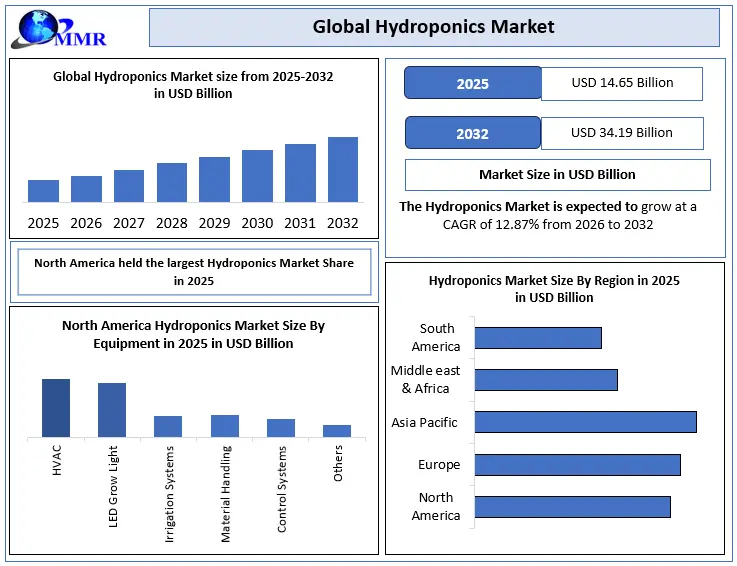
The Global Hydroponics Market was valued at USD 14.65 billion in 2025 and is expected to reach USD 34.19 billion by 2032, growing at a CAGR of 12.87% during the forecast period. Market growth is primarily driven by increasing urbanization, rising commercial and residential construction, and heightened awareness of hygiene and sanitation standards.
Hydroponics Market Overview
The global Hydroponics market is expected to maintain a 12.87% growth rate during the forecast period, with technology-enabled solutions, sustainability-focused systems, and automated facility management outperforming the average. The main growth drivers of the market include practices that improve operational efficiency, environmental sustainability targets, indoor climate regulations, and advanced automation technologies.
The integrated hydroponic solutions that combine cultivation systems with water recycling, energy-efficient climate control, and waste management enable businesses to secure longer, more extensive contracts. The precision farming technologies, vertical farming, and industrial-scale hydroponic operations are fast-growing market segments that offer opportunities for businesses to implement cross-selling and tiered pricing models while increasing their profitability. Companies that successfully integrate innovation, sustainability, and operational efficiency into their hydroponic offerings will achieve the highest financial success.
Hydroponics Market Key Highlights
• In 2025, North America became its largest market, which generated more than 35% of worldwide revenue because hydroponic systems were widely used in both commercial and residential settings.
• The Asia Pacific region will achieve its highest compound annual growth rate of 15% between 2025 and 2032 because urbanization and greater public knowledge about food safety, clean agricultural practices, and sustainable farming methods have developed.
• The commercial hydroponics segment generated the highest revenue in 2025 because large-scale vertical farms and greenhouse operations expanded their capacity to supply the increasing market demand.
• The adoption of technology through AI-controlled growth systems, LED lighting, automated nutrient delivery, and IoT sensors will enable efficiency gains between 10% and 20%, which will lead to market growth acceleration.
• The demand for hydroponic produce is expanding annually at a rate between 12% and 13% because consumers prefer to buy fresh vegetables and leafy greens that have no pesticide traces.
• Integrated solutions that combine hydroponics with water recycling and energy-efficient climate control and smart automation will boost commercial operators' contract values by 15% to 25%.
• The hydroponic infrastructure investment is expected to expand at an approximate compound annual growth rate of 13% because the government supports sustainable agriculture and urban farming initiatives.
To know about the Research Methodology :- Request Free Sample Report
Transforming Global Farming with AI, Hydroponics, and Dairy
Across the globe, agriculture is being transformed by innovative technologies. In India, startups like Krop AI use AI-powered hydroponics to grow leafy greens, herbs, and exotic vegetables in controlled environments, saving up to 95% of water and producing around 500 plants per farm unit. Meanwhile, ventures such as The Farming Buddha source over 500 litres of milk daily, paying farmers 40% above market rates, and employ 70% women staff. These examples show how agriculture can become climate-resilient, technology-driven, and economically sustainable, inspiring entrepreneurs worldwide to adopt scalable solutions that enhance productivity, food security, and rural livelihoods.
High Costs of AI-Powered Hydroponics Limit Small-Scale Farmers Globally
Across the world, small-scale farmers often face a major hurdle in adopting AI-driven hydroponic farming due to high upfront costs. Installing sensors, IoT devices, and automated climate-control systems can range from $6,000 to $12,000 per unit, making it difficult for many growers to invest. Despite these systems being able to increase crop yields by 30–50% and cut water usage by up to 95%, limited access to financing, government subsidies, or supportive policies prevents widespread adoption. As a result, the global shift toward technology-enabled, climate-resilient agriculture is progressing more slowly than its potential allows.
Key Government Schemes & Programs for Hydroponic Farming
| Country / Region | Scheme / Program | Description / Benefit |
| India | NABARD | Subsidized loans and financial assistance for sustainable hydroponic setups. |
| National Horticulture Board (NHB) Subsidies | 50–75% subsidies for protected cultivation, including hydroponics. | |
| PM-Kisan Samman Nidhi | Direct income support to farmers for hydroponic inputs. | |
| Agri-Clinics & Agri-Business Centers (ACABC) | Grants for agripreneurs establishing hydroponic farms as a business. | |
| United States | USDA Grants (SARE) | Funding for small-scale hydroponic farmers and sustainable agriculture. |
| NRCS EQIP | Financial aid for water-efficient hydroponic systems. | |
| Local & State Agriculture Incentives | Hydroponics-specific programs under urban or controlled-environment farming. | |
| European Union | EU Green Agriculture Grants | Funding for hydroponic projects focusing on sustainability and resource efficiency. |
| Other Countries | Australia – National Landcare Program | Funding for water-efficient farming methods, including hydroponics. |
| Canada – AgriInnovate & AgriScience | Encourages innovation in vertical farming and hydroponics. |
US Hydroponics Investors Powering Sustainable, Profitable Farming Innovations
Hydroponics farming in the US is picking up speed, fueled by venture capital, corporations, and government grants. In 2024, Y Combinator supported more than 800 startups, Sosv backed 170 projects, and IndieBio invested in 76 vertical farm and smart garden companies. Meanwhile, AgFunder, IFC, and the Department of Energy provided millions in funding to encourage soil-less, climate-friendly farming. Big players like Cargill, Plug and Play Tech Center, and 500 Global are among the top 16 investors helping farms grow fresh, pesticide-free produce year-round, making agriculture more sustainable, innovative, and future-ready.
Hydroponics Market Segment Analysis:
Based on type, the Hydroponics market is segmented into Aggregate Hydroponic Systems and Liquid Hydroponic Systems. The aggregate hydroponic systems segment is expected to hold the largest share in the global hydroponics market during the forecast period, owing to it consist of the most commonly used hydroponic systems such as the ebb and flow system, the water culture system, drip systems, and the wick system. The liquid hydroponic systems segment is also expected to drive the global hydroponics market in the near future. Based on equipment, HVAC is anticipated to hold the largest share in the global hydroponics market during the forecast period, as it has elements that are beneficial for control environment for hydroponic cultivation. In terms of Crop Area, the nutrients segment is estimated to hold the largest share in the global hydroponics market during the forecast period.
Europe’s Hydroponics: Pioneering Controlled-Environment Agriculture
Europe has long been at the forefront of hydroponic horticulture, with countries like the Netherlands, Spain, and France leading innovation in controlled-environment farming. While many Dutch growers still use simple tunnel-like greenhouses without advanced climate control, companies such as InFarm are transforming the sector with modular farms in supermarkets, restaurants, and distribution hubs, allowing fresh vegetables to be grown closer to consumers. Government initiatives and technological advances in greenhouse farming have helped Europe achieve the highest hydroponics adoption on the continent. This mature market serves as a blueprint for sustainable, high-efficiency agriculture, inspiring similar growth across North America and beyond.
Unlock High-Yield, Pesticide-Free Farming: Profitable Hydroponics Opportunities Across India
Hydroponic farming in India is emerging as a practical and sustainable way to grow crops without relying on traditional soil-based methods. On a one-acre farm (about 4,000 sq.m), cultivating leafy greens, herbs, and bell peppers can bring in ₹5–6 lakh each month. Setting up such a farm usually costs between ₹1.5–2 crore, but government subsidies can cover half or more of the expenses. With the ability to scale using rooftops, vertical systems, and controlled environments, farmers can see returns in 3–5 years. As more people seek fresh, pesticide-free produce, hydroponics offers a promising and profitable opportunity.
Global Hydroponics Market Scope: Inquire before buying
| Hydroponics Market | |||
|---|---|---|---|
| Report Coverage | Details | ||
| Base Year: | 2025 | Forecast Period: | 2026-2032 |
| Historical Data: | 2020 to 2025 | Market Size in 2025: | USD 14.65 Bn. |
| Forecast Period 2026 to 2032 CAGR: | 12.87% | Market Size in 2032: | USD 34.19 Bn. |
| Segments Covered: | by Type | Aggregate Hydroponic System EBB & Flow Systems Drip Systems Wick Systems Liquid Hydroponic Systems Deep Water Culture Nutrient Film Technique (NFT) Aeroponics |
|
| by Crop Type | Vegetables Fruits Herbs Others |
||
| by Equipment | HVAC LED Grow Light Irrigation Systems Material Handling Control Systems Others |
||
| by Crop Area | Upto 1000 sq.ft. 1000-50000 sq.ft. Above 50000 sq.ft |
||
Hydroponics Market Key Players by Value Chain Positioning
The competitive landscape of the hydroponics market is structured based on value chain positioning to differentiate core infrastructure companies, technology enablers, and downstream farm operators.
1. Technology & Automation Enablers
(Upstream component and control system providers)
These companies provide lighting, irrigation, automation, and environmental control systems used in hydroponic farming.
• Signify N.V.
• Heliospectra AB
• Koninklijke Philips N.V.
• Argus Control Systems Ltd.
• HortiMaX
• Netafim Limited
• LumiGrow, Inc.
Positioning Insight: Indirect exposure to hydroponics growth through lighting, irrigation, and automation technologies.
2. Core Hydroponics System & Input Providers
(Pure-play and input-focused companies)
These companies manufacture hydroponic systems, nutrients, and cultivation equipment. Their revenues are directly linked to hydroponic acreage expansion.
• Hydrofarm Holdings Group, Inc.
• General Hydroponics
• American Hydroponics
• Hydrodynamics International, Inc.
• Emerald Harvest
• Advanced Nutrients Ltd.
• GrowLife, Inc.
• The Scotts Miracle-Gro Company
• Pegasus Agritech
• Greentech Agro LLC
Positioning Insight: High revenue sensitivity to hydroponic farm expansion and capital investment cycles.
3. Greenhouse & Infrastructure Developers
(Engineering and turnkey project providers)
These players design and build large-scale greenhouse and controlled-environment agriculture infrastructure.
• KUBO Greenhouse Projects
• Logiqs B.V.
• Thanet Earth
Positioning Insight: Revenue linked to commercial-scale greenhouse construction and modernization.
4. Hydroponic & Controlled Environment Farm Operators
(Downstream production companies)
These companies operate hydroponic or vertical farms and generate revenue through crop sales.
• Village Farms International, Inc.
• Circle Fresh Farms
• Terra Tech Corp.
• AeroFarms
• Freight Farms, Inc.
• BrightFarms, Inc.
• Gotham Greens
• Infarm
• Green Sense Farms
• Pure Harvest Smart Farms
Positioning Insight: Direct exposure to crop yield, retail demand, and production scalability.
Frequently Asked Questions
1] What segments are covered in the Global Hydroponics Market report?
Ans. The segments covered in the Global Hydroponics Market report are based on type, Crop Area, equipment, and crop type.
2] Which region is expected to hold the highest share in the Global Hydroponics Market?
Ans. Europe is expected to hold the highest share in the Global Hydroponics Market.
3] What is the Market size of Global Hydroponics Market in 2032?
Ans. The Market size of Global Hydroponics Market in the forecast period 2032 is USD 34.19 Bn.
4] Who are the top key players in the Global Hydroponics Market?
Ans. Hydrofarm Inc, Lumigrow Inc., Argus Control Systems Ltd., General Hydroponics Inc., Hydrodynamics International Inc, Greentech Agro Inc., Heliospectra AB, Logiqs B.V, Koninklijke Philips NV
5] What was the Global Hydroponics Market size in 2025?
Ans: The Global Hydroponics Market size was USD 14.65 billion in 2025.