Hybrid Solar Wind Market Size by Type, Product, End use, Region – Segment-Level Market Assessment, Growth Opportunity Analysis, Competitive Mapping & Forecast to 2032

7.4%
CAGR (2026-2032)
2.07 USD Bn.
Market Size
313
Report Pages
129
Market Tables

Overview

The Hybrid Solar Wind Market size was valued at USD 2.07 Billion in 2025 and the total Hybrid Solar Wind revenue is expected to grow at a CAGR of 7.4% from 2026 to 2032, reaching nearly USD 3.42 Billion.

Hybrid Solar Wind Market Overview:

Solar Wind Hybrid Energy Systems (SWHES) have emerged as a reliable solution for small-scale power applications by integrating both solar photovoltaic (PV) and wind energy technologies. This hybrid approach aims to enhance the efficiency of solar power generation while mitigating air pollution associated with conventional energy sources. By deploying SWHES at individual households, the strain on conventional power grids is alleviated. Additionally, the inclusion of battery storage ensures an uninterrupted power supply, even during periods of low or no energy generation. SWHES finds application across various sectors, providing electricity to remote and inaccessible locations. These systems are characterized by their reliability, efficiency, minimal environmental impact, and low maintenance requirements.
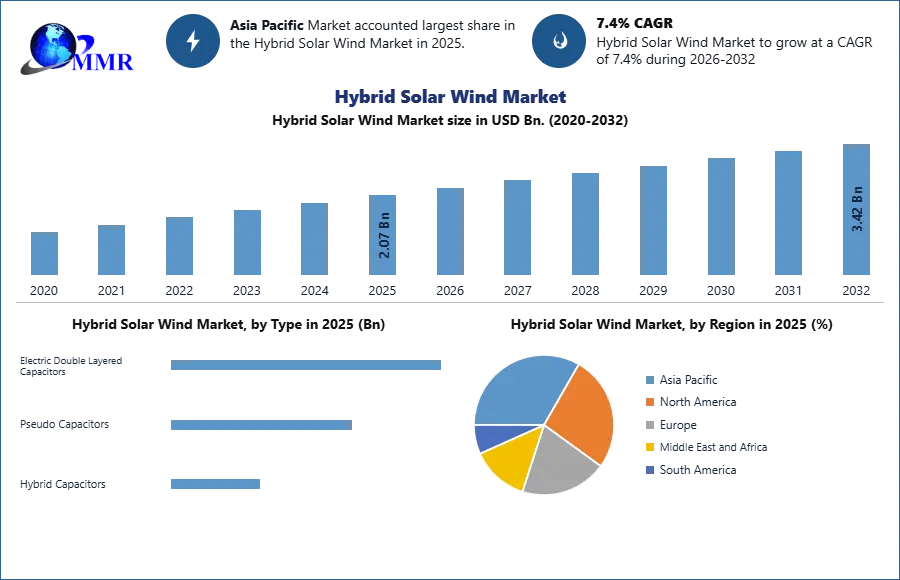
Hybrid Solar Wind Market

To know about the Research Methodology:-Request Free Sample Report

The Hybrid Solar Wind Market is witnessing significant growth driven by increasing awareness of renewable energy sources and efforts to reduce carbon emissions. This market combines the strengths of both solar and wind energy systems to ensure continuous power generation. Factors such as technological advancements, government incentives, and growing environmental concerns are fueling market. The current scenario reflects a rising adoption of hybrid solar-wind systems in various applications including residential, commercial, and industrial sectors. Key players in the market, such as GE Renewable Energy, Siemens Gamesa Renewable Energy, and Vestas, are actively investing in research and development to enhance the efficiency and reliability of hybrid systems. Recent developments include strategic partnerships, mergers, and acquisitions aimed at expanding market presence and offering innovative solutions. Additionally, advancements in energy storage technologies are improving the reliability and stability of hybrid solar-wind systems, further driving market growth. Overall, the Hybrid Solar Wind Market is poised for continued expansion as it plays a crucial role in the global transition towards sustainable energy solutions.

Hybrid Solar Wind Market Dynamics:

Integrated Solar-Wind Farms in India Maximize Energy Generation Drives the Hybrid Solar Wind Market

The increasing global demand for renewable energy sources due to environmental concerns and the need to reduce carbon emissions is a significant growth driver. For instance, countries like Germany have been investing heavily in hybrid solar-wind projects to meet renewable energy targets and reduce dependency on fossil fuels. Advancements in Type, such as improved turbine designs and more efficient solar panels, have enhanced the performance and reliability of hybrid systems, leading to wider adoption. An example is the development of integrated solar-wind farms in India, where innovative hybrid solutions are being deployed to maximize energy generation and optimize land use. Government incentives and policies supporting renewable energy deployment have been pivotal in driving market growth. Countries like China have implemented feed-in tariffs and subsidies for hybrid solar-wind projects, incentivizing investments and fostering market development. Additionally, the declining cost of renewable energy technologies has made hybrid solar wind systems increasingly competitive compared to traditional energy sources. For example, the falling prices of solar panels and wind turbines have made hybrid projects financially viable in regions like the United States, where utilities are investing in large-scale hybrid installations.Hybrid-Solar-Wind-Market
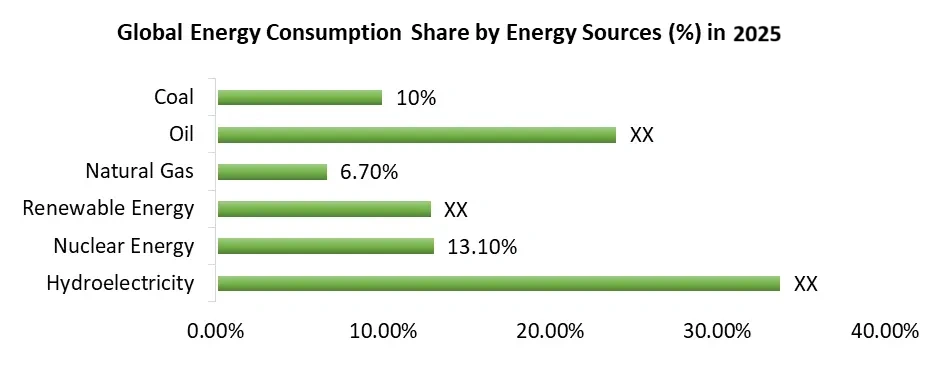
The growing focus on energy security and decentralization is driving demand for distributed generation solutions, with hybrid solar wind systems offering a reliable and resilient energy supply. This trend is evident in remote communities and island regions, where hybrid microgrids are being deployed to reduce dependence on imported fossil fuels and improve energy access. Furthermore, the scalability and flexibility of hybrid solar-wind systems make them suitable for a wide End-Use of applications, from residential and commercial to industrial and utility-scale projects. For instance, hybrid systems are being integrated into smart grids in Europe, enabling dynamic management of renewable energy resources and enhancing grid stability. Overall, the Hybrid Solar Wind Market is poised for continued growth as it addresses the growing demand for clean, reliable, and sustainable energy solutions globally.

For instance, on February 22, 2024, EDP Renewables, the renewables arm of Portuguese energy provider EDP, completed Portugal's second solar-wind hybrid project. The installation comprises 36,000 bifacial solar panels and 13 wind turbines, aimed at generating 79 GWh of renewable energy annually. This project underscores EDP's commitment to advancing sustainable energy solutions and diversifying Portugal's renewable energy portfolio, contributing significantly to the country's renewable energy targets.Hybrid Solar Wind Market
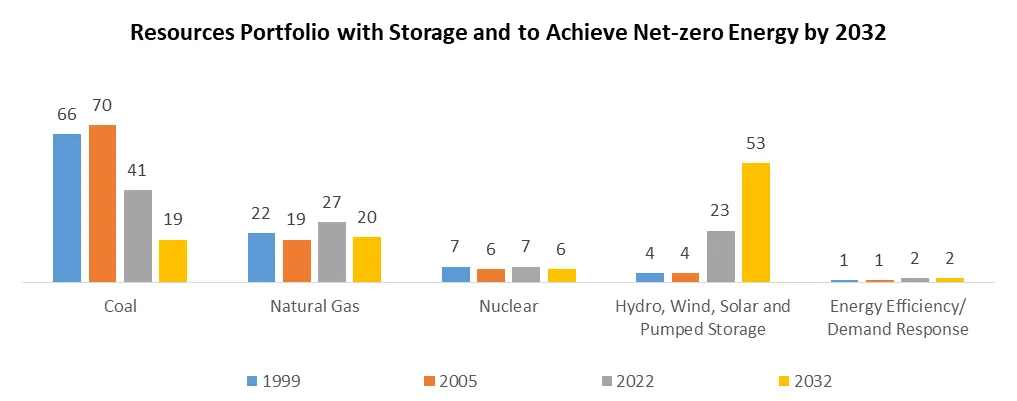
Overcoming Technical Limitations in Hybrid System Implementation Restrains the Hybrid Solar Wind Market

The intermittency and variability of renewable energy sources, with solar generation contingent on sunlight availability and wind power reliant on wind speed and direction. This variability leads to fluctuations in power output, posing grid stability and energy management challenges. Moreover, the high initial costs associated with integrating solar panels, wind turbines, and requisite infrastructure present a significant barrier to market. For instance, capital expenditure for hybrid projects in remote areas or off-grid applications can be prohibitively expensive. Land and space constraints also impede growth, as finding suitable sites with optimal solar exposure and consistent wind patterns can be challenging, particularly in densely populated regions. Integration into existing grid infrastructure presents technical hurdles, with variability in generation necessitating sophisticated control systems and potentially costly upgrades. Furthermore, the need for energy storage and backup systems to mitigate intermittency adds complexity and cost to projects, impacting overall economics, especially in remote areas where reliable backup power is crucial. Environmental and social impacts, including disruptions to local ecosystems and community resistance, can delay or prevent project development. Regulatory uncertainties, technical limitations, and competition from conventional energy sources further complicate the market landscape. Overcoming these challenges requires concerted efforts in technological innovation, policy support, and stakeholder collaboration to foster the continued growth and development of the Hybrid Solar Wind Market.
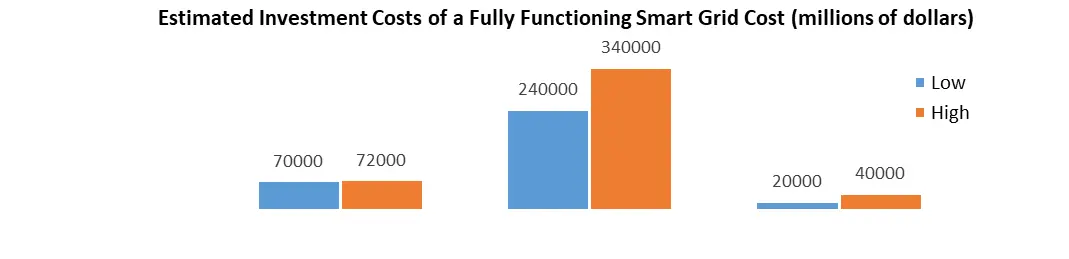
Hybrid Solar Wind Market

Accelerating Innovation through Public-Private Partnerships Boost the Hybrid Solar Wind Market Growth

The advancements in Type offer the potential for enhanced efficiency and cost-effectiveness of hybrid systems. For example, improvements in turbine design and solar panel efficiency can increase overall energy output, making hybrid solutions more attractive to investors and consumers. The increasing focus on sustainability and environmental responsibility creates a favorable market environment for renewable energy solutions. Governments worldwide are setting ambitious renewable energy targets, providing incentives and subsidies for hybrid solar-wind projects. For instance, initiatives like the Green New Deal in the United States and the European Green Deal aim to accelerate the transition to renewable energy, presenting significant opportunities for market Growth. The growing demand for decentralized energy solutions and off-grid applications opens up new avenues for the hybrid solar-wind market. Remote communities, islands, and rural areas with limited access to traditional power sources can benefit from hybrid systems to achieve energy independence and resilience. Additionally, emerging markets in regions like Asia-Pacific and Africa offer untapped potential for market growth, driven by rapid urbanization, industrialization, and increasing electricity demand. Furthermore, partnerships and collaborations between governments, private sector companies, and research institutions can drive innovation and accelerate market penetration. The Hybrid Solar Wind Market is poised for significant growth as it continues to play a vital role in the global transition towards sustainable energy solutions.

On Feb 22, 2024, State-owned SJVN Ltd's 1,500 MW solar-wind hybrid project witnessed tariff bids as low as Rs3.43/kWh in its recent reverse auction, contrasting with the previous Rs4.38/kWh tariff. Juniper Green Energy Pvt. Ltd secured 150 MW capacity with the lowest bid, while Avaada Energy Pvt. Ltd earned 530 MW at Rs3.49/kWh, the highest winning bid. Datta Power Infra Pvt. Ltd secured 50 MW at Rs3.47/kWh, and Green Infra Wind Energy Ltd clinched 440 MW at Rs3.48/kWh. Despite participating, NTPC Renewable Energy Ltd failed to secure any capacity with its bid of Rs3.55/kWh.

Recent Industry Developments (2025–2026)

Exact Date Company Development Impact
14 March 2026 PFC Consulting Launched a bidding process for a 14 GW power evacuation transmission system specifically to link hybrid energy zones in Gujarat and Maharashtra. The development resolves grid-connectivity bottlenecks, allowing developers to scale up hybrid solar-wind installations in resource-rich regions.
16 November 2025 Senvion India Partnered with KP Group to develop a 2 GW framework for wind and wind-solar hybrid projects across multiple Indian states over three years. This strategic collaboration streamlines project execution and provides a turnkey model for large-scale hybrid renewable assets.
29 August 2025 Gamesa Successfully reached a 14% global market share in the hybrid systems segment through its latest integrated turbine and solar controller technology. Securing a dominant market position increases competitive pressure on mid-tier players to innovate in smart power management.
12 May 2025 LG Energy Solution Partnered with OCI Energy to develop the 120 MW / 480 MWh Alamo City BESS project in Texas to support hybrid renewable integration. Enhanced storage capacity stabilizes the output of solar-wind hybrids, making them more competitive against traditional baseload power.
15 January 2025 GE Vernova Commenced the pilot deployment of a 6 MVA, 2000-volt DC utility-scale inverter designed specifically for large hybrid solar parks. The new technology lowers capital expenditure for hybrid sites by improving energy conversion efficiency and reducing hardware footprint.

Hybrid Solar Wind Market Scope: Inquire before buying

Hybrid Solar Wind Market
Report Coverage Details
Base Year: 2025 Forecast Period: 2026-2032
Historical Data: 2020 to 2025 Market Size in 2025: 2.07 USD Bn.
Forecast Period 2026-2032 CAGR: 7.4% Market Size in 2032: 3.42 USD Bn.
Segments Covered: by Type Electric Double Layered Capacitors
Pseudo Capacitors
Hybrid Capacitors
by Product Standalone
Grid-connected
by End use Residential
Commercial
Industrial

Hybrid Solar Wind Market, by Region

North America (United States, Canada and Mexico)
Europe (UK, France, Germany, Italy, Spain, Sweden, Austria and Rest of Europe)
Asia Pacific (China, South Korea, Japan, India, Australia, Indonesia, Malaysia, Vietnam, Taiwan, Bangladesh, Pakistan and Rest of APAC)
Middle East and Africa (South Africa, GCC, Egypt, Nigeria and Rest of ME&A)
South America (Brazil, Argentina Rest of South America)

Key Players / Competitors Profiles Covered in Brief in Global Hybrid Solar Wind Market Report in Strategic Perspective:

  1. NextEra Energy Resources
  2. Canadian Solar
  3. SunPower Corporation
  4. First Solar
  5. GE Renewable Energy
  6. SMA Solar Technology
  7. Schneider Electric
  8. Siemens Gamesa Renewable Energy
  9. Acciona Energía
  10. Ørsted
  11. EDF Renewables
  12. Nordex Group
  13. Enel Green Power
  14. Trina Solar
  15. Longi Solar
  16. JinkoSolar
  17. Suzlon Energy
  18. Goldwind
  19. Alpha Windmills
  20. Zenith Solar Systems
  21. Unitron Energy Systems
  22. UGE International
  23. Alternate Energy Company
  24. ReGen Powertech
  25. Blue Pacific Solar Product

Table of Contents

1. Hybrid Solar Wind Market Introduction
1.1. Study Assumption and Market Definition
1.2. Scope of the Study
1.3. Executive Summary
2. Global Hybrid Solar Wind Market: Competitive Landscape
2.1. MMR Competition Matrix
2.2. Competitive Landscape
2.3. Key Players Benchmarking
2.3.1. Company Name
2.3.2. Business Segment
2.3.3. End-user Segment
2.3.4. Revenue (2025)
2.3.5. Company Locations
2.4. Leading Hybrid Solar Wind Market Companies, by market capitalization
2.5. Market Structure
2.5.1. Market Leaders
2.5.2. Market Followers
2.5.3. Emerging Players
2.6. Mergers and Acquisitions Details
3. Hybrid Solar Wind Market: Dynamics
3.1. Hybrid Solar Wind Market Trends by Region
3.1.1. North America Hybrid Solar Wind Market Trends
3.1.2. Europe Hybrid Solar Wind Market Trends
3.1.3. Asia Pacific Hybrid Solar Wind Market Trends
3.1.4. Middle East and Africa Hybrid Solar Wind Market Trends
3.1.5. South America Hybrid Solar Wind Market Trends
3.2. Hybrid Solar Wind Market Dynamics by Region
3.2.1. North America
3.2.1.1. North America Hybrid Solar Wind Market Drivers
3.2.1.2. North America Hybrid Solar Wind Market Restraints
3.2.1.3. North America Hybrid Solar Wind Market Opportunities
3.2.1.4. North America Hybrid Solar Wind Market Challenges
3.2.2. Europe
3.2.2.1. Europe Hybrid Solar Wind Market Drivers
3.2.2.2. Europe Hybrid Solar Wind Market Restraints
3.2.2.3. Europe Hybrid Solar Wind Market Opportunities
3.2.2.4. Europe Hybrid Solar Wind Market Challenges
3.2.3. Asia Pacific
3.2.3.1. Asia Pacific Hybrid Solar Wind Market Drivers
3.2.3.2. Asia Pacific Hybrid Solar Wind Market Restraints
3.2.3.3. Asia Pacific Hybrid Solar Wind Market Opportunities
3.2.3.4. Asia Pacific Hybrid Solar Wind Market Challenges
3.2.4. Middle East and Africa
3.2.4.1. Middle East and Africa Hybrid Solar Wind Market Drivers
3.2.4.2. Middle East and Africa Hybrid Solar Wind Market Restraints
3.2.4.3. Middle East and Africa Hybrid Solar Wind Market Opportunities
3.2.4.4. Middle East and Africa Hybrid Solar Wind Market Challenges
3.2.5. South America
3.2.5.1. South America Hybrid Solar Wind Market Drivers
3.2.5.2. South America Hybrid Solar Wind Market Restraints
3.2.5.3. South America Hybrid Solar Wind Market Opportunities
3.2.5.4. South America Hybrid Solar Wind Market Challenges
3.3. PORTER's Five Forces Analysis
3.4. PESTLE Analysis
3.5. Technology Roadmap
3.6. Regulatory Landscape by Region
3.6.1. North America
3.6.2. Europe
3.6.3. Asia Pacific
3.6.4. Middle East and Africa
3.6.5. South America
3.7. Key Opinion Leader Analysis For Hybrid Solar Wind Industry
3.8. Analysis of Government Schemes and Initiatives For Hybrid Solar Wind Industry
3.9. Hybrid Solar Wind Market Trade Analysis
3.10. The Global Pandemic Impact on Hybrid Solar Wind Market
4. Hybrid Solar Wind Market: Global Market Size and Forecast by Segmentation (in USD Bn.) 2025-2032
4.1. Hybrid Solar Wind Market Size and Forecast, by Type (2025-2032)
4.1.1. Electric Double Layered Capacitors
4.1.2. Pseudo Capacitors
4.1.3. Hybrid Capacitors
4.2. Hybrid Solar Wind Market Size and Forecast, by Product (2025-2032)
4.2.1. Standalone
4.2.2. Grid-connected
4.3. Hybrid Solar Wind Market Size and Forecast, by End use (2025-2032)
4.3.1. Residential
4.3.2. Commercial
4.3.3. Industrial
4.4. Hybrid Solar Wind Market Size and Forecast, by Region (2025-2032)
4.4.1. North America
4.4.2. Europe
4.4.3. Asia Pacific
4.4.4. Middle East and Africa
4.4.5. South America
5. North America Hybrid Solar Wind Market Size and Forecast by Segmentation (in USD Bn.) 2025-2032
5.1. North America Hybrid Solar Wind Market Size and Forecast, by Type (2025-2032)
5.1.1. Electric Double Layered Capacitors
5.1.2. Pseudo Capacitors
5.1.3. Hybrid Capacitors
5.2. North America Hybrid Solar Wind Market Size and Forecast, by Product (2025-2032)
5.2.1. Standalone
5.2.2. Grid-connected
5.3. North America Hybrid Solar Wind Market Size and Forecast, by End use (2025-2032)
5.3.1. Residential
5.3.2. Commercial
5.3.3. Industrial
5.4. North America Hybrid Solar Wind Market Size and Forecast, by Country (2025-2032)
5.4.1. United States
5.4.1.1. United States Hybrid Solar Wind Market Size and Forecast, by Type (2025-2032)
5.4.1.1.1. Electric Double Layered Capacitors
5.4.1.1.2. Pseudo Capacitors
5.4.1.1.3. Hybrid Capacitors
5.4.1.2. United States Hybrid Solar Wind Market Size and Forecast, by Product (2025-2032)
5.4.1.2.1. Standalone
5.4.1.2.2. Grid-connected
5.4.1.3. United States Hybrid Solar Wind Market Size and Forecast, by End use (2025-2032)
5.4.1.3.1. Residential
5.4.1.3.2. Commercial
5.4.1.3.3. Industrial
5.4.2. Canada
5.4.2.1. Canada Hybrid Solar Wind Market Size and Forecast, by Type (2025-2032)
5.4.2.1.1. Electric Double Layered Capacitors
5.4.2.1.2. Pseudo Capacitors
5.4.2.1.3. Hybrid Capacitors
5.4.2.2. Canada Hybrid Solar Wind Market Size and Forecast, by Product (2025-2032)
5.4.2.2.1. Standalone
5.4.2.2.2. Grid-connected
5.4.2.3. Canada Hybrid Solar Wind Market Size and Forecast, by End use (2025-2032)
5.4.2.3.1. Residential
5.4.2.3.2. Commercial
5.4.2.3.3. Industrial
5.4.3. Mexico
5.4.3.1. Mexico Hybrid Solar Wind Market Size and Forecast, by Type (2025-2032)
5.4.3.1.1. Electric Double Layered Capacitors
5.4.3.1.2. Pseudo Capacitors
5.4.3.1.3. Hybrid Capacitors
5.4.3.2. Mexico Hybrid Solar Wind Market Size and Forecast, by Product (2025-2032)
5.4.3.2.1. Standalone
5.4.3.2.2. Grid-connected
5.4.3.3. Mexico Hybrid Solar Wind Market Size and Forecast, by End use (2025-2032)
5.4.3.3.1. Residential
5.4.3.3.2. Commercial
5.4.3.3.3. Industrial
6. Europe Hybrid Solar Wind Market Size and Forecast by Segmentation (in USD Bn.) 2025-2032
6.1. Europe Hybrid Solar Wind Market Size and Forecast, by Type (2025-2032)
6.2. Europe Hybrid Solar Wind Market Size and Forecast, by Product (2025-2032)
6.3. Europe Hybrid Solar Wind Market Size and Forecast, by End use (2025-2032)
6.4. Europe Hybrid Solar Wind Market Size and Forecast, by Country (2025-2032)
6.4.1. United Kingdom
6.4.1.1. United Kingdom Hybrid Solar Wind Market Size and Forecast, by Type (2025-2032)
6.4.1.2. United Kingdom Hybrid Solar Wind Market Size and Forecast, by Product (2025-2032)
6.4.1.3. United Kingdom Hybrid Solar Wind Market Size and Forecast, by End use (2025-2032)
6.4.2. France
6.4.2.1. France Hybrid Solar Wind Market Size and Forecast, by Type (2025-2032)
6.4.2.2. France Hybrid Solar Wind Market Size and Forecast, by Product (2025-2032)
6.4.2.3. France Hybrid Solar Wind Market Size and Forecast, by End use (2025-2032)
6.4.3. Germany
6.4.3.1. Germany Hybrid Solar Wind Market Size and Forecast, by Type (2025-2032)
6.4.3.2. Germany Hybrid Solar Wind Market Size and Forecast, by Product (2025-2032)
6.4.3.3. Germany Hybrid Solar Wind Market Size and Forecast, by End use (2025-2032)
6.4.4. Italy
6.4.4.1. Italy Hybrid Solar Wind Market Size and Forecast, by Type (2025-2032)
6.4.4.2. Italy Hybrid Solar Wind Market Size and Forecast, by Product (2025-2032)
6.4.4.3. Italy Hybrid Solar Wind Market Size and Forecast, by End use (2025-2032)
6.4.5. Spain
6.4.5.1. Spain Hybrid Solar Wind Market Size and Forecast, by Type (2025-2032)
6.4.5.2. Spain Hybrid Solar Wind Market Size and Forecast, by Product (2025-2032)
6.4.5.3. Spain Hybrid Solar Wind Market Size and Forecast, by End use (2025-2032)
6.4.6. Sweden
6.4.6.1. Sweden Hybrid Solar Wind Market Size and Forecast, by Type (2025-2032)
6.4.6.2. Sweden Hybrid Solar Wind Market Size and Forecast, by Product (2025-2032)
6.4.6.3. Sweden Hybrid Solar Wind Market Size and Forecast, by End use (2025-2032)
6.4.7. Austria
6.4.7.1. Austria Hybrid Solar Wind Market Size and Forecast, by Type (2025-2032)
6.4.7.2. Austria Hybrid Solar Wind Market Size and Forecast, by Product (2025-2032)
6.4.7.3. Austria Hybrid Solar Wind Market Size and Forecast, by End use (2025-2032)
6.4.8. Rest of Europe
6.4.8.1. Rest of Europe Hybrid Solar Wind Market Size and Forecast, by Type (2025-2032)
6.4.8.2. Rest of Europe Hybrid Solar Wind Market Size and Forecast, by Product (2025-2032)
6.4.8.3. Rest of Europe Hybrid Solar Wind Market Size and Forecast, by End use (2025-2032)
7. Asia Pacific Hybrid Solar Wind Market Size and Forecast by Segmentation (in USD Bn.) 2025-2032
7.1. Asia Pacific Hybrid Solar Wind Market Size and Forecast, by Type (2025-2032)
7.2. Asia Pacific Hybrid Solar Wind Market Size and Forecast, by Product (2025-2032)
7.3. Asia Pacific Hybrid Solar Wind Market Size and Forecast, by End use (2025-2032)
7.4. Asia Pacific Hybrid Solar Wind Market Size and Forecast, by Country (2025-2032)
7.4.1. China
7.4.1.1. China Hybrid Solar Wind Market Size and Forecast, by Type (2025-2032)
7.4.1.2. China Hybrid Solar Wind Market Size and Forecast, by Product (2025-2032)
7.4.1.3. China Hybrid Solar Wind Market Size and Forecast, by End use (2025-2032)
7.4.2. S Korea
7.4.2.1. S Korea Hybrid Solar Wind Market Size and Forecast, by Type (2025-2032)
7.4.2.2. S Korea Hybrid Solar Wind Market Size and Forecast, by Product (2025-2032)
7.4.2.3. S Korea Hybrid Solar Wind Market Size and Forecast, by End use (2025-2032)
7.4.3. Japan
7.4.3.1. Japan Hybrid Solar Wind Market Size and Forecast, by Type (2025-2032)
7.4.3.2. Japan Hybrid Solar Wind Market Size and Forecast, by Product (2025-2032)
7.4.3.3. Japan Hybrid Solar Wind Market Size and Forecast, by End use (2025-2032)
7.4.4. India
7.4.4.1. India Hybrid Solar Wind Market Size and Forecast, by Type (2025-2032)
7.4.4.2. India Hybrid Solar Wind Market Size and Forecast, by Product (2025-2032)
7.4.4.3. India Hybrid Solar Wind Market Size and Forecast, by End use (2025-2032)
7.4.5. Australia
7.4.5.1. Australia Hybrid Solar Wind Market Size and Forecast, by Type (2025-2032)
7.4.5.2. Australia Hybrid Solar Wind Market Size and Forecast, by Product (2025-2032)
7.4.5.3. Australia Hybrid Solar Wind Market Size and Forecast, by End use (2025-2032)
7.4.6. Indonesia
7.4.6.1. Indonesia Hybrid Solar Wind Market Size and Forecast, by Type (2025-2032)
7.4.6.2. Indonesia Hybrid Solar Wind Market Size and Forecast, by Product (2025-2032)
7.4.6.3. Indonesia Hybrid Solar Wind Market Size and Forecast, by End use (2025-2032)
7.4.7. Malaysia
7.4.7.1. Malaysia Hybrid Solar Wind Market Size and Forecast, by Type (2025-2032)
7.4.7.2. Malaysia Hybrid Solar Wind Market Size and Forecast, by Product (2025-2032)
7.4.7.3. Malaysia Hybrid Solar Wind Market Size and Forecast, by End use (2025-2032)
7.4.8. Vietnam
7.4.8.1. Vietnam Hybrid Solar Wind Market Size and Forecast, by Type (2025-2032)
7.4.8.2. Vietnam Hybrid Solar Wind Market Size and Forecast, by Product (2025-2032)
7.4.8.3. Vietnam Hybrid Solar Wind Market Size and Forecast, by End use (2025-2032)
7.4.9. Taiwan
7.4.9.1. Taiwan Hybrid Solar Wind Market Size and Forecast, by Type (2025-2032)
7.4.9.2. Taiwan Hybrid Solar Wind Market Size and Forecast, by Product (2025-2032)
7.4.9.3. Taiwan Hybrid Solar Wind Market Size and Forecast, by End use (2025-2032)
7.4.10. Rest of Asia Pacific
7.4.10.1. Rest of Asia Pacific Hybrid Solar Wind Market Size and Forecast, by Type (2025-2032)
7.4.10.2. Rest of Asia Pacific Hybrid Solar Wind Market Size and Forecast, by Product (2025-2032)
7.4.10.3. Rest of Asia Pacific Hybrid Solar Wind Market Size and Forecast, by End use (2025-2032)
8. Middle East and Africa Hybrid Solar Wind Market Size and Forecast by Segmentation (in USD Bn.) 2025-2032
8.1. Middle East and Africa Hybrid Solar Wind Market Size and Forecast, by Type (2025-2032)
8.2. Middle East and Africa Hybrid Solar Wind Market Size and Forecast, by Product (2025-2032)
8.3. Middle East and Africa Hybrid Solar Wind Market Size and Forecast, by End use (2025-2032)
8.4. Middle East and Africa Hybrid Solar Wind Market Size and Forecast, by Country (2025-2032)
8.4.1. South Africa
8.4.1.1. South Africa Hybrid Solar Wind Market Size and Forecast, by Type (2025-2032)
8.4.1.2. South Africa Hybrid Solar Wind Market Size and Forecast, by Product (2025-2032)
8.4.1.3. South Africa Hybrid Solar Wind Market Size and Forecast, by End use (2025-2032)
8.4.2. GCC
8.4.2.1. GCC Hybrid Solar Wind Market Size and Forecast, by Type (2025-2032)
8.4.2.2. GCC Hybrid Solar Wind Market Size and Forecast, by Product (2025-2032)
8.4.2.3. GCC Hybrid Solar Wind Market Size and Forecast, by End use (2025-2032)
8.4.3. Nigeria
8.4.3.1. Nigeria Hybrid Solar Wind Market Size and Forecast, by Type (2025-2032)
8.4.3.2. Nigeria Hybrid Solar Wind Market Size and Forecast, by Product (2025-2032)
8.4.3.3. Nigeria Hybrid Solar Wind Market Size and Forecast, by End use (2025-2032)
8.4.4. Rest of ME&A
8.4.4.1. Rest of ME&A Hybrid Solar Wind Market Size and Forecast, by Type (2025-2032)
8.4.4.2. Rest of ME&A Hybrid Solar Wind Market Size and Forecast, by Product (2025-2032)
8.4.4.3. Rest of ME&A Hybrid Solar Wind Market Size and Forecast, by End use (2025-2032)
9. South America Hybrid Solar Wind Market Size and Forecast by Segmentation (in USD Bn.) 2025-2032
9.1. South America Hybrid Solar Wind Market Size and Forecast, by Type (2025-2032)
9.2. South America Hybrid Solar Wind Market Size and Forecast, by Product (2025-2032)
9.3. South America Hybrid Solar Wind Market Size and Forecast, by End use (2025-2032)
9.4. South America Hybrid Solar Wind Market Size and Forecast, by Country (2025-2032)
9.4.1. Brazil
9.4.1.1. Brazil Hybrid Solar Wind Market Size and Forecast, by Type (2025-2032)
9.4.1.2. Brazil Hybrid Solar Wind Market Size and Forecast, by Product (2025-2032)
9.4.1.3. Brazil Hybrid Solar Wind Market Size and Forecast, by End use (2025-2032)
9.4.2. Argentina
9.4.2.1. Argentina Hybrid Solar Wind Market Size and Forecast, by Type (2025-2032)
9.4.2.2. Argentina Hybrid Solar Wind Market Size and Forecast, by Product (2025-2032)
9.4.2.3. Argentina Hybrid Solar Wind Market Size and Forecast, by End use (2025-2032)
9.4.3. Rest Of South America
9.4.3.1. Rest Of South America Hybrid Solar Wind Market Size and Forecast, by Type (2025-2032)
9.4.3.2. Rest Of South America Hybrid Solar Wind Market Size and Forecast, by Product (2025-2032)
9.4.3.3. Rest Of South America Hybrid Solar Wind Market Size and Forecast, by End use (2025-2032)
10. Company Profile: Key Players
10.1. NextEra Energy Resources
10.1.1. Company Overview
10.1.2. Business Portfolio
10.1.3. Financial Overview
10.1.4. SWOT Analysis
10.1.5. Strategic Analysis
10.1.6. Scale of Operation (small, medium, and large)
10.1.7. Details on Partnership
10.1.8. Regulatory Accreditations and Certifications Received by Them
10.1.9. Awards Received by the Firm
10.1.10. Recent Developments
10.2. Canadian Solar
10.3. SunPower Corporation
10.4. First Solar
10.5. GE Renewable Energy
10.6. SMA Solar Technology
10.7. Schneider Electric
10.8. Siemens Gamesa Renewable Energy
10.9. Acciona Energía
10.10. Ørsted
10.11. EDF Renewables
10.12. Nordex Group
10.13. Enel Green Power
10.14. Trina Solar
10.15. Longi Solar
10.16. JinkoSolar
10.17. Suzlon Energy
10.18. Goldwind
10.19. Alpha Windmills
10.20. Zenith Solar Systems
10.21. Unitron Energy Systems
10.22. UGE International
10.23. Alternate Energy Company
10.24. ReGen Powertech
10.25. Blue Pacific Solar Product
11. Key Findings
12. Industry Recommendations
13. Hybrid Solar Wind Market: Research Methodology
14. Terms and Glossary

Custom Market Research Services

We Will Customise The Research For You, In Case The Report Listed Above Does Not Meet With Your Requirements