
Human Milk Oligosaccharides (HMO) Market Size by Product, Type, Application and Region – Segment-Level Market Assessment, Growth Opportunity Analysis, Competitive Mapping & Forecast to 2032
Overview
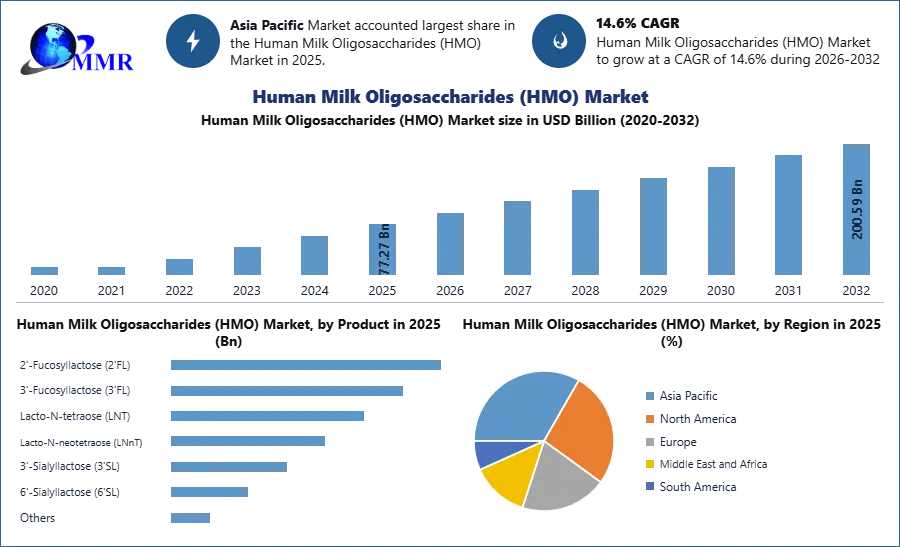
Human Milk Oligosaccharides (HMO) Market size is expected to reach nearly USD 200.59 Bn by 2032 with the CAGR of 14.6% during the forecast period.
High Cost of Product Due to Expensive Manufacturing Process:
The low availability of a group of donors, and HMO cannot be produced directly from human milk are the key restraints for the growth of the human milk oligosaccharides (HMO) market. Now, producers are emerging technologies through chemical and enzymatic synthesis to generate human milk oligosaccharides (HMO). These synthetic and enzymatic methods need a high amount of capital and energy, but the production of the final product is comparatively low. For example, for costly substrates like glycosyltransferases, enzymatic synthesis is required and this is one of the main factors due to the high price of oligosaccharides of human milk.
 To know about the Research Methodology :- Request Free Sample Report
Human Milk Oligosaccharides (HMO) Market Opportunities:
The growing concerns among consumers about gut health and the consumption of dietary supplements is expected to generate significant opportunities for the HMO Market. For instance, DuPont Nutrition & Health's CARE4U is used as a dietary supplement ingredient. The market viewing strong competition because of the increasing number of market entrants. Human milk oligosaccharides (HMOs) act as prebiotics in the human body and support to maintain gut health. They encourage bacterial growth, particularly bifidobacteria genus, in the gut, which helps improve metabolic activity.
Covid-19 Impact on the Human Milk Oligosaccharides (HMO) Market:
• The Covid-19 impact on the market like food production and delivery systems can be disrupted. Recent challenges in food like human milk oligosaccharides (HMO) supply-chain, there is now significant concern about human milk oligosaccharides (HMO) production, processing, distribution, and demand.
• COVID-19 resulted in the movement restrictions of workers, fluctuations in demand of consumers, closure of food production facilities, restricted food trade policies, and financial pressures in the food supply chain. Facilities should change the working conditions and maintain the health and safety of employees by altering safety measures. Food companies face several challenges due to a drop in income, while others are working hard to meet the growing demand of retailers.
Human Milk Oligosaccharides (HMO) Market Segment Analysis
By Product, Lacto-N-neotetraose segment accounted for the largest market share in 2025
Lacto-N-neotetraose segment accounted for the largest market share of the global market in 2025. This is mainly due to the increasing growth of useful bifidobacteria and decreasing the growth of pathogenic bacteria which is ultimately appealing to the producers of food & beverages and food supplements. But, 2'-Fucosyllactose (2'FL) segment is expected to hold the highest CAGR of 14.6% during the forecast period (2026-2032). Producers of dietary supplements are shifting towards 2’-fucosyllactose (2’FL) because of its capability of changing the composition and activity of gut microbiota from formula-fed infants receiving complementary feeding and its support the development of a healthy gut, which is likely to push the growth of the human milk oligosaccharides (HMO) market.
By Application, Infant Formulas application accounted for the largest market share in 2025
Infant Formulas application accounted for the largest market share in 2025 and is expected to hold steady dominance in the forecasted period (2025-2032). This is mainly due to the growing middle-class family unit and the numerous working women are the key factors increasing the demand for human milk oligosaccharides (HMOs) in infant formulas. Likewise, the demand for human milk oligosaccharides (HMOs) in infant formulas is increasing as it encourages infant health by supporting digestive, immune, and intellectual improvement.
Global Human Milk Oligosaccharides (HMO) Market Regional Insights:
Europe is expected to account for the largest market during the forecast period in terms of value. Europe is the key region dominating the human milk oligosaccharides (HMO) market with a revenue share of 42.15% in 2025. This is mainly because of the occurrence of various prominent infant formula and baby food producers with technological advancement. The country in Europe like the UK has recorded the lowest rate for breastfeeding. This is mainly because of the increasing rate of working women population and cuts in public health funding.
Asia Pacific region is expected to be the fastest growing region with highest CAGR of 14.6% during the forecast period.
Asia Pacific region is expected to be the fastest-growing region with the highest CAGR of 14.6% during the forecast period 2026-2032. This is mainly because of the rising population, mortality rate, disposable income, and consumer alertness about health and hygiene. Growing concerns regarding gut diseases, high blood pressure, and diabetes. The developing economies such as China and India are the emerging markets for baby foods and dietary supplements.
The objective of the report is to provide the following:
• To provide market size, forecast data for global, regional and market segments
• To provide strategic developments, benchmarking and market share analysis of 10 players operating in the global human milk oligosaccharides (HMOs) market
• Detailed insights on drivers, restraints, opportunities, and challenges in the human milk oligosaccharides (HMOs) industry
• Impact of technological advancements in the human milk oligosaccharides (HMOs) market and its future outlook
• High level insights on the regional and country level analysis along with regional attractiveness
• Market intelligence on the growth trends and opportunity analysis in the human milk oligosaccharides (HMOs) market at the segmental and overall market levels
• In-depth coverage of SWOT, PORTER, PEST and VALUE & SUPPLY CHAIN
• Demand Side Drivers:
o Increasing concerns among consumers regarding gut health including bacteria, archaea and fungi are the key drivers resulting market to reach USD xx Bn globally by 2032.
o Europe dominated the Human Milk Oligosaccharides (HMO) Market with a share of 42.18% in the year 2025.
• Supply Side Drivers:
o The market is driven by large players meeting 14.6% of the demand, which include manufacturers, supplier, and distributors. These players are pushing multiple offerings at different price points.
o Dutch multinational corporation (DSM) would acquire Glycom for USD 830 million, a Danish company, one of the leading supplier of human milk oligosaccharides (HMOs). With the acquisition, DSM will follow firms like BASF and DuPont, to expand its business presence in the next 5 years.
o According to DSM, the global HMO market is currently around USD 110 million per year and growing rapidly. Glycom reported USD 80 million in sales in 2025, mostly to Nestlé, which is a large investor in Glycom.
Drivers: Growing consumption of dietary supplements, encourage optimal health and help to prevent certain diseases, help to improve the brain development and enhance memory power, the demand of HMO in infant formula, market players are increasingly investing in the R&D activities, and among others are the key factors resulting the market to grow at a CAGR of 24.1% by 2032.
Rising Demand for HMO in Infant Formula:
The human milk oligosaccharides (HMO) market is poised to receive an upsurge because of useful properties like infection prevention, brain development and memory enhancement in humans, prebiotic effects, and improvement of intestinal health, the demand for HMOs in the design of infant formulas is growing. For instance, in June 2018, Abbott announced its new infant formula product, Similac Eye-Q Plus with human milk oligosaccharides (HMO), in Vietnam.
The addition of HMOs in functional food & beverage products supports the growth of good bacteria and can also eliminate harmful bacteria such as salmonella and campylobacter. The fast-rising health awareness among people in emerging countries like China and India is expected to boost market growth during the forecast period (2026-2032). For instance, in April 2025, Nestle S.A., presented three new products in the U.K., specifically, SMA Advanced Follow-on Formula, SMA Advanced Growing up Milk, and SMA Advanced Infant Formula. These products contained artificial HMOs and were planned for infants who were not breastfed. Such growths within the infant formula sector are expected to drive the demand for human milk oligosaccharides (HMO) in the current future.
Restraint: Lack of technology for large-scale production, high R&D cost, limited production, and stringent government regulations are likely to restrain the HMO market growth.
Recent Industry Developments
| Exact Date | Company | Development | Impact |
|---|---|---|---|
| 24 February 2026 | Towards FNB | Updated industry data confirmed the market value reached USD 438.13 million for the 2026 fiscal cycle. | Demonstrates accelerated commercialization of high-purity HMOs in the dietary supplement sector. |
| 16 January 2026 | Mordor Intelligence | Analytical data revealed that fucosylated neutral HMOs captured a dominant 43.05% share of global volume. | Signals a strategic shift toward multi-HMO blends to better replicate complex human breast milk profiles. |
| 15 June 2025 | Nestlé | The company launched its Gerber PRO rice cereal enriched specifically with 2'-fucosyllactose (2'-FL) in the Chinese market. | Expands HMO applications beyond liquid formula into the solid infant cereal category. |
| 22 May 2025 | BENEO / WACKER | The partners officially entered a global agreement to produce and commercialize fermentation-based 2'-FL for European manufacturers. | Improves supply chain stability and lowers production costs through advanced precision fermentation. |
| 14 January 2025 | DSM-Firmenich | The company secured FSANZ approval for four additional HMOs (2'-FL, DFL, LNT, 6'-SL) for use in the Australia-New Zealand region. | Opens new geographic revenue streams and standardizes regulatory compliance across the Oceania region. |
Scope of the Global Human Milk Oligosaccharides (HMO) Market: Inquire before buying
| Human Milk Oligosaccharides (HMO) Market | |||
|---|---|---|---|
| Report Coverage | Details | ||
| Base Year: | 2025 | Forecast Period: | 2026-2032 |
| Historical Data: | 2020 to 2025 | Market Size in 2025: | 77.27 USD Billion |
| Forecast Period 2026-2032 CAGR: | 14.6% | Market Size in 2032: | 200.59 USD Billion |
| Segments Covered: | by Product | 2'-Fucosyllactose (2'FL) 3'-Fucosyllactose (3'FL) Lacto-N-tetraose (LNT) Lacto-N-neotetraose (LNnT) 3'-Sialyllactose (3'SL) 6'-Sialyllactose (6'SL) Others |
|
| by Type | Neutral HMOs Fucosylated Non-fucosylated Acidic (Sialylated) HMOs |
||
| by Application | Infant Formula Food & Beverages Dietary Supplements Pharmaceuticals / Clinical Nutrition Others |
||
Human Milk Oligosaccharides (HMO) Market, By Region
North America (United States, Canada and Mexico)
Europe (UK, France, Germany, Italy, Spain, Sweden, Austria, Holland, Turkey, Russia and Rest of Europe)
Asia Pacific (China, India, Japan, South Korea, New Zealand, Australia, ASEAN and Rest of APAC)
Middle East and Africa (South Africa, GCC, Egypt, Nigeria and Rest of ME&A)
South America (Brazil, Argentina, Columbia and Rest of South America)
Key Players / Competitors Profiles Covered in Brief in Global Human Milk Oligosaccharides (HMO) Market Report in Strategic Perspective:
- Abbott Laboratories
- BASF SE
- DSM-Firmenich
- Nestlé S.A.
- Chr. Hansen Holding A/S
- FrieslandCampina
- DuPont Nutrition & Biosciences
- Inbiose NV
- Glycom A/S
- Gnubiotics Sciences S.A.
- Jennewein Biotechnologie GmbH
- Elicityl SA
- Dextra Laboratories
- Glycosyn LLC
- Medolac Laboratories
- Neolacta Lifesciences Pvt. Ltd.
- ZuChem Inc.
- Kyowa Hakko Bio Co., Ltd.
- Biosynth Carbosynth
- Wyeth Nutrition
- Hoeslandt
- Biostime International Holdings
- Danone S.A.
- H&H Group
- Reckitt Benckiser Group