
Honey Market Size by Product Type, Packaging, Application, Distribution Channel, Region – Segment-Level Market Assessment, Growth Opportunity Analysis, Competitive Mapping & Forecast to 2032
Overview
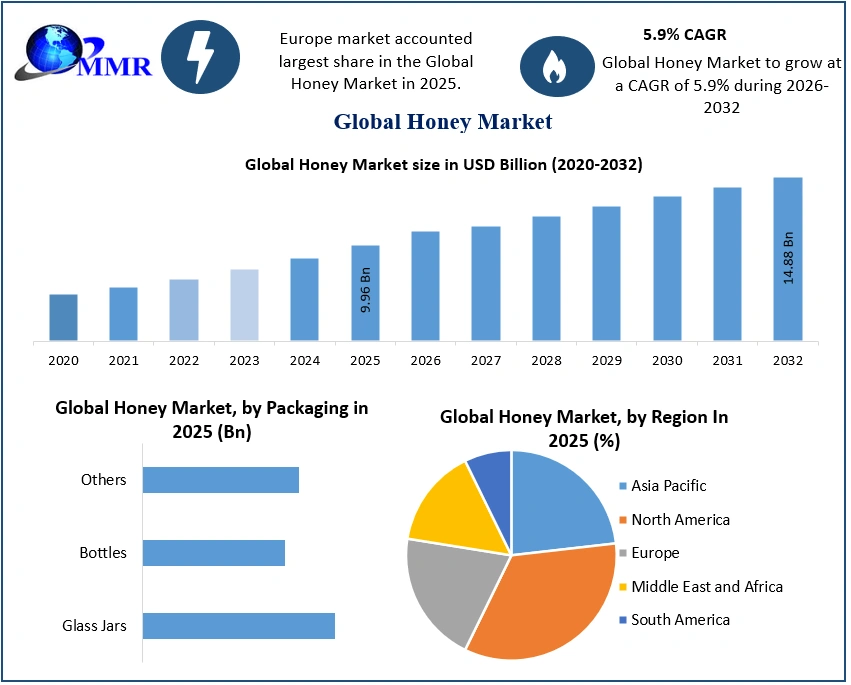
The Honey Market size was valued at USD 9.96 Billion in 2025 and the total Honey revenue is expected to grow at a CAGR of 5.9% from 2025 to 2032, reaching nearly USD 14.88 Billion by 2032.
Overview
Honey is rich in vitamins and minerals, minerals, calcium, and antioxidants, which are all beneficial to your health. Honey also has medical benefits, including the ability to improve metabolic activity, maintain blood pressure levels, lower the risk of diabetes, and even treat burn scars. Honey is used in a variety of applications apart from food and beverages, such as cosmetics and pharmaceuticals, which is anticipated to enhance market growth. Honey productivity and availability are affected by climatic conditions in each area; as a result, a few countries, such as North and South America, Asia, and Europe, account for the majority of output.
To know about the Research Methodology :- Request Free Sample Report
Honey, a natural sweetener rich in antioxidants, amino acids, and enzymes, holds significant health benefits and has been used for culinary, medicinal, and cosmetic purposes for millennia. As the demand for honey grows, companies are gaining prominence, distinguished by their commitment to quality and sustainable practices. The honey market's growth is facilitated by various factors, including increasing consumer awareness of health and wellness, the accessibility of honey through e-commerce platforms, and a preference for natural and organic food products. However, challenges such as colony collapse disorder and declining bee populations must be addressed to sustain the industry's growth.
Honey Market Dynamics:
Health and Wellness Trends among the Consumers to Influence the Market Growth
The increasing focus on health and wellness among consumers has been a significant driver for the growth of the honey market. Honey is perceived as a natural and healthier alternative to refined sugar, making it increasingly popular among health-conscious individuals. Its reputation for possessing various health benefits, such as antioxidant properties, antimicrobial effects, and potential allergy relief, has driven its demand. Moreover, as people become more aware of the detrimental effects of artificial sweeteners and processed sugars, they are turning to honey as a wholesome substitute in their diets. This trend is expected to continue driving growth in the honey industry as consumers prioritize healthier lifestyles and seek out natural, functional foods.
Embracing the Top Health and Wellness Trends for a Balanced Life:

As health and wellness trends prioritize natural and holistic remedies, the demand for honey surges. With its reputation as a nutritious, antioxidant-rich sweetener, honey fits perfectly into plant-based diets and mindful eating practices. Its versatility in culinary and medicinal applications appeals to consumers seeking functional foods. As a result, the honey market experiences a robust 70% growth as it aligns seamlessly with evolving health-conscious lifestyles.
Growing Use of Honey in Various Industries to Drive the Market
The versatility of honey has led to its expanding use across diverse industries, contributing to market growth. In addition to its traditional consumption as a sweetener, honey is increasingly utilized in cosmetics, pharmaceuticals, and food processing. Its natural humectant and antimicrobial properties make it a valuable ingredient in skincare and beauty products. Furthermore, its role in wound healing and potential applications in pharmaceutical formulations are being explored, opening up new avenues for market expansion. Additionally, honey's use in food processing as a natural preservative and flavor enhancer further drives demand. As these industries continue to innovate and incorporate honey into their products, the Honey Market is poised for sustained growth.
Honey Bee Farming Process:

Honey is a famous food ingredient that is exploring opportunities in the Food and Beverage (F&B) industry. Commercial beverage production is one of honey's modern applications in the F&B industry. Fermentation of honey in the production of sweet alcoholic drinks such as meads, Honey Wines and Honey Beers is also gaining momentum. The healing benefits of honey are expected to be a crucial factor driving the growth of the Market. Honey fermentation for the creation of sweet alcoholic beverages is also gaining popularity. Honey's healing properties are expected to be a major element in the Honey industry growth.
Europe is one of the largest honey markets in the world, with large local production and high consumption of the product. Europe offers good opportunities for honey exporters from developing countries, as the region is the world's largest honey importer and supplies about half of its honey needs by importing from developing countries. In addition, Europe is the largest market for organic food, and organic honey is becoming increasingly popular among European consumers.
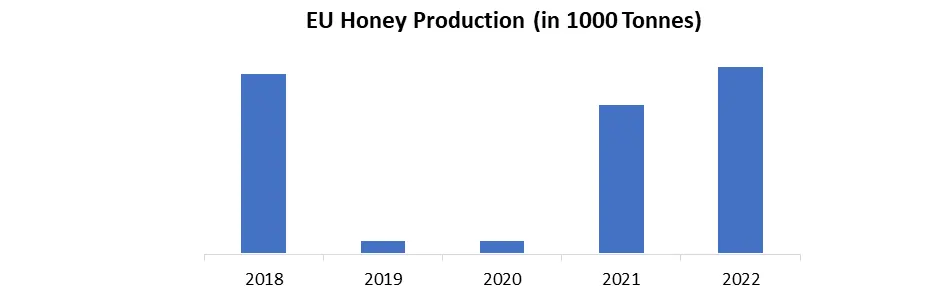
Europe is also among the largest global consumers of honey, together with China and the United States, and accounts for an estimated 20% share of total consumption worldwide.
Honey's therapeutic use expands the market into industrial verticals including Drug Manufacturing, Healthcare Facilities, and Medical Disposables Manufacturing. The sugar profile of honey continues to elicit consumer suspicion in the global honey industry. Medical use of honey will continue to expand business opportunities for manufacturers, unifying pharmaceutical production with honey production. The increase in product additives is anticipated to hinder the Global Honey Market's expansion. Adulteration and fraud incidences in honey have been one of the industry's significant difficulties in recent years, negatively impacting Honey Market Growth worldwide.
Government Interventions for the Honey Industry:
The Indian honey industry is mainly dominated by small-scale beekeepers and honey collectors. The government has initiated various schemes and programs to promote honey production and export in the country. These include the National Beekeeping and Honey Mission, which aims to increase honey production and improve the livelihoods of beekeepers, and the Honey Mission in the Northeast region of India, which focuses on promoting honey production in the region. Some of the schemes include:
| Initiative | Description |
| National Beekeeping and Honey Mission (NBHM) | Launched by the Indian government in 2017, the NBHM is a centrally sponsored scheme aimed at promoting beekeeping and honey production. It provides technical and financial assistance to beekeepers, establishes processing facilities, and enhances marketing and export efforts. |
| Apiculture Mission | Implemented by various state governments, the Apiculture Mission supports beekeeping and honey industry development at the state level. It assists in setting up bee colonies, offers training, and facilitates access to marketing and export opportunities. |
| Export Promotion Scheme | The Indian government's export promotion schemes include support for the honey sector, and offering financial aid to exporters. This assistance covers reimbursement of taxes and duties, as well as support for marketing and promotional activities. |
Climate Change's Impact on Honey Bee Population and Diseases and Restrain the Market Growth
Honey production relies heavily on the health and productivity of bee populations, which are vulnerable to the effects of climate change. Changes in temperature, rainfall patterns, and the prevalence of pests and diseases disrupt bee habitats and forage availability, leading to reduced honey yields and lower-quality honey. The European honey bee, Apis mellifera, plays a crucial role in maintaining biodiversity and agricultural productivity worldwide. However, shifting environmental conditions, including temperature variations and habitat disruptions, disrupt bee behavior, physiology, and distribution. Climate change influences the prevalence and distribution of bee diseases and parasites, such as Varroa mites, Nosema apis, bacteria, and viruses. These pathogens pose serious threats to honey bee colonies, leading to colony collapse and mortality. Additionally, climate-induced changes in flora availability impact bees' foraging activity and nutritional intake, further exacerbating colony health. As a result, these factors impact the production of honey and restrain the Honey Market growth.
Honey Market Segment Analysis:
By Product Type:
Based on product type, the Global Honey Market is segmented into Wildflower, Acacia, Clover Honey, Buckwheat and Alfalfa. The Wildflower Honey segment is estimated to account for the highest market share and increase at a CAGR of 7.35% during the forecast period 2025-2032. Buckwheat and Alfalfa held the second-highest market share of 37% in the year 2025. It’s also expected to raise the market share by up to 60% in the Market. These types of products are widely used in the Food and beverages industry within the various food items. Pharmaceutical, Food and beverages industries are contributing to the market growth of the Global Honey Market.
By Application:
Based on Application, the Global Honey Market is segmented into Food and Beverages Personal Care, Pharmaceuticals &Cosmetics. The food and Beverage segment is dominated by the Market and accounted for a market share of more than 70.2% in 2025. Thanks to the extensive usage of honey in bakery products non-alcoholic beverages and restaurants. Product adulteration is one of the significant issues in the global market. The personal care and cosmetics market is predicted to grow at the fastest rate, with a CAGR of over 7% during the forecast period. The growing use of natural sweeteners in organic confectionery and bakery items is expected to boost the honey market's potential.
Honey Market Regional Analysis:
Europe held the largest Honey Market share contributing more than 35.1% in the year 2025. According to the European Commission's statistics, 60% of the honey consumed in the region is produced in Europe. Additionally, big regional company invests substantial amounts of money in maintaining their production and supply chains. European demand for honey is strong and growing. Importers are increasingly looking for new suppliers. Germany is the main market for honey, followed by the UK, France, Belgium, Poland and Italy. The German, British, French and Belgian markets account for more than 50% of total European honey imports.
Asia Pacific Honey Market is expected to grow at a significant CAGR over the forecast period. The existence of a high number of honey producers in some of the region's growing countries, such as China and India, is projected to continue to be a positive factor in the region's development. China was the leading exporter of honey in the United States and throughout Europe. Altparmak a Turkish honey producer gained USD 4.98 million in funding from the European Bank for Reconstruction and Development (EBRD) in January 2018 to grow and advance its in-house value chain.
The objective of the report is to present a comprehensive analysis of the Global Honey Market to the stakeholders in the industry. The past and current status of the industry with the forecasted Market size and trends are presented in the report with the analysis of complicated data in simple language. The report covers all the aspects of the industry with a dedicated study of key players that include Market leaders, followers, and new entrants.
PORTER, PESTEL analysis with the potential impact of micro-economic factors of the Market have been presented in the report. External as well as internal factors that are supposed to affect the business positively or negatively have been analyzed, which will give a clear futuristic view of the industry to the decision-makers.
The report also helps in understanding the Global Honey Market dynamics, and structure by analyzing the Market segments and project the Global Honey Market size. Clear representation of competitive analysis of key players by Deployment, price, financial position, Deployment portfolio, growth strategies, and regional presence in the Global Honey Market makes the report investor’s guide.
Global Honey Market Scope: Inquire before buying
| Global Honey Market | |||
|---|---|---|---|
| Report Coverage | Details | ||
| Base Year: | 2025 | Forecast Period: | 2026-2032 |
| Historical Data: | 2020 to 2025 | Market Size in 2025: | USD 9.96 Bn. |
| Forecast Period 2026 to 2032 CAGR: | 5.9% | Market Size in 2032: | USD 14.88 Bn. |
| Segments Covered: | by Product Type | Alfalfa Acacia Wildflower Buckwheat Clover Honey |
|
| by Packaging | Glass Jars Bottles Others |
||
| by Application | Food &Beverages Personal Care Pharmaceutical and Cosmetic Others |
||
| by Distribution Channel | Super Market Convenience store Online Store |
||
Global Honey Market, by Region
North America (United States, Canada and Mexico)
Europe (UK, France, Germany, Italy, Spain, Sweden, Austria and Rest of Europe)
Asia Pacific (China, South Korea, Japan, India, Australia, Indonesia, Malaysia, Vietnam, Taiwan, Bangladesh, Pakistan and Rest of APAC)
Middle East and Africa (South Africa, GCC, Egypt, Nigeria and Rest of ME&A)
South America (Brazil, Argentina Rest of South America)
Honey Key players
North America
1. Sioux Honey Association Co-op (United States)
2. Barkman Honey (United States)
3. Bee Maid Honey (Canada)
4. Dutch Gold Honey Inc. (United States)
5. Golden Acres Honey (United States)
6. Honeytree Inc. (United States)
7. Wedderspoon Organic Inc. (United States)
8. Wholesome Sweeteners Inc. (United States)
Asia Pacific
9. Capilano Honey Ltd. (Australia)
10. Comvita Ltd. (New Zealand)
11. Dabur India Ltd. (India)
12. HoneyLab Ltd. (New Zealand)
13. Little Bee Impex (India)
14. Manuka Health New Zealand Ltd. (New Zealand)
15. The Honey Company (New Zealand)
16. Honey Bunny (India)
17. Steens Manuka Honey (New Zealand)
Europe
18. Langnese Honig (Germany)
19. Rowse Honey Ltd. (United Kingdom)
20. Companhia Apiária D'Ave Ltda (Brazil)
21. Others
Frequently Asked Questions:
1] What is the growth rate of the Global Honey Market?
Ans. The Global Honey Market is growing at a significant rate of 5.9 % during the forecast period.
2] Which region is expected to dominate the Global Honey Market?
Ans. Europe is expected to dominate the Honey Market during the forecast period.
3] What is the expected Global Honey Market size by 2032?
Ans. The Honey Market size is expected to reach USD 14.88 Bn by 2032.
4] Which are the top players in the Global Honey Market?
Ans. The major top players in the Global Honey Market are Sioux Honey Association Co-op, Barkman Honey and others.
5] What are the factors driving the Global Honey Market growth?
Ans. As consumers become more health-conscious and seek natural alternatives to refined sugars, the demand for honey, which is perceived as a healthier sweetener, continues to rise.
6] What was the Global Honey Market size in 2025?
Ans: The Global Honey Market size was USD 9.96 Billion in 2025.