
Glass to Metal Seals Market Size by Type, Material, Application, and Region - Segment-Level Market Assessment, Growth Opportunity Analysis, Competitive Mapping & Forecast to 2032
Overview
The Glass to Metal Seals Market size was valued at USD 1282.21 Million in 2024 and the total Glass to Metal Seals revenue is expected to grow at a CAGR of 4.34% from 2025 to 2032, reaching nearly USD 1801.22 Million.
Glass to Metal Seals Market Overview:
Glass-to-metal seals is the sealing elements in a liquid pump. They safeguard the system from fluid and gas leaks both inside and outside. A glass-to-metal seal is usually used for high pressure, but a low-temperature glass-to-metal seal is typically used for moderate pressures like those found in home appliances and electronic parts. Different sorts of glass products, including battery cells, semiconductor packages, and home appliances, are sealed using glass to metal seals. To know about the Research Methodology :- Request Free Sample Report
Glass sealants that can endure high temperatures are known as high-temperature sealing glasses. These seals offer defence against bacterial or fungal invasion, corrosion, erosion and abrasion, and water vapour permeability. Depending on the nature of the product, high-temperature sealing glasses offer a wide range of transparency to opacity.
Glass to Metal Seals Market Dynamic:
The MMR report covers all the trends and technologies playing a major role in the growth of the Glass to Metal Seals market over the forecast period. It highlights the drivers, restraints, and opportunities expected to influence the market growth during 2025-2032
Rising Demand for Glass to Metal Seals in Various End Use Industry:
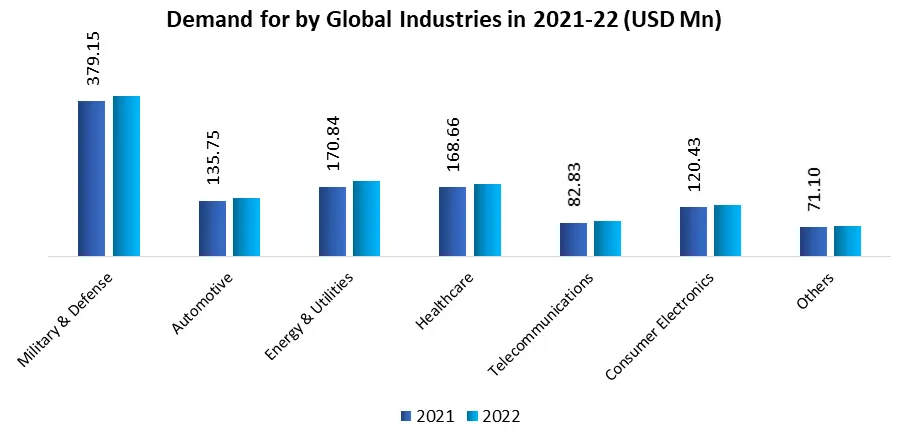
The demand for glass to metal seals is expected to increase over the forecast period owing to their use in the manufacture of fuel cells, electrical penetration control, veterinary and dental applications, airbag initiation, and other applications.
Automotive electronics offer higher levels of comfort, security, and safety. As consumers choose technologically advanced vehicles more frequently, the need for automotive electronics is also expected to grow. As a result, there will likely be an increase in demand for glass to metal seals for a number of automobile components, such as airbag initiators, collision sensors, and others. Increased urbanisation and industrialisation are key factors in the demand for glass to metal sealing.
Electronics Component Drives the Glass to Metal Seals Market Growth:
An optical interface that also serves to safeguard electronics components is a glass to metal seal. Even under difficult conditions like high pressure, high temperature, and proximity to harmful chemicals, these remain completely sealed.
 Thanks to the numerous advantages that glass to metal sealings provide, these are expected to be used in more and more applications, which will help the electronics sector of the glass to metal seals market grow between 2025 and 2032
Increased Growth of Semiconductors devices: In the semiconductor industries, glass to metal seals is employed. They are used in the production of batteries, home appliances, as well as other sectors including automotive and construction hardware. Glass to metal seals is mostly used for hermetic sealing, which prevents corrosive gases, moisture, or air from entering a space that needs to be sealed off.
Glass to Metal Seals Market Opportunities:
The glass to metal sealing has a variety of possible technological and security benefits. It is a more cost-effective option that offers reliable packaging for delicate electronics and other components. Glass to metal seals, which can also act as an optical interface, guard electronic components. These remain completely sealed even in challenging conditions including high pressure, high temperatures, and close exposure to aggressive chemicals. Because of the numerous benefits they provide for a range of applications, the use of glass to metal seals is expected to rise, which is expected to drive the growth of the glass to metal seals market during the forecast period.
Glass to Metal Seals Market Restraints:
The usage of glass to metal seals is restricted due to strict standards for aerospace, military, and medical applications. The protocol was implemented about their use in personal, academic, and professional applications. Regarding the application of glass to metal seals in the field of defence, every country has a unique policy and set of regulations. Manufacturers are consequently subject to numerous design restrictions, regular reviews, renewals, licences, approvals, certificates, and other stringent specifications imposed by various national agencies. Additionally, a delay in the production of UAV propulsion components is expected as a result of the emergency airworthiness requirement.
Glass to Metal Seals Market Segment Analysis:
In , Compression Seal Segment Held the Largest Glass to Metal Seals Market Share of nearly 45%:
Compression Seal segment held the largest share in total Glass to Metal Seals Market of 45% in and is projected to grow at the CAGR of 5.42% over 2025-2032. Compression glass-to-metal sealing is typically used for signal processing and power supply in corrosive settings with exceptionally high temperatures and pressures. Because of the significantly different CTEs of the glass and metal in compression seals, the outside metal eyelet shrinks firmly onto the sealing glass during manufacture. Using this compressive force, a seal is produced that has exceptional physical bond strength. Glass' compressive strength is actually ten to twenty times larger than its tensile strength. Compression seals are therefore frequently used in systems that call for a high level of mechanical resilience. Applications in the automotive and energy sectors are two examples where long-term seal integrity is required for the continued safe operation of electronics in risky circumstances.
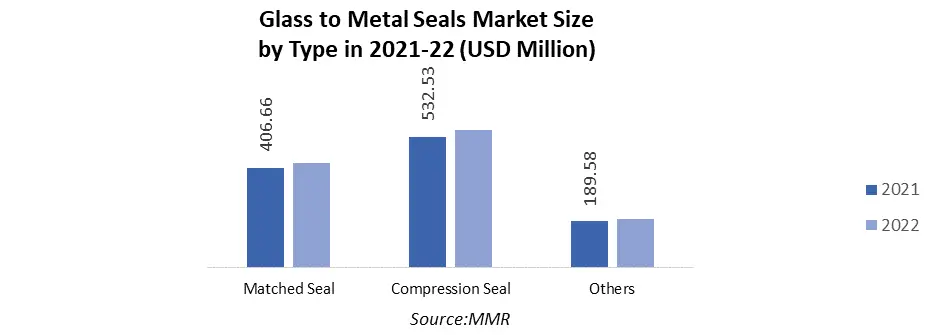 Matched Seal segment was valued USD 406.66 Mn in and is expected to reach at a CAGR of 4.75% over forecast period. Matching glass to metal sealing is mostly used in the sphere of signal processing, which calls for a sophisticated industrial control system. The CTE of the glass and metal are balanced in matching seals. Matching seals are typically used in applications where tight pin pitch, high temperature variations, or dimensional limits (such as micro or non-round shapes) are problems. Matching glass-to-metal seals are perfect for semiconductor and optoelectronic assemblies because they can maintain structural integrity during tens of thousands of temperature cycles, which are required for the precise operation of the enclosed electronics.
Military & Defense segment Expected to Hold Significant Share
Based on Application, Military & Defense segment was valued USD 379.15 million in . Glass to metal seal feedthroughs is used in the aerospace & defence industries in a wide range of parts where system reliability is crucial, with vacuum feedthroughs, sealed relays, thermal sensors, pin feed-through terminals, injector pipes, LEDs, beam-line feedthroughs, thermocouple feedthroughs, packages for electronic components, AC/DC power distribution assemblies, and time delay equipment.
Automotive segment is expected to grow rapidly at a CAGR of 4.85% during the forecast period 2025-2032. GTMS feedthroughs are used in the automotive industry with a variety of sensors. High-pressure and resistance capabilities are required for the pressure, flow, gyro, and acceleration sensors (i.e. vibrations, temperature fluctuations).
Healthcare also plays important roles in Glass to Metal Seals Market, with market size of US$ 168.66 Mn in . In the healthcare industry, GMTS is increasingly used for a variety of surgical and endoscopic instruments as well as implantable medical devices to halt the diffusion of gases.
Glass to Metal Seals Market Regional Analysis:
Geographically, in 2024, Asia-Pacific Glass to Metal Seals Market accounted for the largest share of nearly 35%. In APAC, glass to metal seals is most widely used. China and India are the two largest markets in the area. The countries account for the majority of the demand for glass to metal seals in the area. The rise in demand for glass to metal seals in the consumer electronics, energy and utilities, automotive and transportation, and telecommunications industries in Asia Pacific can be attributed to industrialization and the region's consumers' greater purchasing power. During the forecast period, the market is anticipated to grow as FDI in the automotive and telecommunications sectors increases in the developing countries of Asia Pacific.
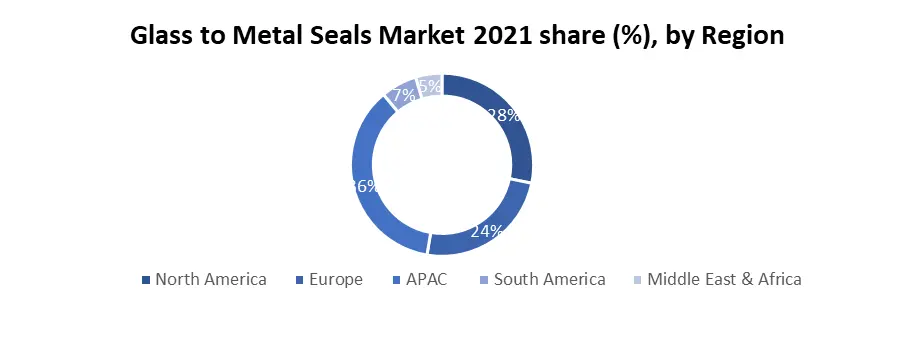 North America accounted for the second largest market share in 2024, with a market value of US$ 318.76 million; the regional market is expected to register a CAGR of 5.21% during the 2025-2032. The figure is related to the fact that North America is one of the regions that has produced high-end electronic products, and as a result, there is a stronger demand for sealing solutions. Thanks to increased disposable incomes and rising use of consumer electronics like smartphones and tablets, there is an increasing need for semiconductors and batteries in the US electronics industry. Over the projected period, increasing glass seal usage in household appliances is expected to boost the market's growth prospects in North America.
Glass to Metal Seals Market: Competitive Strategic Window
The vendor can identify an alignment or fit between their strengths and opportunities for potential future growth prospects with the aid of the Competition Strategic Window, which analyzes the competitive landscape in terms of markets, applications, and geographies. It outlines the best or most advantageous fit for the vendors to implement subsequent merger and acquisition plans, geography expansion strategies, research and development strategies, and new product introduction strategies to carry out future business growth over a projection time. Such as, In the NR600 Artificial Retina Device from NanoRetina in , glass laser bonding technology from SCHOTT Primoceler was utilised. The creation of NanoRetina's retinal implant may offer a remedy for the degenerative loss of eyesight. Utilizing hermetic glass wafer micro bonding technology from SCHOTT Primoceler, the device's ultra-compact, all-glass container was built.
Schott AG debuted a number of hermetic products in along with the introduction of its ground-breaking HEATAN technology, expanding the company's product line.
The research report covers Glass to Metal Seals Market statistics including current Glass to Metal Seals Market size, Glass to Metal Seals Market Share, and Growth Rates (CAGR) by segments and sub-segments at global, regional, and country levels, with an annual forecast till 2032. The study provides a clear insight into market penetration by different types, applications, and sales channels of Glass to Metal Seals with corresponding future potential, validated by real-time industry experts. Further, Glass to Metal Seals market share by key metrics such as manufacturing methods/technology and raw material can be included as part of customization. This enables the client to identify the most potential segment from their growth rates along with corresponding drivers and restraints. The research considered as historical years, as the base year, and as the estimated year, with an outlook period from 2025 to 2032. The report identifies the most profitable products of Glass to Metal Seals market, dominant end uses and evolving distribution channel of the Glass to Metal Seals Market in each region.
Glass to Metal Seals Market Scope: Inquire before buying
| Glass to Metal Seals Market | |||
|---|---|---|---|
| Report Coverage | Details | ||
| Base Year: | 2024 | Forecast Period: | 2025-2032 |
| Historical Data: | 2019 to 2024 | Market Size in 2024: | USD 1282.21 Mn. |
| Forecast Period 2025 to 2032 CAGR: | 4.34% | Market Size in 2032: | USD 1801.22 Mn. |
| Segments Covered: | by Type | Matched Seal Compression Seal Others |
|
| by Material | Borosilicate Glass Aluminosilicate Glass Quartz |
||
| by Application | Military & Defense Automotive Energy & Utilities Healthcare Telecommunications Consumer Electronics Others |
||
Glass to Metal Seals Market, by Region
North America (United States, Canada and Mexico)
Europe (UK, France, Germany, Italy, Spain, Sweden, Austria and the Rest of Europe)
Asia Pacific (China, South Korea, Japan, India, Australia, Indonesia, Malaysia, Vietnam, Taiwan, Bangladesh, Pakistan and the Rest of APAC)
South America (Brazil, Argentina Rest of South America)
Middle East & Africa (South Africa, GCC, Egypt, Nigeria and the Rest of ME&A)
Global Glass to Metal Seals Market Key Players are:
North America
1. AMETEK, Inc. (United States)
2. Complete Hermetics, Inc. (United States)
3. Concept Group LLC (United States)
4. Emerson Electric Co. (United States)
5. Hermetic Solutions Group LLC (United States)
6. Palomar Technologies, Inc. (United States)
7. SGA Technologies, Inc. (United States)
Asia Pacific
8. Botou Hi-Tech Electronic Accessories Co., LTD (China)
9. Kyocera Corporation (Japan)
10. Shinko Electric Co., Ltd. (Japan)
11. Televac Private Limited (India)
Europe
12. Dietze Group GmbH & Co. KG (Germany)
13. Egide SA (France)
14. Electrovac AG (Austria)
15. Rosenberger Hochfrequenztechnik GmbH & Co. KG (Germany)
16. Schott AG (Germany)
17. Vac-Tron SA (Spain)
Frequently Asked Questions:
1] What is the growth rate of the Global Glass to Metal Seals Market?
Ans. The Global Glass to Metal Seals Market is growing at a significant rate of 4.34 %during the forecast period.
2] Which region is expected to dominate the Global Glass to Metal Seals Market?
Ans. APAC region is expected to dominate the Glass to Metal Seals Market during the forecast period.
3] What is the market size of the Global Glass to Metal Seals Market by 2032?
Ans. The market size of the Glass to Metal Seals Market by 2032 is expected to reach USD 1801.22 Mn.
4] Which are the top key players of the Global Glass to Metal Seals Market?
Ans. The major key players of the Global Glass to Metal Seals Market are Schott, AMETEK, Inc.
Amkor Technology, Inc.and Others
5] What was the Global Glass to Metal Seals Market size in 2024?
Ans: The Global Glass to Metal Seals Market size was USD 1282.21 Million in 2024.