
Functional Food Market by Ingredients, Application, Product and Region – Global Market Size Estimation, Industry-Wide Analysis, Competitive Landscape Assessment & Long-Term Forecast to 2032
Overview
Functional Food market size was valued at USD 375 Billion in 2025 and the total Functional Food revenue is expected to grow at a CAGR of 7.8% from 2026 to 2032, reaching nearly USD 634.4 Billion.
Functional Food Market report is a comprehensive analysis of the industry, market, and key players. The report has covered the market by demand and supply-side by segments. The Functional Food Market report also provides trends by market segments, technology, and investment with a competitive landscape.
Functional Food Market Overview:
Functional food can be stated as foods that have a potentially positive effect on health due to its additional functionality which adds new ingredients or more of existing ingredients to the diet. Researchers of functional food suggest that it does not cure disease wholly but aids to reduce the risk of deadly diseases by providing necessary nutrients and proteins. Functional food is also seen to provide benefits to the physiological state.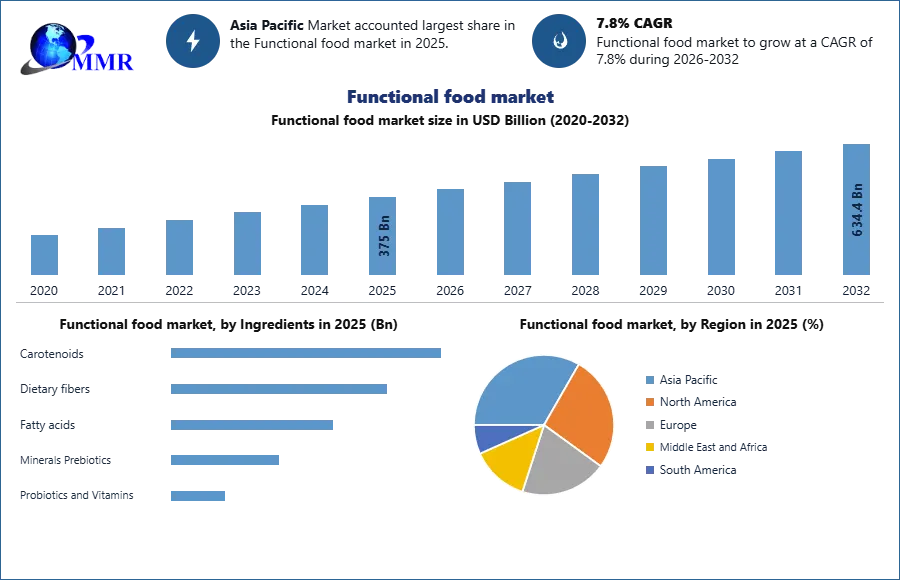 To know about the Research Methodology:- Request Free Sample Report
Functional Food Market Dynamics:
Functional Food Market Drivers:
The demand for fortified food products has been one of the largest growing health and wellness food & beverage category worldwide, followed by naturally healthy, and organic food products. Products like milk formula, energy drinks, sports drink, probiotic yoghurt, juice drinks, cereals and biscuits topped the functional global health and wellness category sector in 2013 as per International Food Information Council (IFIC). Increasing awareness in consumers regarding various diseases, nutritional deficiency, desire for healthy aging and influence of celebrity diets have driven the market for this segment.
Consumer interest in healthy food products has been driving the market. Today consumers have different perception about the food product, it is just not a means to combat hunger but also gaining essential nutrients to the body. One important factor for the drivers is associated with the increasing investment in healthcare, the expected increase in life expectancy and the zeal of people to look ageless and young.
Functional Food Market Restraints:
The development, making and commercial aspects of functional food ingredients are multiplex, expensive and scientific. Product development in these sectors requires high technological conditions, consumer demand and legislative regulatory background. A huge investment in research and development is required to carry out a particular strain for the production of probiotics elements present in the product.
Functional Food Market Opportunities:
Natural carotenoids are largely preferred by consumer these days due to their pure form compared to synthetic carotenoids, especially in the dietary supplements area, due to their high nutritional quality. The ongoing methods used for the production of carotenoids are specified and subject to contamination. The application of these methods are expensive and therefore the prices of natural carotenoids like beta and lycopene are three times more than any synthetic carotenoids.
According to Nutraceuticals World, anchovy is the most common omega-3 source in 2014, accounting for roughly 70% of the sector. Due to taste, odour, and dietary habits, end consumers in certain parts of the world avoid fish-based items. As a result, fish oil producers are looking at new algae, zooplanktons (krill), and genetically modified (GM) plants as possible sources of omega-3. To meet the growing demand for EPA and DHA, scientists are researching large-scale microalgae cultivation and testing different strains in order to produce more viable and cost-effective omega-3 products. New algae suppliers are entering the market, including Algae Biosciences Inc. (US), Aurora Algae Inc. (US), and Lonza Group (Switzerland)
Functional Food Market Challenges:
Consumer knowledge of the health effects of particular ingredients will influence whether or not a functional food is accepted. Foods enriched with probiotics, prebiotics, flavonoids, carotenoids, and conjugated linolenic acid are favored over foods enriched with probiotics, prebiotics, flavonoids, carotenoids, and conjugated linolenic acid.
To resolve all of the difficulties associated with the selection and growth of strains, as well as the related production process, the researcher must work diligently. The most basic requirement for probiotics is that they contain enough microorganisms to last until the expiration date. To produce health benefits in the host, probiotics must contain particular strains and maintain a certain number of live cells.
The minimum number of viable cells needed in a probiotic product for it to be effective has been determined by different countries. Changes in pH and temperature have an effect on probiotic strains. The strains must be able to maintain themselves while being integrated with functional food items. The protection of these probiotic microorganisms is difficult due to their sensitivity to temperature, oxygen, and light.
Functional Food Market Segment Analysis:
On the basis of ingredients, the market is segregated into carotenoids, dietary fibers, fatty acids, minerals, prebiotics and probiotics and vitamins. The vitamin section drove the general market in 2025, by means of revenue, followed by dietary fibers and minerals.
Countless advantages are related to the consumption of fiber including gut wellbeing support, bringing down cholesterol levels, and controlling glucose levels, among others. These benefits, combined with the developing functional food industry, are expected to dominate a critical part in the development of the dietary fiber segment.
Dietary fibre, which is often found in fruits, vegetables, whole grains, and legumes, is best known for its ability to prevent and alleviate constipation. Fiber-rich foods, on the other hand, will help you maintain a healthy weight and reduce your risk of diabetes and heart disease.
The prebiotics and probiotics segment is expected to observe the quickest development during the forecast time frame. Prebiotics are short-chain carbohydrates that are not easily digestible by human digestive enzymes and boost the function of some beneficial bacteria. Beneficial bacteria in the intestine ferment prebiotics to produce short-chain fatty acids.
Prebiotics likewise render numerous other medical advantages in the digestive organ, for example, diminish the hazard of malignancy and expanded retention of calcium and magnesium. Prebiotics are found in a few vegetables and products of the soil considered useful food parts that present huge mechanical benefits.
On the basis of application, the market is segregated into sports nutrition, weight loss, immunity, digestive health, clinical nutrition, and cardio health. In 2025, the cardio health segment was the most common, accounting for 24.2 per cent of the market. Due to the demand for functional foods in cardiovascular diseases, congestive heart failure, artery hardening, and congenital heart defects, it is expected to grow at an annual rate of 8.1 per cent from 2026 to 2032. Digestive health is expected to develop as a result of a strong desire to preserve digestive health among women throughout their reproductive lives and men, especially after 40 years of age.
Because of a variety of health goals, such as improving joint health, weight loss, and bone and muscle strength, there is a growing demand for functional foods and beverages. By improving digestion, these foods can also lower the risk of cardiovascular disease and type 2 diabetes. They also aid in the reduction of wrinkles. Functional foods will help you lose weight and reduce your risk of noncommunicable diseases by enhancing your metabolism, optimising nutrition absorption, and aiding digestion. The preference of consumers for lower sugar intake is expected to have a positive impact on development.
On the basis of product, the market is segregated into Non-vegetarian products (Meat, Fish and Eggs), as well as soy products and fats and oils. In terms of sales, the dairy goods segment led the overall market in 2025, followed by bakery and cereals. Meat, fish, and eggs, as well as soy products and fats and oils, are other major product segments. The industry is expected to benefit from new innovations in the bakery and cereals sectors.
Over the forecast era, rising demand for functional snack and cereal bars such as energy bars, protein bars, and nutrition bars is expected to drive significant growth. Companies like Kellogg are introducing new product lines to grab market share, so fortified cereals are expected to rise quickly.
Functional Food Market Regional Analysis:
The market has been divided into five regions: North America, Europe, Asia Pacific, Central and South America, and the Middle East and Africa (MEA). In terms of sales, Asia Pacific accounted for more than 40% of the total market share in 2025. The introduction of e-commerce portals in Southeast Asia, such as Ali-Baba and Made-in-China, is expected to have a positive effect on the regional economy.
The Asia Pacific has probably the biggest market for these items inferable from the expanding populace combined with rising discretionary cash flow. Quickly developing utilization of prepared food alongside rising mindfulness in regards to wellbeing and wellness in creating economies are significant driving elements for the local market.
The area is portrayed by developing sanitation worries among shoppers, impacting buyer conduct, consequently driving the development. Food stronghold is required to be the vital concentration for the public authority to battle expanding worries of unhealthiness and destitution. This factor, thusly, is relied upon to contribute fundamentally to the market development.
Recent Industry Developments
| Exact Date | Company | Development | Impact |
|---|---|---|---|
| 19 May 2025 | PepsiCo Inc. | Completed the $1.95 billion acquisition of prebiotic soda brand Poppi to accelerate its functional beverage strategy. | Significantly strengthens its gut health portfolio to compete with emerging wellness-focused beverage startups. |
| 22 July 2025 | PepsiCo Inc. | Launched the industry's first-ever prebiotic cola in the traditional carbonated soft drink category. | Positions the company to capture health-conscious Gen Z consumers seeking functional benefits in staple beverage products. |
| 11 November 2025 | Arla Foods Ingredients | Unveiled five new high-protein application concepts, including a functional "Easy Bite" snack bar with 40% protein content. | Targets the guilt-free snacking segment which currently attracts over 30% of health-conscious dairy consumers. |
| 20 November 2025 | Danone S.A. | Launched Silk Protein in North America, offering 13 grams of plant protein per serving with 50% less sugar than dairy. | Fills a critical market void for high-protein, low-sugar alternatives in the plant-based dairy sector. |
| 11 December 2025 | Glanbia PLC | Announced a strategic pivot toward GLP-1 companion nutrition, focusing on nutrient-dense foods for weight management. | Aligns the company with a projected global megatrend where 38% of consumers prioritize proactive weight health. |
| 09 March 2026 | Oatly Group AB | Committed $16 million to expand its Landskrona plant, boosting functional oat milk production capacity by over 33%. | Scales operations to meet a 9.7% CAGR in the oat-based functional beverage market through 2026. |
Functional Food Market Scope: Inquire before buying
| Functional food market | |||
|---|---|---|---|
| Report Coverage | Details | ||
| Base Year: | 2025 | Forecast Period: | 2026-2032 |
| Historical Data: | 2020 to 2025 | Market Size in 2025: | 375 USD Billion |
| Forecast Period 2026-2032 CAGR: | 7.8% | Market Size in 2032: | 634.4 USD Billion |
| Segments Covered: | by Ingredients | Carotenoids Dietary fibers Fatty acids Minerals Prebiotics Probiotics and Vitamins |
|
| by Application | Sports nutrition Weight loss Immunity Digestive health Clinical nutrition Cardio health |
||
| by Product | Meat, Fish and Eggs Soy Products Fats & Oils |
||
Functional Food Market, by Region
North America (United States, Canada and Mexico)
Europe (UK, France, Germany, Italy, Spain, Sweden, Austria and Rest of Europe)
Asia Pacific (China, South Korea, Japan, India, Australia, Indonesia, Malaysia, Vietnam, Taiwan, Bangladesh, Pakistan and Rest of APAC)
Middle East and Africa (South Africa, GCC, Egypt, Nigeria and Rest of ME&A)
South America (Brazil, Argentina Rest of South America)
Key Players / Competitors Profiles Covered in Brief in Functional Food Market Report in Strategic Perspective:
- Nestle SA
- Danone S.A.
- PepsiCo Inc.
- General Mills Inc.
- Unilever PLC
- Abbott Laboratories
- The Kellogg Company
- The Kraft Heinz Company
- Amway Corp.
- Glanbia PLC
- Archer Daniels Midland Company (ADM)
- Arla Foods amba
- Meiji Holdings Co., Ltd.
- Barix Clinics
- BASF SE
- Cargill, Inc.
- Hearst Communications Inc.
- Raisio plc
- Royal DSM N.V.
- Oatly Group AB
- Hain Celestial Group
- Ingredion Incorporated
- Kerry Group PLC
- Ajinomoto Co., Inc.
- Chr. Hansen Holding A/S