
Freight Trucking Market – Global Market Size, Strategic Growth Drivers, Risk Assessment Framework, Regulatory Landscape Review, Competitive Intensity Mapping & Long-Term Industry Outlook to 2032
Overview
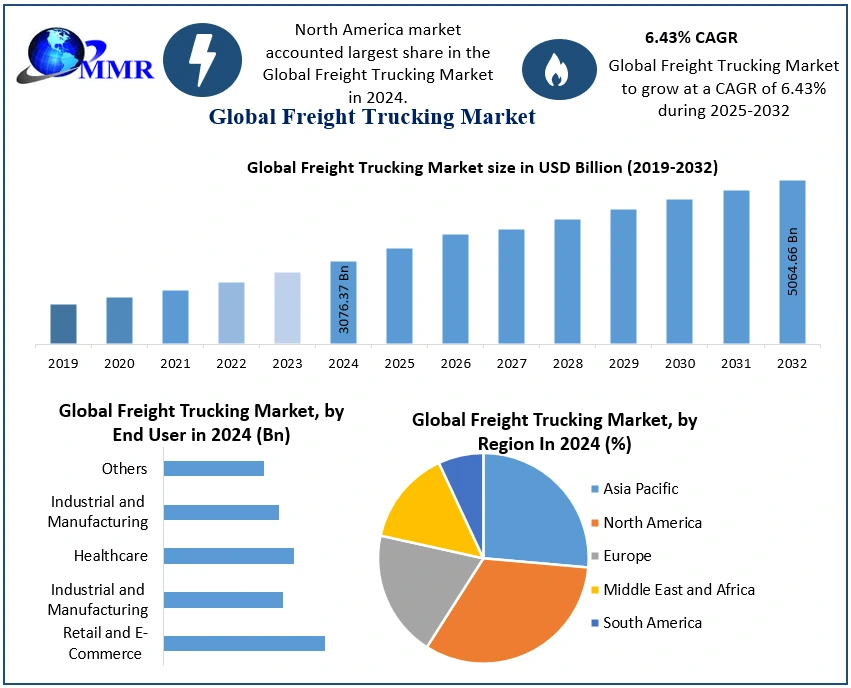
The Freight Trucking Market size was valued at USD 3076.37 Billion in 2024 and the total Freight Trucking revenue is expected to grow at a CAGR of 6.43% from 2025 to 2032, reaching nearly USD 5064.66 Billion.
Freight Trucking Industry Snapshot:
A freight truck, also known as a heavy-duty vehicle, is a vehicle that is used to move products from one location to another. It is commonly used in logistics services and is particularly well suited to off-road driving. Freight trucks with advanced and high-powered engines readily transport big loads. The freight trucking market has grown as a result of the increase in demand for effective freight transportation brought about by the rise of e-commerce and globalization.
Technological innovations that improve route optimization, fuel efficiency, and cargo security like automation, GPS tracking, and telematics are revolutionizing the transportation sector. With businesses progressively using electric and alternative fuel cars to lower carbon emissions, sustainability is also becoming a top priority. Many truck manufacturers rely heavily on cutting-edge technology to enhance the functioning and performance of their vehicles. The need for order tracking has increased, forcing the freight Trucking industry to implement new tracking technologies. The self-driving freight trucks are expected to become more common on the road, particularly in developed countries of North America and Europe, owing to the fast advancement of technology.
 To know about the Research Methodology :- Request Free Sample Report
Freight Trucking Market Key Dynamics:
Technological Advancements and E-Commerce Surge Growth in Global Freight Trucking Market
The transportation and logistics industries have seen constant progress. As truck manufacturers continue to roll out new truck models with enhanced cargo capacity and technologies, technological improvements are expected to drive the growth of the freight trucking market. Several truck manufacturers are highly dependent on innovative technology to improve the vehicle's performance and functionality. The freight trucking industry has been forced to integrate new tracking systems thanks to an increase in demand for order tracking. Food and beverage industry operators are largely focused on improving their product supply chain by reducing logistics and responding to the market's low-volume, high-frequency requirements. Also, as a result of the intense competition in the food and beverage industry, some food corporations are increasingly focusing on adapting to new transportation networks and lowering costs.
The Freight Trucking Market's major drivers are undergoing technological advancements, with a special focus on long-distance freight trucking. The growing popularity of online shopping is fuelling the global freight transportation industry. The attractive steps taken by the e-commerce sector, particularly in emerging and developed countries, are driving demand for the freight transportation services market.
Additionally, the freight trucking Industry benefits from online shopping, as well as significant advancements in internet services around the world. The trend of home delivery has driven a significant increase in the use of freight transportation services. E-commerce platforms and online shopping sites make arrangements for accurate and effective home delivery to achieve acceptance. This is in addition to current technical improvements, which are expected to assist the market's growth over the forecast period. For Instance, (e-commerce penetration in India) With over 950 Mn users, India is the 2nd largest internet market in the world with 131.16 Lakh Cr UPI transactions in FY 2023-24. Close to 100% of pin codes in India have seen e-commerce adoption. More than 60% of transactions and orders in India come from tier two cities and smaller towns. Emerging trend in the Freight Trucking Market
The need for strong support from logistics providers is becoming more crucial as companies work to keep their supply chain operations timely and intact. The start of 2024 put many companies' reliability to the test, resulting in a greater emphasis on customer experience. Businesses are currently looking for solid partnerships for strategic direction and flexibility in adapting to changes, even in a more digitalized setting.
Decarbonization is becoming increasingly important in the ground freight trucking sector. Businesses are advocating for increased sustainable initiatives, such as adopting electric vehicles (EVs) and integrating technologies such as vehicle routing and carbon reporting to achieve their environmental objectives. This movement is pushing the sector to prioritize efforts that help clients decrease their carbon emissions.
Freight Trucking Market Segment Overview:
Dry Van & Box Truck segment held the largest share in 2024 for the Freight Trucking Market. A dry van, also called a box truck or straight truck, is a trailer utilized for transporting goods. These trailers are created with walls and usually transport various items like furniture and building materials. Dry van trailers are the perfect option for individuals in search of trustworthy and safe transportation solutions. Box trucks, however, are created for transporting bigger objects.
Moving different types of goods across different industries is a critical function of the dry van and box truck industries which are important to the transportation sector. Since they shield the cargo from outside factors like weather and road conditions enclosed trailers also known as dry vans are perfect for moving non-perishable goods electronics clothes and other products. Box trucks are commonly utilized for short-haul deliveries and are essentially compact versions of dry vans. Box trucks and dry vans are valued for their flexibility. Businesses in the retail, manufacturing, and consumer goods sectors often prefer them because they can carry various products without requiring special care.
For instance, Walmart and Target heavily depend on dry vans to transport goods from distribution centers to retail stores. These trucks guarantee that items are delivered securely, without any damage, and in a sellable condition, thus upholding the effectiveness of their distribution networks. Walmart Transportation Management operates one of the largest trucking fleets in North America, with over 6,000 tractors and 15,000 trailers. The company uses a variety of transportation methods to move goods from its distribution centers to its stores, including rail, sea, and air freight.

Freight Trucking Market Regional Insight:
North America held xx% market share in 2024 for the Freight Trucking Market. Moving goods over long distances requires the use of freight trucks which are a vital component of North America's transportation industry. Trucking is the preferred method of freight delivery because of the region’s extensive highway network particularly in the United States and Canada which makes it easier to move goods quickly. International trade depends heavily on trucking since trucks are frequently used to transport goods across borders including farm products electronics and auto parts. Technological developments also have a big effect on the trucking industry in North America. For example, an increasing number of companies are putting telematics systems into place to monitor fleet performance reduce fuel consumption, and ensure driver safety.
Environmental regulations are also shaping the Freight Trucking industry, with a push toward cleaner, more fuel-efficient trucks to reduce carbon emissions. This combination of robust infrastructure, technological advancements, and regulatory pressures makes the freight trucking industry in North America both dynamic and integral to the region's economy.
Freight Trucking Market Competitive Landscape:
DHL, XPO Logistics, and FedEx have a strong presence in the industry owing to their widespread networks, advanced technology incorporation, and commitment to sustainability. These players are making significant investments in upgrading their fleets, digital platforms, and last-mile delivery solutions in order to stay competitive. DHL is a major player in the freight trucking industry, offering a wide range of transportation solutions. Recognized for its wide-reaching network and effective operations, DHL provides customized trucking services for local and international shipments. XPO is a top provider of asset-based less-than-truckload (LTL) freight transportation in North America. The company's customer-centered structure effectively transports 18 billion pounds of cargo annually, thanks to its in-house technology.
DHL and XPO Logistics compete aggressively in the freight trucking market through strategic investments and innovation. DHL leverages its extensive global network and advanced technology to enhance supply chain efficiency, focusing on sustainability and real-time tracking. XPO Logistics, on the other hand, emphasizes its robust digital platforms and data-driven solutions to optimize routing and reduce costs. Both companies are committed to fleet modernization and last-mile delivery improvements, yet DHL’s strength lies in its international reach and integrated services, while XPO excels with its technology-driven approach and operational agility. This competition drives both companies to continuously innovate and refine their logistics strategies.
Recent Development in Freight Trucking Industry
• In November 2024, The Biden administration revealed a new effort focused on drawing in and keeping truck drivers, which includes financial support for training programs and apprenticeship chances.
• In February 2024, CEMEX received its order for a fully electric and zero exhaust emission heavy-duty concrete mixer truck. CEMEX is an international construction materials company offering cement, ready-mix concrete, aggregates, transportation, and urbanization solutions in markets across the globe.
Freight Trucking Market Scope: Inquiry Before Buying
| Global Freight Trucking Market | |||
|---|---|---|---|
| Report Coverage | Details | ||
| Base Year: | 2024 | Forecast Period: | 2025-2032 |
| Historical Data: | 2019 to 2024 | Market Size in 2024: | USD 3076.37 Bn. |
| Forecast Period 2025 to 2032 CAGR: | 6.43% | Market Size in 2032: | USD 5064.66 Bn. |
| Segments Covered: | by Truck Type | Dry van & box truck Refrigerated truck Tanker truck Flatbed truck Others |
|
| by End-User | Retail and E-Commerce Industrial and Manufacturing Healthcare Industrial and Manufacturing Others |
||
Freight Trucking Market, by Region
North America (United States, Canada and Mexico)
Europe (UK, France, Germany, Italy, Spain, Sweden, Austria, Turkey, Russia and Rest of Europe)
Asia Pacific (China, India, Japan, South Korea, Australia, ASEAN and Rest of APAC)
Middle East and Africa (South Africa, GCC, Egypt, Nigeria and Rest of ME&A)
South America (Brazil, Argentina, Columbia and Rest of South America)
Leading Companies in the Freight Trucking Industry
1. DHL
2. XPO Logistics
3. UPS
4. C.H. Robinson
5. J.B. Hunt Transport Services
6. YRC
7. Old Dominion Freight Line
8. Knight-Swift Transportation Holdings
9. Ryder System
10. ArcBest Corporation
11. Landstar System
12. Werner Enterprises
13. Hub Group
14. Saia, Inc.
15. Estes Express Lines
16. Marten Transport
17. Prime, Inc.
18. Others key Players
FAQs:
1] What is the growth rate of the Freight Trucking Market?
Ans. The Global Freight Trucking Market is growing at a significant rate of 6.43 % during the forecast period.
2] What is the expected Freight Trucking Market size by 2030?
Ans. The Freight Trucking Market size is expected to reach USD 4253.9 Billion by 2030.
3] What segments are covered in the Market report?
Ans. The segments covered in the market report are Truck Type and End-User.
4] What are the factors driving the Freight Trucking Market growth?
Ans. The rapid growth of online shopping has significantly increased the demand for efficient freight trucking, particularly in last-mile delivery, driving market growth.
5] How are the technological advancements influencing the growth of the freight trucking market?
Ans: Technological advancements are significantly driving the growth of the freight trucking market by improving truck performance and functionality, integrating new tracking systems, and enhancing order tracking. These innovations cater to the increasing demand for efficient and reliable freight transportation, particularly in long-distance trucking.
6 ] What is the impact of online shopping on the freight trucking industry?
Ans: The rise of online shopping is boosting the freight trucking industry by increasing demand for global freight transportation services. The trend of home delivery, driven by e-commerce platforms, has led to higher usage of freight transportation services and improvements in delivery accuracy and efficiency.