
Envelope Tracking Chips Market - Industry Structure Evaluation, Demand Drivers Analysis, Regional Growth Analysis and Identification, Competitive Positioning / Landscape Review & Global Market Size Forecast to 2032
Overview
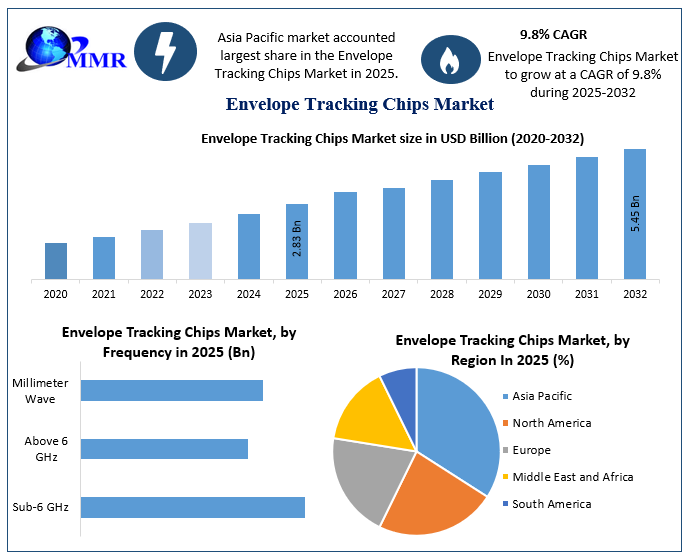
The Envelope Tracking Chips Market size was valued at USD 2.83 Billion in 2025 and the total Envelope Tracking Chips revenue is expected to grow at a CAGR of 9.8% from 2026 to 2032, reaching nearly USD 5.45 Billion by 2032.
Envelope Tracking Chips Market Overview:
Global Envelope Tracking Chips Market including power management semiconductor industry focusing on enhancing energy efficiency in RF power amplifiers used in mobile devices, wireless infrastructure IoT devices and 5G communication systems. Envelope tracking chips dynamically adjust the power supply voltage to the amplifier in real time, reducing energy loss and significantly improving battery life and signal quality. chips are critical in modern high-speed communication systems where performance, power efficiency and thermal management are essential. Asia Pacific dominated the Envelope Tracking Chips Market in 2024 registering the highest market share due to early adoption of 5G technology strong presence of major telecom OEMs and robust investment in RF front end component R&D. The U.S., in particular is leading in the integration of envelope tracking technology across smartphones, satellite systems and defence communication modules. Growth in this region fueled by increasing demand for low-latency and high efficiency communication systems.
 To know about the Research Methodology:- Request Free Sample Report
Leading market players include Qualcomm Technologies Inc., Analog Devices Inc., Qorvo Inc., NXP Semiconductors, Murata Manufacturing Co. and Skyworks Solutions Inc. all of whom are focusing on developing compact, low power ET chip solutions. Envelope Tracking Chips Market players are also investing in advanced packaging technologies and AI based signal optimization to support the evolving needs of 5G NR and Wi-Fi 7 architectures.
Global Envelope Tracking Chips Market Report provides a comprehensive analysis of chip architectures, integration with RF power modules end user verticals and regional trends through 2032. It delivers competitive intelligence based on innovation strategies, IP portfolios, strategic partnerships and manufacturing capabilities empowering industry participants to identify growth prospects, evaluate technology shifts and gain competitive advantage in the rapidly evolving wireless communication ecosystem.
Envelope Tracking Chips Market Dynamics
Growing demand for Electronic Devices boosts the Envelope Tracking Chips Market Growth
The growth of the Envelope Tracking Chips Market is significantly driven by the booming electronics industry, which includes the design, production, and sale of various electronic components and devices. As consumer electronics, telecommunications equipment, and IoT devices multiply, the demand for Envelope Tracking Chips rises. These chips enable power amplifiers to operate at peak efficiency, thus extending battery life and improving overall performance in mobile devices, wearables, and smart home technologies.
Rising Mobile Device Usage and 5G Expansion in 2025 Drive Demand for Envelope Tracking Chips
In 2025, the number of mobile devices operating worldwide reached nearly 17.6 billion, continuing its upward trajectory from 16.8 billion in 2025. With increasing reliance on high-performance mobile applications, the demand for faster connectivity and lower latency has intensified, making 5G networks a critical enabler of next-generation communication. In North America, 5G connections are estimated to have reached around 260 million in 2025, accounting for over 54% of all mobile connections in the region—up significantly from previous years. This surge in 5G adoption is driving the need for envelope tracking chips, which are essential for improving power efficiency and thermal performance in RF front-end modules, ensuring longer battery life and enhanced signal quality in smartphones, IoT devices, and wireless infrastructure.
Semiconductor Shortages Challenge Envelope Tracking Chips Market Growth
Envelope Tracking Chips Market faces challenges due to global semiconductor shortages, which have slowed down production and increased lead times. The demand for electronic devices, particularly in telecommunications, automotive, and consumer electronics, has surged, making the situation worse. To overcome these challenges, many companies are expanding their manufacturing capabilities. They are building new production facilities and increasing the number of production lines. Additionally, they are forming partnerships with suppliers to ensure a steady supply of materials. Companies are also looking to diversify their supply chains by sourcing components from different regions. This approach helps reduce reliance on a few suppliers and strengthens their operations against future shortages. These steps aim to stabilize production and meet the growing demand for Envelope Tracking Chips even with current supply chain issues.
Envelope Tracking Chips Market Segment Analysis
Based on Technology Satellite Communication, Wireless Communication, and Cellular Communication segments are covered. The Cellular Communication segment dominated the envelope tracking chips market in 2025 and is expected to hold largest share during the forecast period, driven by the widespread adoption of smartphones, 5G technology and IoT devices. Wireless Communication is the second-largest segment. A surge in the adoption of various wireless communication standards such as Bluetooth, Zigbee, Wi-Fi, and many other wireless communications standards for wireless devices such as headphones and speakers is attributed to the growth of the market. A growing market for cellular communication technologies such as LTE, 3G, 4G, and 5G, rising adoption of 3G and 4G technology-based cellular phones, and increasing introduction of various RF-based devices to use in cellular applications are likely to expand the growth of the market during the forecast period. The Satellite Communication segment, while critical in specialized fields (defense, remote sensing, etc.), typically holds a smaller portion of the Envelope Tracking Chips market.
Based on industry the Envelope Chips Market is segmented into Telecommunications, Consumer Electronics, Aerospace and Defence, Automotive, Healthcare and others. Telecommunications segment dominated the Envelope Tracking Chips Market in 2025 due to the massive rollout of 5G networks, increasing mobile data usage, and rising demand for energy-efficient RF power amplifiers in smartphones, base stations, and network infrastructure. The need for better signal quality and battery efficiency in mobile devices made envelope tracking technology a key enabler in telecom equipment.
Envelope Tracking Chips Market Regional Insight
Asia-Pacific region dominated the Envelope Tracking Chips Market in 2025 and is expected to hold largest share during the forecast period. due to high Internet penetration and rising demand for consumer electronics products. Also for the same reasons, Asia-Pacific is projected to have a significant growth rate during the forecast period. The demand for high end smartphones is forecast to escalate in the coming years in developing countries such as China, Japan, India, and South East Asian nations. Increasing adoption of automated systems for the manufacturing of automotive and aerospace components is driving the growth of the North American region.
Envelope Tracking Chips Market Competitive Landscape
Global Envelope Tracking Chips Market is shaped by a concentrated group of leading semiconductor manufacturers and RF front end solution providers whose innovation in power efficiency, chip integration and wireless communication standards drive the market’s competitive. We have more than 25 key market players profile, among which Qualcomm Technologies Inc. (USA), Analog Devices Inc. (USA), Qorvo Inc. (USA), Skyworks Solutions Inc. (USA), Murata Manufacturing Co., Ltd. (Japan), and NXP Semiconductors (Netherlands) represent the core strength of the global envelope tracking ecosystem. Qualcomm Technologies Inc. leads the market with its extensive portfolio of integrated ET chipsets, optimized for smartphones, 5G modems, and IoT devices. Leveraging advanced digital signal processing and AI-based optimization, Qualcomm sets the standard for energy efficient wireless connectivity in consumer electronics, and mobile infrastructure. Analog Devices Inc. focuses on high-performance ET solutions for wideband RF applications, enabling precise voltage modulation and signal integrity in next-generation 5G base stations and defense communication systems.
Recent Trends and their impact on Market:
| Sr No | Trends | Impact on Market |
| 1 | Rapid 5G Deployment Globally | Drives demand for high-efficiency ET chips to optimize power usage in 5G RF front-end modules. |
| 2 | Growth in Mobile and IoT Devices | Increases need for battery-efficient solutions, boosting adoption of ET chips in smartphones and IoT. |
| 3 | Semiconductor Supply Chain Constraints | Causes production delays and increased costs, challenging consistent market growth. |
| 4 | Advancements in RF Power Amplifier Technology | Enables integration of ET chips with newer RF architectures, expanding their application scope. |
| 5 | Increased Focus on Energy Efficiency and Thermal Management | Strengthens the value proposition of ET chips, particularly in compact and high-performance devices. |
Recent Developments in the Envelope Tracking Chips Market
• On 12 January 2024, Qualcomm Technologies Inc. (USA) announced the launch of its next-generation envelope tracking solution designed specifically for 5G mmWave smartphones, offering improved thermal performance and up to 30% better power efficiency over previous versions.
• On 28 March 2024, Analog Devices Inc. (USA) completed the expansion of its RF front-end production facility in Oregon, USA, aiming to shorten lead times and meet growing demand for ET chips in telecom and industrial applications.
• On 17 May 2024, Skyworks Solutions Inc. (USA) entered into a strategic partnership with a leading Asian smartphone manufacturer to integrate its ET chips into a new line of mid-range 5G devices, signaling increased adoption beyond premium models.
• On 8 July 2024, Murata Manufacturing Co., Ltd. (Japan) unveiled a compact envelope tracking chip targeting IoT wearables and edge devices, focusing on low power consumption and miniaturized designs for space-constrained applications.
• On 4 September 2024, Qorvo Inc. (USA) introduced a new ET power management module with integrated AI-based signal processing, designed to dynamically adapt power delivery for enhanced efficiency in real-time network conditions.
Envelope Tracking Chips Market Scope: Inquire before buying
| Global Envelope Tracking Chips Market | |||
|---|---|---|---|
| Report Coverage | Details | ||
| Base Year: | 2025 | Forecast Period: | 2026-2032 |
| Historical Data: | 2020 to 2025 | Market Size in 2025: | USD 2.83 Bn. |
| Forecast Period 2026 to 2032 CAGR: | 9.8% | Market Size in 2032: | USD 5.45 Bn. |
| Segments Covered: | by Technology | Linear Amplification Non-Linear Amplification Digital Signal Processing |
|
| by Frequency | Sub-6 GHz Above 6 GHz Millimeter Wave |
||
| by Application | Smartphones Tablets Wireless Communication Devices Wearable Devices |
||
| by End-User | Consumer Electronics Telecommunications Automotive Aerospace |
||
Global Envelope Tracking Chips Market, by Region:
North America (United Packaging Types, Canada, and Mexico)
Europe (UK, France, Germany, Italy, Spain, Sweden, Austria, and the Rest of Europe)
Asia Pacific (China, South Korea, Japan, India, Australia, Indonesia, Philippines, Malaysia, Vietnam, Thailand and the Rest of APAC)
Middle East & Africa (South Africa, GCC, Nigeria, Rest of ME&A)
South America (Brazil, Argentina, Rest of South America)
Key Players in Envelope Tracking Chips Market
North America
1. R2 Semiconductor (USA)
2. Analog Devices, Inc. (USA)
3. Qualcomm, Inc. (USA)
4. Texas Instruments Inc. (USA)
5. Qorvo (USA)
6. Skyworks Solutions, Inc. (USA)
7. Efficient Power Conversion Corporation (USA)
8. MACOM Technology Solutions Holdings Inc. (USA)
9. Broadcom Inc. (USA)
10. Maxim Integrated (USA)
Europe
11. Nujira Ltd. (UK)
12. MediaTek (UK)
13. Infineon Technologies AG (Germany)
14. STMicroelectronics (Switzerland)
15. Dialog Semiconductor (UK)
16. Nordic Semiconductor (Norway)
17. ams OSRAM AG (Austria)
Asia Pacific
18. Toshiba Corporation (Japan)
19. MediaTek (Taiwan)
20. Samsung Electronics Co., Ltd. (South Korea)
21. Qualcomm, Inc. (Taiwan)
22. Texas Instruments Inc. (China)
23. Analog Devices, Inc. (Singapore)
24. MediaTek (China)
25. Murata Manufacturing Co., Ltd. (Japan)
26. Renesas Electronics Corporation (Japan)
27. ROHM Semiconductor (Japan)
Middle East & Africa
28. Tower Semiconductor (Israel)
29. SITEC Semiconductor (Israel)
South America
30. Chipus Microelectronics (Brazil)
Frequently ask Questions
1. What is the primary function of envelope tracking chips in RF power amplifiers?
Ans: Envelope tracking chips dynamically adjust the supply voltage to RF amplifiers, improving energy efficiency and reducing heat.
2. Why are envelope tracking chips critical in 5G communication systems?
Ans: They enhance power efficiency and thermal control, essential for managing high-speed, low-latency 5G signals.
3. Which technology segment led the Envelope Tracking Chips Market in 2025?
Ans: The Cellular Communication segment led in 2025 due to widespread 5G and smartphone adoption.
4. How are companies addressing semiconductor shortages in the envelope tracking market?
Ans: Firms are expanding production lines, forming supplier partnerships and diversifying regional sourcing.
5. Why is Asia-Pacific expected to grow rapidly in this market?
Ans: Due to rising smartphone demand, high internet penetration and increased consumer electronics manufacturing.