
Electronic Data Interchange Market - Industry Structure Evaluation, Demand Drivers Analysis, Regional Growth Analysis and Identification, Competitive Positioning Review & Global Market Size Forecast to 2032
Overview
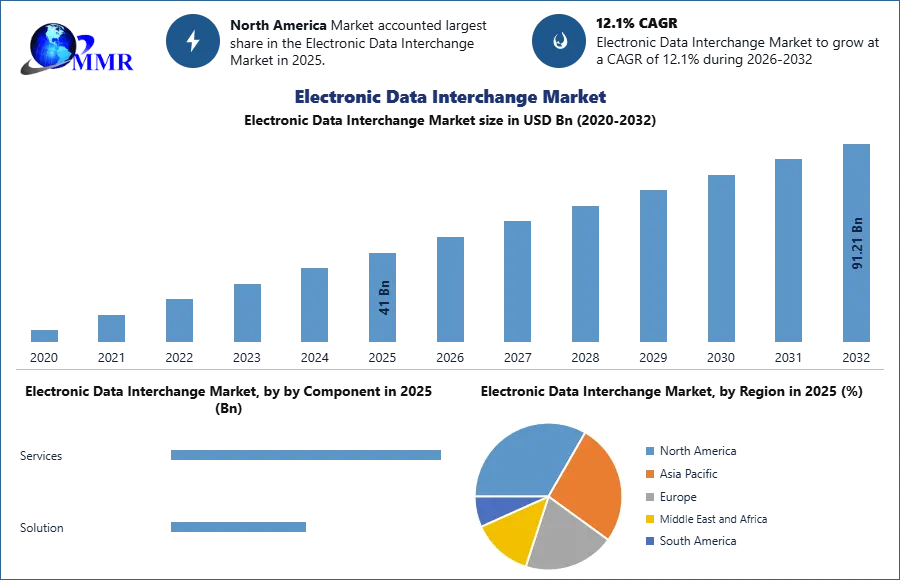
Global Electronic Data Interchange Market was valued at USD 41 Bn in 2025 and is expected to reach USD 91.21 Bn by 2032, growing at a CAGR of 12.1% during the forecast period.
Electronic Data Interchange (EDI) Market Overview
Electronic Data Interchange (EDI) is a standardized electronic communication method used by businesses to exchange data in a structured format. It enables organizations to transfer documents, such as purchase orders, invoices, shipping notices, and other business documents, between computer systems or different companies electronically. EDI replaces traditional paper-based methods of exchanging business documents, such as mail, fax, or email, with a more efficient and automated process. It typically involves the use of standardized formats, such as ANSI X12, EDIFACT, or XML, to ensure compatibility and interoperability between different systems.
To know about the Research Methodology :- Request Free Sample Report
The global Electronic Data Interchange (EDI) Market is experiencing steady growth, driven by factors such as the need for process automation, cost reduction, and improved supply chain efficiency. Maximize Market research reports suggest that the Electronic Data Interchange (EDI) Market size has been increasing and is expected to continue growing at a significant growth rate over the forecast period. EDI technology is utilized across various industries, including retail, healthcare, automotive, manufacturing, logistics, and finance. Each sector has its specific requirements and standards, leading to a diverse range of EDI solutions tailored to different industries' needs.
| Exact Date | Company | Development | Impact |
|---|---|---|---|
| 04 March 2026 | AGCO Corporation | AGCO's OutRun™ autonomous tillage solution, developed via the PTx Trimble brand, was awarded a major 2026 farm innovation prize for its driverless capabilities. | The commercialization of this retrofit technology allows farmers to upgrade existing fleets with AI-driven autonomy, reducing labor dependency and enhancing operational scale. |
| 01 March 2026 | Mahindra & Mahindra Ltd. | The company reported a 35% year-on-year growth in domestic tractor sales for February 2026, totaling 32,153 units. | This surge, driven by robust Rabi sowing and healthy reservoir levels, underscores a strong recovery in rural cash flows and mechanization demand in the Asia-Pacific region. |
| 23 February 2026 | AGCO Power | The Core80 Engine from AGCO Power was officially named Diesel Engine of the Year 2026 for its efficiency and sustainability profile. | The engine's high performance and low-emission design provide a competitive edge for the Fendt and Massey Ferguson tractor lineups in strictly regulated global markets. |
| 07 January 2026 | Kubota Corporation | At CES 2026, Kubota announced the commercialization of an integrated autonomous solution for the specialty crop market, built into the 105.7-HP M5 Narrow tractor. | Developed with Agtonomy, this system utilizes Physical AI for precise obstacle detection and tasking, addressing the critical skilled labor shortage in vineyards and orchards. |
| 11 November 2025 | CNH Industrial | CNH showcased its Sense and Act Spraying portfolio, utilizing AI for targeted weed detection to deliver up to 60% herbicide savings. | This precision agriculture advancement significantly lowers input costs for farmers while promoting sustainable environmental outcomes through reduced chemical drift. |
| 11 March 2025 | John Deere | John Deere unveiled its Model Year 2026 combines featuring Predictive Ground Speed Automation at the 2025 Commodity Classic. | By integrating stereo cameras and satellite imagery, the system automatically adjusts speed to crop density, improving threshing performance and reducing crop loss by up to 10%. |
Electronic Data Interchange (EDI) Market Dynamic
Growth in digital transformation across various industries to boost Electronic Data Interchange (EDI) Market growth
Large and small enterprises are continuously investing in cloud computing, EDI solutions, web apps, artificial intelligence, predictive analytics, the Internet of Things, and big data, as digital technologies are constantly transforming industries across the globe and revolutionizing business processes by improving operational efficiency at reduced costs. The rising adoption of cloud computing for deploying Electronic Data Interchange technology and service consumption models is expected to boost the Electronic Data Interchange (EDI) Market growth. Organizations are diverting their focus on applications, data, connections, and cloud integration, including EDI. As cloud computing has grown there is a shortage of well-trained IT professionals. Process automation and digital transformation create unparalleled opportunities for businesses to create more value and increase revenue and this opportunity is significantly expected to boost the Electronic Data Interchange (EDI) Market growth. Invoicing is a considerable function in all business segments, including B2B and B2C, which require a substantial cost, time, and workforce. Along with paper-based invoices, a large number of e-invoices are generated daily reducing the overall productivity cost of the business. The rising adoption of e-invoicing helps businesses save substantial costs associated with invoicing generation and transmission to end customers.
Automating the invoicing process through e-invoicing offers several strategic and operational benefits to buyers, suppliers, and managers. A few advantages of EDI solutions include reduced costs, increased accuracy, faster payments, improved cash management, enhanced productivity, environmental benefits, and improved compliance. The rising adoption of innovative and digitalized solutions, such as EDI, drives global electronic data interchange (EDI) market growth.
Shippers communicate with ship carriers and other transportation-related stakeholders through EDI technology. Instead of physically inputting information onto paper forms, shipping businesses transfer information electronically through EDI. EDI also benefits organizations in terms of time and money savings. By utilizing EDI, shippers automate billing, tracking shipments, and payment collection. EDI also maintain inventories and handle client orders in the shipping sector. By removing mistakes and decreasing human data entry, EDI helps processes run more smoothly. Since there is less need for human interaction, processing paperwork takes less time.
Various countries are deploying the EDI in their shipping port. For example, in December 2021, Japan provided US$ 12.2 million to construct a Port EDI system in Cambodia to speed up administrative and business work at all ports. According to Heang Sotheayuth, IT specialist at the Ministry of Public Works, the EDI on the shipping port help to ease legal procedures for cargo ships at all ports in Japan. Such development propels the electronic data interchange (EDI) market growth in the shipping industry.
There has been a growing trend towards cloud-based EDI solutions due to their scalability, flexibility, and cost-effectiveness. Cloud-based EDI offers easier integration with existing systems, reduced infrastructure costs, and the ability to access data from anywhere with an internet connection. Integration of EDI with Enterprise Resource Planning (ERP) systems has become increasingly important for businesses seeking to streamline their operations. Seamless integration allows for the automatic exchange of data between EDI and ERP systems, leading to improved efficiency and accuracy in business processes.
| Electronic Data Interchange Market | |||
|---|---|---|---|
| Report Coverage | Details | ||
| Base Year: | 2025 | Forecast Period: | 2026-2032 |
| Historical Data: | 2020 to 2025 | Market Size in 2025: | 41 USD Bn |
| Forecast Period 2026-2032 CAGR: | 12.1% | Market Size in 2032: | 91.21 USD Bn |
| Segments Covered: | by Component | Services Managed Services Professional Services Solution EDI Translation Software EDI Integration Software EDI Mapping Software |
|
| by Deployment Mode | On-Premises Cloud-Based |
||
| by Organization Size | Small & Medium Enterprises (SMEs) Large Enterprises |
||
| by End-User | Retail & Consumer Goods BFSI (Banking, Financial Services & Insurance) Healthcare & Life Sciences IT & Telecommunications Transportation & Logistics Manufacturing Government & Defense Others |
||
Benefits of EDI
1. EDI technology saves time and money through the automation of a process that was previously manually run with paper documents.
2. EDI solutions improve efficiency and productivity because more business documents are shared and processed in less time with greater accuracy.
3. EDI data transfer reduces errors through rigid standardization, which helps to ensure that information and data are correctly formatted before they enter business processes or applications.
4. Integration of EDI improves traceability and reporting by allowing electronic documents to be incorporated with various IT systems, facilitating data collection, visibility and analysis.
5. Efficient EDI automation enables reliable product and service delivery for a positive customer experience.
Improvements in B2B Processes due to API emergence to limit Electronic Data Interchange (EDI) Market growth
EDI has a potential threat from modern APIs (Application Programming Interface). It has been argued that EDI is here to stay, at least, during the upcoming decade. Companies in the market are capitalizing on incremental opportunities, as many organizations are opting for cloud-based integration platforms (iPaaS) that accelerate processes and reduce time taken to complete EDI integrations. Modern iPaaS is known for its intuitive attributes and robust functioning in the IT industry.
Next-gen iPaaS platforms are predicted to enable API enhancements and B2B process improvements sans the need for an IT professional. This has challenged companies in the electronic data interchange (EDI) solution market. However, the shortage of IT skills has emerged as a roadblock for proliferation of API in organizations.
Electronic Data Interchange (EDI) Market Segment Analysis
Based on Component, In the Electronic Data Interchange (EDI) Market by Component, the Solution segment dominated in 2025. Within solutions, EDI Integration Software was the leading sub-segment. Companies across industries invested heavily in integration platforms that streamline communication with multiple trading partners, automate workflows, and ensure compliance with global standards. The demand was further supported by the rise of omni-channel retail, globalized supply chains, and digital transformation initiatives.
Based on Deployment Mode, the Cloud-Based EDI segment dominated in 2025. Businesses increasingly shifted from on-premises setups to cloud platforms due to their lower upfront costs, faster implementation, and scalability. Cloud EDI enabled SMEs and large enterprises to reduce IT infrastructure costs while ensuring real-time data exchange.
The COVID-19 driven acceleration of remote operations, combined with the need for flexible and secure B2B communication, solidified cloud-based solutions as the most adopted deployment mode in 2024.
Electronic Data Interchange (EDI) Market Regional Insight
Cost Reduction and Operational Efficiency to boost North America Market growth
Businesses across various industries are seeking ways to reduce costs and enhance operational efficiency. EDI eliminates manual processes associated with paper-based document exchange, such as printing, mailing, and data entry. By automating these tasks, organizations reduce transaction costs, minimize errors, and accelerate business processes, driving the adoption of EDI solutions, which significantly boosts the Market growth. The rapid growth in e-commerce and the retail sector in North America has led to increased demand for Electronic Data Interchange solutions. Retailers, suppliers, and distributors rely on EDI to exchange purchase orders, invoices, and shipping notifications seamlessly. As e-commerce continues to thrive, the need for efficient data exchange mechanisms becomes more pronounced, fueling the growth of the market.
In an increasingly globalized business environment, companies are expanding their supply chains across geographical boundaries. EDI facilitates seamless communication and integration among trading partners irrespective of their location. By standardizing communication protocols and data formats, EDI enables smoother collaboration, inventory management, and order fulfillment across diverse supply chains, driving its adoption. Advancements in technology, including cloud computing, artificial intelligence, and blockchain, are revolutionizing the EDI landscape. Cloud-based EDI solutions offer scalability, flexibility, and cost-effectiveness, making them increasingly attractive to businesses of all sizes. Emerging technologies such as AI and blockchain are being integrated into EDI platforms to enhance data security, automate processes, and provide real-time insights, which is expected to boost the Market growth.
Organizations are increasingly prioritizing sustainability and environmental responsibility. By transitioning from paper-based to electronic document exchange, businesses significantly reduce paper consumption, carbon emissions, and environmental impact. EDI aligns with these sustainability objectives by promoting paperless transactions, making it an attractive option for environmentally conscious enterprises.
Electronic Data Interchange (EDI) Market Scope: Inquiry Before Buying
Key Players /Competitor Profiles Covered in the Global Electronic Data Interchange Market
Report from a Strategic Perspective.
- SAP SE
- IBM Corporation
- Oracle Corporation
- SPS Commerce Inc.
- Cleo Communications LLC
- TrueCommerce Inc.
- OpenText Corporation
- DiCentral Corporation
- MuleSoft LLC
- Boomi Inc.
- Software AG
- Comarch SA
- EDICOM
- Data Masons Software LLC
- Babelway
- Seeburger AG
- Jitterbit Inc.
- EDI Source Inc.
- Intertrade Systems
- Descartes Systems Group Inc.
- RSSBus
- Liaison Technologies Inc.
- TIE Kinetix N.V.
- Axway Inc.
- Infor Inc.