
Disposable Medical Supplies Market – Global Market Size, Strategic Growth Drivers, Risk Assessment Framework, Regulatory Landscape Review, Competitive Intensity Mapping & Long-Term Industry Outlook to 2030
Overview
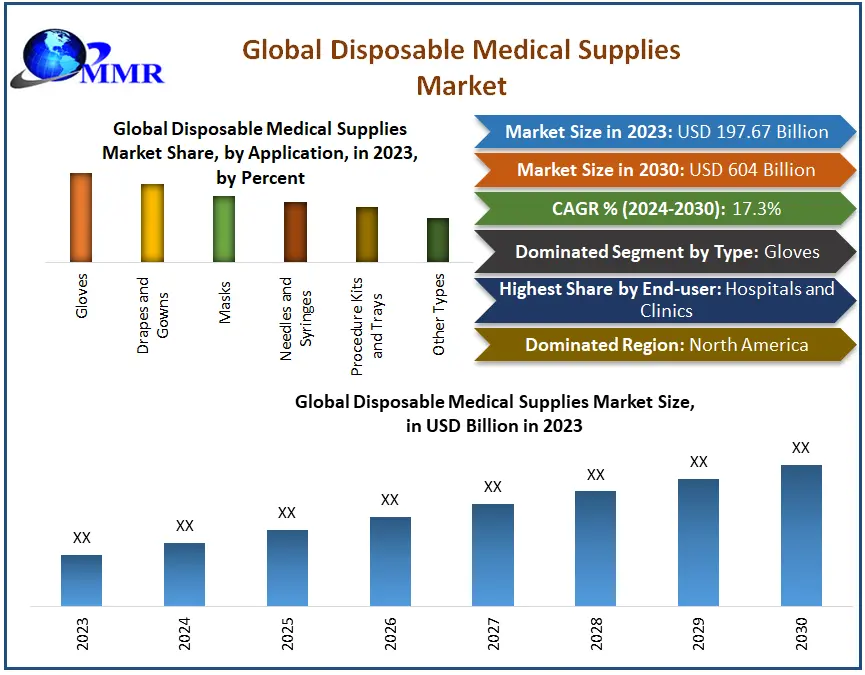
The Disposable Medical Supplies Market size was valued at USD 197.67 Billion in 2023 and the total Disposable Medical Supplies revenue is expected to grow at a CAGR of 17.3% from 2024 to 2030, reaching nearly USD 604 Billion by 2030
Disposable products are an important part of the multibillion-dollar health device industry. Disposable Medical Supplies play a vital role in modern healthcare systems, ensuring patient safety, infection control, and efficient medical procedures. These products are designed for single-use, minimizing the risk of cross-contamination between patients and healthcare providers. From needles and syringes to surgical gloves and face masks, Disposable Medical Supplies are indispensable in hospitals, clinics, and other medical facilities worldwide. Hypodermic needles and disposable syringes are among the most fundamental medical supplies, facilitating the administration of medications and the collection of samples with precision and minimal risk of transmission of infections. Healthcare and dental professionals prioritize patient safety, recognizing the heightened risk of infections associated with reusable supplies due to potential cross-contamination. This concern makes the Disposable Medical Supplies Market demand, which is pre-packed or sterilized, a preferred choice for ensuring patient safety.
 To Know About The Research Methodology :- Request Free Sample Report
Additionally, environmental considerations play a significant role in driving the demand for disposable supplies. While they contribute to biomedical waste accumulation, companies are increasingly adopting sustainable practices to minimize environmental impact. For instance, Richmond Dental and Medical utilize sustainably grown cotton in their products, aligning with their commitment to both patient safety and environmental responsibility. Moreover, the cost efficiency of disposable supplies is becoming increasingly evident. Despite initial assumptions about higher costs, hidden expenses associated with reusable supplies, such as cleaning products, employee time, and maintenance, make them less cost-effective in the long run. Furthermore, the risk of cross-contamination can lead to expensive legal battles and fines, highlighting the financial advantages of the Disposable Medical Supplies Market.
Bandages, cotton, and gauze are indispensable wound care supplies used for wound dressing, hemostasis, and wound protection, ensuring optimal healing and preventing infections. Surgical medical gloves provide a barrier against pathogens and contaminants during surgical procedures, protecting both healthcare providers and patients from cross-contamination. Disposable shoe covers and laboratory coats help maintain a clean and hygienic environment in healthcare settings, preventing the spread of contaminants and infectious agents. Face masks have become especially critical in the context of the COVID-19 pandemic, serving as a primary means of respiratory protection for healthcare workers and patients. Companies like Liaoning KANGYI Medical Equipment Co., Ltd play a crucial role in manufacturing high-quality Disposable Medical Supplies, adhering to stringent quality standards and certifications to ensure product safety and efficiency.
Disposable Medical Supplies Market Dynamics:
Disposable Medical Supplies a New Way to Health
The society's medical capabilities advance, the popularity of Disposable Medical Supplies, including skin boosters, continues to rise steadily. These supplies play a crucial role in skincare treatments, especially in scenarios involving injuries or surgical procedures. The Skin Boosters Market witnesses this trend, propelled by several key factors driving their increasing adoption. The safety and reliability of Disposable Medical Supplies significantly reduce the risk of infections, both in wound care and during medical procedures. For instance, hyaluronic acid serums, a popular type of skin booster, are often packaged in single-dose ampules or pre-filled syringes. These individual doses ensure sterility and minimize the risk of contamination, providing peace of mind to both dermatologists and patients. By avoiding the need for multi-use containers or applicators, the likelihood of bacterial growth or product contamination is greatly reduced, contributing to improved treatment outcomes and patient satisfaction which boosts the Disposable Medical Supplies Market.
Disposable Medical Supplies contribute to enhanced medical efficiency, a critical factor in the fast-paced healthcare environment. In the skincare industry, this translates to streamlined treatment protocols and quicker patient care. For example, micro-needling devices, a common method for delivering skin boosters, often come with disposable needle cartridges. These cartridges can be easily replaced between treatments, reducing downtime and allowing practitioners to focus on delivering optimal results without the need for time-consuming sterilization processes. Additionally, single-use packaging of skin booster products like vitamin C serums or peptide creams ensures easy access and rapid application, facilitating efficient treatment delivery without compromising safety or efficacy which drives Disposable Medical Supplies Market growth.
| Year | Market Size (in billion USD) | Local Production (in billion USD) | Imports (in billion USD) | Exports (in billion USD) | Imports from the U.S. (in billion USD) |
| 2019 | 35.0 | 37.6 | 20.2 | 22.8 | 4.9 |
| 2020 | 36.7 | 40.5 | 22.7 | 26.5 | 6.8 |
| 2021 | 39.2 | 43.3 | 24.2 | 28.3 | 7.3 |
| 2022 | 41.9 | 46.2 | 25.9 | 30.2 | 7.8 |
The Vital Role of Disposable Medical Supplies in Infection Control
In the ongoing battle against healthcare-associated infections (HAIs), disposable medical supplies emerge as indispensable allies, particularly in high-acuity settings like intensive care units (ICUs). While both reusable and disposable supplies have their merits, the certainty provided by disposables in maintaining aseptic practices is beyond compare, significantly reducing the risk of cross-contamination and ultimately safeguarding both patients and healthcare workers. The urgency of this matter is underscored by staggering statistics. The Centers for Disease Control and Prevention (CDC) estimates that HAIs afflict one in every thirty-one hospitalized patients daily, highlighting the pervasive threat they pose to patient safety. Furthermore, a study published in the Journal of the American Medical Association revealed that over half of ICU patients worldwide experienced confirmed or possible infections, with devastating consequences including heightened mortality rates.
In such critical environments, where every moment counts, the use of disposable medical supplies becomes paramount. Unlike reusable alternatives, disposable supplies eliminate the need for complex reprocessing procedures, minimizing the risk of inadequate cleaning that could leave behind contaminants. The U.S. Food and Drug Administration (FDA) has acknowledged the public health concern posed by HAIs resulting from insufficiently cleaned medical devices, emphasizing the imperative for stringent safety measures. The COVID-19 pandemic served as a poignant reminder of the pivotal role played by disposable supplies in infection control. Shortages of personal protective equipment (PPE) highlighted the dire consequences of inadequate supply, with healthcare workers facing heightened risks of infection due to reuse which propelled the Disposable Medical Supplies Market. Disposable ventilator circuits emerged as crucial barriers against the aerosolization of the virus, underscoring the life-saving potential of such supplies during health crises.
The economic implications of HAIs cannot be overstated. The CDC estimates that these infections cost billions of dollars annually, placing a significant burden on healthcare systems, payers, and patients alike. Value-based healthcare initiatives, such as the CMS Hospital-Acquired Condition Reduction Program, underscore the importance of infection prevention in reducing healthcare costs and improving patient outcomes. Real-world examples further elucidate the advantages of disposable supplies. Studies comparing the costs of disposable versus reusable equipment in surgical procedures have consistently shown cost savings associated with disposables. For instance, a cost analysis of endoscopic carpal tunnel release surgery revealed a 10% reduction in total costs when using disposable equipment, attributed to reduced setup time, operating room time, and overall staff time. In addition to cost savings, disposable supplies offer operational efficiencies and mitigate risks associated with inadequate reprocessing of reusable equipment. The simplicity of using prepackaged sterile supplies minimizes setup time and eliminates variability in processing protocols, ensuring consistency and reliability in infection control practices. These are all major factors that could impede revenue growth in the Disposable Medical Supplies Market.
Disposable Medical Supplies Market Segment Analysis:
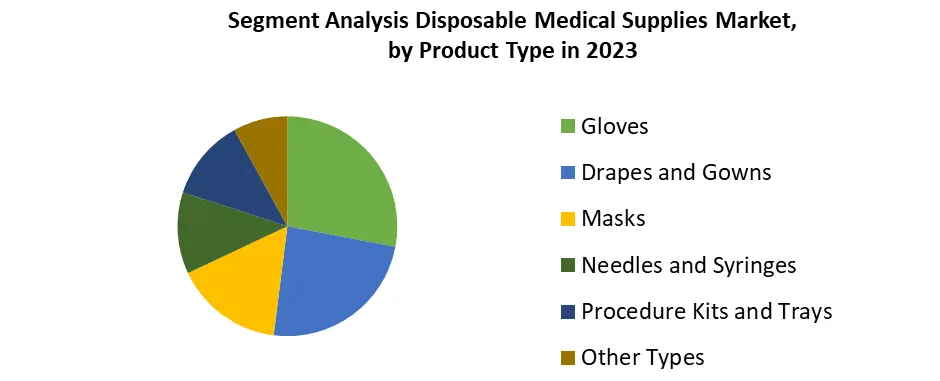
Based on Type, the market is divided into Gloves, Drapes and Gowns, Masks, Needles and Syringes, Procedure Kits and Trays, and Other Types. The gloves sub-segment witnessed the highest market share in the global Disposable Medical Supplies Market in 2023. The surge in domestic production of PPE amid the COVID-19 pandemic has fueled the disposable gloves market, underlining the critical role of self-sufficiency and resilience in safeguarding frontline workers and the public. This trend is paralleled by the growing adoption of clean room environments driven by regulatory standards and technological advancements, further boosting demand for disposable gloves tailored to sterile conditions. Technological innovations in materials and manufacturing processes, including the shift towards nitrile and eco-friendly options, alongside advancements in automation, are driving sustained growth in the disposable gloves market. Moreover, increased glove usage across non-healthcare sectors such as food processing and chemical industries reflects a commitment to hygiene and safety standards, with a notable preference for powder-free and sustainable alternatives to address health and environmental concerns. The rise in infectious diseases and healthcare-associated infections (HAIs) is reshaping the healthcare landscape, emphasizing the need for advanced medical solutions and infection control measures, driving demand for high-quality protective gear like nitrile gloves. Concurrently, the increasing number of surgical procedures and patient examinations underscores the importance of collaboration among healthcare stakeholders to meet evolving healthcare needs efficiently.
Disposable Medical Supplies Market Regional Insights:
North America serves as a leading center for medical innovation and technology, with advancements in medical devices often incorporating disposable components, driving the demand for disposable medical products. While essential for infection control and convenience, there's a growing recognition of environmental sustainability, prompting developments in eco-friendly disposables and advocating for responsible disposal practices. With a rapidly aging population in the region, the increased need for medical care among the elderly, including products like adult diapers and wound care items, is propelling demand for disposable healthcare supplies. The ongoing expansion and modernization of healthcare facilities to meet rising demands further fuel the need for disposable medical supplies and equipment. Coverage of healthcare expenses by private or public insurance schemes in North America makes disposable medical products more accessible to patients and healthcare providers. Additionally, the growing health-consciousness among consumers drives the demand for disposable healthcare items for personal health management. The robust trade agreements and partnerships in North America facilitate the import and export of disposable medical products, ensuring a continuous supply to meet regional demands. Moreover, the digitization of healthcare processes has spurred demand for disposable items like RFID-enabled wristbands and barcode labels for patient information management, enhancing patient safety and record-keeping efficiency which boosts Disposable Medical Supplies Market demand.
Global Disposable Medical Supplies Market Scope: Inquire before buying
| Global Disposable Medical Supplies Market | |||
|---|---|---|---|
| Report Coverage | Details | ||
| Base Year: | 2023 | Forecast Period: | 2024-2030 |
| Historical Data: | 2018 to 2023 | Market Size in 2023: | US $ 197.67 Bn. |
| Forecast Period 2024 to 2030 CAGR: | 17.3% | Market Size in 2030: | US $ 604 Bn. |
| Segments Covered: | by Type | Gloves Drapes and Gowns Masks Needles and Syringes Procedure Kits and Trays Other Types |
|
| by End User | Hospitals and clinics Ambulatory surgery center Others |
||
Disposable Medical Supplies Market, by Region
North America (United States, Canada and Mexico)
Europe (UK, France, Germany, Italy, Spain, Sweden, Austria, Turkey, Russia and Rest of Europe)
Asia Pacific (China, India, Japan, South Korea, Australia, ASEAN and Rest of APAC)
Middle East and Africa (South Africa, GCC, Egypt, Nigeria and Rest of ME&A)
South America (Brazil, Argentina, Columbia and Rest of South America)
Disposable Medical Supplies Market Key Players:
Major Contributors in the Disposable Medical Supplies Market in North America:
1. 3M Company (Minnesota, United States)
2. Abbott Laboratories (Illinois, United States)
3. Aspen Surgical (Michigan, United States)
4. Becton, Dickinson and Company (New Jersey, United States)
5. Boston Scientific Corporation (Massachusetts, United States)
6. Cardinal Health (Ohio, United States)
7. Halyard Health (Georgia, United States)
8. Johnson & Johnson (New Jersey, United States)
9. Stryker Corporation (Michigan, United States)
10. Teleflex Incorporated (Pennsylvania, United States)
11. Thermo Fisher Scientific (Massachusetts, United States)
Major Leading Players in the Disposable Medical Supplies Market in Europe:
1. ConvaTec Group PLC (Reading, United Kingdom)
2. Fresenius Medical Care (Bad Homburg, Germany)
3. Medtronic (Dublin, Ireland)
4. Molnlycke Health Care (Gothenburg, Sweden)
5. Smith & Nephew (London, United Kingdom)
Major Leading Players in the Disposable Medical Supplies Market in Asia Pacific:
1. Terumo Corporation (Tokyo, Japan)
2. Olympus Corporation (Tokyo, Japan)
3. Liaoning KANGYI Medical Equipment Co., Ltd (Liaoning, China)
4. Ansell Limited (Richmond, Australia)
Major Leading Players in the Disposable Medical Supplies Market in the Middle East and Africa:
1. Ecoppia (Israel)
2. Maytronics Ltd. (Israel)
Frequently Asked Questions:
1. Which region has the largest share in the Global Disposable Medical Supplies Market?
Ans: North American region holds the highest share in 2023.
2. What is the growth rate of the Global Disposable Medical Supplies Market?
Ans: The Global Disposable Medical Supplies Market is growing at a CAGR of 17.3% during the forecast period 2023-2029.
3. What is the scope of the Disposable Medical Supplies market report?
Ans: Disposable Medical Supplies Market report helps with the PESTEL, PORTER, COVID-19 Impact analysis, Recommendations for Investors & Leaders, and market estimation of the forecast period.
4. Who are the key players in the Disposable Medical Supplies market?
Ans: The important key players in the Disposable Medical Supplies Market are ConvaTec Group PLC (Reading, United Kingdom), Fresenius Medical Care (Bad Homburg, Germany), Medtronic (Dublin, Ireland), Molnlycke Health Care (Gothenburg, Sweden), and Smith & Nephew (London, United Kingdom)
5. What is the Forecast period of this market?
Ans: The Global Disposable Medical Supplies Market is forecast between 2024 to 2030.