
Digital Workplace Market by Component, Deployment Type, Organization Size, Vertical, and Region – Global Market Size Estimation, Industry-Wide Analysis, Competitive Landscape Assessment & Long-Term Forecast to 2030
Overview
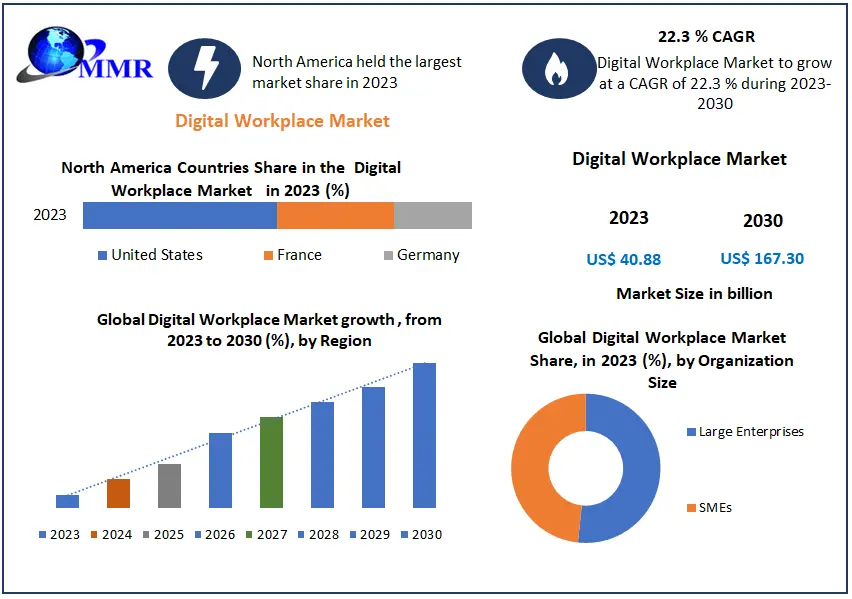
The Digital Workplace Market size was valued at US 40.88 Bn in 2023 and market revenue is growing at a CAGR of 22.3 % from 2024 to 2030, reaching nearly USD 167.30 Bn by 2030.
Digital Workplace Market: Overview
The digital workplace market is undergoing substantial growth, driven by the accelerated adoption of remote work, advancements in cloud computing, and the imperative for digital transformation across industries. Core components of the digital workplace ecosystem include collaboration tools facilitating seamless communication and project management, productivity applications enhancing workflow efficiency, and employee experience platforms prioritizing engagement and satisfaction. With businesses increasingly prioritizing employee-centric approaches and agile work environments, investment in digital workplace technologies continues to surge, presenting abundant opportunities for vendors and organizations to optimize collaboration, productivity, and competitiveness in today's dynamic business landscape which helps to boost the Digital Workplace Market.
 To know about the Research Methodology :- Request Free Sample Report
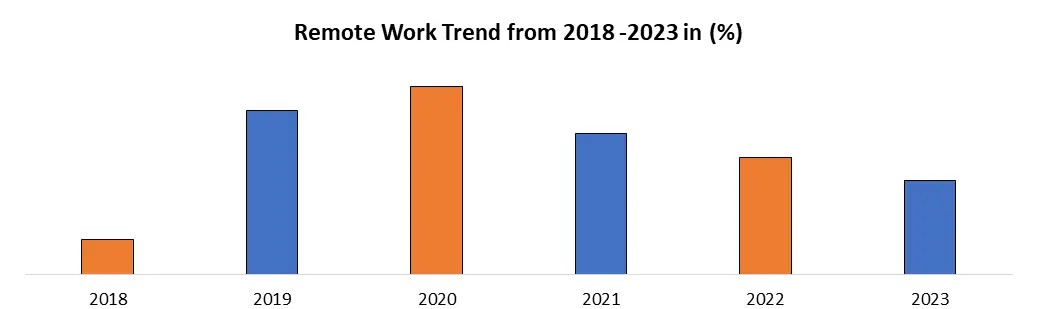
The COVID-19 pandemic catalyzed a rapid shift towards remote work, driving unprecedented demand for digital workplace solutions. Organizations swiftly adopted cloud-based collaboration tools, virtual communication platforms, and remote access technologies to ensure business continuity and employee safety. Amid the transition, emphasis on employee well-being and engagement surged, leading to investments in virtual team-building activities and wellness programs. The shift to remote work also heightened cybersecurity concerns, prompting organizations to prioritize strong security measures and compliance protocols. Looking ahead, the pandemic's legacy is expected to endure, with hybrid work models becoming more prevalent. As businesses navigate the evolving landscape, digital workplace technologies continue to play an important role in driving agility, resilience, and innovation in the workplace of the future.
According to the MMR Study Report As of 2023, in the USA 12.7% of full-time employees work remotely, while 28.2% adopt a hybrid model. By 2025, an estimated 32.6 million Americans work remotely, constituting 22% of the workforce. Remarkably, 98% of workers desire remote work, while 93% of employers plan to conduct remote job interviews. Currently, 16% of companies operate fully remotely.
Digital Workplace Market: Dynamics
Driver
Increasing Remote Work Trends boosts the Digital Workplace Market growth
The growth of the digital workplace market is significantly influenced by the increasing trend of remote work. As remote work becomes more common, organizations are realizing the importance of having robust digital workplace solutions to enable seamless collaboration, boost productivity, and ensure the well-being of their distributed workforce. This surge in demand has created a favorable environment for digital workplace providers to innovate and expand their offerings, thereby driving market growth.
The evolution of remote work has resulted in a shift in organizational priorities, with a greater focus on cloud-based collaboration tools, communication platforms, and security solutions. Consequently, the digital workplace market is witnessing steady growth, with both new and established players competing to capture market share by delivering innovative solutions tailored to the requirements of remote and hybrid work environments. The long-term implications of the remote work trend, accelerated by events such as the COVID-19 pandemic, indicate continued growth opportunities for the digital workplace market as organizations embrace flexible work arrangements and invest in digital infrastructure to support remote teams.
Restrain
Lack of Training and required education in the Workforce limits the growth of the Digital Workplace Market
The digital workplace market thrives on innovation and technological advancements, demanding a skilled workforce equipped with the necessary training and education to navigate complex digital ecosystems. A pervasive lack of adequate training and education among the workforce presents a significant hurdle, impeding the growth potential of this Digital Workplace Market. Digital workplaces encompass a wide array of technologies such as cloud computing, data analytics, artificial intelligence, and cybersecurity. Without proper training, employees struggle to utilize these tools effectively, leading to decreased productivity and missed opportunities for innovation. Also, as digital transformation accelerates across industries, the demand for specialized skills continues to rise, creating a widening skills gap.
The rapid pace of technological evolution necessitates continuous learning and upskilling. Yet, many organizations fail to prioritize ongoing training initiatives, leaving employees ill-prepared to adapt to new technologies and workflows. This lack of investment in workforce development stifles innovation and undermines employee morale and retention. The absence of formal education pathways tailored to emerging digital roles exacerbates the problem. Traditional educational institutions often struggle to keep pace with rapidly evolving technology trends, leaving graduates without the practical skills demanded by employers in the digital workplace.
The growth of the Digital Workplace Market is intricately linked to the proficiency and expertise of the workforce. Addressing the shortage of training and education opportunities is paramount to unlocking the full potential of digital technologies, fostering innovation, and driving Digital Workplace Market growth. By investing in comprehensive training programs and collaborating with educational institutions to develop relevant curricula, organizations empower their workforce to thrive in the digital age.
Opportunity:
Technological Advancements Creates Lucrative Growth Opportunities for the Digital Workplace Market Growth
Technological advancements continuously shape and redefine the landscape of the digital workplace, offering a plethora of growth opportunities for this burgeoning market. The rapid evolution of cloud computing, which enables seamless collaboration, data storage, and access to applications from anywhere, fosters greater efficiency and flexibility within organizations. The proliferation of mobile devices and high-speed internet connectivity empowers employees to work remotely, blurring the boundaries of traditional office spaces and driving the demand for digital workplace solutions.
The integration of artificial intelligence (AI) and machine learning (ML) technologies enhances automation, personalization, and decision-making capabilities within digital workplaces. AI-driven chatbots, virtual assistants, and predictive analytics streamline workflows, improve communication, and deliver actionable insights, thereby optimizing productivity and enhancing the overall employee experience. The emergence of Internet of Things (IoT) devices and wearable technology augments connectivity and data collection, enabling real-time monitoring of assets, environments, and employee well-being. This connectivity facilitates the creation of smart workplaces, where processes are automated, and environments are responsive to user needs and preferences.
As organizations increasingly prioritize digital transformation initiatives to stay competitive in the modern business landscape, the Digital Workplace Market is poised for significant growth. Leveraging these technological advancements, digital workplace solutions providers capitalize on the rising demand for innovative tools and platforms that empower organizations to adapt, collaborate, and thrive in an increasingly digital-centric world.
Some examples of digital workplace technologies include online collaboration through tools like Google Docs and Dropbox, simplified shift planning through mobile apps, streamlined communication channels through messaging services, HR portals for employee benefits, and employee and customer feedback through polls and surveys. Other examples include the cloud for data storage and access, virtual reality for immersive team apps, and secure group messaging systems for real-time communication. Additionally, document management, work management, collaboration and communication, solution building with no-code development, cybersecurity, and data management are essential technologies for a digital workplace
Digital Workplace Market Segment Analysis:
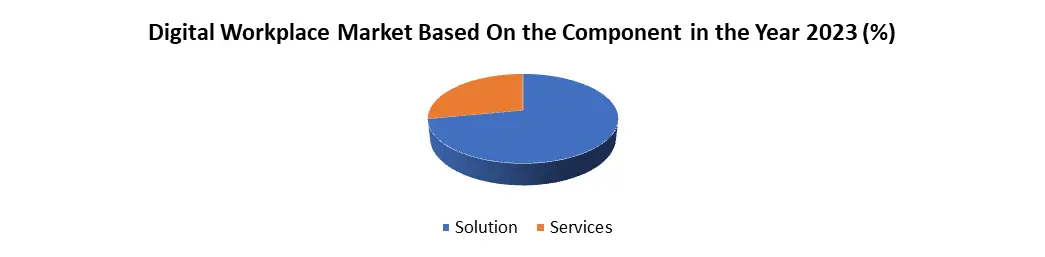
Based On the Component, the solution sub-segment dominated the Component segment of the Digital Workplace Market in the year 2023. The growth in this segment is attributed to the increasing adoption of workplace solutions such as social and collaborative tools, cloud storage platforms, and content management systems by end-users. These tools are being embraced to boost resource utilization and productivity.
For instance, Trianz PULSE, a cutting-edge digital workplace solution, facilitates collaboration and communication among clients, vendors, and partners within a unified platform, streamlining remote workforce management. By fostering a workplace social network, it encourages collaboration and team building across the organization, while also enabling access to social media for corporate messaging. It enhances productivity and efficiency by offering self-service capabilities for IT departments within the organization. These advantages offered by digital workplace solutions are expected to drive the growth of the Digital Workplace Market.
Digital Workplace Market Regional Analysis:
North American region dominated the Digital Workplace Market in the year 2023. The dominance of the North American region in the digital workplace industry is attributed to North America boasting a highly developed technological infrastructure, including strong internet connectivity and widespread adoption of digital tools and platforms. This foundation provides a conducive environment for the growth of digital workplace solutions.
The region is home to a large number of tech-savvy enterprises across various industries, including finance, healthcare, and technology, which are early adopters of digital workplace technologies. These organizations prioritize innovation and efficiency, driving the demand for advanced digital workplace solutions. Also, North America hosts many leading technology companies and startups specializing in digital workplace software and services. This ecosystem fosters innovation and competition, leading to the development of innovative solutions tailored to the needs of modern businesses. In addition, favorable government policies and initiatives aimed at promoting digital transformation further boost the adoption of digital workplace technologies in North America. Therefore, the combination of advanced technological infrastructure, a culture of innovation, a concentration of tech-savvy enterprises, and supportive government policies positions North America as a dominant force in the global Digital Workplace Market.
Digital Workplace Market Scope: Inquire before buying
| Global Digital Workplace Market | |||
|---|---|---|---|
| Report Coverage | Details | ||
| Base Year: | 2023 | Forecast Period: | 2024-2030 |
| Historical Data: | 2018 to 2023 | Market Size in 2023: | US $ 40.88 Bn. |
| Forecast Period 2024 to 2030 CAGR: | 22.3% | Market Size in 2030: | US $ 167.30 Bn. |
| Segments Covered: | by Component | Solution Unified communication and collaboration Unified endpoint management Enterprise mobility and management Services |
|
| by Deployment | On-premises Cloud |
||
| by Organization Size | Large Enterprises SMEs |
||
| by Vertical | BFSI Consumer goods and retail Telecommunication Manufacturing Healthcare and pharmaceuticals Government and public sector Media and entertainment Others |
||
Digital Workplace Market, by Region
North America (United States, Canada and Mexico)
Europe (UK, France, Germany, Italy, Spain, Sweden, Austria and Rest of Europe)
Asia Pacific (China, South Korea, Japan, India, Australia, Indonesia, Malaysia, Vietnam, Taiwan, Bangladesh, Pakistan and Rest of APAC)
Middle East and Africa (South Africa, GCC, Egypt, Nigeria and Rest of ME&A)
South America (Brazil, Argentina Rest of South America)
Digital Workplace Market, Key Players are
North America
1. Microsoft Corporation (USA)
2. Slack Technologies, Inc. (USA)
3. Google LLC (USA)
4. Cisco Systems, Inc. (USA)
5. IBM Corporation (USA)
6. VMware, Inc. (USA)
7. Citrix Systems, Inc. (USA)
8. Box, Inc. (USA)
9. Dropbox, Inc. (USA)
10. Asana, Inc. (USA)
11. ServiceNow, Inc. (USA)
12. Adobe Inc. (USA)
13. Zoom Video Communications, Inc (USA)
Asia Pacific
1. HCL Technologies Ltd. (India)
2. Atlassian Corporation Plc (Australia)
3. Zoho Corporation Pvt. Ltd. (India)
Frequently Asked Questions
1] What segments are covered in the Global Digital Workplace Market report?
Ans. The segments covered in the Digital Workplace Market report are based on, Service Type, Sourcing Type, Application, and Regions.
2] Which region is expected to hold the highest share of the Global Digital Workplace Market?
Ans. The Asia Pacific region is expected to hold the highest share of the Digital Workplace Market.
3] What is the market size of the Global Digital Workplace Market by 2030?
Ans. The market size of the Digital Workplace Market by 2030 is expected to reach US$ 167.30 Bn.
4] What was the market size of the Global Digital Workplace Market in 2023?
Ans. The market size of the Digital Workplace Market in 2023 was valued at US$ 40.88 Bn.
5] Key players in the Digital Workplace Market.
Ans. Microsoft Corporation (USA), Slack Technologies, Inc. (USA), Google LLC (USA), Cisco Systems, Inc. (USA), IBM Corporation (USA)