
DevOps Certification Service Market – Industry Structure Evaluation, Demand Drivers Analysis, Regional Growth Analysis and Identification, Competitive Positioning Review & Global Market Size Forecast to 2030
Overview
The DevOps Certification Service Market was valued at US$ 3.47 Bn. in 2023. DevOps Certification Service Market size is estimated to grow at a CAGR of 24.7 % over the forecast period.
DevOps Certification Service Market Overview:
The needs of information technology are evolving day by day. There are many new possibilities gaining importance with increasing developments, "DevOps" is one such innovation. DevOps is a mix of cultural philosophies, methods, and resources that improves the capacity of an enterprise to produce high-speed technologies and services, evolving and developing products faster than companies using conventional processes of software development and technology management. This pace helps companies to please their customers better and compete in the market more efficiently. Aspects such as teamwork, automation, coordination, measurement and integration of information technology experts and software developers are used in the software development process. With the aid of different computational methods and innovations, DevOps is a synthesis of disparate activities. The rise of DevOps has evolved from the principles of "agile activities" and "agile system management.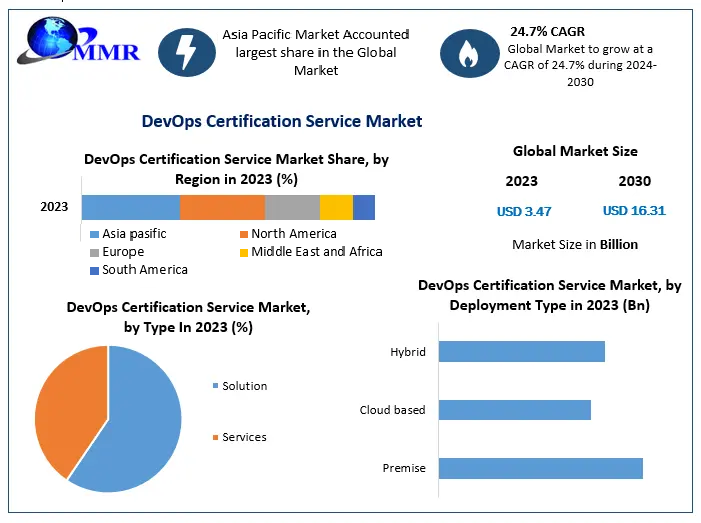 To know about the Research Methodology :- Request Free Sample Report
DevOps Certification Service Market Dynamics:
One of the key factor which helps for the growth of market is increased usage & rapid adoption of digitally advanced devices such as smartphones, laptops & tablets. The increasing demand for application growth is one of the key drivers of the DevOps certification service industry. Several other factors are driving the growth of the DevOps certification service industry. Increased cloud service usage rising the market for qualification services from DevOps.
Global Smartphone Ownership Is Increasing Quickly:
Global adoption of mobile technology has been accelerating. Over 5 Bn individuals are thought to own mobile devices today, with smartphones accounting for more than half of these connections. However, neither within countries nor between them, the development of mobile technology has not been uniform to this point. People in developed economies are more likely than those in emerging economies to utilise the internet & social media, as well as to own mobile phones, particularly smartphones. For instance, a median of 76% of smartphone ownership was found among 18 established economies, compared to only 45% in emerging economies.
Even in developed economies, smartphone ownership can vary greatly from one nation to the next. While the ownership rates of smartphones are approximately nine out of ten or higher in South Korea, Israel, & the Netherlands, they are closer to six out of ten in other developed countries like Poland, Russia, & Greece. Smartphone ownership rates also differ greatly among emerging economies, reaching highs of 60% in South Africa & Brazil and lows of just around 40% in Indonesia, Kenya, and Nigeria. With only 24% of respondents reporting owning a smartphone, India has the lowest ownership rate among the nations surveyed.
Younger people, those with better levels of education, & those with higher incomes are more likely to be digitally connected, whether in established or emerging economies. 12 Younger people in each nation surveyed are much more likely to have smartphones, access the internet & use social media. The majority of people under the age of 35 who live in all of the advanced economies studied have a smartphone. In contrast, smartphone ownership among elderly people in industrialized nations varies greatly, from just over 25% of Russians over 50 to nearly 90% of senior South Koreans. When it comes to determining why different countries use technology differently, education & income level also significantly contribute.
Better educated & wealthier people are more likely to utilise the internet than less educated or less wealthy persons in each country studied. The same can be said for the use of social media in almost every country. Education disparities are particularly pronounced in developing economies. For instance, there is a 48 % point difference in the use of social media among Nigerians with secondary education or higher (58%) & those with less education (only 10%). The difference in internet usage according to schooling is 53 points wider: Only 12% of Nigerians with lower levels of education utilise the internet, compared to 65% of those with higher degrees.
Market opportunities:
The market for new age credentials is raising the attention of companies from conventional data centres to cloud-based data centres. DevOps gives people various opportunities in information management & additional experience in technology. Such factors favour the growth of the DevOps qualification service industry. The new era credential programmes area is being implemented by a variety of institutes. The need to exploit the software development of an enterprise is important. Agile management is one of the qualification approaches offered by firms that support interactive construction methods and the design of engineering principles. The aim of this qualification is to include highly collaborative and scalable strategies for management. In recent years, the increased demand for IT security management has evolved and has given the demand for DevOps certification services an opportunity.
DevOps certification favours production of high quality, thereby being one of the key drivers of the demand for DevOps certification services. Organizations are becoming increasingly competitive and are focused on developing robust automation. In advanced learning, such as augmented reality and virtual reality, several companies aim to establish DevOps certification courses, among others. The demand for DevOps certification programmes is still in its introductive phase. There are not many organisations or entities that provide this programme. Thus in the near future, this demand is expected to grow. DevOps Institute.com, Knowledge Hut, PEOPLECERT, Red Hat, Inc., and Chef Apps, Inc. are among the DevOps certification providers.
Data-center spending is half that of cloud services:
According to MMR, expenditure on cloud services hit $178 Bn. in total in the year 2021, a 37% increase over the $130 Bn. spent in 2020 and twice what businesses spend on their data centers. The total cost of cloud services for the fourth quarter of 2021 was $50.5 billion. When the COVID-19 pandemic struck in 2020, it caused a significant shift in global IT investment & operations to the cloud as businesses began allowing employees to work from home. Even while the pandemic is slowing off and businesses are calling employees back into the workplace, this trend is only growing. The cloud market will keep growing at a rapid rate. There is no question in my mind that the cloud market will keep growing quickly. Leading cloud providers should be able to continue growing their revenues significantly in that climate.
The market is far from being stable, though. Some places are growing, while others are declining. With a 33% market share, Amazon Web Services (AWS) continues to be the dominant player. Over the past five years, AWS has been constant around 33%, give or take a couple of percentage points. AWS keeps growing even if its market share is stable. Instead of revenues, the graphic displayed market shares. While its market share may be stagnant at 33%, it is a stable share in a sizable market that is growing quickly. The steady increase in AWS's revenue is actually rather astounding.
On the other side, Microsoft has experienced consistent growth over the past five years. From roughly 13% in 2017 to 21% in 2021, it has increased. Through its server & software offerings, Microsoft also benefited from already-existing business partnerships in all areas & nations. The mix of concentration, financial support, and a global brand therefore appeals to businesses. As of the fourth quarter of 2021, Google has a roughly 10% global market share for cloud services, with China's Alibaba coming in second with a 6% share. The two groups that are trending downward are "others" and IBM, whose market share decreased from about 8% in 2017 to 4% in 2021.
DevOps Certification Service Market Segment Analysis:
During the forecast period, the service segment is expected to grow at a higher CAGR & the solution segment is estimated to account for a larger market share. Because of the ease of use and versatility they provide the adoption of DevOps technologies and services by small and medium-sized enterprises (SMEs) has become a core part of the business process. In addition, the usage of DevOps technologies and services is expected to grow.
Impact Assessment of the Russia-Ukraine War:
The DevOps Certification Service market report also discusses the war between Russia & Ukraine and how it has affected both domestic & international markets. The report is an excellent resource for advice and information for companies and clients who are interested in the industry. It includes important data as well as an update on the market for the leading manufacturers.
DevOps Certification Service Market Regional Overview:
North America is expected to account for the largest market share while the Asia Pacific (APAC) region is anticipated to rise at the fastest CAGR during the forecast period in the DevOps market. A growing need for powerful computing platform and full security when operating in physical, virtual, or cloud environments are projected to drive the global market.
The report's objective is to provide industry stakeholders with a thorough insight of the global IPTV Market. The research analyses complex data in plain terms & shows the historical & current state of the industry together with predicted market size & trends. The analysis analyses important companies, including market leaders, followers, and new entries, in detail and covers all areas of the industry. The research includes a PORTER, PESTEL analysis with the probable influence of market micro-economic aspects. Analysis of both internal & external variables that are thought to have an impact on the company either favourably or unfavorably has been done in order to provide decision-makers with a clear futuristic vision of the sector.
The reports also help in understanding the DevOps Certification Service Market dynamic, and structure by analyzing the market segments and projecting the DevOps Certification Service Market size. Clear representation of competitive analysis of key players by Design, price, financial position, Type portfolio, growth strategies, and regional presence in the DevOps Certification Service Market make the report investor’s guide.
DevOps Certification Service Market Scope: Inquire before buying
| DevOps Certification Service Market | |||
|---|---|---|---|
| Report Coverage | Details | ||
| Base Year: | 2023 | Forecast Period: | 2024-2030 |
| Historical Data: | 2018 to 2023 | Market Size in 2023: | US$ 3.47 Bn. |
| Forecast Period 2024 to 2030 CAGR: | 24.7 % | Market Size in 2030: | US$ 16.31 Bn. |
| Segments Covered: | by Type | Solution Services |
|
| by Deployment Type | Premise Cloud based Hybrid |
||
| by End-User | Telecom and IT BFSI (Banking, Financial Services and Insurance) Healthcare Retail Automotive Industrial Food and Beverages Manufacturing Others (Transportation and logistics, and travel and hospitality) |
||
DevOps Certification Service Market by Region:
North America (United States, Canada and Mexico)
Europe (UK, France, Germany, Italy, Spain, Sweden, Austria and Rest of Europe)
Asia Pacific (China, South Korea, Japan, India, Australia, Indonesia, Malaysia, Vietnam, Taiwan, Bangladesh, Pakistan and Rest of APAC)
Middle East and Africa (South Africa, GCC, Egypt, Nigeria and Rest of ME&A)
South America (Brazil, Argentina Rest of South America)
Key Players are :
1. CA Technologies (US)
2. IBM (US)
3. Atlassian (Australia)
4. Micro Focus (UK)
5. Puppet (US)
6. Red Hat (US)
7. AWS (US)
8. Microsoft (US)
9. Google (US)
10.Oracle (US)
11.Cigniti (India)
12.GitLab (US)
13.RapidValue (US)
14.Chef Software (US)
15.TO THE NEW (India)
16.XebiaLabs (US)
17.CFEngine (US)
18.Docker (US)
19.CollabNet (US)
20.Electric Cloud (US)
Frequently Asked Questions:
1. What is the study period of the market?
Ans. The Global DevOps Certification Service Market is studied from 2023-2030.
2. What is the growth rate of DevOps Certification Service Market?
Ans. The Global DevOps Certification Service Market is growing at a CAGR of 24.7 % over forecast period.
3. Which region has largest share in The Global DevOps Certification Service Market?
Ans. Asia-Pacific holds the largest share.
4. What is the Global DevOps Certification Service Market segment based on End-User?
Ans. Telecom and IT, BFSI (Banking, Financial Services and Insurance), Healthcare
Retail, Automotive, Industrial, Food & Beverages, Manufacturing, Others (Transportation and logistics, and travel and hospitality).
.
5. Who are the key players in the Global DevOps Certification Service Market?
Ans. The key players in the Global DevOps Certification Service Market are CA Technologies (US), IBM (US) Atlassian (Australia), Micro Focus (UK), Puppet (US), Red Hat (US), AWS (US), Microsoft (US), Google (US), Oracle (US), Cigniti (India), GitLab (US), RapidValue (US), Chef Software (US), TO THE NEW (India), XebiaLabs (US), CFEngine (US), Docker (US), CollabNet (US), Electric Cloud (US).