
Connected Rail Market – Industry Structure Evaluation, Demand Drivers Analysis, Regional Growth Analysis and Identification, Competitive Positioning Review & Global Market Size Forecast to 2032
Overview
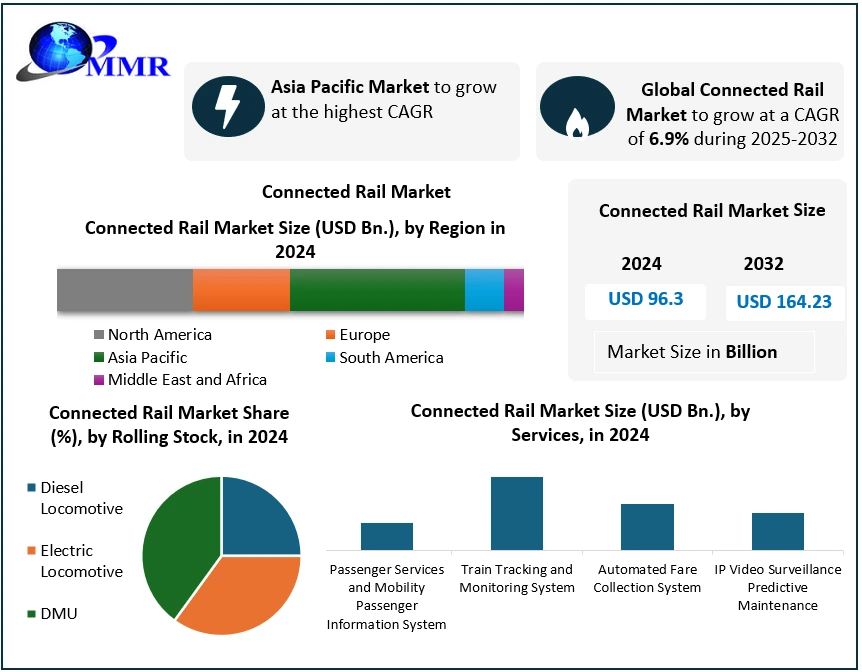
The Global Connected Rail Market size was valued at USD 96.3 Bn. in 2024, and the total Connected Rail Market revenue is expected to grow by 6.9% from 2025 to 2032, reaching nearly USD 164.23 Bn.
Connected Rail Market Overview
Connected rail involves integrating IoT (Internet of Things) and digital technology into rail transport networks to enhance operational efficiency, predictability, safety, customer experience, and predictive maintenance. In the last decade, connected rail networks have matured from simple signalling systems to sophisticated networks involving AI, cloud computing, big data analysis, and 5G-based communication. Some of the key features now are condition-based observing, real-time passenger data, automated control systems, and cyber-secure communications infrastructure. The world is witnessing a surge in demand for connected rail technologies controlled by the upgradation of rail infrastructure in countries like Europe, North America, India, China, the Middle East and Southeast Asia.
 To know about the Research Methodology:-Request Free Sample Report
Railway companies and system integrators are increasingly focused on creating smarter, safer, and more sustainable transportation solutions, which is a key driver of growth in the Connected Rail Market. Both private industries and governments are investing in digital rail initiatives such as the European Rail Traffic Management System (ERTMS), Positive Train Control (PTC), and smart ticketing solutions to modernise rail infrastructure and enhance efficiency.
The report covered an in-depth analysis of key growth drivers in the Connected Rail Market, including increasing urbanisation, the need for improved rail system efficiency, environmental regulations, and rising passenger expectations. The market is segmented by solution type (signalling, passenger information systems, rail analytics, asset management), rail type (high-speed rail, metro, light rail, freight), and deployment mode (onboard, wayside).
Leading players in the Connected Rail Market include Siemens AG, Alstom, Hitachi Rail, Thales Group, and Wabtec Corporation—companies recognised for their innovations in rail automation, digitalisation, and integrated transport systems. The research also explores how government investments in rail infrastructure, the rise of smart mobility, and the development of integrated transport networks are reshaping the global Connected Rail Market.
The report includes the analysis of the impact of the COVID-19 lockdown on the revenue of market leaders, followers, and disrupters. Since lockdown was implemented differently in different regions and countries, the impact of the same is also different by regions and segments. The report has covered the current short-term and long-term impact on the market, same will help decision makers to prepare the outline for short-term and long-term strategies for companies by region.
Connected Rail Market Dynamics:
Growing Demand for Operational Efficiency and Passenger Experience to Drive Connected Rail Market Growth
The adoption of connected rail technologies is primarily driven by the need for enhanced operational efficiency and improved passenger experience. Advanced solutions like predictive maintenance, real-time monitoring, and automated signaling systems help reduce delays, optimize energy consumption, and increase rail network capacity. Governments and rail operators are investing heavily in IoT-enabled systems and AI-driven analytics to modernise ageing infrastructure, making connectivity a critical enabler for the future of rail transport.
Integration of 5G and IoT for Smart Rail Networks to Create Connected Rail Market Opportunity
The significant opportunity presented by the integration of 5G and IoT in the connected rail market. High-speed, low-latency 5G networks enable seamless communication between trains, tracks, and control centres, facilitating real-time data exchange for improved safety and efficiency. Additionally, IoT sensors can monitor track conditions, train health, and passenger flow, enabling predictive maintenance and dynamic scheduling. This digital transformation opens new revenue streams for rail operators and tech providers, positioning the market for exponential growth.
High Implementation Costs and Cybersecurity Risks to Create a Connected Rail Market Challenge
High capital expenditure and cybersecurity vulnerabilities as major challenges in the connected rail market. Deploying advanced communication systems (such as GSM-R or FRMCS) and upgrading legacy infrastructure requires substantial investment, which may deter budget-constrained operators. Furthermore, increased connectivity exposes rail networks to cyber threats, including hacking and data breaches. Firms like KPMG emphasise the need for robust cybersecurity frameworks and public-private partnerships to mitigate risks while ensuring seamless digital transformation in rail systems.
Global Connected Rail Market Segment Analysis:
The global connected rail market is segmented by service, rolling stock, safety, signalling system and geography. Services are classified as passenger services & mobility, passenger information system, train tracking & monitoring system. Rolling stock is divided into diesel locomotives, electric locomotives, and DMUs. Safety and signalling systems are categorised into positive train control, communication/computer-based train control, and automated/integrated train control. Region wise divided into North America, Europe, Asia Pacific, the Middle East & Africa, and Latin America.
Based on Rolling Stock, the electric locomotive segment dominated the connected rail market in 2024, due to its alignment with global sustainability goals, operational efficiency, and government-backed rail electrification initiatives. Electric locomotives are favoured over diesel variants because they produce zero direct emissions, reducing carbon footprints in line with stringent environmental regulations like the European Green Deal. Additionally, electric locomotives offer lower operational costs and higher energy efficiency, as they rely on regenerative braking and optimised power consumption through IoT-enabled energy management systems. Advancements in predictive maintenance and real-time monitoring—key components of connected rail systems—are more seamlessly integrated into electric locomotives, enhancing reliability and reducing downtime. With countries like China, India, and Germany aggressively expanding electrified rail networks, the electric locomotive segment is poised to maintain its market leadership in the connected rail ecosystem.
Based on the safety and signalling system, Computer-Based Train Control (CBTC) Segment dominated the Connected Rail Market in 2024, system of the typical old-block signalling system. A CBTC-equipped train is capable of calculating, communicating, and providing updates over a radio to the wayside equipment distributed along the line. CBTC system allows the optimal utilisation of the existing rail infrastructure in achieving maximum capacity and minimum headway among operating trains while maintaining the safety requirements. These technologies have fuelled the growth of connected rail technology.
Global Connected Rail Market Regional Analysis:
In terms of region, Asia-Pacific region is projected to be the largest market share holder in the year 2032, for the connected rail market, in terms of value. The mounting urbanization in India, China and Japan, smart city projects, Chinese policy of 'One Belt and One Road', among others is estimated to further register high growth rate in the connected rail market in the region.
Connected Rail Competitive Landscape
The Connected Rail Market is highly competitive and fuelled by invention in digital signalling, analytical maintenance, and smart passenger systems. Key players like Siemens AG (Germany) and Alstom SA (France) led the market through strong partnerships and innovative solutions. Siemens stated USD xx billion in revenue in 2024 from its intelligent mobility systems, sponsored by large-scale ERTMS and automation projects in Europe and Asia. Alstom followed closely with USD xx billion in revenue from its Smart Mobility segment, registering 12% year-on-year growth driven by cloud-based passenger data and driver assistance technologies. The companies are integrating AI, 5G, and modular digital platforms to improve rail safety, efficacy, and sustainability. Other prominent competitors, such as Hitachi Rail (Japan), Thales Group (France), and Wabtec Corporation (USA), are also growing their connected rail portfolios, contributing to a fast-evolving and innovation-led global market landscape.
Connected Rail Market Key Trends
• Digitalisation of Rail Infrastructure:
Railway companies are rapidly embracing digital technologies such as AI, IoT, and cloud computing to improve efficiency, automate processes, and lesser maintenance costs.
• Role of 5G and IoT:
5G networks with high speeds and IoT sensors are being employed for real-time monitoring, data transmission, and enhanced communication between trains and control centres.
• Predictive Maintenance:
Train systems are employing AI-driven analytics to anticipate equipment failures prior to them happening, improving safety and cutting downtime.
Connected Rail Market Key Development
• United States (2025) – Wabtec Corporation implemented Positive Train Control (PTC) upgrades and onboard digital diagnostics across Class I freight networks to meet federal safety regulations and improve automation.
• India (2025) – Indian Railways partnered with Thales Group to deploy advanced train control and communication systems for metro and suburban corridors, focusing on safety and real-time passenger information.
• China (2024) – CRRC Corporation launched intelligent rail solutions powered by 5G and IoT, integrating onboard diagnostics and digital signalling systems to modernise high-speed rail operations
• Germany (2024) – Siemens AG expanded its Digital Rail Germany initiative by deploying advanced ERTMS and automated train operation (ATO) systems to improve capacity and safety in urban rail networks.
• France (2024) – Alstom SA launched a next-gen smart signalling solution integrated with AI and cloud analytics for SNCF (French National Railway Company), enhancing real-time decision-making and network efficiency.
Global Connected Rail Market, Key Highlights:
1. Global Connected Rail Market analysis and forecast, in terms of value.
2. Comprehensive study and analysis of market drivers, restraints and opportunities influencing the growth of the Global Market
3. Global Connected Rail Market segmentation based on type, source, end-user, and region (country-wise) has been provided.
4. Global Connected Rail Market strategic analysis concerning individual growth trends, prospects, along with the contribution of various sub-market stakeholders, has been considered under the scope of study.
5. Global Connected Rail Market analysis and forecast for five major regions, namely North America, Europe, Asia Pacific, the Middle East & Africa (MEA) and Latin America, along with country-wise segmentation.
6. Profiles of key industry players, their strategic perspective, market positioning and analysis of core competencies are further profiled.
7. Competitive developments, investments, strategic expansion and competitive landscape of the key players operating in the Global Connected Rail Market are also profiled.
The scope of the Global Connected Rail Market: Inquire before buying
| Global Connected Rail Market | |||
|---|---|---|---|
| Report Coverage | Details | ||
| Base Year: | 2024 | Forecast Period: | 2025-2032 |
| Historical Data: | 2019 to 2024 | Market Size in 2024: | USD 96.3 Bn. |
| Forecast Period 2025 to 2032 CAGR: | 6.9% | Market Size in 2032: | USD 164.23 Bn. |
| Segments Covered: | by Services | Passenger Services and Mobility Passenger Information System Train Tracking and Monitoring System Automated Fare Collection System IP Video Surveillance Predictive Maintenance |
|
| by Rolling Stock | Diesel Locomotive Electric Locomotive DMU |
||
| by Safety and Signalling System | Positive Train Control (PTC) Communication/Computer-Based Train Control (CBTC) Automated/Integrated Train Control (ATC) |
||
Global Connected Rail Market, by Region
North America (United States, Canada, and Mexico)
Europe (UK, France, Germany, Italy, Spain, Sweden, Austria, and the Rest of Europe)
Asia Pacific (China, South Korea, Japan, India, Australia, ASEAN, Indonesia, Philippines, Malaysia, Vietnam, Thailand, ASEAN, Rest of Asia Pacific)
Middle East & Africa (South Africa, GCC, Nigeria, Rest of ME&A)
South America (Brazil, Argentina, Rest of South America)
Global Connected Rail Market, Key Players
The connected rail industry is marked by aggressive competition among a diverse array of players including established rail operators, technology firms, and startups focused on innovation. Key competitors in the Connected Rail industry leverage various strategies to foster growth such as forming strategic alliances, investing heavily in digital technologies and infrastructure, and expanding into emerging markets. They also pursue collaborative initiatives, joint ventures, and the development of advanced connected solutions such as real-time monitoring systems and predictive analytics, to strengthen their competitive position and expand their service offerings.
North America
1. Wabtec Corporation – United States
2. Cisco Systems Inc. – United States
3. IBM Corporation – United States
Europe
1. Siemens AG – Germany
2. Alstom SA – France
3. Thales Group – France
4. Nokia Networks – Finland
Asia-Pacific
1. Hitachi Rail – Japan
2. CRRC Corporation Limited – China
3. Huawei Technologies Co., Ltd. – China
4. Mitsubishi Electric Corporation – Japan
Middle East & Africa
5. Etihad Rail – United Arab Emirates
6. Egyptian National Railways – Egypt
Frequently Asked Questions:
1. Which region has the largest share in the Global Connected Rail Market?
Ans: The Asia Pacific region held the highest share in 2024.
2. What is the growth rate of the Global Connected Rail Market?
Ans: The Global Connected Rail Market is growing at a CAGR of 6.9% during the forecasting period 2025-2032.
3. What is the scope of the Global Connected Rail Market report?
Ans: The Global Connected Rail Market report helps with the PESTEL, Porter's, COVID-19 Impact analysis, Recommendations for Investors& Leaders, and market estimation of the forecast period.
4. Who are the key players in the Global Connected Rail Market?
Ans: The important key players in the Global Market are – Denso Corporation, Hanon Systems, Sanden Holding Corporation, Mitsubishi Heavy Industries Ltd, MAHLE GmbH, Valeo SA, Keihin Corporation, Calsonic Kansei Corporation, SamvardhanaMotherson Group, Subros Limited, SMAC Auto Air, TransAir Manufacturing, Eberspacher Group, Marelli Corporation.
5. What is the study period of the Connected Rail Market?
Ans: The Global Market is studied from 2024 to 2032.