
Conductive Textiles Market – Global Market Size, Strategic Growth Drivers, Risk Assessment Framework, Regulatory Landscape Review, Competitive Intensity Mapping & Long-Term Industry Outlook to 2032
Overview
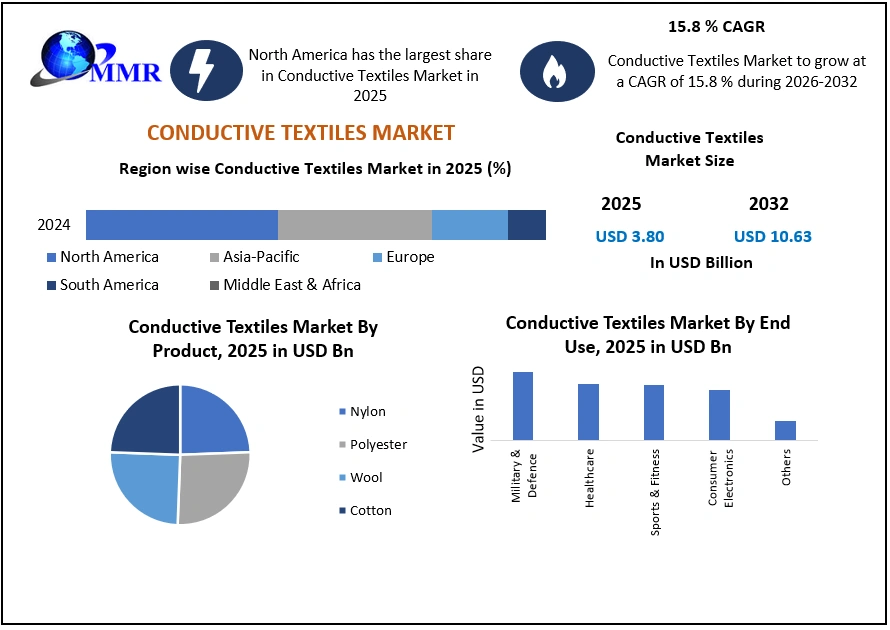
The Global Conductive Textiles Market was valued at USD 3.80 Billion in 2025 and is expected to reach USD 10.63 Billion by 2032, at a CAGR of 15.8%
A conductive textile, also known as lamé, is a fabric capable of conducting electricity through metallic fibers wrapped around a non-metallic core or with a metallic coating, achieved by weaving metallic strands into the textile.
 To know about the Research Methodology:-Request Free Sample Report
The Conductive Textiles Market rapidly growing as the demand for wearable electronics, smart textiles, and innovative applications across various industries. Conductive textiles, also known as e-textiles, enable the integration of electronic components into fabric, facilitating functionalities such as sensing, heating, and communication. The Conductive Textiles Market growth is driven by increasing consumer awareness of wearable technology benefits, particularly in healthcare for remote patient monitoring and personalized solutions, as well as in automotive for comfort and safety features like heated seats and gesture-controlled interfaces. The sports and fitness sector is leveraging conductive textiles for performance monitoring and injury prevention, while aerospace and defense industries employ them for electromagnetic shielding and integrated power systems. Geographically, Asia Pacific leads in market growth due to rapid industrialization and technological advancements, while North America and Europe also play significant roles with extensive research and development in smart textiles.
Conductive Textiles Market Dynamics:
Growing Healthcare Applications Driving Conductive Textiles Market Growth
The increasing adoption of wearable devices, such as smartwatches and fitness trackers, is driving the growth of conductive textiles market. Companies such as Fitbit utilize these fabrics to enhance user experience, enabling touch-sensitive controls and heart rate monitoring. In healthcare, conductive textiles play a crucial role, empowering healthcare providers with real-time patient data for better diagnosis and treatment. Smart garments embedded with sensors, such as those from Hexoskin, facilitate continuous monitoring of vital signs. Technological advancements in smart textiles enable their integration into various applications, as seen with Adidas' smart clothing lines such as the Adidas GMR, which tracks soccer players' performance metrics during gameplay using conductive textiles.
The sports and fitness sector widely employs conductive textiles for performance monitoring and injury prevention. Brands like Athos utilize these fabrics to monitor muscle activity and movement patterns, optimizing training regimes. In automotive interiors, conductive textiles find applications in heated seats and gesture-controlled interfaces, enhancing comfort and convenience, as exemplified by BMW's incorporation of these fabrics. Aerospace and defense industries utilize conductive textiles for electromagnetic shielding and integrated power systems, with companies like BAE Systems providing advanced functionalities in military uniforms. The emergence of smart fashion drives demand for conductive textiles in clothing and accessories, catering to tech-savvy consumers' preferences with features like illuminated patterns and responsive touch controls, as demonstrated by brands like CuteCircuit. Additionally, conductive textiles contribute to energy-efficient solutions, particularly in heating applications, as developed by companies like Ohmatex. Ongoing advancements in material science and government initiatives, such as the European Commission's Horizon program, further boost innovation and conductive textiles market growth in the field of conductive textiles.
High Product costs Hinders the Conductive Textiles Market Growth
The production of conductive textiles is complex manufacturing processes, resulting in high production costs that hinder widespread adoption. Incorporating conductive materials into fabrics necessitates specialized equipment and skilled labor, elevating production expenses and final product prices. Durability issues also plague conductive textiles, with degradation of conductivity over time or with frequent washing posing challenges. For instance, conductive coatings on fabrics may wear off with repeated use, compromising functionality and longevity, thereby limiting reliability in long-term applications. Integrating conductive textiles into existing products or systems presents challenges due to compatibility issues and design constraints. Embedding conductive fibers into clothing or electronic devices requires careful consideration of structural integrity and functionality, further complicating seamless integration without compromising performance.
Safety concerns associated with conductive textiles, particularly regarding electromagnetic interference (EMI) and fire hazards, heighten regulatory compliance demands. For example, conductive fabrics used in wearable electronics may emit electromagnetic radiation or pose fire risks if not properly insulated or treated, necessitating adherence to strict safety standards. Additionally, the production and disposal of conductive textiles raise environmental implications, including the use of chemicals and energy-intensive manufacturing processes. The disposal of these textiles may contribute to environmental pollution and resource depletion, highlighting the need for sustainable practices and regulatory compliance in the conductive textiles market.
Conductive Textiles Market Segment Analysis:
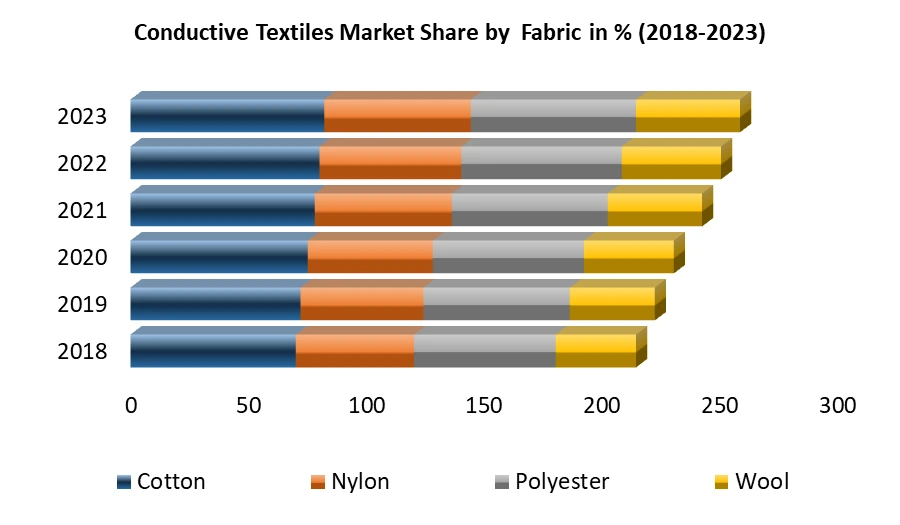
Based on Fabric, the market is segmented into cotton, nylon, polyester, and wool. In 2024, the second highest category was polyester-based conductive textiles, which accounted for 37.5 percent of total sales. Polyester fabric is extensively used because it is durable, resistant to most chemicals, and shrinks less than other fabrics. It is consequently utilised as a raw material for creating conductive wearables like as jackets and sportswear, which is expected to fuel development. Cotton has better breathability and gives better wearing comfort, making it ideal for the production of conductive fabrics. When graphene-based inks are infused with cotton fabric, they make conductive wearables that are free of hazardous ingredients and are environmentally beneficial.
In compared to cotton, nylon, and polyester, wool is expected to grow slowly during the forecast period, accounting for more than 7.8 percent of sales in 2024. Wool is not often used in the production of conductive textiles because it is a poor heat conductor and the weakest of all natural textile fibres. Nylon fabric has seen remarkable expansion in Asia Pacific as a result of rising demand and awareness in the region, as well as the presence of a significant garment manufacturing base. The conductive textiles market is expected to increase over the forecast period due to high demand for nylon in the manufacture of conductive textiles due to its higher strength and damage resistance.
Based on product, the market is segmented into woven, non-woven, and knitted. Woven textiles had the biggest revenue share of 49.2 percent in 2024 and is expected to retain its dominance during the forecast period. Because of their outstanding conductivity and shielding capability, these textiles are preferred by manufacturers all over the world. Non-woven textiles are expected to be the second most important, with considerable development due to their superior water repellent, abrasion resistant, and flame-resistant properties. Furthermore, rising medical product demand is expected to drive market expansion over the forecast period.
Growing demand for non-woven goods in a variety of industries, including the military, healthcare, and automotive, has led in rapid growth for these items. Due to superior performance over replacements, Asia Pacific is expected to be the fastest expanding area for the aforementioned factors. The usage of knitted conductive fabrics in areas such as lifestyle, sports, medical, and construction is estimated to increase demand. Due to the presence of a smaller production and application sector base, the segment's growth is expected to be slower than that of woven and non-woven textiles.
Conductive Textiles Market Regional Insights:
North America Dominance in the Conductive Textiles Market
The Asia-Pacific region is expected to dominate the market for conductive fabrics. Demand for conductive textiles has been expanding in nations such as China, India, and Japan due to the increased use of smart fabrics in many industries. The Asia-Pacific region is home to the most conductive textile manufacturers. TORAY INDUSTRIES, INC, Arrow Technical Fabrics Private Limited, HYOSUNG, and Bekaert are among the top manufacturers of conductive textiles.
Increasing awareness among the Asian population about the usage of conductive wearables, as well as a shift toward health consciousness, are expected to boost the market growth during the forecast period. Furthermore, factors such as expanding population, better economic conditions, and thriving industrial sectors are expected to have a beneficial influence on industry growth. In 2019, China has increased its defence budget by 7.5 percent over the previous year to around Yuan 1.19 trillion (USD 177.61 billion), expanding the use of conductive yarns in smart textiles as part of technical innovation. The Defense Budget in India has increased by 6.87 percent from INR 2.98 lakh crore in 2019 to INR 3.18 lakh crore in .
Europe emerged as the second most important region, accounting for 40.7 percent of total revenue share in and is likely to keep a major part of the market during the forecast period. Germany has the largest share of the European market due to its modern infrastructure and technology, automotive legacy, and highly qualified workforce. The nylon fabric dominated the product demand in North America due to its conductivity and superior protective performance. Furthermore, the existence of a large technology-based population and ongoing R&D activities are expected to drive product demand during the forecast period.
Because of the limited presence of the application industries, South America's proportion of the total market has been modest. The nylon fabric type is expected to dominate the Brazilian conductive textile market. Because of the growing awareness of nylon's smoothness and resilience, it is widely employed as a raw material in the production of conductive clothes.
Table: Top 10 Importers of Textiles, 2020
| Country | Value 2020 billion dollars | Impact Area Share in world exports/imports 2020 | Annual percentage change 2020 |
| European Union | 87 | 24.3 | 29 |
| United States of America | 45 | 12.6 | 44 |
| Vietnam | 16 | 4.4 | -8 |
| China | 14 | 3.9 | -10 |
| Japan | 12 | 3.3 | 34 |
| United Kingdom | 11 | 3 | 52 |
| Bangladesh | 9 | 2.5 | -17 |
| Canada | 6 | 1.8 | 41 |
| Korea, Republic of | 6 | 1.6 | 9 |
| Indonesia | 5 | 1.5 | -21 |
Conductive Textiles Market Scope: Inquire before buying
| Global Conductive Textiles Market | |||
|---|---|---|---|
| Report Coverage | Details | ||
| Base Year: | 2025 | Forecast Period: | 2026-2032 |
| Historical Data: | 2020 to 2025 | Market Size in 2025: | USD 3.80 Bn. |
| Forecast Period 2026 to 2032 CAGR: | 15.8 % | Market Size in 2032: | USD 10.63 Bn. |
| Segments Covered: | by Fabric | Cotton Nylon Polyester Wool |
|
| by Form | Woven Non-Woven Knitted |
||
| by End User | Military & Defence Healthcare Sports & Fitness Consumer Electronics Others |
||
Conductive Textiles Market, by Region
North America (United States, Canada and Mexico)
Europe (UK, France, Germany, Italy, Spain, Sweden, Austria and Rest of Europe)
Asia Pacific (China, South Korea, Japan, India, Australia, Indonesia, Malaysia, Vietnam, Taiwan, Bangladesh, Pakistan and Rest of APAC)
Middle East and Africa (South Africa, GCC, Egypt, Nigeria and Rest of ME&A)
South America (Brazil, Argentina Rest of South America)
Conductive Textiles Market, Key Players:
Major Contributors in the Conductive Textiles Industry in North America:
1. Eeonyx Corporation (United States)
2. Laird Performance Materials (United States)
3. Herculite Products Inc. (United States)
4. Textronics, Inc. (United States)
5. Swift Textile Metalizing LLC (United States)
6. Conductive Technologies Inc. (United States)
Leading players in the Europe Conductive Textiles Market:
1. Bekaert (Belgium)
2. Shieldex® Trading GmbH (Germany)
3. Novonic GmbH (Germany)
4. HeiQ Materials AG (Switzerland)
5. Intelligent Textiles Limited (United Kingdom)
Key players driving the Asia-Pacific Conductive Textiles Market:
1. Seiren Co., Ltd. (Japan)
2. Toray Industries Inc.. (Japan)
3. AiQ Smart Clothing Inc. (Taiwan)
FAQs:
1] What segments are covered in the Global Conductive Textiles Market report?
Ans. The segments covered in the Conductive Textiles Market report are based on Fabric, Product, and End User.
2] Which region is expected to hold the highest share in the Global Conductive Textiles Market?
Ans. North America region is expected to hold the highest share in the Conductive Textiles Market.
3] What is the market size of the Global Conductive Textiles Market by 2032?
Ans. The market size of the Conductive Textiles Market by 2032 is expected to reach USD 10.63 Billion.
4] What is the forecast period for the Global Conductive Textiles Market?
Ans. The forecast period for the Conductive Textiles Market is 2026-2032.
5] What was the Global Conductive Textiles Market size in 2025?
Ans: The Global Conductive Textiles Market size was USD 3.80 Billion in 2025.